


Quick Answer:
The most effective yoga poses for posture correction are Mountain Pose (Tadasana), Cat-Cow (Marjaryasana-Bitilasana), Cobra Pose (Bhujangasana), Child’s Pose (Balasana), and Bridge Pose (Setu Bandha Sarvangasana). These five foundational poses strengthen the core, open the chest, lengthen the spine, and retrain your body’s natural alignment—delivering visible improvements in 2-4 weeks with consistent daily practice of 10-15 minutes.
Look down at your phone. Notice how your head naturally tilts forward.
Now look at your computer screen. Your shoulders probably round forward slightly without you realizing it.
This is forward head posture—and it’s become one of the most prevalent postural deviations in the modern world. For every inch your head moves forward from its neutral position, the weight your neck must support increases by 10 pounds. Someone with a 3-inch forward head shift is essentially carrying an extra 30-pound weight around their neck all day.
The consequences extend far beyond neck pain.
Forward head posture creates a cascade of physical problems: rounded shoulders, weakened upper back muscles, compressed lungs (reducing oxygen intake by 30%), chronic tension headaches, TMJ dysfunction, and accelerated spinal degeneration. It’s not just a cosmetic issue—it’s a health crisis silently affecting millions of desk workers, students, and anyone spending hours looking down at devices.
The good news? Yoga offers a scientifically-proven solution.
Unlike forced posture corrections that create tension and fatigue, yoga addresses the root cause of poor posture: muscular imbalances, lack of body awareness, and weak postural stabilizers. Through consistent practice of specific poses, your body literally rebuilds itself—strengthening weak muscles, stretching tight areas, and retraining your nervous system to recognize and maintain proper alignment automatically.
This comprehensive guide reveals the best yoga poses for posture correction with step-by-step instructions, the science behind why they work, how to practice safely, and how to integrate them into your daily routine for permanent postural transformation.
Understanding Forward Head Posture: The Modern Epidemic
Poor posture isn’t a personal failure or a character flaw. It’s a biomechanical adaptation your body makes to the modern environment.
When you spend 8-10 hours daily looking at screens, your body gradually shifts into forward head posture (FHP)—a position where the head protrudes forward relative to the shoulders. This happens because:
- Screen height mismatch: Most people position monitors too low, forcing constant downward gaze
- Weak postural muscles: Modern life (sitting in cars, at desks) doesn’t require engagement of postural stabilizer muscles
- Tight chest muscles: Rounded shoulder posture tightens the pectoralis major and minor
- Weak upper back: The rhomboids and lower trapezius (which pull shoulders back) become inhibited through disuse
This postural pattern is self-reinforcing. As your posture worsens, the muscles holding you upright become weaker, so your posture worsens further. Without intervention, this cycle continues for years or decades.
The solution isn’t “just sitting up straighter.” Forced posture corrections create muscle tension and fatigue—they’re not sustainable. The real solution is rebuilding your body’s postural system through targeted yoga practice that simultaneously:
- Strengthens weak postural muscles
- Stretches tight chest and front shoulder muscles
- Retrains nervous system proprioception (body awareness)
- Creates sustainable, effortless good posture
The Postural Chain: How Yoga Fixes More Than Posture
Poor posture isn’t isolated to your head and shoulders. Your entire spine works as an interconnected system.
When your head moves forward, a cascade of compensations occurs down your entire spine:
| Postural Level | What Happens | Yoga Solution |
|---|---|---|
| Cervical Spine (Neck) | Head moves 3+ inches forward | Neck strengthening + spine extension poses |
| Thoracic Spine (Upper Back) | Excessive kyphosis (rounding) | Chest openers + back strengtheners |
| Lumbar Spine (Lower Back) | Increased curve to compensate | Core stability + hip flexor lengthening |
| Pelvis | Anterior tilt increases | Hip opening + glute activation |
This is why single-area fixes (just “do neck exercises”) fail. You must address the entire postural chain. The yoga poses recommended in this guide work because they systemically correct postural deviations from neck to pelvis.
Best Yoga Poses for Posture Correction: The Complete Practice
Pose 1: Cat-Cow Stretch (Marjaryasana-Bitilasana) – Spinal Mobility Foundation
Why it fixes posture:
Cat-Cow teaches spinal extension and flexion awareness, mobilizes the thoracic spine (which becomes stuck in flexion from sitting), and gently activates postural muscles.
Step-by-step instructions:
Cat Pose (flexion):
- Begin on hands and knees (tabletop position)
- Stack shoulders over wrists, hips over knees
- Exhale and round your spine dramatically
- Drop your head, tuck your chin toward chest
- Draw your belly button toward spine
- Hold for 2-3 breaths
Cow Pose (extension):
- Inhale and drop your belly toward the floor
- Lift your gaze upward (not excessively)
- Gently press chest forward
- Draw shoulders away from ears
- Keep core lightly engaged (don’t sag completely)
- Hold for 2-3 breaths
Full flow:
- Move between Cat and Cow with your breath
- Inhale: Cow (extension)
- Exhale: Cat (flexion)
- Repeat 8-12 times, 1-2 minutes total
Postural benefit:
Mobilizes the thoracic spine which becomes rigid from sitting hunched. This mobility is essential for achieving natural, upright posture.
Modifications:
- Tight shoulders: Only move 50% of the range
- Wrist pain: Practice on forearms instead of hands
- Neck sensitivity: Keep head neutral (don’t drop or lift excessively)
Pose 2: Downward-Facing Dog (Adho Mukha Svanasana) – Upper Back Strengthener
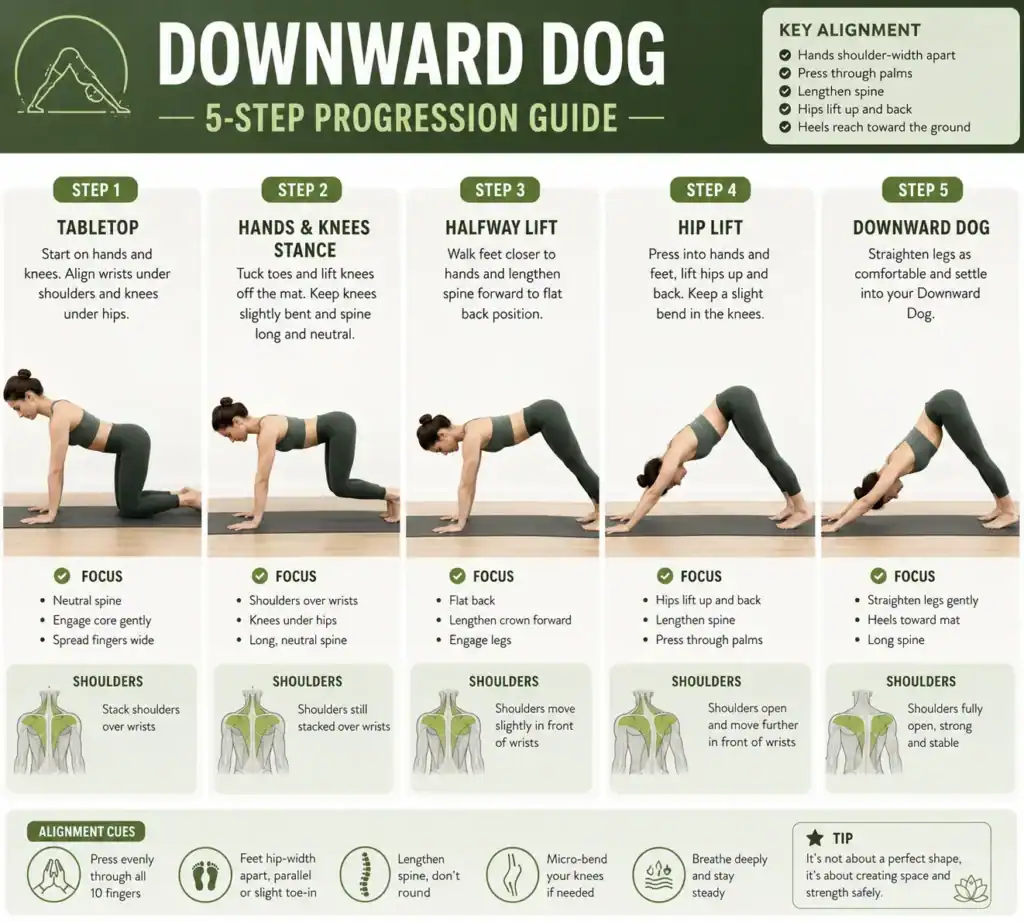
Why it fixes posture:
Downward Dog strengthens the trapezius, rhomboids, and serratus anterior (muscles that pull shoulders back and down). It also decompresses the cervical spine and opens the chest.
Step-by-step instructions:
- Begin on hands and knees
- Spread fingers wide, press firmly through palms
- Exhale and lift hips toward ceiling
- Form an inverted V-shape with your body
- Head hangs neutrally between arms (don’t look at feet)
- Shoulders press away from ears
- Chest moves toward thighs
- Engage your core to prevent lower back sag
- Hold for 5-10 breaths
Postural benefit:
Strengthens the muscles that hold your shoulders back and down (lower trapezius, rhomboids). When these muscles are strong, good posture requires minimal effort.
Common mistakes:
- ❌ Looking forward (strains neck)
- ❌ Shoulders hiking toward ears (defeat the purpose)
- ❌ Lower back sag (indicates weak core)
- ❌ Wrists rolled inward (causes wrist strain)
Corrections:
- ✅ Head stays neutral between arms
- ✅ Shoulders actively press away from ears
- ✅ Engage core and glutes to protect lower back
- ✅ Wrists externally rotated, fingers spread wide
Modifications:
- Tight hamstrings: Bend knees generously
- Wrist pain: Practice on forearms (dolphin pose)
- Shoulder tightness: Decrease hold time, practice more frequently with shorter holds
Hold time: 5-10 breaths (beginner to intermediate), work up to 30-60 seconds for advanced practitioners
Pose 3: Upward-Facing Dog (Urdhva Mukha Svanasana) – Chest Opening & Spine Extension
Why it fixes posture:
Upward Dog is the ultimate posture corrector because it:
- Opens the entire front body (chest, shoulders, hip flexors)
- Strengthens the posterior chain (back muscles)
- Extends the thoracic spine (opposite of forward slouch)
- Trains the nervous system to recognize extension as comfortable
Step-by-step instructions:
- Lie on your belly, forehead on floor
- Place hands under shoulders, elbows tucked close to ribs
- Tops of feet flat on floor (not toes curled)
- Inhale and press through hands, lifting chest
- Arms straighten (or stay slightly bent for modification)
- Shoulders press away from ears
- Front of pelvis stays on or slightly lifts from floor
- Gaze forward and slightly upward (don’t hyperextend neck)
- Hold for 3-5 breaths
Postural benefit:
Upward Dog teaches your body what natural spinal extension feels like—the opposite sensation from forward head posture. By practicing this regularly, your nervous system learns this as comfortable, and you default to it more naturally throughout your day.
Critical safety note:
Unlike backbends that force excessive extension, Upward Dog maintains length throughout the spine. The extension comes from the thoracic spine (upper back), not the cervical spine (neck).
Common mistakes:
- ❌ Hyperextending the neck (looking too far back)
- ❌ Shoulders hunching toward ears
- ❌ Elbows flaring outward
- ❌ Pelvis sinking into floor (creates lower back strain)
Modifications:
- Beginner: Keep pelvis on floor, only lift chest partially
- Tight shoulders: Hands further forward, less arm extension
- Neck sensitivity: Keep gaze neutral or slightly forward
Progression:
- Week 1-2: Hold 3 breaths, practice 2-3x weekly
- Week 3-4: Hold 5 breaths, practice 3-4x weekly
- Week 5+: Hold 5-8 breaths, incorporate into daily flow
Pose 4: Warrior I (Virabhadrasana I) – Full-Body Postural Integration
Why it fixes posture:
Warrior I integrates posture correction throughout the entire body:
- Strengthens legs and core (provides foundation)
- Opens hips and chest
- Trains upright alignment against gravity
- Builds muscular endurance for maintaining posture
Step-by-step instructions:
- Stand at top of mat, feet hip-width apart
- Step your left foot back about 3-4 feet
- Turn left foot out 45 degrees
- Bend right knee, stacking it over ankle
- Square your hips forward
- Lift arms overhead, shoulder-width apart
- Press firmly through back foot
- Engage core to support lower back
- Lift through crown of head
- Shoulders stay relaxed away from ears
- Hold for 5-8 breaths, then switch sides
Postural benefit:
Standing poses train your postural muscles to work against gravity, building the sustained strength needed for good posture throughout your day. Warrior I specifically trains the entire postural chain: from grounded feet, through engaged core, to extended spine and open chest.
Common alignment issues:
- Back hips flare out: Consciously square hips forward
- Front knee caves inward: Press outer thigh back
- Torso leans forward: Move front foot forward to reduce hip demand
- Shoulders hunched: Press shoulders down, lift through crown
Modifications:
- Tight hips: Place back heel off ground for more ease
- Weak knees: Decrease front knee bend
- Balance issues: Practice near a wall for support
Postural note:
In Warrior I, notice that good posture here feels strong and grounded, not tense. This is the feeling to carry into your daily life.
Pose 5: Bridge Pose (Setu Bandha Sarvangasana) – Glute & Core Activation
Why it fixes posture:
Bridge Pose activates the glutes (which inhibit in people with forward head posture) and strengthens the core—both essential for supporting upright posture.
Step-by-step instructions:
- Lie on your back, knees bent, feet hip-width apart
- Place arms alongside body, palms down
- Press feet into floor, lift hips toward ceiling
- Squeeze glutes at the top
- Press shoulders down and roll shoulders under
- Keep chest lifted and open
- Engage core (draw navel toward spine)
- Hold for 5-10 breaths
Postural benefit:
Glute weakness is a major postural problem—when glutes don’t fire, lower back overworks to compensate. Bridge Pose reactivates glutes and teaches proper pelvic stability, which is the foundation for upright posture.
Common mistakes:
- ❌ Clenching glutes without full engagement
- ❌ Pushing through toes instead of heels
- ❌ Arching lower back excessively
- ❌ Letting knees cave inward
Modifications:
- Tight hip flexors: Place a block under sacrum for support
- Lower back pain: Reduce lift height, focus on glute engagement
- Neck sensitivity: Avoid turning head side to side; keep neutral
Advanced variation:
Once comfortable, try single-leg bridge: Lift one foot off floor while maintaining level hips. This demands significant core and glute engagement.
Pose 6: Shoulder Rolls & Arm Circles – Shoulder Mobility Reset
Why it fixes posture:
Simple shoulder mobility work releases tension in the shoulder girdle and retrains shoulder positioning. This is often overlooked but profoundly effective.
Shoulder Roll Sequence:
Forward rolls (5 rotations):
- Stand tall, arms at sides
- Lift shoulders toward ears
- Roll shoulders backward and down
- Complete full circle forward
- Repeat 5 times slowly
Backward rolls (5 rotations):
- Reverse direction, rolling shoulders backward and up
- This targets the rhomboids and lower trapezius
- Repeat 5 times slowly
Arm Circle Sequence:
Small circles backward (10 rotations):
- Arms extended at shoulder height
- Make small circles backward
- Emphasize pulling shoulder blades together
Large circles backward (5-10 rotations):
- Extend arms wider, make large circles backward
- Feel shoulder blades engaging
Why this works:
Shoulder mobility work breaks up the tension pattern that created forward head posture in the first place. By regularly practicing this, you maintain the mobility gains from deeper poses.
Pose 7: Cobra Pose (Bhujangasana) – Gentle Spinal Extension
Why it fixes posture:
Cobra Pose gently extends the thoracic spine (upper back), teaching your body what upright posture feels like and strengthening the back muscles required to maintain it.
Step-by-step instructions:
- Lie on belly, forehead on floor
- Place hands under shoulders
- Inhale and press through hands, lifting chest
- Keep elbows close to ribs
- Lower abdomen stays on floor
- Gaze downward (don’t hyperextend neck)
- Hold for 3-5 breaths
- Lower and rest
Postural benefit:
Unlike more intense backbends, Cobra Pose provides gentle, accessible spinal extension. This is especially valuable for people with significant forward head posture who can’t yet handle deeper poses safely.
Modifications:
- Beginner: Lift only partially, using arm strength more than back strength
- Tight chest: Reduce lift height
- Neck sensitivity: Keep gaze straight down
Key difference from Upward Dog:
In Cobra, the abdomen stays connected to floor. In Upward Dog, the pelvis lifts. This makes Cobra a safer starting point for posture correction.
Pose 8: Supported Shoulder Stand (Salamba Sarvangasana) OR Legs-Up-Wall (Viparita Karani) – Inversion for Cervical Decompression
Why it fixes posture:
Inversions decompress the cervical spine (neck), providing relief from compression caused by forward head posture. Legs-Up-Wall offers similar benefits with significantly less risk.
Legs-Up-Wall (Recommended for beginners):
- Sit sideways next to a wall
- Swing legs up the wall as you lie back
- Bottom stays close to wall
- Arms rest at sides or above head
- Stay for 5-10 minutes
Benefits:
- Decompresses cervical spine
- Reverses the forward head position
- Calms nervous system
- Improves circulation to brain
Why Legs-Up-Wall over Shoulder Stand:
Shoulder Stand, while powerful, requires significant neck support and can strain the cervical spine if done incorrectly. Legs-Up-Wall provides cervical decompression with zero risk.
Daily Practice Routines for Posture Correction
Quick Morning Posture Reset (10 minutes)
This routine preps your body for good posture throughout the day.
Sequence:
- Cat-Cow Stretch — 1 minute (6-8 rounds)
- Shoulder Rolls — 1 minute (5 forward, 5 backward)
- Downward Dog — 30 seconds
- Cobra Pose — 30 seconds
- Warrior I (each side) — 1 minute total
- Bridge Pose — 1 minute
- Arm Circles — 1 minute
- Seated Forward Fold — 2 minutes
Timing: Practice immediately after waking, before sitting at desk
Benefit: By activating postural muscles first thing in the morning, you set the tone for the entire day. Your body remembers this postural awareness.
Desk Break Posture Reset (5 minutes)
Practice every 2-3 hours while working to interrupt the forward slouch cycle.
Sequence:
- Stand and Stretch — 30 seconds (reach arms overhead)
- Shoulder Rolls — 30 seconds (backward emphasis)
- Neck Rolls — 30 seconds (gentle circles)
- Arm Circles — 1 minute (backward emphasis)
- Upward Dog at Desk — 30 seconds (hands on desk, lift chest)
- Warrior I — 1 minute (each side, 30 seconds)
- Forward Fold — 1 minute
Why it works:
Regular micro-breaks prevent the postural pattern from solidifying. After 2-3 hours of forward slouch, your nervous system begins to accept poor posture as normal. These 5-minute breaks reset this.
Evening Full Posture Correction Flow (25-30 minutes)
Complete practice addressing the full postural chain.
Warm-up (5 minutes):
- Cat-Cow: 1 minute
- Shoulder Rolls: 1 minute
- Arm Circles: 1 minute
- Gentle neck rolls: 1 minute
- Breathing (5 deep breaths): 1 minute
Main practice (20 minutes):
- Downward Dog: 1 minute
- Upward Dog: 30 seconds (3-5 rounds)
- Cobra Pose: 30 seconds (3-5 rounds)
- Warrior I (each side): 1.5 minutes
- Bridge Pose: 1 minute
- Supported Shoulder Stand or Legs-Up-Wall: 5-10 minutes
- Child’s Pose: 2 minutes
Cool-down (5 minutes):
- Seated Forward Fold: 2 minutes
- Supine Twist: 1 minute (each side)
- Corpse Pose: 2 minutes
Frequency: 4-5 times weekly for maximum benefit
Misinformation Inoculation: What Posture Correction Yoga CANNOT Do
Common myths that need correction:
Myth #1: “One yoga session will fix my posture”
Reality: Posture correction takes consistent practice over weeks to months. Your postural muscles have been in their current pattern for years or decades. Expecting them to change overnight sets you up for disappointment. Be patient—meaningful changes appear in 4-6 weeks, transformative changes in 12+ weeks.
Myth #2: “If I just remember to sit up straight, I’ll fix my posture”
Reality: Conscious postural correction creates fatigue and tension because you’re forcing muscles that are currently weak to work continuously. True posture correction rebuilds the muscles so good posture becomes effortless. Yoga does this; willpower doesn’t.
Myth #3: “Yoga will completely eliminate my forward head posture”
Reality: Significant postural deviations (those present for 10+ years) may require additional interventions like physical therapy, ergonomic changes, or in rare cases, orthopedic evaluation. Yoga is profoundly effective but not a complete solution for severe postural dysfunction.
Myth #4: “Any yoga practice fixes posture”
Reality: Not all yoga helps posture. Fast, heating practices (power yoga, hot yoga) can actually reinforce poor posture if done without postural awareness. Slow, alignment-focused practices (Hatha, Yin, gentle Vinyasa) are most effective for posture correction. Speed is counterproductive; awareness is everything.
Myth #5: “Once I fix my posture, I’m done”
Reality: Posture correction requires maintenance. If you return to the same sitting habits and screen time without continued practice, your posture will gradually revert. Lifelong good posture requires lifelong attention—though this becomes effortless once corrected.
Common Mistakes in Posture Correction Yoga Practice
Mistake #1: Forcing Forward Head Correction
Problem:
Many people try to “correct” forward head posture by aggressively pulling the head back. This creates neck tension and doesn’t address the root cause.
Why it happens:
The head position is a symptom of weak back muscles and tight chest muscles. Forcing the head back doesn’t strengthen or loosen anything—it just creates tension.
Correction:
Allow the head position to correct naturally as you strengthen back muscles and open the chest through yoga. When the muscles are rebalanced, the head naturally repositions without force.
Result:
Natural, effortless posture correction instead of tension-based “corrections.”
Mistake #2: Neglecting the Lower Body
Problem:
Many posture correction programs focus entirely on the upper body (shoulders, chest, neck) and ignore the lower body. This fails because posture is a whole-body system.
Why it happens:
People see forward head posture and assume it’s a neck/shoulder problem. They don’t realize that hip tightness and weak glutes contribute significantly.
Correction:
Include hip openers (like Low Lunge) and glute activation (Bridge Pose) in every posture correction session.
Result:
Systemic posture correction rather than isolated upper-body fixes.
Mistake #3: Practicing Without Body Awareness
Problem:
Going through the motions of poses without noticing how your body feels or what muscles are engaging doesn’t create posture correction.
Why it happens:
People rush through practices, checking poses off a list rather than truly inhabiting them.
Correction:
Slow down. In each pose, notice:
- Which muscles are engaging?
- What does good alignment feel like?
- Where do you feel tension?
- How does this differ from your daily posture?
Result:
Each practice rewires your nervous system’s postural awareness, creating lasting change.
Mistake #4: Inconsistent Practice
Problem:
Practicing intensely for 2 weeks, then stopping for 3 weeks prevents consistent muscle adaptation and nervous system retraining.
Why it happens:
Motivation starts high but fades without visible immediate results.
Correction:
Commit to consistent, moderate practice (3-4x weekly) rather than sporadic intense practice. Even 10 minutes daily outperforms 60 minutes once weekly.
Result:
Sustainable postural transformation within 4-6 weeks.
Mistake #5: Ignoring Ergonomic Factors
Problem:
Practicing posture correction yoga daily then sitting hunched at a desk for 10 hours negates the benefits.
Why it happens:
People treat yoga as the sole solution without addressing the lifestyle habits that created poor posture.
Correction:
While practicing yoga, also adjust:
- Monitor height: Top of screen at eye level
- Desk setup: Keyboard and mouse at elbow height
- Chair: Lumbar support, feet flat on floor
- Phone usage: Hold phone at eye level, not down
- Regular breaks: Every 1-2 hours, stand and move
Result:
Yoga + ergonomic optimization = permanent posture correction
Contraindications: When to Modify or Avoid
Condition: Severe Neck Pain or Cervical Radiculopathy
- Avoid: Upward Dog, Shoulder Stand, aggressive chest openers
- Modify: Use gentle, supported poses (Child’s Pose, Legs-Up-Wall)
- Consult: A physical therapist or doctor before practicing any yoga for the neck
Condition: Recent Shoulder Surgery
- Avoid: All shoulder-bearing poses until cleared by surgeon
- Modify: Work with hip and core poses (Bridge, Warrior with modified arms)
- Timeline: Typically 6-8 weeks minimum post-surgery
Condition: Osteoporosis (Especially in Upper Back)
- Avoid: Deep backbends, spinal extensions
- Modify: Gentle mobility work, supported poses
- Consult: Your rheumatologist or orthopedist before practicing
Condition: Whiplash or Recent Neck Injury
- Avoid: All spinal extension poses for 2-4 weeks post-injury
- Modify: Gentle mobility work only
- Consult: A healthcare provider before returning to full practice(1)
How to Deepen Posture Correction Practice
Extended Hold Times
As your postural muscles strengthen, extend hold times:
Week 1-2:
- Downward Dog: 30 seconds
- Upward Dog: 3-5 breaths
- Warrior I: 20 seconds each side
Week 3-4:
- Downward Dog: 45-60 seconds
- Upward Dog: 5-8 breaths
- Warrior I: 30 seconds each side
Week 5+:
- Downward Dog: 60-90 seconds
- Upward Dog: 8-10 breaths
- Warrior I: 45-60 seconds each side
Advanced Variations
Downward Dog on forearms (Dolphin Pose):
Increases shoulder engagement and upper back strengthening.
One-leg Bridge:
Lift one foot while maintaining level hips. This demands intense core and glute engagement.
Warrior I to Warrior II to Reverse Warrior Flow:
Chain these poses together for full-body postural integration.
Supported Shoulder Stand (with props):
For those ready for deeper inversions—always learn from a qualified teacher first.
KEY TAKEAWAYS
Essential Posture Correction Knowledge:
✅ Forward head posture is an epidemic affecting millions of desk workers, students, and device users. Every inch forward increases neck load by 10 pounds.
✅ Poor posture isn’t a character flaw—it’s biomechanical. Your body adapted to modern sitting environments. Yoga can rewire this adaptation.
✅ The best yoga poses for posture correction are: Cat-Cow, Downward Dog, Upward Dog, Warrior I, Bridge Pose, Shoulder Rolls, Cobra Pose, and Legs-Up-Wall.
✅ Yoga works because it addresses root causes: weak postural muscles, tight chest muscles, poor body awareness—not just the symptom (forward head).
✅ Consistency beats intensity: Daily 10-minute practice outperforms sporadic 60-minute sessions. Your nervous system needs regular stimulus to relearn posture.
✅ Results appear in 4-6 weeks of consistent practice (3-5x weekly). Significant transformation requires 12+ weeks. Be patient—muscle memory takes time.
✅ Ergonomic changes are essential: Yoga + proper desk setup = permanent posture correction. Yoga alone can’t overcome 10 hours daily of poor ergonomics.
✅ Common mistakes to avoid: Forcing the head back (creates tension), neglecting the lower body (posture is whole-system), practicing without awareness, inconsistent practice, ignoring ergonomics.
✅ The postural chain connects everything: Tight hips affect lower back, which affects lumbar spine, which affects thoracic spine, which affects cervical spine. Treat posture holistically.
✅ Misinformation to reject: “One session fixes posture” (requires months), “Just sit up straight” (creates fatigue, not strength), “Any yoga helps” (alignment-focused practices work best).
✅ Posture maintenance is lifelong: Once corrected, posture requires continued practice. Without maintenance, postural patterns gradually revert to old patterns.
✅ Proper alignment is non-negotiable: Practicing poses with poor alignment reinforces bad posture patterns. Form quality matters infinitely more than session length.
FAQ SECTION
Q 1: How long does it take to fix posture with yoga?
Most practitioners see noticeable improvements within 4-6 weeks of consistent practice (3-5x weekly). Significant postural transformation typically requires 12+ weeks. Timeline depends on severity of initial posture deviation and consistency of practice. Daily 10 minutes beats sporadic 60-minute sessions.
Q 2: Can yoga permanently fix forward head posture?
Yes, yoga can permanently correct forward head posture through consistent practice that strengthens postural muscles and retrains nervous system awareness. However, maintaining good posture requires continued practice and ergonomic awareness. If you return to slouching habits without maintenance, posture gradually reverts within weeks.
Q 3: What if I have severe posture problems?
If you have severe forward head posture, significant spinal curvature, or chronic pain, begin with gentle, supported poses and consult a physical therapist or doctor before practicing. Yoga is highly effective for posture correction but may need to complement physical therapy for severe cases.
Q 4: Can I do posture correction yoga if I have neck pain?
If you have acute neck pain, wait 2-3 days before practicing yoga. Start with gentle mobility work (Cat-Cow, Shoulder Rolls) and avoid deep backbends. If pain persists beyond 2-3 weeks, consult a healthcare provider. Never force poses through sharp pain.
Q 5: How often should I practice posture correction yoga?
For optimal results, practice 3-5 times weekly for 20-30 minutes. Consistency matters more than intensity. Even daily 10-minute practices outperform sporadic 60-minute sessions. Three months of regular practice (12 weeks) produces lasting postural transformation.
CONCLUSION
Your posture is not a personality trait.
It’s not a character flaw or a reflection of your discipline. It’s a biomechanical adaptation—a series of muscular imbalances that developed in response to your environment. The good news? Biomechanical adaptations can be changed.
Every forward-hunching hour at your desk rewires your nervous system to accept slouching as normal. Every time you look down at your phone, your thoracic spine rounds a little more. Every month without proper chest opening, your shoulder muscles tighten further. This is neuroplasticity working against you.
But it works both ways.
Every yoga session that strengthens your upper back rewires your nervous system toward upright posture. Every time you practice Upward Dog, you’re teaching your body what spinal extension feels like. Every Warrior I grounds your entire postural chain into alignment. Every Bridge Pose reactivates the glutes that modern sitting has deactivated. This is neuroplasticity working for you.
The poses in this guide work because they address the complete postural chain—from your tight hip flexors through your weak glutes, from your collapsed thoracic spine through your forward cervical position. They’re not isolated fixes. They’re a systemic rewiring of how your entire body supports itself against gravity.
The timeline is real: 4-6 weeks for noticeable improvement, 12+ weeks for transformation. This isn’t because yoga is slow. It’s because your nervous system requires repeated stimulus to accept new patterns. Your postural muscles need progressive overload to gain strength. Your spine needs consistent mobility work to regain its natural curves.
But within this timeline, something profound happens.
At week 4, you notice you’re sitting up without thinking. By week 8, strangers comment on how much taller you look. By week 12, good posture feels effortless, and slouching feels uncomfortable—your body has permanently rewired itself.
Your posture transformation begins today.
Choose one of the daily routines above. Commit to 4 weeks of consistent practice. Show up even when you don’t feel like it. Notice what changes. Then commit for 12 weeks and watch your body rebuild itself.
You’re not just fixing your posture.
You’re reclaiming the upright, confident, pain-free movement that’s your birthright.
MEDICAL DISCLAIMER: This guide is for educational purposes only and is not medical advice. Consult your doctor or physical therapist before starting any yoga practice, especially if you have neck pain, spinal conditions, or pre-existing injuries. Stop
immediately if you experience sharp pain. Individual results vary. Yoga complements professional treatment but does not replace it.

