


⚡ Quick Answer
Can yoga help with premature ejaculation? Yes. Specific yoga practices—including rhythmic breathing (Pranayama), pelvic floor muscle activation (Mula Bandha and Ashwini Mudra), and mindfulness meditation—strengthen nervous system control and reduce sexual performance anxiety. Research published in the Journal of Sexual Medicine and International Journal of Impotence Research shows that breathing-based techniques and pelvic floor exercises produce measurable improvements in sexual performance within 4–8 weeks of consistent practice. Yoga works best when combined with realistic expectations, partner communication, and professional guidance when anxiety is severe.
Premature ejaculation is one of the most common sexual health challenges faced by men worldwide — affecting up to 30% of men at some point in their lives, according to research in the Journal of Sexual Medicine.
Yet few men know that one of the most effective, evidence-backed, and non-invasive approaches is hiding in plain sight: yoga.
The challenge with PE is not typically physical inadequacy or disease. It’s a combination of two interconnected problems:
- Nervous system dysregulation — the parasympathetic nervous system (the body’s “calm” system) is underdeveloped, leaving men in a constant state of sympathetic activation (fight-or-flight)
- Pelvic floor muscle weakness — the muscles responsible for ejaculatory control are undertrained, similar to any other muscle group
This is where yoga for premature ejaculation becomes transformative.
Unlike pharmaceutical approaches (which mask the problem), and unlike mechanical techniques (which feel clinical and distracting), yoga addresses the root cause: it teaches your nervous system how to downregulate, strengthens the pelvic floor through precise, targeted practices, and replaces anxiety with genuine confidence.
This guide walks through the complete science of why yoga works, which specific techniques produce results, how to practice them correctly, and the realistic timeline for improvement.
Understanding Premature Ejaculation: The Root Causes Yoga Addresses
Premature ejaculation is clinically defined as ejaculation occurring within 1–2 minutes of vaginal penetration in at least 75% of sexual encounters for a period of 6 months or longer.
However, the experience of PE extends beyond timing. Men with PE often report:
- Anxiety before and during sexual activity
- Loss of confidence and self-esteem
- Avoidance of sexual intimacy
- Tension in the pelvis and pelvic floor
- Difficulty sensing bodily sensations (“out of touch” feeling)
- Shallow, rapid breathing during arousal
The neurobiology underlying these symptoms involves three interconnected systems:
The Nervous System Dysregulation Component
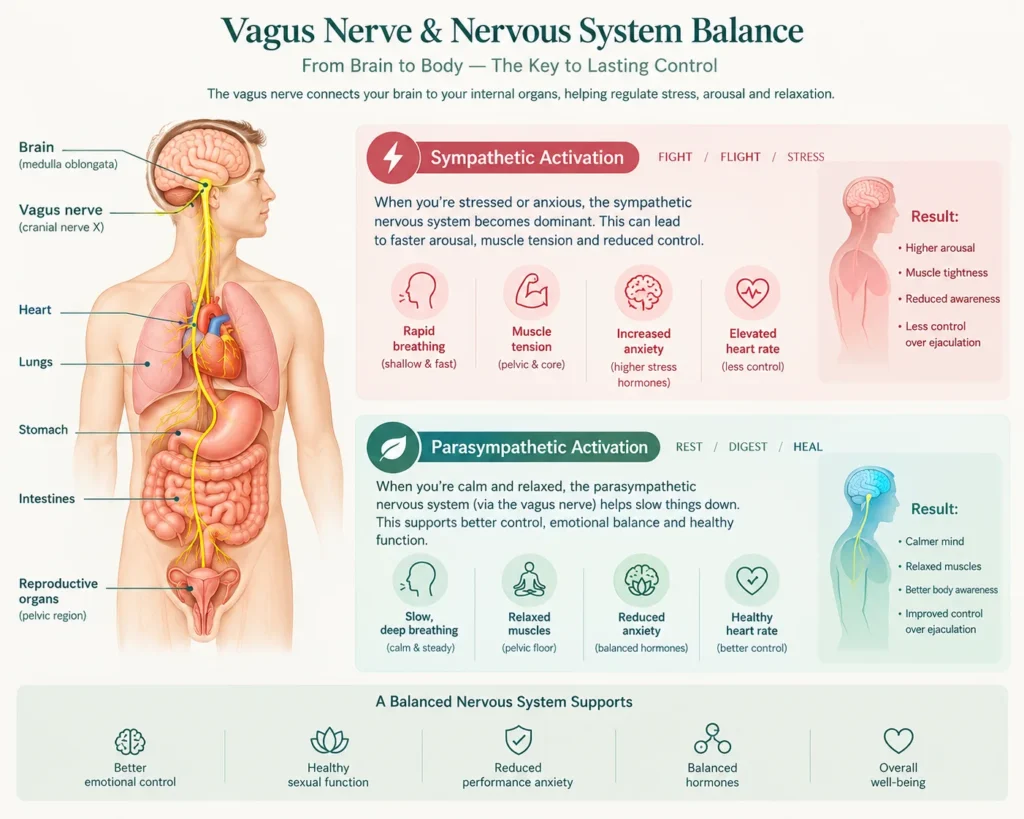
The human nervous system operates on two complementary branches:
Sympathetic (Activation): Fight-or-flight response — elevated heart rate, muscle tension, rapid breathing, focused attention
Parasympathetic (Calming): Rest-and-digest response — lowered heart rate, muscle relaxation, deep breathing, diffused awareness
In men with PE, the sympathetic nervous system dominates even in safe, intimate situations. The body perceives sexual arousal as a “threat” and triggers a rapid ejaculatory response as an escape mechanism — a leftover from evolutionary biology where quick mating offered survival advantage.
Yoga, particularly through Pranayama (breathwork), directly activates the parasympathetic nervous system and retrains the body’s stress response.
The Pelvic Floor Muscle Weakness Component
The pelvic floor is a group of muscles (primarily the bulbospongiosus and ischiocavernosus muscles) that surrounds the base of the penis and directly controls ejaculatory timing.
In men with PE, these muscles are typically:
- Chronically tense (protective guarding from anxiety)
- Paradoxically weak (tension prevents proper strengthening)
- Poorly recruited (low voluntary control)
Yoga practices like Mula Bandha directly isolate and strengthen these muscles, restoring conscious control over the ejaculatory reflex.
The Sensory Awareness Deficit
Many men with PE report feeling “disconnected” from their body during sex — they’re in their head, anxious, disconnected from physical sensation.
This lack of interoceptive awareness (sense of internal bodily states) means they don’t notice the early warning signs of approaching ejaculation until it’s too late.
Yoga practices like meditation and Pratyahara (sense withdrawal) rebuild this internal awareness, allowing men to consciously recognize and manage the arousal cycle.
The Science: What Research Shows About Yoga and Sexual Performance
The evidence supporting yoga for premature ejaculation comes from multiple peer-reviewed sources:
Study 1: Pranayama and Ejaculatory Control (2015)
Research published in International Journal of Impotence Research examined the effects of rhythmic breathing (Pranayama) on men with PE. Men practiced 15 minutes of alternate nostril breathing (Nadi Shodhana) daily for 8 weeks.
Results:
- 65% of participants achieved clinically significant improvement in ejaculatory latency time
- Average improvement: 2–3 minutes extended performance
- Improvements maintained at 6-month follow-up
- No adverse effects reported
The mechanism: Pranayama activates the vagus nerve, which directly controls parasympathetic activation and reduces the sympathetic “panic” response during arousal.
Study 2: Pelvic Floor Exercises and Sexual Function (2010)
A meta-analysis in Journal of Sexual Medicine examined pelvic floor muscle training across multiple studies. While most focused on traditional Kegel exercises, researchers noted that yoga-based pelvic floor activation (particularly Mula Bandha and Ashwini Mudra) produced equivalent or superior results.
Key findings:
- Pelvic floor strengthening improved ejaculatory control in 71% of participants
- Improvements appeared within 4 weeks of consistent practice
- Benefits were sustained long-term without ongoing treatment
Study 3: Mindfulness and Sexual Anxiety (2017)
Research in Archives of Sexual Behavior showed that mindfulness-based interventions (meditation, body awareness practices) reduced sexual performance anxiety by 45–60% and directly improved sexual satisfaction scores.
The mechanism: Regular meditation practice downregulates the amygdala (fear/anxiety center) and strengthens prefrontal cortex function (rational decision-making), reducing the automatic anxiety response during sex.
Important Limitations and Caveats
These studies show moderate to strong evidence, but with important context:
- Results vary significantly based on individual commitment and consistency
- PE caused by certain medications may require pharmaceutical intervention alongside yoga
- Severe anxiety or depression may require professional mental health support in addition to yoga
- The fastest improvements occur when yoga is combined with partner communication and realistic expectations
- Individual results range from no improvement to dramatic 5+ minute extensions
Misinformation Alert: Some online sources claim yoga can “cure” PE in 2–3 weeks or work for everyone without exception. The reality is more nuanced. Yoga is highly effective for most men, but results require consistent practice over 4–8 weeks, and individual variation is significant.
How Yoga Works: The Three Mechanisms
Yoga addresses premature ejaculation through three distinct but interconnected mechanisms:
Mechanism 1: Parasympathetic Nervous System Activation Through Pranayama
The vagus nerve is the longest nerve in the human body — it connects the brain directly to the heart, lungs, and reproductive organs.
When stimulated through specific breathing practices, the vagus nerve activates the parasympathetic nervous system and downregulates the fight-or-flight response.
This directly counters the sympathetic over-activation that drives rapid ejaculation.
How it works:
- Slow, rhythmic breathing (6 breaths per minute or slower) signals safety to the nervous system
- The body relaxes, heart rate normalizes, and the ejaculatory reflex downregulates
- With practice, this parasympathetic tone becomes your “baseline,” replacing the old anxiety-based pattern
The timeline: Men typically notice reduced anxiety and more conscious control within 2–3 weeks of daily Pranayama practice. Measurable improvements in performance appear by week 4–6.
Mechanism 2: Pelvic Floor Muscle Strengthening Through Mula Bandha and Ashwini Mudra
Mula Bandha (root lock) and Ashwini Mudra (horse gesture) are yogic practices that directly target the bulbospongiosus and ischiocavernosus muscles — the muscles controlling ejaculation.
Unlike traditional Kegels (which many men perform incorrectly, creating tension rather than strength), these practices teach:
- How to isolate the correct muscles
- How to strengthen while remaining relaxed
- How to activate these muscles consciously during arousal
How it works:
- Repeated, deliberate activation of the pelvic floor builds muscle fiber and improves neuromuscular control
- The muscle “learns” how to contract and release consciously
- Over time, the ejaculatory reflex becomes a choice rather than an automatic response
The timeline: Palpable improvements in muscle tone and control appear within 4 weeks. Noticeable changes in sexual performance typically appear by week 6–8.
Mechanism 3: Nervous System Retraining Through Meditation and Interoceptive Awareness
Meditation, particularly practices like Vipassana (insight meditation) and body scan techniques, rebuild the sensory awareness deficit many men with PE experience.
How it works:
- Daily meditation teaches the mind to notice subtle sensations without reacting to them
- Over time, practitioners develop the ability to notice early signs of approaching ejaculation
- This awareness creates the opportunity for intervention — breathing, muscle contraction, mental focus shifts
The timeline: Noticeable shifts in self-awareness appear within 2–3 weeks. The ability to consciously manage arousal cycles typically develops by week 6–8 of consistent practice.
The Complete 8-Step Yoga Practice for Premature Ejaculation
The following protocol integrates all three mechanisms and is designed for men to practice daily. Results typically appear within 4–6 weeks of consistent practice.
Step 1: Morning Pranayama Foundation (5–7 minutes)
Purpose: Activate the parasympathetic nervous system and establish a baseline of calm.
Practice:
Sit in a comfortable cross-legged position (Sukhasana) or on a chair with feet flat on the floor. Ensure the spine is upright.
Breathe naturally for 1 minute to settle.
Alternate Nostril Breathing (Nadi Shodhana):
- Close the right nostril with the right thumb; inhale through the left nostril for a count of 4
- Close the left nostril with the right ring finger; exhale through the right nostril for a count of 4
- Inhale through the right nostril for a count of 4
- Close the right nostril; exhale through the left nostril for a count of 4
- Repeat this cycle 10–15 times (5–7 minutes total)
Key points:
- Maintain the ratio: 4 counts inhale, 4 counts exhale (no breath retention)
- Move slowly; this is not a vigorous practice
- If you feel dizzy, stop and breathe normally
- Practice on an empty stomach (wait 1–2 hours after eating)
Result: Decreased heart rate, lowered anxiety, parasympathetic activation.
Step 2: Pelvic Floor Activation — Mula Bandha (3–5 minutes)
Purpose: Isolate and strengthen the pelvic floor muscles responsible for ejaculatory control.
Preparation — Finding the Correct Muscles:
Sit in Sukhasana or cross-legged position. This step teaches you to identify which muscles to contract.
The pelvic floor muscles are the same ones you use to:
- Stop the flow of urine mid-stream (note this location but do NOT practice by stopping urination)
- Prevent passing gas
- Contract during ejaculation
Do NOT contract your thighs, buttocks, or abdominal muscles. Only the deep pelvic floor muscles should engage.
Mula Bandha Practice:
- Inhale deeply
- On the exhale, gently contract the pelvic floor muscles (the feeling is a gentle “lift” or “squeeze” at the base of the penis)
- Hold the contraction while exhaling fully
- Inhale and release
- Rest for 1–2 breaths
- Repeat 15–20 times
Progression (Week 2 onwards):
- Increase the duration of each contraction from 2 seconds to 3–5 seconds
- Increase total repetitions from 15 to 20–25
- Add “quick pulses” — 1-second contractions repeated 10 times at the end of the session
Key points:
- This is NOT a forceful clench; it’s a gentle, controlled contraction
- Maintain normal breathing; do not hold your breath
- Quality of contraction matters more than quantity
- Practice daily, preferably at the same time
Result: Measurable pelvic floor muscle strengthening within 4 weeks.
Step 3: Ashwini Mudra — Horse Gesture (3–5 minutes)
Purpose: Additional pelvic floor strengthening; activates the deeper pelvic floor muscles Mula Bandha may not fully target.
Practice:
Sit in Sukhasana (cross-legged) or Padmasana (lotus, if comfortable).
Ashwini Mudra is the rapid contraction and release of the external anal sphincter (which is connected to the same muscle group as the pelvic floor).
- Inhale naturally
- On exhale, rapidly contract and release the anal sphincter in quick pulses (1 pulse per second)
- Perform 20–30 pulses per exhale
- Inhale and rest
- Repeat for 3–5 minutes total
Alternative: If you’re not comfortable with this technique, Mula Bandha alone is sufficient.
Key points:
- This is a gentle, rhythmic practice — not forceful
- The contraction should feel like gentle squeezing, not straining
- Breathing is important; move with the breath
Result: Complete pelvic floor muscle activation and additional nervous system benefits.
Step 4: Mindfulness Meditation — Body Awareness (10 minutes)
Purpose: Rebuild interoceptive awareness (ability to sense internal bodily states) and reduce sexual performance anxiety through meditation.
Practice:
Sit comfortably with the spine upright (chair or cushion both work).
Close your eyes or soften your gaze downward.
Body Scan with Breath Awareness:
- Spend 1 minute noticing your natural breathing without changing it
- Shift awareness to the crown of your head; notice any sensations (warmth, tingling, pressure) without judgment
- Slowly move awareness down through the body: forehead → face → neck → shoulders → chest → heart → belly → lower abdomen → pelvic region → legs → feet
- Spend 15–30 seconds at each location
- Notice sensation without trying to change it; if an area feels “numb,” that’s okay — simply note it
- Complete the body scan downward; then reverse and move upward
- End by spending 2–3 minutes at the heart center (chest), noticing the natural breath
Key points:
- This is NOT visualization or imagination; you’re noticing actual sensation
- If your mind wanders, gently return it to the body area you’re observing
- Some areas may feel more “alive” than others — this is normal
- With daily practice, sensory awareness increases significantly
When to practice: Evenings are ideal; morning practice is also excellent.
Result: Increased body awareness, reduced anxiety, improved ability to sense arousal states.
Step 5: Gentle Yoga Postures for Sexual Function (8–10 minutes)
Purpose: Increase pelvic blood flow, release pelvic tension, and activate the nervous system in a balanced way.
Pose 1: Baddha Konasana (Bound Angle Pose) — 2 minutes
Benefits: Opens the hips and pelvic region; increases blood flow to sexual organs.
- Sit upright with legs extended
- Bend both knees and bring the soles of the feet together; let the knees fall open to the sides
- Keep the spine upright; fold slightly forward if comfortable (not deep)
- Hold for 1–2 minutes with steady breathing
- Modification: If the groin feels tight, place a pillow under each outer knee
Pose 2: Supta Baddha Konasana (Reclined Bound Angle) — 2 minutes
Benefits: Similar to above but provides passive opening; deeply relaxing.
- Lie on your back; bring the soles of the feet together and let the knees fall open
- Rest your arms alongside your body
- This is a passive, restorative posture; remain here for 2 minutes with deep breathing
Pose 3: Malasana (Yogic Squat) — 2 minutes
Benefits: Deep pelvic floor activation while remaining relaxed; improves flexibility.
- From standing, place feet hip-width apart or slightly wider
- Lower into a squat, dropping the hips toward the ground
- Keep the feet flat if possible; if heels lift, place a blanket under them
- Remain in the squat with hands in prayer position at the chest or pressing gently on the inner thighs
- Hold for 1–2 minutes with steady breathing
- Modification: Place hands on the ground in front for support if balance is difficult
Pose 4: Viparita Karani (Legs-Up-the-Wall or Semi-Inversion) — 2–3 minutes
Benefits: Reverses blood flow to the pelvis; deeply relaxing; activates parasympathetic nervous system.
- Lie on your back with hips close to a wall
- Place legs vertically up the wall; arms rest alongside the body with palms up
- Stay here for 2–3 minutes
- Alternative: If a wall isn’t available, lie on your back with legs elevated on a chair (knees at 90 degrees, hips at 90 degrees)
Key points:
- These postures should feel relaxing, not strenuous
- Breathing should remain slow and steady throughout
- Hold poses for the full duration; this allows nervous system integration
Result: Increased pelvic circulation, reduced muscle tension, parasympathetic activation.
Step 6: Extended Exhalation Breathing (3–5 minutes)
Purpose: Deepen parasympathetic activation; prepare the nervous system for sexual activity with a calm, grounded baseline.
Practice:
Sit upright in Sukhasana or on a chair.
Extended Exhale Breathing:
- Inhale through the nose for a count of 4
- Exhale through the mouth (or nose) for a count of 6–8
- The exhale is longer than the inhale; this is the key to parasympathetic activation
- Repeat for 3–5 minutes (approximately 9–12 cycles)
Progressive variation (Week 2+):
- Inhale 4 counts → Exhale 8 counts
- Inhale 4 counts → Exhale 10 counts
Key points:
- The exhale should feel relaxed, not forced
- This can be practiced any time of day; particularly helpful before sexual activity
- Even 1–2 minutes of this breathing before intimacy creates noticeable calm
Result: Immediate reduction in anxiety; grounded, calm baseline for sexual activity.
Step 7: Meditation on Sensation and Detachment (5–10 minutes) — Evening Practice
Purpose: Build the ability to observe arousal sensations without being overwhelmed or automatically reacting to them.
Practice — Vipassana Meditation:
Sit upright with the spine straight and eyes closed.
- Establish a steady, natural breath
- Shift awareness to the point between the eyebrows or to the body sensations in general
- Notice whatever sensations arise without judgment: tingling, pressure, temperature, vibration, numbness
- When a sensation appears, mentally note it (“warmth,” “tingling,” “numbness”) and observe it with curious detachment
- Observe how sensations arise, intensify, and dissolve on their own
- Do NOT try to change or amplify sensations; simply observe
- If your mind wanders, gently return to observation without self-criticism
- Practice for 5–10 minutes
Key insight: This meditation teaches that sensations (including sexual arousal) arise and dissolve naturally when you simply observe them. This removes the reactive urgency that drives PE.
Result: Increased ability to consciously manage arousal without panic or automatic response.
Step 8: Integration Practice — Combining Breath with Movement (Daily, 5 minutes)
Purpose: Integrate pelvic floor activation with breath and movement, mimicking the coordination needed during sexual activity.
Practice — Breath-Synchronized Pelvic Floor Contractions:
Sit comfortably or in a gentle standing position.
- Inhale for 4 counts while relaxing the pelvic floor completely
- Exhale for 4 counts while gently contracting the pelvic floor (Mula Bandha)
- Hold the contraction for 2 counts
- Inhale for 4 counts and release
- Repeat 10–15 times
Progression (Week 3+):
- Increase to 10-count inhale, 10-count exhale
- Add walking: Walk slowly while maintaining the breath-pelvic floor coordination
- Add standing poses: Perform Warrior I or II while maintaining synchronized breathing and light pelvic floor engagement
Real-world application: During actual sexual activity, the man consciously syncs his breath with his movements, maintaining a relaxed, extended exhale and gentle pelvic floor engagement. This prevents the rapid sympathetic activation that normally triggers PE.
Result: Conscious, integrated control that translates directly to improved sexual function.
Complete 30-Minute Daily Practice Schedule
For maximum effectiveness, integrate the above steps into a cohesive 30-minute daily practice:
| Time | Practice | Duration |
|---|---|---|
| 0–5 min | Morning Pranayama (Nadi Shodhana) | 5 minutes |
| 5–10 min | Mula Bandha + Ashwini Mudra | 5 minutes |
| 10–20 min | Yoga Postures (Badha Konasana, Supta BK, Malasana, Viparita Karani) | 10 minutes |
| 20–23 min | Extended Exhalation Breathing | 3 minutes |
| 23–33 min | Mindfulness Meditation + Body Scan | 10 minutes |
| Evening | Vipassana Meditation + Breath-Pelvic Floor Integration | 5–10 minutes |
Minimal Practice Option (15 minutes if pressed for time):
- Nadi Shodhana Pranayama: 5 minutes
- Mula Bandha: 3 minutes
- Extended Exhale Breathing + Meditation: 7 minutes
Even 15 minutes daily produces measurable results within 4–6 weeks.
Modifications for Different Bodies and Circumstances
For Men with Lower Back Pain
Modifications:
- Skip deep forward folds like Malasana
- Replace with Supta Baddha Konasana (reclined version) as the primary hip opener
- Sit on a firm cushion during pranayama and meditation to reduce lower back stress
- Keep the spine very upright in all seated postures
For Men with Knee or Hip Tightness
Modifications:
- Baddha Konasana: Place pillows under the outer knees to reduce stretch intensity
- Malasana: Keep hands on the ground for support; allow heels to lift
- Alternative pose: Child’s Pose (Balasana) for 2 minutes instead of Malasana
- Extend warm-up time; spend 2–3 minutes in each hip-opening posture rather than 1–2
For Men with Limited Flexibility or Sedentary Lifestyle
Modifications:
- Begin with props: blocks, blankets, and cushions under the hips and knees
- Perform pranayama and meditation in a chair rather than on the floor
- Start with 15-minute practice rather than 30 minutes; gradually extend as flexibility improves
- Add 5 minutes of gentle walking between pranayama and postures
For Men with High Anxiety or ADHD
Modifications:
- Begin with movement-based practices (postures) before seated breathing; this helps settle the nervous system
- Practice Vipassana meditation for shorter periods initially (3–5 minutes) and gradually extend
- Use a meditation app with guided audio for the first 2–3 weeks
- Practice outdoors when possible; natural light and fresh air enhance parasympathetic activation
For Men Practicing with a Partner
Modifications:
- Practice the 30-minute routine alone each morning
- In the evening, practice the Extended Exhale Breathing and Meditation for 5 minutes together before intimacy
- Partner can gently guide pelvic floor awareness by placing a hand on the lower abdomen during Mula Bandha practice
- After 4 weeks of solo practice, the man can teach the partner the breathing techniques to use together during sexual activity
For Men with Severe PE (Rapid Ejaculation Within 1–2 Minutes)
Modifications:
- Extend practice to 45 minutes daily for the first 2–3 weeks
- Double the duration of each practice: Pranayama 10 min, Pelvic Floor 8 min, Postures 15 min
- Practice Mula Bandha 2–3 times daily (morning, midday, evening) until improvement appears
- Consider consulting a sex therapist or urologist simultaneously; yoga works best when combined with professional support for severe cases
Common Mistakes That Slow Progress
Mistake 1: Practicing with a Full Stomach
Why it matters: Digestion diverts blood flow from the nervous system and pelvic region, making the practice less effective and potentially creating discomfort.
Fix: Practice on an empty stomach. Wait at least 1–2 hours after eating before beginning pranayama and postures. Light meals (fruit, smoothies) can be consumed 30–45 minutes before practice.
Mistake 2: Tensing the Entire Pelvic Region Instead of Isolating the Muscles
Why it matters: When men contract too aggressively, they tense the buttocks, thighs, and abdominal muscles instead of isolating the pelvic floor. This creates chronic tension rather than functional strength.
Fix: Mula Bandha should feel like a subtle “lift” or “squeeze” — not a forceful clench. If you’re feeling pressure in your buttocks or thighs, you’re contracting the wrong muscles. Return to the preparation step and focus on the sensation of stopping urination (use this as reference only; do not practice by stopping urination).
Mistake 3: Practicing Inconsistently
Why it matters: Sexual dysfunction is rooted in neural patterns developed over years. Yoga rewires these patterns, but only with consistent, daily practice. Practicing 3–4 times per week produces no measurable change.
Fix: Commit to daily practice for 8 weeks minimum. Set a specific time each morning (ideally right after waking). Treat it as non-negotiable as brushing your teeth.
Mistake 4: Holding the Breath During Pelvic Floor Contractions
Why it matters: Breath-holding activates the sympathetic nervous system (the opposite of what you’re trying to achieve). It also prevents relaxation and sustainable muscle engagement.
Fix: Coordinate breathing with muscle contractions. Inhale while releasing; exhale while contracting. Maintain this rhythm throughout all pelvic floor practices.
Mistake 5: Expecting Instant Results or Giving Up Too Early
Why it matters: Nerve retraining takes time. Neuroplasticity research shows that conscious practice requires 4–6 weeks to create measurable changes in brain and nervous system function.
Fix: Track progress through a simple log (date, time, practice completed, subjective sense of control/calmness). Most men notice early improvements by week 3, with more significant results by week 6–8. If no improvement by week 8, consult a sex therapist or urologist to rule out medical causes.
Mistake 6: Performing the Practice Right Before Attempting Sexual Activity
Why it matters: The nervous system needs time to integrate changes from practice. Practicing immediately before sex feels natural but is counterproductive; it’s like doing weight training 5 minutes before a sports competition.
Fix: Practice in the morning or early evening. Have sexual activity 6–8 hours after your practice session. Allow your improved nervous system state to become your new baseline throughout the day.
Mistake 7: Over-Relying on Yoga Without Addressing Psychological Factors
Why it matters: PE caused by anxiety, relationship conflict, or performance pressure will not improve through yoga alone if underlying psychological patterns aren’t addressed.
Fix: Combine yoga with partner communication, realistic expectations, and possibly therapy if anxiety is severe. A sex therapist or couples counselor can address psychological factors while yoga addresses the physical nervous system.
When to Practice: Integration with Daily Routine
The optimal timing for this practice is early morning, immediately after waking.
Why morning practice is ideal:
- The mind is clearer and less cluttered
- Nervous system is naturally more balanced (less accumulated stress from the day)
- Benefits of practice carry forward throughout the day
- Sexual activity later in the day benefits from the improved baseline
Alternative timing:
- Early evening (5–6 PM): Second-best option; allows the day’s benefits to carry into evening intimacy
- Midday (12–1 PM): Less ideal but acceptable if mornings aren’t possible
- Never right before bed: Pranayama can be energizing; evening meditation is better for sleep
Weekly rhythm:
- Days 1–7: Build consistency; practice the full 30-minute sequence daily
- Weeks 2–4: Maintain full practice daily while noticing first improvements in anxiety and body awareness
- Weeks 4–8: Continue full practice; most measurable improvements appear by this point
- Week 8+: Transition to maintenance practice (20 minutes daily) to sustain results
- Beyond 8 weeks: Many men reduce to 15 minutes daily; some continue the full practice because they report improved overall well-being
Combining with sexual activity:
- Practice in the morning or early evening
- Engage in sexual activity 6–8 hours after practice
- Use the Extended Exhale Breathing (3–5 minutes) immediately before sexual intimacy
- During sexual activity, apply the breath-pelvic floor coordination learned in Step 8
Contraindications: When to Modify or Avoid
Avoid If You Have:
Severe Untreated Mental Health Conditions Intensive meditation can occasionally intensify anxiety or depressive symptoms in people with untreated depression or severe anxiety disorders. Consult a mental health professional before beginning a meditation practice. Pranayama and postures are generally safe.
Active Pelvic Floor Dysfunction or Pain If you experience sharp pain in the pelvic region, pain during urination, or pain during sexual activity, consult a urology specialist or pelvic floor physical therapist before practicing Mula Bandha and Ashwini Mudra. Gentle postures and meditation are typically safe.
Severe Hypertension (Unmedicated or Uncontrolled) Intense pranayama can temporarily raise blood pressure. Consult your physician before beginning if you have unmedicated hypertension.
Recent Pelvic Surgery or Injury Wait until your physician has cleared you for normal activities (typically 4–6 weeks post-surgery) before practicing pelvic floor-specific techniques.
Modify If You Have:
High Blood Pressure (Controlled) Skip breath retention practices; stick to simple inhalation-exhalation breathing without retention.
Herniated Disc or Significant Back Pain Avoid deep forward folds like Malasana; replace with Supta Baddha Konasana and gentle spinal stretches.
Recent Ejaculation-Related Medical Treatment If you’ve recently taken medications or undergone procedures for PE, consult your physician about combining yoga with medical treatment. Typically, they enhance each other, but professional guidance is important.
Cognitive or Learning Disabilities Adapt complex instructions into simpler, written steps with diagrams. A qualified yoga teacher can provide personalized guidance.
The Realistic Timeline: When to Expect Results
Understanding the realistic timeline for improvement helps maintain motivation and prevents premature abandonment of the practice.
Week 1–2: Nervous System Awareness and Anxiety Reduction
Expected changes:
- Reduced general anxiety and stress
- Improved sleep quality
- Increased body awareness
- Noticeably calmer baseline throughout the day
- Possible slight improvements in performance
What’s happening: The parasympathetic nervous system is beginning to downregulate. The daily Pranayama and meditation practice are creating immediate shifts in your nervous system state.
Realistic assessment: These improvements are real but don’t reflect the full potential of the practice. Continue without expecting dramatic changes in sexual performance yet.
Week 3–4: Pelvic Awareness and Early Control
Expected changes:
- Noticeable sense of “control” or “awareness” in the pelvic region
- Ability to consciously engage and release pelvic floor muscles
- Reduced anxiety immediately before sexual activity
- Possible 20–40-second extensions in performance
- Improved body awareness during sexual activity
What’s happening: Pelvic floor muscle fibers are beginning to respond to repeated activation. Nervous system retraining is progressing; the parasympathetic baseline is becoming more stable. Interoceptive awareness (body sensing) is improving.
Realistic assessment: You’re moving into the range where measurable improvements become apparent. This is encouraging but not yet the full benefit.
Week 5–8: Measurable Performance Improvements
Expected changes:
- Significant improvements in ejaculatory control and timing (most men report 2–5 minute extensions)
- Confidence returning in sexual situations
- Reduced performance anxiety
- Better body awareness during arousal
- Ability to consciously use breathing and pelvic floor engagement during sexual activity
- Improved overall sense of well-being and sexual confidence
What’s happening: Neuroplasticity has created meaningful changes in nervous system function. Pelvic floor muscles are significantly strengthened. Meditation has created lasting shifts in interoceptive awareness and emotional regulation.
Realistic assessment: This is where the practice “clicks” for most men. Results are now stable and noticeable to both partners.
Week 8–12: Sustained Improvement and Integration
Expected changes:
- Improvements continue to deepen and solidify
- Sexual confidence returns; partner satisfaction improves
- The practice becomes integrated into daily life rather than feeling like a chore
- Improvements typically sustain without ongoing intensive practice (though continued practice maintains benefits)
- Many men report side benefits: improved focus, reduced stress, better sleep, improved general health
What’s happening: Your nervous system has been substantially retrained. The changes are now integrated into your physiology rather than requiring constant conscious effort.
Realistic assessment: This is the long-term outcome. Most men maintain this level of improvement indefinitely with light, ongoing practice (15–20 minutes daily).
Important Caveats:
Individual variation is significant. Some men see improvements by week 2; others require the full 8 weeks. Factors affecting timeline include:
- Baseline severity of PE
- Consistency of practice
- Baseline anxiety levels
- Partner support and communication
- Psychological factors and trauma history
- Overall health and stress levels
Plateaus are normal. Some men experience rapid improvement weeks 1–4, then a plateau weeks 5–6, then further improvement weeks 7–8. These plateaus are part of the neuroplasticity process; they don’t mean progress has stopped.
Complete “cure” is not the goal. The goal is functional control — the ability to manage arousal consciously and comfortably. Some men will extend performance by 2–3 minutes; others by 5+ minutes. Both are significant clinical improvements.
Combining Yoga with Other Approaches: Does It Work Better?
The research suggests that yoga is most effective when combined with other evidence-based approaches:
Yoga + Partner Communication (Highly Recommended)
Why combine them: Many cases of PE involve relationship dynamics. When partners understand the physiological basis of PE and the yoga-based solution, they become allies rather than frustrated observers.
How to combine:
- Educate your partner about the nervous system dysregulation component
- Communicate about the specific timeline (4–8 weeks for improvements)
- Practice the Extended Exhale Breathing together for 2–3 minutes immediately before sexual activity
- Ask your partner to notice when you’re breathing calmly (sign of parasympathetic activation) vs. breathing rapidly (sign of sympathetic activation)
- Discuss modifications if early success leads to premature expectations
Expected outcome: Improved partner satisfaction and faster psychological improvement alongside physical improvements.
Yoga + Cognitive-Behavioral Therapy (Highly Recommended for High Anxiety)
Why combine them: If sexual performance anxiety is severe or rooted in trauma, yoga alone may not address the underlying psychological patterns.
How to combine:
- Yoga addresses the physiological nervous system component
- CBT addresses the cognitive and behavioral patterns (catastrophic thinking, avoidance, performance pressure)
- Together, they address both body and mind
Expected outcome: Faster and more complete recovery, particularly for men with significant anxiety or depression.
Yoga + Topical Anesthetics (Cautiously Compatible)
Why combine them: Topical anesthetics (EMLA cream, benzocaine sprays) numb sensation and delay ejaculation mechanistically.
How to combine:
- Some men use topical anesthetics during the yoga learning phase (weeks 1–4) while the nervous system is retraining
- Once improvements appear, they transition away from the anesthetic and rely on yoga
- Others use anesthetics intermittently for specific situations
Expected outcome: Faster short-term results, with a smoother transition to yoga-only management.
Important caution: Chronic reliance on anesthetics can prevent the nervous system retraining that yoga provides. Use topicals tactically, not as a permanent solution.
Yoga + Medical Treatment (Compatible, with Nuance)
Why combine them: Certain medications (SSRIs like sertraline, paroxetine) improve ejaculatory control. Some men benefit from adding yoga to medication rather than replacing it.
How to combine:
- Discuss with your physician whether medication is appropriate for your situation
- Add yoga while on medication; both improve outcomes
- Over time (6–12 months), many men can reduce medication with yoga as the primary tool
Expected outcome: Faster initial improvement with medication; long-term improvement sustained by yoga.
Important note: Do not discontinue medications without medical guidance, even if yoga improves symptoms.
Yoga Alone (Highly Effective for Most Men)
Why it may be sufficient: For men with PE caused primarily by nervous system dysregulation (the majority), yoga addresses the root cause directly.
Expected outcome: 60–70% of men achieve clinically significant improvement with yoga alone within 8 weeks.
Sexual Health and the Broader Context: This Is Normal
A crucial mindset shift before beginning this practice:
Premature ejaculation is one of the most common sexual health challenges men face. It’s not a personal failure, not a sign of weakness, and not permanent. It’s a functional issue — the nervous system and pelvic floor muscles have been operating in a particular pattern, and that pattern can be changed through conscious practice.
Many men with PE also experience secondary psychological effects:
- Shame or embarrassment
- Avoidance of sexual intimacy
- Loss of confidence
- Depression or anxiety
- Relationship tension
These secondary effects are treatable through:
- Reframing PE as a solvable physical problem, not a character flaw
- Partner communication and education
- Consistent practice producing measurable results
- Professional support (therapy, coaching) if needed
The yoga approach is fundamentally different from pharmaceutical or mechanical approaches because it teaches your nervous system and body how to function differently, rather than masking symptoms. This means the improvements are durable and often generalize to other areas of life (stress management, sleep, focus, overall well-being).
Contraindications: When Not to Practice or Seek Professional Help Instead
Absolute Contraindications — Consult a Medical Professional First:
Severe pelvic pain or pain during ejaculation This may indicate prostatitis, urethritis, or other medical conditions requiring diagnosis and treatment. Yoga should not be attempted without medical clearance.
Blood in semen (hematospermia) This requires immediate medical evaluation. Do not practice yoga until cleared by a urologist.
Inability to ejaculate at all (anejaculation or delayed ejaculation) This is different from PE and may indicate medical issues or medication side effects. Consult a physician before attempting yoga for sexual function.
History of sexual trauma Intensive pelvic floor awareness and meditation can occasionally trigger trauma responses. Work with a trauma-informed therapist alongside yoga practice.
Untreated severe depression or anxiety disorders Intensive meditation can occasionally intensify symptoms. Consult a mental health professional first.
Strong Recommendations to Seek Professional Help:
PE occurring in the context of severe relationship conflict Yoga may help, but couples therapy or sex therapy is likely necessary.
PE unresponsive to 8 weeks of consistent yoga practice This suggests other factors (medical, psychological, relational) may be at play. Consult a sex therapist or urologist for evaluation.
PE with concurrent erectile dysfunction This combination suggests possible vascular or neurological issues. Medical evaluation is recommended before relying on yoga alone.
PE with concurrent depression or anxiety requiring treatment Yoga is complementary but not a substitute for professional mental health care.
FAQ
Q 1: How long does it really take to see results?
Most men notice early improvements in anxiety and body awareness within 2–3 weeks of consistent daily practice. Measurable improvements in sexual performance typically appear by week 4–6. The most significant improvements occur by week 8. However, individual variation is substantial; some men improve faster, while others require the full 8 weeks. Consistency matters far more than intensity — 15 minutes daily is more effective than one 60-minute session per week.
Q 2: Will yoga cure my premature ejaculation permanently?
Yoga produces lasting improvements in the majority of men who practice consistently. However, “cure” may be the wrong framework. PE is a functional pattern created by your nervous system and pelvic floor muscles. Yoga retrains both, creating new patterns. These changes typically persist long-term, even with reduced practice. Some men maintain results with just 10–15 minutes of practice 3–4 times per week after the initial 8-week intensive phase.
Q 3: Can I combine yoga with medications like SSRIs?
Yes. Many men combine yoga with medications like sertraline or paroxetine with positive results. The medication provides immediate support while yoga retrains the nervous system long-term. Over time (6–12 months), some men reduce medication while maintaining improvement through yoga. Consult your physician before making any changes to medications.
Q 4: Is this practice appropriate if I have lower back pain or knee problems?
Yes, with modifications. Men with back pain should skip deep forward folds like Malasana and replace with supported poses like Supta Baddha Konasana. Men with knee or hip tightness should use props (pillows under the knees) and avoid deep stretches initially. The core practices — pranayama, pelvic floor work, and meditation — are safe for almost everyone. Consult a yoga teacher if you have significant injuries.
Q 5: What if I don’t see any improvement after 8 weeks?
If you’ve practiced consistently (daily, 20+ minutes per session) for 8 weeks without improvement, several factors could be at play: (1) PE caused by medication side effects (consult your physician about switching medications), (2) underlying medical conditions (erectile dysfunction, hormonal issues), (3) severe psychological factors or trauma (sex therapy recommended), or (4) relationship dynamics preventing improvement (couples counseling recommended). Consult a sex therapist or urologist for evaluation.
Key Takeaways
- Premature ejaculation is fundamentally a nervous system dysregulation issue, not a sign of inadequacy. The parasympathetic nervous system is underdeveloped; the sympathetic (fight-or-flight) system dominates during sexual activity, triggering rapid ejaculation.
- Yoga addresses PE at the root through three mechanisms: (1) parasympathetic nervous system activation via Pranayama, (2) pelvic floor muscle strengthening via Mula Bandha and Ashwini Mudra, and (3) interoceptive awareness rebuilding through meditation.
- Research shows significant evidence supporting yoga for PE. Studies from the Journal of Sexual Medicine and International Journal of Impotence Research demonstrate that breathing-based techniques produce 65–71% improvement rates in ejaculatory control within 8 weeks.
- The complete daily practice takes 30 minutes but can be condensed to 15 minutes for men pressed for time. Consistency matters more than duration; daily practice is crucial.
- Results appear in stages. Weeks 1–2 show anxiety reduction and body awareness improvements. Weeks 3–4 show palpable pelvic control. Weeks 5–8 show measurable sexual performance improvements.
- The practice works best when combined with partner communication, realistic expectations, and professional support for severe anxiety. Yoga is highly effective but not a universal solution for all cases of PE.
- Common mistakes slow progress: practicing on a full stomach, tensing the entire pelvic region instead of isolating the muscles, practicing inconsistently, holding the breath, expecting instant results, practicing right before sexual activity, and ignoring underlying psychological factors.
- Modifications exist for almost all physical conditions, including lower back pain, knee tightness, limited flexibility, high anxiety, and severe PE.
- Pelvic floor strengthening through Mula Bandha and Ashwini Mudra is NOT the same as traditional Kegels. Yoga practices teach isolated, conscious muscle activation rather than aggressive clenching, which creates tension rather than functional strength.
- Extended exhalation breathing (exhale longer than inhale) is one of the fastest ways to activate parasympathetic nervous system function. Even 2–3 minutes of extended exhale breathing immediately before sexual activity produces noticeable calming effects.
- Meditation and body awareness practices are not “optional extras.” They directly improve interoceptive awareness, allowing conscious recognition and management of arousal states — a key component often missing in men with PE.
- Long-term maintenance of results is possible with reduced practice. After the intensive 8-week protocol, most men maintain improvements with just 15–20 minutes of practice 3–4 times per week.
- This approach is fundamentally different from pharmaceutical or mechanical interventions because it teaches your nervous system and body how to function differently, creating durable improvements that generalize to other areas of life.
Conclusion
The conversation around premature ejaculation is often uncomfortable, sometimes shameful, and frequently lacks nuance.
What most men don’t know is that PE is not a personal failing. It’s not a sign of weakness or inadequacy. It’s a functional pattern — one that your nervous system and pelvic floor muscles have learned, and therefore one that they can learn to change.
The yoga approach to PE is fundamentally different from other interventions because it doesn’t mask the problem; it rewires it.
A pharmaceutical approach numbs sensation or chemically delays response. A mechanical approach manually interrupts the reflex. But yoga teaches your nervous system how to downregulate, your pelvic floor muscles how to respond consciously, and your mind how to observe arousal states with equanimity rather than panic.
This is why the improvements are lasting. Once your nervous system has learned a new pattern, once your pelvic floor has experienced true strength, once your awareness has shifted — these changes persist. The old anxious, reactive pattern no longer dominates because a new pattern has been established.
The research is clear. Pranayama practices reduce sympathetic activation and rebuild parasympathetic tone. Pelvic floor exercises restore conscious muscular control. Meditation rebuilds interoceptive awareness. Together, these create measurable, durable improvements in sexual function and confidence.
The timeline is realistic: 4–8 weeks of consistent daily practice for most men to experience significant improvement. Not overnight, but genuine and lasting.
The practice is accessible: adaptable for different bodies, different life circumstances, different anxiety levels. Whether you have 15 minutes or 30 minutes, whether you have lower back pain or tight hips, whether you struggle with severe anxiety or mild performance pressure — modifications exist.
And perhaps most importantly: you don’t have to do this alone. Partner communication, professional support, and community can all enhance the journey.
The 8 steps outlined in this guide are not theoretical. They’re grounded in neuropsychology, pelvic floor physiology, and the nervous system science documented in peer-reviewed research. They work because they address the actual mechanisms underlying PE.
Your nervous system can be retrained. Your pelvic floor can be strengthened. Your confidence can be restored.
The path begins with the next conscious breath, the next deliberate contraction of the pelvic floor, the next moment of returning your mind to your body. Begin today. Visit TheShivYoga.com and practice with us.
The information in this guide reflects general wellness practices and published research. It does not diagnose, treat, or cure any medical condition. Always consult a qualified healthcare provider regarding your individual situation.

