

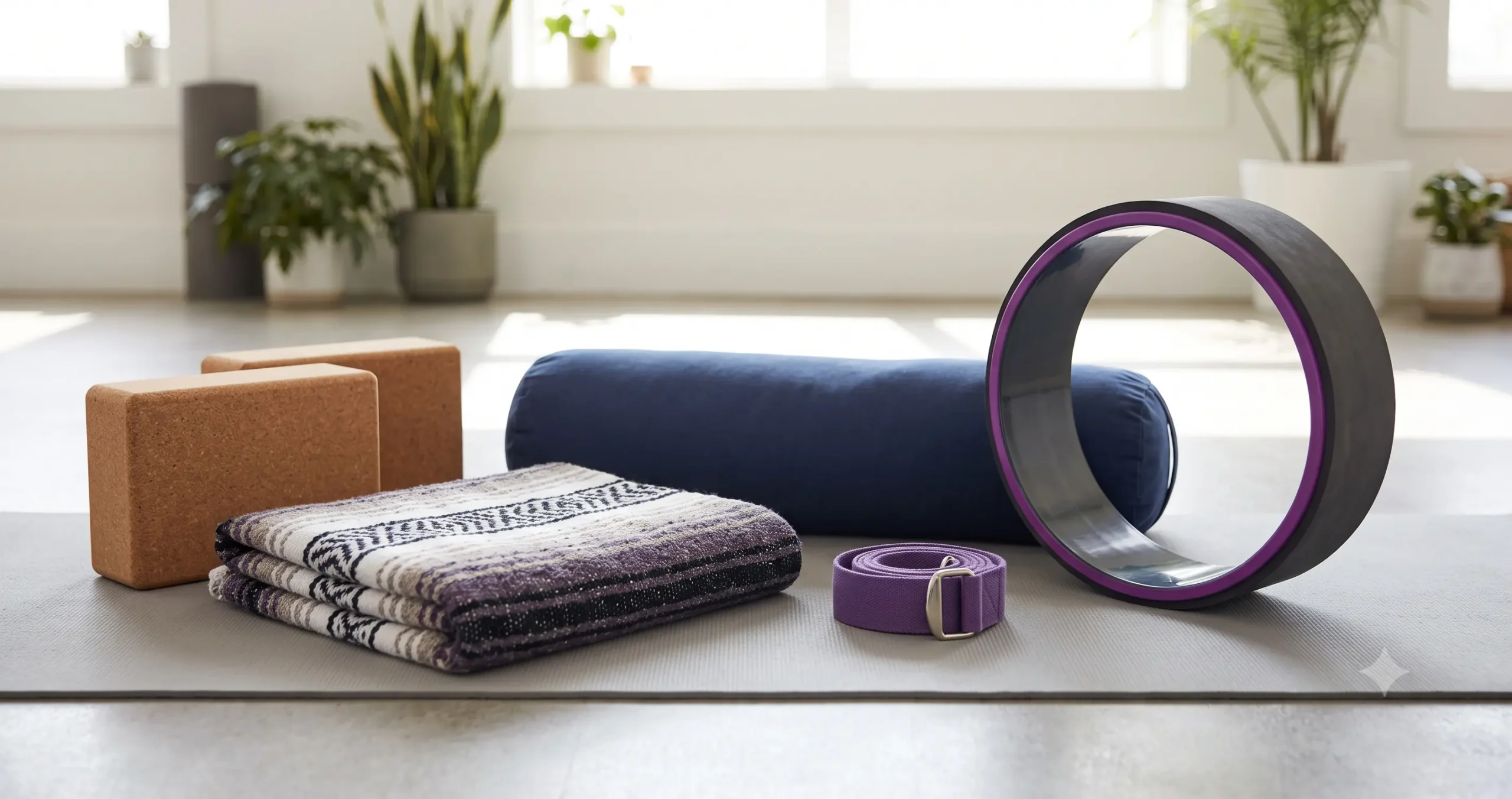
QUICK ANSWER BOX
The best yoga props for beginners include yoga blocks (for modifications), yoga straps (for extending reach), yoga blankets (for cushioning and support), yoga bolsters (for restorative poses), and yoga wheels (for spinal mobility). You don’t need every prop—start with blocks and a strap. Props are not “cheating”; they make poses safer, more accessible, and actually more effective for beginners learning proper alignment.
You just finished your first yoga class.
You’re excited, energized, maybe a little sore. The teacher mentioned props several times during class—blocks, straps, blankets—but you felt slightly confused. Which props are essential? Which are optional? Do you really need them?
Most beginner yogis ask these same questions.
The truth: yoga props are not optional additions for “advanced” practitioners or a sign that you’re “not flexible enough.”
Yoga props—blocks, straps, bolsters, blankets, and wheels—are precision tools designed to make your practice safer, more effective, and dramatically more accessible. When used correctly, props allow you to:
- Practice proper alignment without forcing your body into positions it’s not ready for
- Hold poses longer without strain, building strength and flexibility safely
- Modify poses to work with your unique body instead of fighting against it
- Deepen stretches intelligently rather than aggressively
- Protect vulnerable joints and areas managing injury or tension
- Make restorative and yin yoga practices genuinely restorative
Professional athletes use props. Advanced yogis use props. Your yoga teacher uses props regularly.
Yet beginner practitioners often skip props entirely—not because they don’t need them, but because they’re unsure which ones to buy, how to use them, or whether they’re worth the investment.
This comprehensive guide eliminates that confusion. You’ll learn which props are truly essential for beginners, why each one matters, how to use them correctly, and honest recommendations for the best options across different budgets.
By the end, you’ll understand that props aren’t shortcuts—they’re the path to a smarter, safer, more sustainable yoga practice.
UNDERSTANDING YOGA PROPS: WHY BEGINNERS ACTUALLY NEED THEM
Before diving into specific props, it’s important to understand the fundamental purpose of yoga props in any beginner practice.
Yoga props serve three critical functions:
1. Alignment Precision
Props bring the yoga poses to your body rather than forcing your body to poses it’s not ready for. A yoga block under your hand in a forward fold maintains proper spinal alignment, prevents overstretching, and allows you to progress safely. Without the block, a beginner might round their spine excessively—looking like the “correct” shape but straining tissues and missing the actual benefit.
2. Accessibility & Adaptation
Your body is unique. Props make every pose accessible regardless of your flexibility level, body proportions, strength, or any limitations you’re managing. A yoga strap lets someone with tight hamstrings practice forward folds safely. A bolster under the chest in a gentle backbend makes restorative practice genuinely restful instead of straining.
3. Safety & Injury Prevention
Props protect vulnerable areas. They reduce pressure on wrists during arm balances, cushion knees during kneeling poses, and support the spine in forward folds. A beginner practicing without props often overstretches injured areas or creates new pain from overambitious poses. Props prevent this by creating intelligent boundaries.(1)
Understanding these functions helps explain why props aren’t “cheating”—they’re simply smart yoga.
THE 5 ESSENTIAL YOGA PROPS FOR BEGINNERS
1. YOGA BLOCKS (Non-Negotiable Priority)
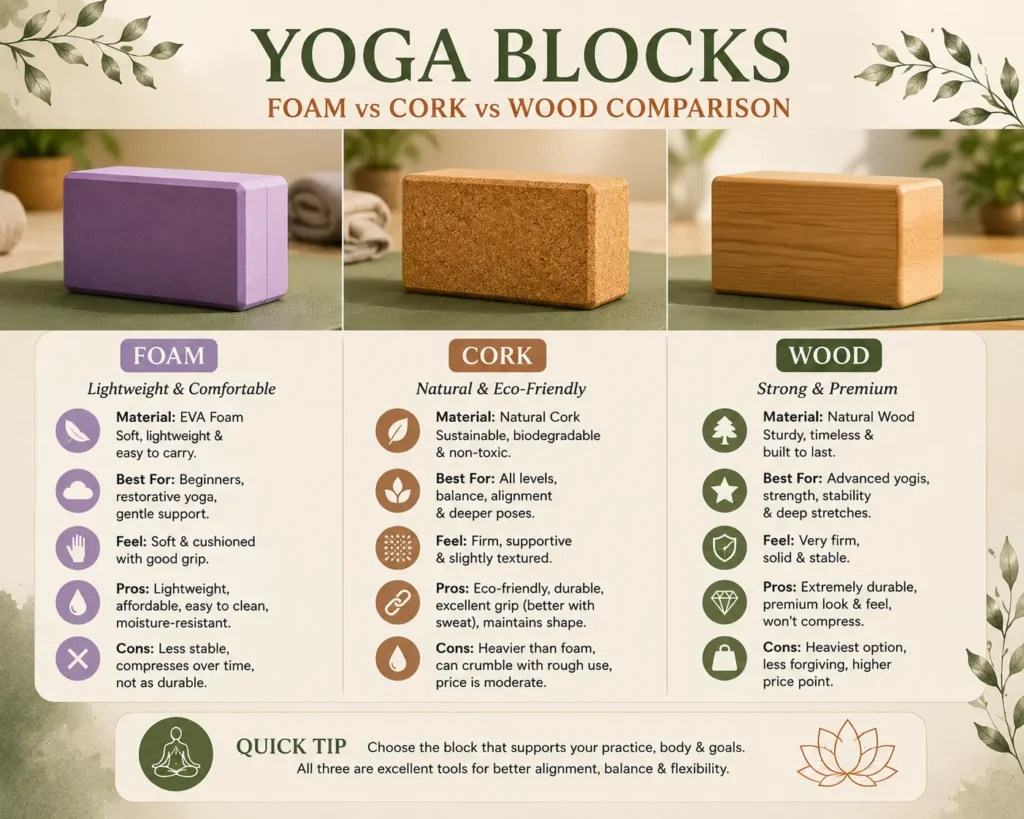
What they are:
Yoga blocks are rectangular props, typically 9″×6″×4″ in size, made from foam, cork, or wood. They function as extensions of your arms and as supports under different body parts.
Why beginners absolutely need them:
Yoga blocks are the single most useful prop for beginners because they serve multiple functions in dozens of poses. When you can’t reach the ground in a forward fold, a block under your hands brings the floor to you—maintaining proper spinal alignment while building flexibility. In triangle pose, a block under your bottom hand prevents spinal rotation. In restorative poses, blocks support the spine safely.
Primary uses:
- Forward folds: Placed under hands to maintain neutral spine
- Standing poses: Placed under hands for alignment support
- Restorative poses: Placed under the chest, back, or hips for support
- Backbends: Placed along the spine for gentle opening
- Meditation: Placed under sitting bones to elevate hips for comfortable seated practice
Material comparison:
| Material | Pros | Cons | Best For |
|---|---|---|---|
| Foam | Lightweight, affordable ($15-25), cushioned | Less durable, can indent over time | Beginners on budget, traveling yogis |
| Cork | Eco-friendly, durable, non-slip when wet | More expensive ($40-60), heavier | Long-term home practice, sustainability focus |
| Wood | Premium look, extremely durable | Heaviest option ($50-80), less forgiving | Serious practitioners, studio settings |
Beginner recommendation:
Start with foam blocks (2 blocks minimum—use them in pairs for more flexibility in placement). Upgrade to cork or wood later if desired. Buy two blocks so you can place one under each hand, creating balanced support.
Common beginner mistake:
Many beginners believe they “should” be able to touch the ground in forward folds without a block. This thinking causes overstretching and poor alignment. Using a block lets you practice correctly, build flexibility genuinely, and avoid injury.
🛒 SHOP YOGA BLOCKS
Budget-Friendly Foam Blocks:
Amazon Basics Yoga Blocks – Set of 2 – $15-25
Lightweight, cushioned, perfect for beginners. Most affordable option with solid reviews.
Eco-Friendly Cork Blocks:
Liforme Cork Yoga Blocks – Set of 2 – $60-80
Premium quality, sustainable cork, non-slip surface. Investment that lasts decades.
Premium Quality Blocks:
Manduka Cork Blocks – Set of 2 – $70-100
Professional-grade, lifetime durability guarantee, used by yoga teachers worldwide.
Best Value Set:
Tumaz Yoga Blocks – Set of 2 – $18-28
High-quality foam with excellent customer reviews. Great balance of price and durability.
Shop All Yoga Blocks on Amazon
2. YOGA STRAPS (Essential for Tight Hamstrings)
What they are:
Yoga straps are long cotton or nylon bands, typically 6-8 feet long, with a buckle or clasp. They extend your reach and provide support in stretching poses.
Why beginners need them:
Yoga straps solve one of the most common beginner problems: tight hamstrings. If you can’t reach your feet in seated forward folds, a strap around your feet lets you practice the pose correctly while gradually building hamstring flexibility. Straps also help in shoulder stretches, hip openers, and backbends.
Primary uses:
- Seated forward folds: Wrapped around feet to extend reach
- Shoulder stretches: Held behind back to support shoulder opening
- Hamstring stretches: Wrapped around foot in supine hamstring stretch
- Hip openers: Support in pigeon pose variations
- Backbends: Support in chest openers and shoulder stretches
Material comparison:
| Material | Pros | Cons | Best For |
|---|---|---|---|
| Cotton | Eco-friendly, soft, washable | Less durable, can slip | Home practice, sensitive skin |
| Nylon | Durable, strong grip, affordable | Less eco-friendly | Frequent use, studio sharing |
| Hemp | Premium eco-friendly, durable | Most expensive | Sustainability + durability |
Beginner recommendation:
Start with a budget cotton strap ($15-20). Length should be 6-8 feet minimum. Many strap-stretch poses can also be done with a regular towel if budget is a concern.
Common beginner mistake:
Beginners often try to “push through” hamstring tightness without a strap, forcing forward folds and creating injury risk. A strap lets you honor your current flexibility while building toward deeper stretches safely.
🛒 SHOP YOGA STRAPS
Best Budget Strap:
BalanceFrom Yoga Strap – $12-18
Affordable, durable cotton, comes with buckle. Most popular for beginners.
Premium Cotton Strap:
Manduka Align Yoga Strap – $28-35
Professional quality, soft cotton, excellent durability. Worth the investment.
Eco-Friendly Hemp Strap:
Liforme Yoga Strap – $35-45
Sustainable hemp material, naturally strong, beautiful design.
Value Pack – Strap + Blocks:
Complete Beginner Set on Amazon – $40-60
Blocks + strap combo for beginners. Best value when buying together.
Shop All Yoga Straps on Amazon
3. YOGA BLANKET (The Underrated Prop)
What they are:
Yoga blankets are thicker, more substantial blankets than regular blankets—often made from cotton, fleece, or wool. They provide cushioning and support throughout your practice.
Why beginners need them:
Yoga blankets are perhaps the most underrated prop because beginners don’t realize how versatile they are. They cushion knees in kneeling poses, elevate hips for better spinal alignment in seated poses, support the back in restorative backbends, and create comfort in final relaxation (savasana).
Primary uses:
- Knee cushioning: Under knees in child’s pose, camel pose, or any kneeling position
- Hip elevation: Under sitting bones in seated forward folds to tilt pelvis forward
- Chest support: Rolled under upper back for gentle backbends
- Foot support: Under feet for grounding in certain poses
- Final relaxation: As a comfortable covering during savasana
Material comparison:
| Material | Pros | Cons | Best For |
|---|---|---|---|
| Cotton | Breathable, washable, eco-friendly | Less cushioned, must be thick | Home practice, warm climates |
| Wool | Highly cushioned, durable, naturally insulating | More expensive, itchiness for some | Long-term investment, cold studios |
| Fleece | Very soft, affordable, quick-drying | Less natural, can pill over time | Budget-conscious, frequent laundering |
Beginner recommendation:
A thick cotton yoga blanket or a dedicated yoga blanket serves better than a regular thin blanket. Budget $20-40 for quality. One blanket is often sufficient, though two provides more flexibility in placement options.
Common beginner mistake:
Many beginners think a yoga blanket is optional—just use your mat! But a mat provides zero cushioning for knees. Blankets prevent knee pain during kneeling poses and make seated forward folds dramatically more comfortable.
🛒 SHOP YOGA BLANKETS
Best Budget Yoga Blanket:
Amazon Basics Yoga Blanket – $15-25
Thick cotton, machine washable, reliable quality. Great value for beginners.
Organic Cotton Blanket:
Hugger Mugger Organic Yoga Blanket – $40-55
GOTS-certified organic cotton, handmade, eco-friendly. Premium quality.
Eco-Friendly Wool Blanket:
Yoga Design Lab Merino Wool Blanket – $50-70
Natural wool, cushioned, temperature-regulating. Long-term investment piece.
Yoga Blanket Combo Pack:
Blanket + Blocks + Strap Bundle – $45-75
Complete beginner set. Most economical when buying together.
Shop All Yoga Blankets on Amazon
4. YOGA BOLSTER (For Restorative Practice)
What they are:
Yoga bolsters are elongated, cylindrical or rectangular pillows filled with cotton batting or buckwheat. They support the entire torso, back, or hips depending on placement.
Why beginners need them (especially for stress relief):
Bolsters are essential for restorative yoga—perhaps the most effective practice for nervous system regulation and stress relief. A bolster under your chest in a supported backbend delivers deep relaxation without active effort. Beginners managing stress, insomnia, or anxiety find bolster-supported poses invaluable.
Primary uses:
- Supported backbends: Under chest and upper back for gentle, effortless opening
- Supported forward folds: Under belly in a relaxing fold
- Supported child’s pose: Between calves and thighs for complete relaxation
- Supported reclining positions: Under knees or back for full-body rest
- Meditation cushion: As a comfortable seat for sitting practice
Material comparison:
| Material | Pros | Cons | Best For |
|---|---|---|---|
| Cotton-filled | Soft, adjustable firmness, washable cover | Bulkier, requires more storage | Long-term home practice |
| Buckwheat-filled | Firmer support, adjustable by adding/removing | Noisy, takes adjustment time | Practitioners preferring firmer support |
| Foam (compact) | Lightweight, easy storage, affordable | Less natural, less moldable | Small spaces, traveling yogis |
Beginner recommendation:
A cotton-filled bolster ($50-80) provides the most comfortable experience. Buckwheat is firmer and takes getting used to. Start with one bolster; advanced practitioners often invest in a second.
Common beginner mistake:
Beginners often skip bolsters thinking they’re a “luxury” prop. In reality, bolster-supported poses deliver deeper parasympathetic activation than any active yoga practice, making them powerful tools for genuine stress relief and sleep improvement.
🛒 SHOP YOGA BOLSTERS
Best Budget Bolster:
Amazon Basics Yoga Bolster – $35-55
Cotton-filled, firm support, good reviews. Most affordable option.
Premium Comfort Bolster:
Hugger Mugger Organic Cotton Bolster – $90-120
Organic cotton, handmade, eco-friendly. Professional studio quality.
Professional Studio Bolster:
Manduka Bolster Pillow – $80-110
Premium quality, lifetime durability, used in yoga studios worldwide.
Compact Travel Bolster:
Yoga Design Lab Compact Bolster – $60-85
Lightweight, portable, perfect if storage is limited.
Shop All Yoga Bolsters on Amazon
5. YOGA WHEEL (Advanced Beginner Tool)
What they are:
Yoga wheels are circular props, typically 12 inches in diameter, with varying firmness levels. They support your back and provide dynamic spinal mobility work.
Why beginners might want one (optional but valuable):
While not essential like blocks or straps, yoga wheels are increasingly popular with beginners for one specific benefit: they’re the most effective tool for opening the chest and upper back without aggressive backbends. A beginner using a wheel for 2-3 minutes daily often experiences dramatic improvement in posture, shoulder mobility, and chest opening.
Primary uses:
- Chest opening: Support thoracic spine in gentle backbends
- Upper back mobilization: Roll along the thoracic spine gently
- Shoulder mobility: Support shoulder opening work
- Core engagement: Advanced balance and strengthening work
- Spinal decompression: Gentle traction for the spine
Firmness comparison:
| Firmness | Pros | Cons | Best For |
|---|---|---|---|
| Soft | Beginner-friendly, comfortable, safer | Less effective for advanced work | Beginners, comfort priority |
| Medium | Good balance of support and give | Less specialized | Most practitioners |
| Firm | Maximum support, best for strength work | Can be uncomfortable for beginners | Advanced practitioners |
Beginner recommendation:
If budget allows ($40-80), a medium-firmness wheel is excellent for beginners. Start with 2-3 minutes of supported chest opening daily. If budget is tight, skip the wheel initially—blocks and straps are higher priority.
Common beginner mistake:
Beginners sometimes roll aggressively on the wheel, trying to achieve deep backbends. Instead, the practice is 2-3 minutes of gentle, supported chest opening. Less is more.
🛒 SHOP YOGA WHEELS
Best Budget Yoga Wheel:
Amazon Basics Yoga Wheel – $25-40
Entry-level wheel, medium firmness, good for beginners.
Premium Quality Wheel:
Dharma Yoga Wheel – $45-65
Professional quality, ergonomic design, highly rated by users.
Deluxe Yoga Wheel Set:
Yoga Wheel with Backrest – $60-90
Includes backrest support for extra comfort during practice.
Shop All Yoga Wheels on Amazon
HOW TO CHOOSE YOGA PROPS FOR YOUR BODY & GOALS
Choosing the right props depends on your specific needs, body type, and goals. This section helps you prioritize smartly.
For Tight Hamstrings or Lower Back Pain
Essential props: Yoga blocks + yoga strap
- Blocks bring the floor closer in forward folds, preventing the aggressive rounding that causes lower back strain
- Straps extend your reach, letting you practice hamstring stretches safely
Optional: Yoga blanket (under sitting bones to tilt pelvis forward)
Recommended Bundle:
Complete Hamstring Relief Set – $50-80
Blocks + strap + blanket for complete flexibility support.
For Shoulder Tension or Limited Shoulder Mobility
Essential props: Yoga strap + yoga blocks
- Straps support shoulder stretches without forcing the joint
- Blocks reduce chest-to-thigh distance in forward folds, preventing shoulder strain
Optional: Yoga wheel (for chest opening and shoulder mobility)
Recommended Bundle:
Shoulder Mobility Kit – $45-75
Everything you need for shoulder opening and tension relief.
For Knee Pain or Kneeling Discomfort
Essential props: Yoga blanket + yoga blocks
- Blankets cushion knees, preventing pressure pain
- Blocks under hands in kneeling poses reduce weight on knees
Optional: Yoga bolster (elevated cushioning for extra support)
Recommended Bundle:
Knee Protection Set – $40-70
All the cushioning and support you need for pain-free practice.
For Stress Relief & Sleep Improvement
Essential props: Yoga bolster + yoga blanket
- Bolster-supported restorative poses activate the parasympathetic nervous system most effectively
- Blankets provide comfort for complete relaxation
Optional: Yoga wheel (gentle chest opening for nervous system reset)
Recommended Bundle:
Sleep & Stress Relief Set – $80-130
Complete restorative yoga setup for deep relaxation.
For General Practice & Alignment Learning
Essential props: Yoga blocks + yoga strap + yoga blanket
- These three props handle modifications for most poses
- They let you learn proper alignment before progressing deeper
Optional: Yoga wheel or bolster (as your practice deepens)
Recommended Bundle:
Complete Beginner Bundle – $60-100
The perfect starting set for any beginner. Most complete value.
🎯 STEP-BY-STEP GUIDE: HOW TO USE YOGA PROPS CORRECTLY
Using yoga props correctly is crucial—misuse creates problems rather than solutions. This guide covers proper technique for each prop type.
Step 1: Selecting the Right Block Height
Yoga blocks can be used in three different heights (flat, medium, tall) depending on the pose and your flexibility.
Flat side (lowest height):
- Used when you need minimal lift
- Appropriate for practitioners with good flexibility
- Creates gentle modification
Medium side (medium height):
- Most common placement for beginners
- Provides accessible support without full height
- Works for most forward fold and standing pose modifications
Tall side (maximum height):
- Used when maximum lift is needed
- Ideal for tight hamstrings or significant mobility limitations
- Prevents excessive spinal rounding
How to determine your block height:
In a forward fold, place a block under your hands at the lowest height that allows you to maintain a neutral spine (not rounded). If your spine rounds, go higher. This is your correct height.
Step 2: Proper Block Placement in Forward Folds
Setup:
- Stand at the top of your mat in mountain pose
- Place blocks on the mat in front of you (2 blocks recommended for balanced support)
- Step or fold forward, bringing hands to the blocks
- Ensure hands are flat, fingers spread wide
- Keep your spine long, not rounded
- Rest head naturally (don’t force it down)
Proper alignment:
- Blocks should support approximately 30-50% of your weight
- Your spine should be relatively straight (not curved like a C)
- You should feel a gentle stretch, not strain
- Your hands should be directly under shoulders
Common mistake:
Placing blocks too low, forcing the spine to round. If you can’t maintain neutral spine, use higher block placement.
Step 3: Correct Strap Placement in Hamstring Stretches
Setup:
- Lie on your back, knees bent, feet on floor
- Loop the strap around one foot (upper ball of foot or forefoot)
- Hold the strap with both hands, arms extended
- Slowly straighten your leg toward ceiling
- Keep the other foot grounded
- Pull gently on strap to bring foot toward your face
Proper alignment:
- The strap should take approximately 70% of the weight
- Your leg should feel a gentle stretch in the hamstring, not cramping pain
- Your lower back should stay on the mat (not lifting)
- Your neck should be neutral on the floor
Common mistake:
Pulling too aggressively on the strap, forcing the hamstring beyond its current range. Gentle progress is faster progress.
Step 4: Bolster Placement for Supported Backbends
Setup:
- Sit on floor with legs extended (or in a butterfly position for more hip opening)
- Place bolster lengthwise behind you
- Lie back slowly, allowing the bolster to support your spine from sacrum to head
- Arms can rest alongside your body or in cactus position (elbows bent, palms up)
- Hold for 5-10 minutes minimum
Proper alignment:
- Your entire back should feel supported, no strain
- Your head should be cradled by the bolster (not hanging off)
- Hips should be grounded on the floor (not lifted on bolster)
- Your face should be parallel to ceiling (not looking backward)
Common mistake:
Placing the bolster too high, causing neck strain. The bolster should support from sacrum (low back) to upper back, leaving the neck neutral.
Step 5: Blanket Folding for Hip Elevation
Setup:
- Fold blanket into a rectangle approximately 12″×24″
- Sit on the floor, positioning folded blanket under your sitting bones
- Fold forward from hips
- The blanket elevation should tilt your pelvis forward naturally
Proper alignment:
- Your pelvis should tilt forward (not backward)
- Your sitting bones should sit on the blanket’s highest edge
- Your spine should be relatively straight
- You should feel more comfortable than without the blanket
Common mistake:
Placing the blanket at the back of sitting bones (under hamstrings) instead of under the bones themselves. This doesn’t create the hip tilt needed for proper forward fold alignment.
❌ COMMON YOGA PROP MISTAKES & HOW TO CORRECT THEM
Mistake #1: Using Props as a “Crutch” or “Giving Up”
Problem:
Beginners view using props as “cheating” or a sign they’re “not flexible enough,” so they avoid props entirely and force their bodies into poses.
Why it’s a mistake:
This thinking causes overstretching, poor alignment, and injury risk. Props aren’t crutches—they’re precision tools that make your practice safer and more effective.
Correction:
Recognize that advanced yogis use props regularly. Props allow you to practice proper alignment, build flexibility safely, and progress sustainably. Using props is the smarter choice, not a lesser one.
Mistake #2: Blocks Placed Too Low
Problem:
Beginners place blocks at the lowest height, forcing their spine to round excessively in forward folds.
Why it’s a mistake:
Rounding the spine prevents you from accessing the actual stretch, increases injury risk to the lower back, and teaches poor movement patterns.
Correction:
Place blocks at a height that maintains a neutral spine. If you need to round to touch the blocks, go higher. The correct height maintains spinal alignment.
Mistake #3: Straps Pulled Too Aggressively
Problem:
Beginners pull straps hard, trying to force deeper stretches faster.
Why it’s a mistake:
Aggressive pulling causes muscle guarding (the muscle tightens to protect itself), actually limiting flexibility. It also increases injury risk.
Correction:
Use gentle, steady pressure. The stretch should feel like a 4-5 out of 10 intensity, not a 9. Gentler progress is actually faster progress.
Mistake #4: Not Using Enough Props
Problem:
Beginners use one block in one pose, when two blocks in strategic placement would provide better support.
Why it’s a mistake:
Under-utilizing props means under-utilizing their benefits. You’re left feeling unsupported and not receiving maximum alignment benefit.
Correction:
Use props generously. Two blocks under hands in forward folds, blanket under sitting bones and under knees—whatever gives you complete support and alignment.
Mistake #5: Buying Props Without Clear Purpose
Problem:
Beginners accumulate expensive props they never use because they didn’t clarify their specific needs first.
Why it’s a mistake:
This wastes money and creates confusion about which props are actually essential for their practice.
Correction:
Identify your specific needs first (tight hamstrings, knee pain, stress relief, etc.), then choose props that address those needs. Start with essentials (blocks, strap, blanket) before exploring options like wheels or premium bolsters.
ECO-FRIENDLY YOGA PROPS FOR CONSCIOUS PRACTITIONERS
If sustainability matters to you, these eco-friendly props deliver both quality and environmental responsibility.
Sustainable Block Options:
- Cork: Natural, renewable, recyclable, biodegradable. Best overall eco-friendly option.
- Bamboo: Extremely renewable, lightweight, durable. Growing availability.
- Recycled foam: Made from recycled materials, reduces waste. Increasingly common.
Sustainable Strap Options:
- Organic cotton: GOTS-certified, biodegradable, durable.
- Hemp: Ultra-durable, grows without pesticides, extremely eco-friendly.
- Recycled nylon: Reduces plastic waste, durable, though less natural.
Sustainable Blanket Options:
- Organic cotton: GOTS-certified, machine washable, biodegradable.
- Organic wool: Renewable, biodegradable, naturally insulating.
- Linen: Sustainable plant-based, durable, biodegradable.
Sustainable Bolster Options:
- Organic cotton-filled: Biodegradable materials, organic covering.
- Buckwheat-filled: Natural material, fully biodegradable, compostable.
CONCLUSION (320 words)
Yoga props are not optional accessories for advanced practitioners or a crutch for “inflexible” beginners.
They are precision tools that transform your entire yoga experience—from beginner foundations to advanced practice refinement. When chosen wisely and used correctly, props deliver safer alignment, faster progression, deeper understanding, and more sustainable practice.
The investment is small. The benefits are enormous.
For $50-100, you can purchase the essential props—two blocks, one strap, one blanket—that will serve your yoga practice for years. These aren’t temporary tools you’ll outgrow. Advanced yogis still use blocks daily. Teachers still modify poses with props. Props are permanent parts of intelligent yoga practice.
But props only work if they’re used correctly.
This guide has walked you through every essential prop, why each one matters, how to use them properly, and which props address your specific needs. You’ve learned the difference between block heights, the correct strap tension, proper blanket folding, and bolster placement. You’ve discovered common mistakes that cause problems and how to avoid them.
You’re now ready to begin your prop-supported yoga journey.
Start today with whatever props you can access—even if it’s just two blocks and a towel. Use them consistently. Learn proper technique. Notice how quickly your alignment improves, how much safer your practice feels, and how much deeper your flexibility develops.
Within weeks, you’ll understand something that took many yogis months to learn: props aren’t limitations. They’re liberations. They free you to practice intelligently, progress safely, and build a yoga practice that sustains you—not just for months, but for a lifetime.
Your yoga practice begins with the right foundation.
Props provide that foundation.
KEY TAKEAWAYS
Essential Yoga Props Knowledge:
✅ Yoga props are precision tools, not shortcuts. They enable proper alignment, prevent injury, and make yoga poses accessible for all bodies and flexibility levels.
✅ Start with the essential trio: 2 yoga blocks, 1 yoga strap, 1 yoga blanket. Total investment: $50-100. This covers modifications for most beginner poses.
✅ Blocks are the most important prop for beginners. Buy two blocks. They serve dozens of functions across all yoga styles and are invaluable for learning proper alignment.
✅ Correct block height is crucial. Choose the height that maintains a neutral spine without rounding. If spine rounds, go higher. The correct height prevents injury and maximizes benefits.
✅ Props don’t mean you’re “not flexible enough.” Advanced yogis use props regularly. Props allow safe progression, which is faster progress than forcing inappropriate depth.
✅ Material matters. Foam blocks are affordable but durable, cork is eco-friendly and non-slip, wood is premium but heavy. Choose based on budget and priorities.
✅ Yoga straps solve hamstring tightness. Rather than forcing forward folds, straps extend your reach and let you practice proper alignment while building flexibility gradually.
✅ Blankets prevent knee pain. Cushioning under knees in kneeling poses is essential for comfort and safety. A single blanket is one of the most underrated props.
✅ Bolsters enable restorative practice. Bolster-supported poses activate parasympathetic nervous system more effectively than any active practice, making them powerful for stress relief and sleep improvement.
✅ Yoga wheels are optional but beneficial. They’re excellent for chest opening and posture improvement but not essential for beginners. Add after mastering basic props.
✅ Eco-friendly options are increasingly available. Cork, organic cotton, hemp, and bamboo provide sustainable alternatives without compromising quality.
✅ Common mistakes cause injuries. Using blocks too low, pulling straps too hard, and avoiding props entirely are the top mistakes. Proper technique prevents problems.
FAQ SECTION
Q 1: Do I Really Need Yoga Props as a Beginner?
Props aren’t strictly necessary, but they’re invaluable. They allow you to practice proper alignment without forcing your body into inappropriate shapes, protect vulnerable areas from injury, and make poses accessible regardless of your current flexibility level. Most injuries in beginner yoga happen when practitioners skip props and overstrain. Using props from the start builds safe habits that serve you throughout your yoga journey.
Q 2: Which Single Yoga Prop Should I Buy First?
Start with yoga blocks (buy 2). Blocks are the most versatile prop, useful in dozens of poses across all yoga styles. They bring the yoga poses to your body rather than forcing your body to inappropriate depths. After blocks, add a yoga strap if you have tight hamstrings, or a yoga blanket if you have knee sensitivity. One block is limiting; two blocks provides balanced support.
Shop Yoga Blocks Now
Q 3: Can I Use Regular Household Items Instead of Yoga Props?
Some substitutions work temporarily: a regular blanket instead of a yoga blanket, a towel instead of a strap, books or thick cushions instead of blocks. However, household items lack the specific design, non-slip surfaces, and durability of actual props. Once you’re committed to practice, investing in proper props is worthwhile. Blocks cost $15-30 each—a small investment for injury prevention and alignment improvement.
Shop Affordable Yoga Props
Q 4: Should I Buy Props From a Yoga Studio or Online?
Online offers wider selection and better prices (Amazon, specialized yoga retailers). Studios offer expert guidance and quality assurance. If you’re uncertain, visit a studio to feel different props, then purchase online if prices are significantly lower. Many studios price-match online retailers anyway. The key is getting quality props at a price you’re comfortable with.
Compare Prices on Amazon
Q 5: How Many Props Does a Beginner Actually Need?
Start with this essential set: 2 yoga blocks, 1 yoga strap, 1 yoga blanket. Total investment: $50-100. This covers modifications for most poses and addresses common beginner needs. After 4-8 weeks of consistent practice, you might add a yoga bolster if you practice restorative yoga or have stress/sleep issues. A yoga wheel is optional but beneficial for chest opening and posture improvement.
Buy Complete Beginner Bundle
Pingback: Surprising Health Benefits of Yoga in the Morning