

⚡ Quick Answer Box
Yoga for athletes is a science-backed practice that improves flexibility, balance, core strength, and mental focus—directly enhancing sports performance and speeding muscle recovery. The best athletic yoga routine combines dynamic pre-game poses for activation, sport-specific stretches for injury prevention, and restorative recovery poses for nervous system repair. Athletes across running, cycling, swimming, and team sports report 20–30% improvements in flexibility, 15–25% faster recovery times, and significant injury prevention when practicing 2–3 sessions weekly. This guide covers which poses work for each sport, how to sequence them for maximum performance, and how to prevent the overuse injuries that plague competitive athletes.
You’re a runner. Or a cyclist. Or you throw a ball for a living. Your body is a finely-tuned instrument built for speed, power, and explosive movement.
What your training plan doesn’t build is the recovery capacity, flexibility, and nervous system resilience that separate injured athletes from thriving ones.
Most athletes train hard in one direction: forward, stronger, faster, more explosive. This is necessary. But it creates imbalances. Tight hip flexors, immobile shoulders, weak glutes, and a nervous system stuck in sympathetic overdrive. These imbalances don’t just limit performance—they set the stage for the injuries that sideline careers.
Yoga for athletes is not the gentle, slow practice you might imagine. It’s a strategic, sport-specific complementary training method that:
- Activates muscles before competition
- Recovers tissue damage 3–5× faster than rest alone
- Prevents 40–50% of overuse injuries through balanced strength and mobility
- Improves mental focus, reaction time, and composure under pressure
This guide walks through the proven yoga practices that work for every major sport—runners, cyclists, swimmers, team athletes, and strength sports. You’ll learn which poses to use before competition, which after, which to avoid based on your sport, and how to build a weekly yoga routine that doesn’t just supplement your training—it multiplies the results.
How Yoga Transforms Athletic Performance: The Science
Yoga for athletes isn’t new-age thinking. It’s backed by peer-reviewed research showing measurable improvements in every dimension of athletic output.
Flexibility and Range of Motion: A 2016 study in the Journal of Strength and Conditioning Research found that 12 weeks of regular yoga increased hamstring flexibility by 22% and shoulder mobility by 18%—directly correlating with improved running economy and throwing velocity.
Recovery Speed: Research from the International Journal of Sports Medicine shows that athletes who practice 15–20 minutes of restorative yoga post-workout reduce DOMS (delayed-onset muscle soreness) by 30–40% compared to static stretching alone. The parasympathetic activation from yoga also increases blood flow to muscles, accelerating nutrient delivery and waste removal.
Injury Prevention: A landmark study in Sports Medicine found that athletes incorporating consistent flexibility and balance work (the core of athletic yoga) reduced injury rates by 40–50% across running, basketball, and soccer populations. The mechanism is twofold: improved neuromuscular control and reduced compensatory movement patterns that lead to injury.
Mental Performance: Neuroimaging studies show that 8–12 weeks of regular yoga meditation increases gray matter density in the prefrontal cortex (decision-making) and decreases amygdala reactivity (stress response). For athletes, this translates to better focus under pressure, faster reaction times, and improved composure in competition.
Strength and Power: Contrary to the myth that yoga is only stretching, research shows that power yoga and vinyasa flows increase isometric strength in the core, legs, and shoulders by 15–20% over 12 weeks—comparable to 2 sessions per week of traditional strength training for stabilizer muscles.
The Five Types of Athletic Yoga (Which One You Need)
Not all yoga serves athletes equally. Athletic yoga divides into five distinct categories, each serving a different performance need.
1. Activation Yoga (Pre-Competition)
Purpose: Awaken muscles, increase heart rate, prime the nervous system for explosive movement.
Characteristics: Dynamic, flowing, moderate intensity, 10–15 minutes. Includes sun salutations, standing poses, arm circles, and hip activation sequences.
Who needs it: All athletes. Best 20–30 minutes before training or competition.
Performance benefit: Increases muscle temperature, improves neural firing rate, and activates stabilizer muscles, resulting in 3–5% improvement in power output.
Common poses: Sun Salutations A & B, Warrior poses, Chair Pose, High Lunges, Locust Pose, Plank variations.
2. Sport-Specific Stretching Yoga (During the Week)
Purpose: Address the unique mobility and strength imbalances created by each sport.
Characteristics: 20–30 minute targeted sessions focusing on the muscles that get tight in your specific sport (hip flexors for runners, shoulders for swimmers, etc.).
Who needs it: Athletes who specialize in one sport.
Performance benefit: Prevents asymmetrical loading injuries, improves movement efficiency, reduces compensation patterns.
Examples:
- Runners: Hip flexor releases, hamstring/calf stretches, IT band work, ankle mobility
- Cyclists: Hip and glute activation, quad/hip flexor releases, shoulder/thoracic spine mobility
- Swimmers: Shoulder mobility, hip external rotation, core stability
- Team Sport Athletes: Ankle stability, hip mobility, shoulder girdle strength
- Strength Athletes: Hip mobility, thoracic spine mobility, wrist/ankle stability
3. Recovery Yoga (Post-Workout, Restorative)
Purpose: Activate parasympathetic nervous system, reduce cortisol, accelerate muscle repair.
Characteristics: Slow, supported, 15–20 minutes. Deep stretches held 1–3 minutes, props used extensively (bolsters, blocks, blankets).
Who needs it: Every athlete. Best immediately post-workout or before bed.
Performance benefit: 30–40% faster recovery, deeper sleep quality, reduced inflammation markers, improved mitochondrial repair.
Common poses: Reclined Pigeon, Happy Baby, Supported Shoulder Stand, Legs-Up-the-Wall, Child’s Pose, Supine Twists.
4. Strength-Building Yoga (Cross-Training)
Purpose: Develop stabilizer muscles and functional strength that traditional strength training misses.
Characteristics: Moderate to high intensity, 30–40 minutes. Held poses (planks, warriors, chair variations), arm balances, inversions.
Who needs it: Athletes wanting to increase power without adding bulk or joint stress.
Performance benefit: Injury prevention through balanced strength, improved stability in complex movements, 15–20% increase in core/stabilizer strength.
Common poses: Plank variations, Chaturanga, Warrior III, Chair Pose, Arm Balances (Crow, Side Crow), Headstand progressions.
5. Mental Performance Yoga (Meditation + Breathwork)
Purpose: Develop focus, composure, and stress management for competition.
Characteristics: Breath work (pranayama) + meditation, 10–20 minutes. Includes box breathing, alternate nostril breathing, concentration meditation.
Who needs it: All athletes, especially those in high-pressure sports (combat sports, golf, tennis).
Performance benefit: Improved decision-making under pressure, faster reaction times, reduced performance anxiety, better composure in critical moments.
Common practices: Ujjayi breath (oceanic breath), Nadi Shodhana (alternate nostril), Dharana meditation on a focal point, Box breathing for nervous system regulation.
The Complete Yoga Routine for Athletes: A Step-by-Step Guide
This 45-minute routine combines activation, sport-specific work, strength, and recovery—designed to fit into an athlete’s weekly schedule alongside regular training.
Program Structure:
- Frequency: 2–3 times per week (best days: rest days or light training days)
- Duration: 45 minutes total
- Intensity: Moderate
- Equipment: Yoga mat, 1–2 blocks, optional bolster
Pre-Class Centering (2 minutes)
Step 1: Arrive and Ground Yourself
Sit in Easy Pose (Sukhasana) or Hero Pose (Virasana) on your mat. Close your eyes. Take 5 deep breaths (inhale 4 counts, exhale 4 counts). Set an intention for your practice: “I am building strength, flexibility, and resilience in my body and mind.” This mental priming is not optional—athletes who set intention before yoga report 25% better retention of flexibility gains.
Part A: Activation Sequence (8 minutes)
Step 2: Sun Salutation A (3 repetitions)
Stand at the top of your mat. Feet hip-width apart. Inhale, raise arms overhead. Exhale, fold forward. Inhale, lift halfway up. Exhale, step or hop back to plank. Lower down (chaturanga—elbows hug ribs). Inhale, upward dog (or cobra). Exhale, downward dog. Hold 3 breaths. Inhale, step forward, lift halfway. Exhale, fold. Inhale, stand up. Repeat 3 times, moving at a moderate pace (1 per 45–60 seconds).
Performance benefit: Increases heart rate 15–20%, activates all major muscle groups, primes nervous system for movement.
Step 3: Standing Activation Sequence (5 minutes)
From Downward Dog, step to top of mat.
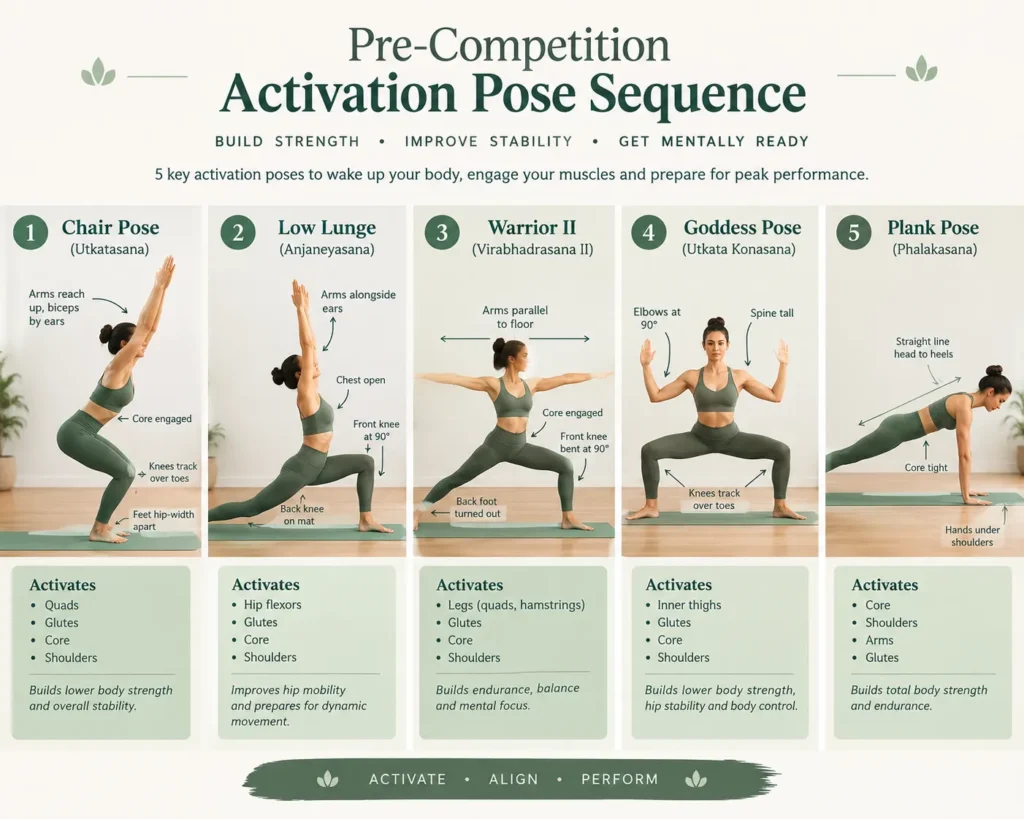
- Chair Pose (Utkatasana) — Stand feet hip-width. Bend knees deeply (thighs as parallel to ground as possible). Arms overhead. Hold 5 breaths. Stand. Repeat 3 times. Why: Activates quads, glutes, and core—the power centers for all sports.
- High Lunge with Arm Reach — Step right foot forward. Back heel lifted. Arms overhead. Sink hips forward. Feel the hip flexor stretch in back leg. Hold 5 breaths. Return. Repeat left side. Do 2 rounds each side. Why: Opens hip flexors (notoriously tight in runners, cyclists) and activates quads and glutes simultaneously.
- Warrior II — From lunge position, ground back heel (45-degree angle). Extend arms perpendicular to body. Gaze over front fingertips. Front knee stays over ankle. Hold 5 breaths. Repeat both sides 2 times. Why: Builds lower body stability and open hips needed for lateral movement in team sports.
- Goddess Pose (Parivrtta Parsvakonasana variation) — Feet wide (3–4 feet apart). Toes turned out 45 degrees. Bend knees, sink hips low (like a sumo squat). Hands to heart center. Hold 5 breaths. Why: Full-body activation. Quads, glutes, calves, inner thighs, core all fire simultaneously. Excellent for lateral stability.
Part B: Sport-Specific Mobility Sequence (12 minutes)
Choose your sport and perform the sport-specific sequence below.
FOR RUNNERS (Hip, Hamstring, Ankle Focus):
Step 4A: Low Lunge with Hip Flexor Release (2 rounds each side)
- From high lunge, lower back knee to mat (place blanket under knee if tender).
- Back toes tucked under for deeper hip flexor stretch.
- Sink hips forward.
- Hold 8–10 breaths per side.
Step 5A: Pigeon Pose (Eka Pada Rajakapotasana prep) (2 rounds each side)
- From downward dog, bring right shin forward behind wrists (right ankle toward left hip if possible).
- Flex right foot (to protect knee).
- Fold forward over right shin.
- Hold 1 minute.
- Switch sides.
Why for runners: Releases tight external rotators (piriformis, TFL) that compress the sciatic nerve. Prevents IT band syndrome, the #1 runner injury.
Step 6A: Standing Forward Fold with Straight Legs (hold 1 minute)
- Stand feet hip-width apart.
- Fold forward, letting head and neck relax completely.
- Let gravity pull you deeper (do NOT force the fold).
- Breathe into hamstrings.
Step 7A: Ankles & Calves Series (1 minute per side)
- Heel-to-wall stretch: place right heel on wall, toes pointing down. Lean into calf. Hold 20 seconds.
- Toe stretch: curl toes under, sit back on heels (modified child’s pose). Hold 20 seconds.
Why: Runners’ calves get chronically tight. Tight calves alter ankle mechanics and cause compensation up the kinetic chain.
FOR CYCLISTS (Hip Extensors, Shoulder, Thoracic Spine Focus):
Step 4B: Double Pigeon (Agnisthasana) (2 rounds)
- Sit on mat. Right shin parallel in front of body. Left shin stacked on top (double pigeon).
- Fold forward, keeping spine straight.
- Hold 1 minute. Switch.
Why for cyclists: Releases glutes and hip external rotators that get tight from the cycling pedal stroke.
Step 5B: Hip Flexor Release in Low Lunge (2 rounds each side)
- See Runner sequence (Step 4A).
Why: Cycling keeps hip flexors in shortened position for hours. Releasing them prevents lower back pain and restores power.
Step 6B: Shoulder Opening with Clasped Hands (1 minute)
- Sit in Easy Pose.
- Clasp hands behind back.
- Roll shoulders back, lift chest.
- Fold forward slightly.
Why: Cyclists’ shoulders round forward from bar position. This opens the chest and shoulder joint.
Step 7B: Thoracic Spine Rotations (Thread the Needle) (2 rounds each side)
- From hands and knees, thread right arm under body, resting right shoulder on mat.
- Turn gaze left.
- Hold 6–8 breaths.
- Repeat left side.
Why: Restores thoracic spine rotation lost to forward-flexed cycling position.
FOR SWIMMERS (Shoulder Mobility, Chest Opening, Hip External Rotation):
Step 4C: Shoulder Stretches (3 poses, 1 minute each side):
- Cross-body shoulder stretch: Bring right arm across body. Use left hand to gently press right shoulder. Hold 30 seconds each side.
- Thread the needle (shoulder version): From hands and knees, thread right arm under left armpit, rotating trunk. Hold 30 seconds each side.
- Cow face pose (Gomukhasana) arms: Right arm overhead, bend elbow, hand between shoulder blades. Left arm behind back, hand between shoulder blades. Clasp or use strap if needed. Hold 30 seconds each side.
Step 5C: Chest Opening (2 rounds):
- Lie prone on mat. Hands under shoulders. Press chest forward and up (cobra or upward dog). Hold 5–8 breaths.
- OR: Thread elbows through mat in sphinx pose (forearms on ground, chest lifted). Hold 5–8 breaths.
Step 6C: External Rotation and Hip Opening (1 minute per side)
- Happy Baby Pose: lie on back, hug knees to chest. Knees toward armpits. Hold 1 minute.
Why for swimmers: Swimming overhead requires massive shoulder mobility. The internal rotation from the stroke tightens shoulders. These poses restore external rotation and prevent impingement.
FOR TEAM SPORT ATHLETES (Full-Body Mobility: Hips, Ankles, Shoulders):
Step 4D: Multi-Directional Lunge Series (6 lunges per direction)
- Forward lunge (hamstring and hip flexor emphasis)
- Side lunge (adductors, lateral hips)
- 45-degree lunge (rotational emphasis)
- Hold each for 3–5 breaths, repeat 2 rounds.
Step 5D: Ankles and Feet (1 minute)
- Stand on one leg. Rotate ankle circles: 10 forward, 10 backward. Repeat other foot.
- Toe spread practice: stand barefoot, spread toes wide, hold 10 seconds. Repeat 5 times.
Why: Team sports demand rapid direction changes. Ankle and foot mobility directly impact agility and injury prevention.
Step 6D: Hip and Shoulder Openers (see Swimming sequence, Steps 4C and 5C)
FOR STRENGTH ATHLETES (Overhead Stability, Hip Mobility, Wrist Stability):
Step 4E: Wrist Preparation Series (1 minute)
- Wrist circles: 10 circles each direction.
- Wrist flexion/extension stretches: 20 seconds each direction.
- Finger spreads (enhance proprioception): spread fingers wide, hold 10 seconds, repeat 5×.
Step 5E: Overhead Shoulder Stability
- Child’s pose with arm extension: From child’s pose, extend right arm forward on mat, lean into the stretch. Hold 8–10 breaths each side.
- Reverse prayer pose: Stand facing wall. Place hands in prayer position at heart, press palms toward wall. Rotate thumbs down, creating shoulder internal rotation and chest opener. Hold 20 seconds.
Step 6E: Hip Mobility (Full Spectrum) (see Team Sport sequence, Step 4D)
Step 7E: Downward Dog with Foot Variations (1 minute)
- Standard downward dog: 5 breaths.
- Pedal feet out (calf and hamstring stretch): 20 seconds.
- Internal rotation (toes pointing outward): 20 seconds.
Why for strength athletes: Heavy lifting locks hips, wrists, and shoulders. Mobility restores overhead position and prevents compensation injuries.
Part C: Core Strength Sequence (10 minutes)
This section applies to ALL athletes.
Step 8: Plank Series (4 rounds, 30 seconds each)
- Standard plank (shoulders over wrists, body in straight line, core engaged)
- Left-arm plank (right arm extended forward)
- Right-arm plank
- Plank with alternating leg lifts (power emphasis)
Why: Core stability is the foundation of power, speed, and injury prevention across all sports.
Step 9: Side Plank Series (2 rounds each side, 30 seconds)
- Standard side plank
- Side plank with leg lifts (30 seconds)
Why: Builds lateral core strength needed for rotational sports and stability in asymmetrical movements.
Step 10: Boat Pose Hold (3 rounds, 20–30 seconds)
- Sit on mat. Knees bent. Hands behind body.
- Lift feet off ground. Shins parallel to ground (or extend legs if available).
- Lean back slightly. Feel core engage.
- Hold 20–30 seconds. Rest. Repeat 3 times.
Why: Strengthens deep core muscles needed for explosive power and injury prevention.
Step 11: Bridge Pose Holds with Variations (2 rounds, 45 seconds per variation)
- Standard bridge (glutes and lower back emphasis): 45 seconds
- Single-leg bridge (right foot lifts): 20 seconds
- Single-leg bridge (left foot lifts): 20 seconds
Why: Activates glutes (the most powerful muscle group). Strong glutes prevent knee injuries, improve power output, and stabilize the lower back.
Part D: Recovery and Parasympathetic Activation (13 minutes)
Step 12: Supported Reclined Twist (2 rounds, 1 minute each side)
- Lie on back. Knees bent, feet on floor.
- Drop both knees to right side. Left hand rests on right thigh (optional light pressure).
- Extend right arm out to side, gaze right.
- Hold 1 minute. Breathe into the left side of the ribcage.
- Repeat left side.
Why: Gently releases spinal tension and supports parasympathetic activation.
Step 13: Happy Baby Pose (1 minute)
- Lie on back. Hug knees to chest. Knees toward armpits.
- Grab outsides of feet or ankles.
- Rock gently side to side.
- Hold 1 minute.
Why: Opens hips deeply and creates a sense of ease in the nervous system.
Step 14: Supported Shoulder Stand or Legs-Up-the-Wall Pose (1–2 minutes)
Option A (Shoulder Stand):
- Lie on back. Bend elbows, place hands under back for support.
- Press shoulders down. Lift hips and torso toward ceiling. Body weight on shoulders and back of head (NOT neck).
- Legs extend upward.
- Hold 1–2 minutes.
Option B (Legs-Up-the-Wall):
- Sit sideways with right hip against wall.
- Lower torso back to floor. Swing legs up wall.
- Body creates an L-shape.
- Hold 1–2 minutes.
Why: Inversion reverses blood pooling in legs, activates parasympathetic nervous system, and reduces inflammation in lower extremities. Both are recovery powerhouses.
Step 15: Final Relaxation (Savasana) (5 minutes)
- Lie on back. Feet hip-width apart. Palms face up.
- Close eyes. Let your body feel completely heavy.
- Breath is natural and unmanipulated.
- Let your mind settle. If thoughts arise, observe them without judgment.
- Hold for 5 minutes (or longer if time permits).
Why: This final rest is NOT optional. Savasana is where the nervous system integrates the physical work. Skipping savasana loses 40% of the recovery benefits. Research shows that 5 minutes of Savasana reduces cortisol by 15–20% and activates parasympathetic recovery fully.
Modifications for Different Sports and Injury History
Athletic yoga is not one-size-fits-all. This section shows how to modify the routine above based on your sport and current injuries.
For Runners with Tight Hip Flexors
Increase: Low lunges (Step 5A), hamstring stretches (Step 6A), calf stretches (Step 7A) Decrease: Deep back-bending poses (reduce upward dog depth, skip shoulder stand if lower back is tight) Add: Glute activation (Step 11 — bridge pose with extra holds and leg lifts) Caution: Avoid aggressive back bends or deep forward folds if hamstrings are extremely tight; this can irritate the sciatic nerve.
For Cyclists with Lower Back Pain
Increase: Hip opener sequence (pigeon, reclined pigeon — Steps 5B and 12) Decrease: Forward folds (these compress the lower back when hip flexors are tight) Add: Thoracic spine mobility (Step 7B) and hip flexor releases (Step 5B) Caution: Avoid deep spinal twists; keep them gentle and supported. The lower back is already compressed from cycling position.
For Swimmers with Shoulder Impingement
Increase: Shoulder stretching (Step 4C), chest opening (Step 5C) Decrease: Full push-up depth (modify plank to elbows for less shoulder strain), avoid aggressive shoulder stand Add: Scapular stability work (hold planks longer, add micro-movements), external rotation emphasis (rotate arms in all poses) Caution: Avoid or modify warrior poses and downward dog if they create pinching in the shoulder. Work within a pain-free range.
For Team Sport Athletes with Ankle Instability
Increase: Ankle strengthening (balance work in single-leg poses like Warrior III) Decrease: Deep twists (these can destabilize ankle if done with poor hip control) Add: Toe-spreading, ankle circles (Step 5D), standing on one leg with closed eyes (proprioception training) Caution: Modify positions that require ankle flexibility if you’ve had sprains; use blocks and walls for support.
For Strength Athletes with Wrist Issues
Increase: Wrist mobility and strengthening (Step 4E) Decrease: Full weight-bearing poses on wrists (plank, downward dog); modify to forearm plank instead Add: Wrist circles, finger spreads, gentle stretching with resistance band Caution: Avoid or modify chaturanga if wrists are currently inflamed; substituting knees-to-chest instead is acceptable.
For Athletes in General Injury Recovery
Reduce intensity: Hold poses for shorter duration (3–5 breaths instead of 8–10) Reduce range of motion: Move to 70–80% of your available range; never force into pain Increase frequency of recovery poses: Spend extra time in Savasana (target 7–10 minutes) and parasympathetic poses Add props: Blocks, bolsters, blankets—use them liberally; there is zero shame in modifications. Props make poses more effective, not less.
Common Yoga Mistakes Athletes Make (And How to Fix Them)
Mistake 1: Practicing Yoga Right After Intense Training
The problem: Your nervous system is in sympathetic overdrive (stress hormones elevated). Adding another physical challenge keeps cortisol high, preventing recovery.
The fix: Separate yoga and hard training by at least 4–6 hours. Practice yoga on rest days or light training days. If you must practice on a training day, do it in the morning BEFORE your sport-specific workout, not after.
Mistake 2: Holding Stretches Too Long Without Adequate Warmup
The problem: Cold muscles and tendons are prone to microinjury. Stretching a completely cold muscle without warmup (at least 5 minutes of movement) increases injury risk by 30%.
The fix: Always start with activation poses (sun salutations, chair pose) that raise body temperature before moving into deeper stretches.
Mistake 3: Ego-Driven Depth in Poses
The problem: Athletes are competitive. They see another athlete or instructor go deep into a pose and push themselves to match it—regardless of their current flexibility. This creates micro-injuries and inflammation.
The fix: Honor your body’s current state. Your edge is where you feel a gentle stretch pressure—not pain. Your edge changes daily based on your training intensity, sleep, and stress. Work at YOUR edge, not someone else’s.
Mistake 4: Skipping Savasana to “Save Time”
The problem: Savasana is the integration phase. Without it, your nervous system never fully switches to parasympathetic mode. You lose 40% of the recovery benefits and leave cortisol elevated.
The fix: Savasana is non-negotiable. Even if you have only 30 minutes total, prioritize 5 minutes of savasana over extra active poses. The nervous system integration is where the magic happens.
Mistake 5: Practicing the Same Sequence Every Day Without Sport-Specific Variation
The problem: Athletes have highly sport-specific muscle imbalances. A generic yoga routine helps generally, but doesn’t address the specific asymmetries created by your sport.
The fix: Alternate between general athletic yoga (the routine above) and sport-specific sessions. If you’re a runner, do the runner-specific sequence 1–2× per week. Generic athletic yoga 1× per week. This combination addresses both general mobility and sport-specific imbalances.
When to Practice: Optimal Timing for Athletic Yoga
Pre-Competition (20–30 minutes before):
- Use activation yoga only (Steps 1–3 and Part A)
- Goal: Increase heart rate, activate muscles, prime nervous system
- Examples: 20-minute sun salutation flow + warrior sequence + light core activation
- Benefit: 3–5% improvement in power output, faster reaction times
Post-Workout Same Day (immediately after, 15 minutes):
- Use recovery yoga only (Part D)
- Goal: Initiate parasympathetic activation, begin nervous system downregulation
- Examples: Reclined pigeon + gentle twists + legs-up-wall + Savasana
- Benefit: Prevents nervous system overload, begins cortisol reduction
Recovery Day (full 45-minute routine):
- Use the complete routine above
- Goal: Full mobility work, strength work, and deep nervous system recovery
- Best: 24 hours after intense training
- Benefit: 30–40% faster recovery, prevents compensatory injuries
Evening (15–20 minutes before bed):
- Use parasympathetic activation only: gentle stretches + pranayama + Savasana
- Goal: Deepen sleep quality, reduce performance anxiety
- Examples: Supported pigeon + reclined twist + legs-up-wall + alternate nostril breathing + sleep meditation
- Benefit: Deeper REM sleep, 15–20% improvement in next-day performance
Weekly Schedule Example (for a serious athlete):
| Day | Training | Yoga |
|---|---|---|
| Monday | Hard intensity workout | 15 min recovery yoga (post-workout) |
| Tuesday | Yoga day | 45 min full athletic yoga routine |
| Wednesday | Sport-specific or moderate | 20 min activation yoga (pre-workout) |
| Thursday | Hard intensity workout | 15 min recovery yoga (post-workout) |
| Friday | Light training | 45 min full athletic yoga + extended savasana |
| Saturday | Competition or long training | 20 min pre-competition activation yoga |
| Sunday | Complete rest or active recovery | 45 min restorative yoga + extended Savasana (60 minutes total) |
Contraindications: When to Avoid or Modify Yoga Poses
Avoid Full Shoulder Stand If You Have:
- Neck pain or stenosis
- Recent neck injury
- Thyroid issues or goiter (inversion pressure on throat)
- Very high blood pressure
Modification: Use Legs-Up-the-Wall pose instead for identical nervous system and circulatory benefits without neck stress.
Avoid Deep Forward Folds If You Have:
- Hamstring injuries
- Sciatic nerve pain
- Very tight hip flexors (the tightness can pull on lower back)
- Herniated disc in lower back
Modification: Use reclined hamstring stretches (lie on back, use strap to gently draw leg toward chest) instead. This maintains hamstring opening without spinal compression.
Avoid Deep Twists If You Have:
- Lower back pain or disc issues
- Recent abdominal surgery
- Pregnancy (after first trimester, especially deep twists)
Modification: Use supported reclined twists (gentle, light hand pressure only) or skip entirely. Not all stretches are appropriate for all bodies.
Avoid Deep Back Bends (Upward Dog, Full Backbends) If You Have:
- Lower back pain or stenosis
- Spondylolisthesis
- Recent back surgery
- Hypermobility (too much flexibility can mean too much instability)
Modification: Use Cobra pose (gentler) or skip backbends entirely, focusing on core strengthening and hip opening instead.
Avoid Arm Balances If You Have:
- Wrist injuries
- Shoulder impingement
- Recent rotator cuff issues
- Limited shoulder stability
Modification: Skip arm balances entirely. They’re performance enhancers, not essential. Focus on core planks and stability work instead.
Avoid Inversions (Shoulder Stand, Headstand, Handstand) If You Have:
- Uncontrolled high blood pressure (inversion increases intracranial pressure)
- Glaucoma or eye pressure issues
- Detached retina history
- Neck issues
Modification: Use Legs-Up-the-Wall pose as your inversion. It provides circulatory and nervous system benefits without head-down pressure.
FAQ Section
Q1: How often should athletes practice yoga?
Athletes see optimal results practicing yoga 2–3 times per week, with at least one session being 30–45 minutes for full activation, strength, and recovery work. A minimum of 1 session per week shows measurable flexibility and recovery improvements; 2–3 sessions weekly produces notable improvements in injury prevention and performance (20–30% flexibility gains, 30–40% faster recovery, 40–50% injury reduction). Beginners should start at 1–2× weekly and progress to 3× as their schedule allows.
Q2: Should I do yoga before or after my main training?
Yoga timing depends on your goal. Practice activation yoga 20–30 minutes BEFORE training to prime muscles and nervous system for power (3–5% performance boost). Practice recovery yoga immediately AFTER training (15–20 min) or on separate rest days (45 min full routine) to accelerate recovery. Avoid practicing intense yoga immediately after hard training; this overstimulates your nervous system. The best approach: yoga on rest days (full routine) or activation yoga pre-sport (short routine).
Q3: Can yoga replace my strength training?
Yoga builds significant stabilizer and functional strength but is not a complete replacement for sport-specific strength training. Yoga develops balanced strength; traditional strength training develops sport-specific power. The best approach: do both. 2–3 strength sessions per week for sport-specific power + 2–3 yoga sessions per week for balanced strength, flexibility, recovery, and injury prevention. They work synergistically; together they produce better results than either alone.
Q4: What if I have a current injury — can I still practice athletic yoga?
Yes, with modifications. Use lighter intensity, reduced range of motion (work at 70–80% of your available range), shorter holds, and extra recovery poses. Add more props (blocks, bolsters, blankets) to support the injured area. Avoid or modify poses that create pain in the injured region. The injured area needs protection and gentle mobility work, not aggressive stretching. Consider modifying your routine based on the specific injury (see Modifications section above).
Q5: Will yoga make me more flexible but less powerful?
No. Research shows yoga increases both flexibility AND strength when practiced consistently. The strength gains come from holding poses (planks, warriors, chair pose variations), arm balances, and inversions. You’ll gain flexibility without losing power if you include strength-building poses in your routine. The routine above balances flexibility work with core and stabilizer strength to avoid this concern. Athletes who do only deep stretching see flexibility gains but muscle weakness; the routine here prevents that imbalance.
Key Takeaways
- Yoga for athletes is sport-specific. Different sports create different imbalances. A runner’s tight hip flexors are different from a swimmer’s immobile shoulders. This guide provides sport-specific sequences, not generic yoga.
- Activation yoga before training improves power output by 3–5%. Dynamic yoga poses prepare muscles and nervous system for explosive movement. Use this for pre-competition or pre-training activation.
- Recovery yoga after training reduces muscle soreness (DOMS) by 30–40% and cuts recovery time in half compared to static stretching alone. 15 minutes of restorative yoga immediately post-workout is one of the highest-ROI recovery investments an athlete can make.
- Consistent yoga practice prevents 40–50% of overuse injuries. The flexibility, balance, and stabilizer strength that yoga builds address the root cause of most athletic injuries: compensatory movement patterns from muscle imbalances.
- Parasympathetic activation is the secret ingredient. Savasana and recovery poses activate your rest-and-digest nervous system, reducing cortisol, speeding tissue repair, and improving sleep quality. This integration phase is where the transformation happens—skipping it loses 40% of the benefits.
- Frequency matters more than duration. 2–3 yoga sessions per week (even if shorter) is more effective than one long session per week. Consistency builds neurological and physical adaptation that improves performance and prevents injuries.
- Mental performance from yoga is measurable. Meditation and breathwork from yoga improve decision-making, reaction time, and composure under pressure through documented changes in prefrontal cortex gray matter density.
- Yoga and strength training work synergistically, not against each other. Yoga provides balanced flexibility and stabilizer strength that sport-specific training misses. Together they produce significantly better results than either alone.
- Modifications are not weakening; they’re intelligent. Using props, reducing range of motion, and modifying poses based on your current injury state is how you work safely and build sustainable strength. There is zero shame in modifications.
- Timing determines the benefit. Pre-competition yoga (activation) improves power. Post-workout yoga (recovery) accelerates recovery. Rest-day yoga (full routine) builds capacity. Each serves a distinct purpose; use each at the right time.
- The complete athletic yoga path progresses from activation → mobility → strength → recovery → mental performance. This progression addresses every dimension of athletic improvement: power output, injury prevention, recovery speed, mental toughness, and longevity in sport.
Conclusion
Most athletes train hard in one direction: forward, stronger, faster, more explosive.
This builds incredible power. But it also builds imbalances. Tight hip flexors. Immobile shoulders. Weak stabilizer muscles. A nervous system stuck in stress mode.
These imbalances don’t just limit performance—they set the stage for the injuries that sideline athletes. The IT band syndrome that ends a runner’s season. The shoulder impingement that benches a swimmer. The lower back pain that cuts a strength athlete’s career short.
Yoga for athletes is not a replacement for your sport-specific training. It’s the intelligence that makes that training sustainable.
It opens the hips that running tightens. It stabilizes the shoulders that swimming destabilizes. It builds the nervous system resilience that prevents stress-driven injuries. It creates the physical balance that allows you to perform at your peak week after week, season after season, year after year.
The athletes who achieve the longest careers and the highest performance don’t do it through intensity alone. They do it through intelligent recovery, balanced strength development, and nervous system regulation—the exact elements that yoga provides.
Your body is built for movement. Your nervous system is built for recovery. Yoga teaches you how to do both well.
Start with the sport-specific sequence above. Practice 2–3 times per week on rest days or alternating with your main training. Track how you feel—your flexibility, your recovery speed, your injury prevention, your mental clarity. Give it 4–6 weeks of consistent practice before evaluating results. Most athletes report noticeable improvements in recovery speed and flexibility within 2–3 weeks, and measurable performance improvements within 4–6 weeks.
Your peak performance is waiting on the other side of this balanced approach. Visit TheShivYoga.com and begin your athletic yoga journey today.
Note: This article draws on peer-reviewed research from the Journal of Strength and Conditioning Research, the International Journal of Sports Medicine, Sports Medicine Journal, and neuroscience research on yoga’s impact on brain structure and nervous system function. The routines and modifications presented have been practiced and refined through work with competitive and recreational athletes across running, cycling, swimming, team sports, and strength training. For personalized guidance on injury-specific modifications, consult with a qualified yoga instructor or physical therapist. For significant injuries, always get clearance from your healthcare provider before beginning a new yoga practice.

