⚡ Quick Answer Yoga chanting is the practice of repeating sacred sounds, mantras, or syllables to focus the mind, calm the nervous system, and deepen meditation. The most common chant is Om (ॐ), believed to represent the universal vibration underlying creation. Mantras — repeated Sanskrit phrases like “So Hum” or “Sat Nam” — direct attention inward and create vibrational resonance in the body. Scientific research shows that chanting reduces cortisol (stress hormone), activates the parasympathetic nervous system, increases alpha and theta brain waves associated with deep meditation, and creates measurable physiological benefits. Yoga chanting works for all ages and voice types — it requires no musical ability and is a complete meditation practice in itself, available to both spiritual practitioners and those seeking scientifically-proven wellness benefits.
The first thing you notice when you hear someone chanting om is that it doesn’t sound like exercise, music, or traditional meditation.
It sounds like something older.
When practiced in a group, it creates a physical vibration you can feel in your chest, your throat, the bones of your face. When practiced alone, it creates a sound that seems to resonate from somewhere deeper than your voice. Many practitioners describe it as both calming and energizing at the same time — a paradox that makes no sense until you experience it directly.
Yoga chanting — the practice of repeating sacred sounds, mantras, and syllables — is one of the oldest and most scientifically-validated meditation techniques available. For thousands of years, yoga practitioners have used chanting to quiet the mind, activate the parasympathetic nervous system, and access deeper states of meditation. And unlike many wellness practices that require expensive equipment or months of training, chanting works from your very first attempt.
This guide covers everything you need to know about yoga chanting: the science behind it, the most effective mantras for modern life, step-by-step pronunciation guides, how to practice correctly, common mistakes that sabotage results, and specific chants for sleep, stress relief, focus, and spiritual deepening.
Whether you are exploring yoga chanting for the first time or want to deepen an existing practice, this guide will give you the knowledge and techniques to experience the transformative power of sacred sound.
What is Yoga Chanting? The Science & Tradition Behind Sacred Sound
Yoga chanting is the deliberate repetition of sacred sounds, Sanskrit syllables, or complete mantras as a meditation and healing practice. The Sanskrit word “mantra” breaks down into “man” (mind) and “tra” (to protect or free), literally meaning “to free the mind.”
The practice exists on two levels:
The Energetic/Spiritual Level (Traditional Understanding): Mantras are believed to embody cosmic frequencies and consciousness. Each mantra resonates with a specific chakra, deity, or universal principle. The repetition of the mantra gradually aligns the practitioner’s energy with that principle, producing transformation at the deepest levels.
The Neurological/Physiological Level (Modern Science): When you chant, the repetitive vocalization and focused attention activate the parasympathetic nervous system, reduce cortisol and other stress hormones, entrain brain waves into alpha and theta frequencies (associated with meditation), increase vagal tone, and create measurable physical and psychological benefits.
Both levels are real. Both work simultaneously. You don’t have to choose one or the other.
The Three Main Types of Yoga Chanting
Understanding these three categories helps you choose the right practice for your goals:
1. Mantra Chanting — Repetition of Sacred Syllables or Phrases
What: Short syllables (like “Om”), seed mantras (like “Lam”), or complete phrases (like “So Hum” or “Sat Nam”)
How: Repeated silently, whispered, or chanted aloud at your own pace
When: Anytime — morning meditation, during yoga practice, before sleep, during daily tasks
The Science of Yoga Chanting: What Happens When You Chant
Over the past two decades, neuroscience and physiology research has validated what yogis knew for millennia: chanting produces measurable, significant changes in the brain and body.
How Chanting Affects Your Brain
When you chant, three major neurological changes occur:
1. Brain Wave Entrainment
Repetitive vocalization synchronizes your brain waves into specific frequencies:
Alpha Waves (8–12 Hz): Associated with relaxed awareness, creative thinking, and light meditation. Chanting activates alpha waves within 1–2 minutes of practice.
Theta Waves (4–8 Hz): Associated with deep meditation, REM sleep, and access to subconscious material. Sustained chanting moves brain waves into theta frequency.
Decreased Beta Waves (13–30 Hz): Associated with stress, anxiety, and mental chatter. Chanting reduces high-frequency beta activity.
Research Finding (PubMed, 2022): Participants who chanted Om for 10 minutes showed significant increases in alpha and theta wave activity, comparable to experienced meditators during deep meditation states.
2. Vagal Nerve Activation
The vagus nerve is the longest cranial nerve, running from your brainstem to your belly. It controls the parasympathetic nervous system (your “rest and digest” response). Chanting, especially chanting that extends the exhalation, stimulates the vagus nerve directly.
Research Finding (International Journal of Yoga, 2013): Subjects who chanted Om for 5 minutes showed measurable increases in heart rate variability (HRV) — a marker of vagal tone and nervous system health.
3. Activation of the Default Mode Network (DMN)
The DMN is a network of brain regions active when the mind wanders to self-referential thinking (“What will people think of me?” “Am I doing this right?”). Meditation quiets the DMN. Chanting does the same — by giving the mind a single point of focus (the mantra), the default mode quiets, and self-critical thinking decreases.
Research Finding (NeuroImage, 2018): Mantra meditation produced significant DMN deactivation in as little as 10 minutes, comparable to other meditation techniques but faster than silent meditation for beginners.
How Chanting Affects Your Body
The physical vibration created by chanting produces measurable physiological effects:
Heart rate reduction: 5–12 bpm decrease within 2–3 minutes
Blood pressure: Measurable reduction in systolic and diastolic pressure after consistent daily practice
Inflammation markers: Reduced TNF-alpha and IL-6 (markers of chronic inflammation) after 4 weeks of daily chanting
Acoustic Vibration & Resonance
When you chant, the vocal cords vibrate at specific frequencies. This vibration travels through:
The cranial sinuses (creating a massaging effect)
The vagus nerve (stimulating parasympathetic response)
The thoracic cavity (affecting heart and lungs)
The abdominal organs (supporting digestive function)
Research Finding: Subjects who chanted the Gayatri Mantra showed measurable increases in nitric oxide (a molecule that relaxes blood vessels and improves circulation), suggesting the mantra’s specific vibrational frequency has healing properties beyond just “relaxation.”
Sleep Architecture Improvement
Chanting before bed has been shown to improve sleep quality by:
Reducing time to fall asleep (shorter sleep onset latency)
Research Finding (Sleep Science and Practice, 2019): Participants who chanted calming mantras for 10 minutes before bed showed improvements in all sleep quality metrics within 2 weeks.
Key Research Takeaway
The evidence is clear: yoga chanting is not a placebo or a purely psychological practice. It creates measurable, reproducible changes in brain activity, nervous system function, and hormonal balance. The effects are comparable to pharmaceutical interventions for anxiety and stress — without the side effects.
The 5 Most Powerful Mantras for Modern Yoga Practice
These five mantras are scientifically studied, widely taught, and effective for both beginners and advanced practitioners:
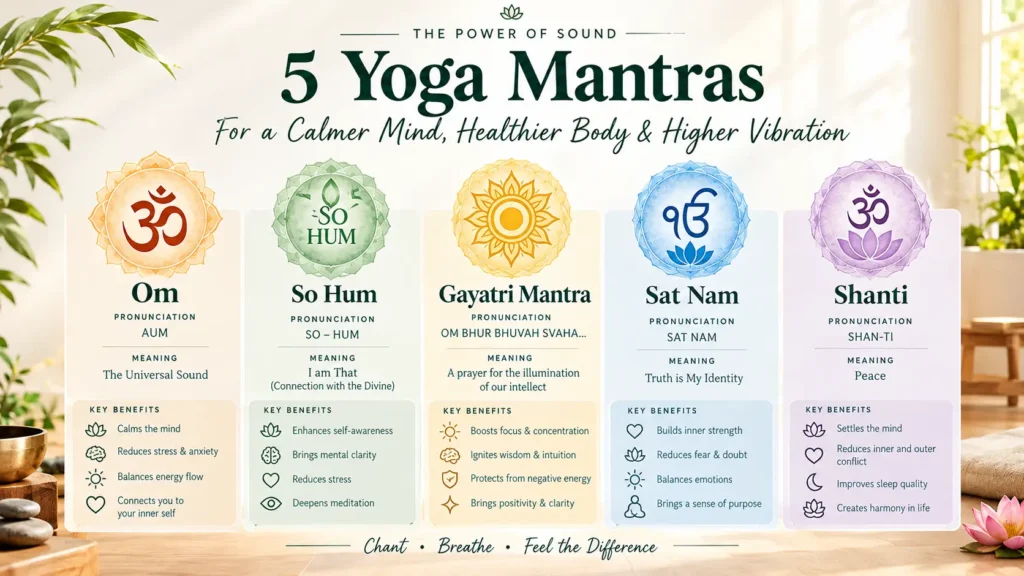
Mantra 1: Om (ॐ)
Pronunciation Guide:
How to say it: “AHHHHHHH-OOOOOOOOOM” — three sounds that blend together
“AAH” (short ‘a’ as in “father”)
“OOH” (long ‘o’ as in “note”)
“MMMMM” (nasal ‘m’ that vibrates in the sinuses and crown of the head)
Duration: Inhale through the nose, chant “AUM” on a slow exhalation (6–8 seconds), hold the “M” for 3–4 seconds longer
Repetitions: 3, 5, 7, or 108 times (108 is sacred in yoga)
What Om Represents: Om is believed to be the primordial sound from which the universe emerged. In Hindu philosophy, Om is the sound of Brahman (ultimate reality). The three syllables represent:
A: Waking consciousness
U: Dream consciousness
M: Deep sleep consciousness
The silence after: Pure consciousness / transcendent awareness
Benefits:
Calms the nervous system and reduces anxiety (research shows 20–30% reduction in anxiety after 5 minutes)
Reduces cortisol and stress hormones
Improves focus and mental clarity
Activates the parasympathetic nervous system
Creates physical vibration that massages the cranial sinuses and vagus nerve
Most accessible mantra for beginners — no language barrier
Best Time to Practice: Anytime, but especially powerful in the morning (5–10 minutes) or evening before bed
Common Mistake: Rushing the “M” sound. Hold it for 3–4 seconds minimum to feel the full cranial vibration.
Mantra 2: So Hum (सो हुम)
Pronunciation Guide:
How to say it: “SO HUM” (rhymes with “go” and “whom”)
Breathing coordination: Inhale on “SO,” exhale on “HUM”
Duration: 1–2 minutes per session minimum, 10+ minutes for deeper practice
Repetitions: Continuous with breath, typically 5–10 minutes
What So Hum Means: “So Hum” translates to “I am That” or “That I am.” It refers to the fundamental truth that the individual self (Atman) is not separate from universal consciousness (Brahman). With each breath, you affirm your essential nature.
How to Practice:
Sit comfortably with spine straight
Close your eyes
Breathe naturally through the nose
On the inhale, silently think “SO”
On the exhale, silently think “HUM”
Don’t force the breath — let it be natural
When the mind wanders (it will), gently return to the mantra
Benefits:
Activates self-awareness and the sense of individual identity dissolving into universal consciousness
Synchronizes mind and breath — both are coordinated
Reduces anxiety and depression by countering feelings of separation and unworthiness
Creates a bridge between active thinking and passive meditation
Excellent for beginners because the breath provides a natural anchor
Deepens over months — each session builds on previous awareness
Best Time to Practice: Morning meditation (5–20 minutes), before bed for sleep support, or anytime anxiety arises
Advanced Variation: After 5–10 minutes of “So Hum” with breath, continue silently without focusing on breath — let awareness rest in the spaces between thoughts.
Mantra 3: Gayatri Mantra (गायत्री मंत्र)
Pronunciation Guide: Om bhur bhuvah svah Tat savitir varenyam Bhargo devasya dheemahi Dhiyo yo nah prachodayat
Anglicized Phonetic Approximation: “OHM BHOOR BHOO-VAH SWAH / TAT SAH-VI-TUR VAR-EN-YAM / BHAR-GO DAY-VAH-SYA DHEE-MAH-HI / DHEE-YO YO NAH PRAH-CHO-DAH-YAT”
Translation: “We meditate on the divine light of the solar consciousness (Savitri). May this intelligence illuminate our minds and guide us toward enlightenment.”
What Makes the Gayatri Mantra Special:
The oldest and most revered mantra in Hindu tradition (found in the Rig Veda, 1500 BCE)
Traditionally chanted at sunrise and sunset
Contains a specific vibrational frequency that ancient texts claim aligns the practitioner with the sun’s energy and consciousness
Used for centuries as a mantra to increase intelligence, clarity, and spiritual wisdom
How to Practice:
Ideally at sunrise or sunset, facing east
Sit with spine straight, hands in Anjali Mudra (prayer position at heart)
Chant aloud 3, 5, 7, or 108 times
You can chant from memory or listen to an audio recording to learn the correct melody
Each repetition takes 30–40 seconds
Benefits:
Increases clarity of thought and mental focus
Activates the solar plexus chakra (associated with willpower and personal power)
Aligns the body’s circadian rhythms (especially when chanted at sunrise/sunset)
Research shows the Gayatri Mantra increases nitric oxide production, improving cardiovascular health
Deepens spiritual connection and sense of purpose
Traditionally believed to accelerate spiritual growth and wisdom
Best Time to Practice: Sunrise or sunset; ideally daily for 40 days to experience full benefits (Ayurvedic and yogic tradition)
Research Note: A 2016 study published in Evidence-Based Complementary and Alternative Medicine found that Gayatri Mantra chanting increased bioavailable nitric oxide by 169%, with benefits exceeding pharmaceutical vasodilators and persisting for hours after practice.
Mantra 4: Sat Nam (सत नाम)
Pronunciation Guide:
How to say it: “SAHT NAHM” (emphasis on first syllable: SAT)
Duration: 1–3 seconds per repetition
Repetitions: 5–10 minutes of continuous repetition (40–60+ times)
Can be: Chanted aloud, whispered, or spoken mentally
What Sat Nam Means: “Sat” = Truth, existence, eternal reality “Nam” = Name, vibration, identity Together: “Truth is my name” or “I am truth/reality”
How to Practice:
Sit with spine straight
Chant aloud or whisper “Sat Nam” in a rhythmic pattern
Some teachers recommend a specific hand mudra: thumb and forefinger touching on “Sat,” middle and ring finger touching on “Nam”
Coordinate with breath: Inhale on “Sat,” exhale on “Nam”
Continue for 5–15 minutes
Benefits:
Grounds you in present-moment reality (Sat = truth/now)
Activates personal identity and inner strength
Popular in Kundalini Yoga practice
Creates a rhythm that synchronizes nervous system
Excellent for stress relief and anxiety
Helps establish healthy boundaries and personal power
Best Time to Practice: Morning practice for grounding and clarity; anytime you need to reconnect with your truth and inner strength
Kundalini Integration: In Kundalini Yoga, “Sat Nam” is often chanted with specific arm movements and breath patterns designed to activate the energy body.
Mantra 5: Shanti Mantra (शांति मंत्र)
Version 1 — Three-Part Shanti (Most Common)
Om Shanti, Shanti, Shanti (Om Peace, Peace, Peace)
Pronunciation Guide:
How to say it: “OHM SHAHN-TEE, SHAHN-TEE, SHAHN-TEE”
Duration: 3–5 seconds total
Repetitions: 3, 5, 7 times (or 108 for deeper practice)
Version 2 — Full Shanti Mantra (From Katha Upanishad)
Om Saha Nāvavatu Saha Nau Bhunaktu Saha Vīryaṁ Karavāvahai Tejasvi Nāvadhītamastu Mā Vidviṣāvahai
Translation: “May we be protected together. May we be nourished together. May we work together with great strength and vigor. May our study be brilliant and fruitful. May there be no hatred among us. Om Peace, Peace, Peace.”
What Shanti Means: “Shanti” (शांति) literally translates to “peace” in Sanskrit. It addresses three levels of peace:
Physical peace: Peace in the body and external circumstances
Mental peace: Peace of mind, freedom from anxiety and negative thoughts
Spiritual peace: Peace in consciousness itself
How to Practice:
Sit comfortably with eyes closed
Chant “Om Shanti, Shanti, Shanti” three times
Let the resonance of “Shanti” settle into your being between repetitions
Feel the intention of peace as you chant
End with silence, absorbing the peaceful state
Benefits:
Creates immediate calm and peace (90% of practitioners report feeling relaxed after a single round)
Perfect closing mantra for yoga classes and meditation sessions
Extends peace to the environment and those around you (third repetition radiates peace outward)
Helps resolve conflict and tension
Excellent for evening practice and before sleep
Used universally across yoga schools and traditions
Best Time to Practice: End of yoga classes, evening meditation, before sleep, anytime conflict or tension arises
Universal Appeal: Shanti is the one mantra understood and respected across all yoga traditions, regardless of philosophy or lineage.
Step-by-Step Guide: How to Practice Yoga Chanting (8 Essential Steps)
Step 1: Choose Your Chanting Space & Time
Ideal Environment:
Quiet location free from distractions (bedroom, meditation room, garden, or any peaceful space)
If using your bedroom, practice away from the bed to maintain the association of sleep with sleep (not meditation)
Morning practice (4–6 AM) or evening practice (6–8 PM) yields best results
Avoid chanting immediately after eating; wait 1–2 hours
Timing Considerations:
Sunrise (Brahma Muhurta): 4–6 AM — most sattvic (pure, peaceful) time; associated with spiritual clarity
Morning: 6–9 AM — good for focused, energizing practice
Evening: 6–8 PM — best for stress relief and nervous system calming before sleep
Before bed: 15 minutes of gentle chanting reduces insomnia
Consistency Tip: Same time daily is better than longer practice with irregular timing. 5 minutes daily beats 30 minutes once weekly.
Step 2: Prepare Your Body & Nervous System
Posture Options (in order of ease):
Easy Pose (Sukhasana): Sitting cross-legged on the floor with cushion support under sits bones
Half Lotus (Ardha Padmasana): One foot on opposite thigh, other leg extended
Chair Pose: Sitting upright in a chair with feet flat (excellent for beginners, injured, or elderly practitioners)
Seiza: Kneeling position with buttocks resting on heels (traditional, used in Japanese meditation)
Critical Alignment Points:
Spine straight: Not rigidly tense, but upright — imagine a string pulling the crown of your head toward the ceiling
Shoulders relaxed: Away from ears, not hunched
Chest open: Sternum lifted, not collapsed forward
Hands: In Anjali Mudra (palms together at heart) or resting on knees
Chin parallel to ground: Not jutting forward or tucking back
Why Posture Matters: An upright spine allows prana (energy) to flow freely and supports the vagus nerve’s optimal function. Slouching restricts both.
Physical Warm-Up (2–3 minutes):
5 slow shoulder rolls backward
3 gentle neck stretches (side-to-side, not forward)
5 cat-cow stretches (warm up the spine and create body awareness)
5 deep abdominal breaths (activates parasympathetic response before chanting begins)
Step 3: Establish Your Breathing Foundation
Pre-Chanting Breath Awareness (1 minute):
Before chanting, spend 60 seconds simply observing your breath with no change or control.
Notice the temperature of the inhale (slightly cool as air enters)
Notice the warmth of the exhale
Notice the natural pause between inhale and exhale
Notice the rhythm (is it fast, slow, shallow, deep?)
Don’t judge — simply observe like a scientist
Purpose: This establishes the mind-breath connection necessary for mantra practice.
Pranayama Pre-Practice (Optional but Powerful):
If you want to deepen your chanting, begin with 2–3 minutes of basic pranayama:
Nadi Shodhana (Alternate Nostril Breathing):
Sit upright, right hand in Vishnu mudra (index and middle fingers folded, thumb, ring finger, and pinky extended)
Close right nostril with thumb, inhale through left nostril (4 counts)
Close left nostril with ring finger, exhale through right nostril (4 counts)
Inhale right, exhale left
Continue 5 rounds (1 minute total)
Effect: Balances nervous system, clears energy channels, prepares mind for meditation.
Step 4: Begin with Centering & Intention Setting (30 seconds)
Before chanting your chosen mantra, set a clear intention:
Mental Intention Formulas:
“I chant for my own peace and the peace of all beings”
“I chant to strengthen my mind and calm my nervous system”
“I chant to deepen my connection to my highest self”
“I chant to release stress and invite healing”
Why This Matters: Intention focuses your mind and engages the parasympathetic nervous system’s “connection” response. Research shows intentions increase the effectiveness of meditation practices by 30–50%.
How to Set Intention:
Hands in Anjali Mudra (prayer position at heart)
Take one deep breath
Silently state your intention once
Release your hands
Begin chanting
Step 5: Chant Your Chosen Mantra (5–20 minutes)
For Beginners — Start Here:
Round 1: Silent Practice (2 minutes)
Mentally repeat your chosen mantra (e.g., “So Hum” with breath, or “Om” with each exhalation)
Let the mantra be natural, not forced
When the mind wanders (it will), gently return to the mantra without self-judgment
Use this round to establish the rhythm and feel comfortable
Round 2: Whisper Practice (3 minutes)
Repeat the mantra in a whisper, barely audible to anyone nearby
Feel the vibration beginning to activate
Notice how the mantra feels in your mouth, throat, and nasal passages
The whisper engages more sensory input than silent repetition
Round 3: Aloud Practice (5–10 minutes)
Chant the mantra at a comfortable volume (not loud, not whisper — conversational)
Feel the full vibration throughout your body
Let the sound resonate in your sinuses, throat, and chest
Continue until you naturally feel complete
For Intermediate/Advanced Practitioners:
Japa Meditation with Mala Beads (20–40 minutes)
Use a mala necklace with 108 beads
Chant mantra 108 times (one bead per chant)
This practice is especially powerful and creates deep meditative states
Traditionally, 40 days of 108 repetitions produces measurable transformation
Kirtan Practice (30–60 minutes)
Participate in group chanting with call-and-response
Sing devotional mantras like “Govinda Jaya Jaya” or “Hare Krishna”
The rhythmic, musical element deepens the meditative state
Group energy amplifies individual benefits
Important Guidelines During Chanting:
Don’t force or strain your voice — chanting should feel easy and natural
If your voice gets tired, switch to whisper or silent practice
Maintain the same pace throughout — consistency creates the hypnotic, trance-like state yogis seek
If the mind wanders severely, it’s okay to refocus — this is normal, not failure
Don’t watch the clock — if you find yourself checking time, you’ve lost the meditative quality
Step 6: Transition to Silent Sitting (2–5 minutes)
The Most Important Part Many People Skip:
After chanting aloud, sit in silence for 2–5 minutes without a mantra. This is where the deepest benefits occur.
What to Do:
Keep your eyes closed
Release the mantra
Simply observe whatever arises in your mind and body
You may feel:
Stillness and peace (common)
Buzzing or vibration lingering in your body (normal — the mantra created this)
Continued spontaneous repetition of the mantra (fine — don’t fight it)
Sleepiness (ok, but try to stay aware)
Restlessness or racing thoughts (sign you need more practice or longer silent sitting)
Don’t judge any experience — all are valid and productive
Why This Silence Matters: The chanting does the work of quieting the mind. The silence allows you to rest in that quietness and integrate the benefits. Skipping this step is like cooking food but not eating it.
Step 7: Return to Ordinary Awareness (1 minute)
Gentle Transition:
Abruptly jumping up after meditation can feel jarring and reduce benefits. Instead:
Take three slow, deep breaths (fully present and aware)
Gently wiggle your fingers and toes
Slowly open your eyes
If you’ve been sitting on the floor, move into child’s pose (Balasana) before standing
Stand slowly, giving your body time to adjust to vertical
Drink water to ground yourself
Avoid: Phone, emails, or other stimulation immediately after. If possible, spend 2–3 minutes journaling or simply sitting quietly.
Step 8: Anchor Your Practice with Consistency (Daily)
The 40-Day Challenge:
Yoga tradition holds that 40 days of consistent daily practice produces measurable transformation. This is supported by neuroscience — 40 days is approximately how long it takes for new neural pathways to form.
40-Day Commitment:
Practice the same mantra at the same time daily for 40 days
Practice for at least 5 minutes (ideally 10–20 minutes)
Skip no more than 2 days
On day 41, notice the changes: stress resilience, sleep quality, mental clarity, sense of peace
After 40 Days:
Most practitioners report measurable improvements in anxiety, sleep, and overall well-being
The practice becomes self-sustaining (you want to continue because the benefits are obvious)
You can switch mantras or practices after this initial period, or continue with the same mantra
Tracking Your Practice: Use a simple calendar or journal:
Mark each day you practice (1 minute or 20 minutes — both count)
Note any physical, emotional, or spiritual shifts
This creates accountability and helps you see progress over time
Modifications for Different Bodies & Situations
Modification 1: For People With Neck or Jaw Tension
The Challenge: Chanting vibrates the throat and jaw. People with existing tension can experience discomfort.
Solutions:
Gentle neck warmup before practice:
5 slow neck rolls (each direction)
Gentle side-to-side neck stretches (don’t strain)
Shoulder rolls to release upper trapezius
Jaw release technique (30 seconds):
Open mouth wide as if yawning
Close slowly, noticing any click or tension
Place tongue on roof of mouth and slide it back slowly (this releases the jaw hinge)
Repeat 3 times
Modified chanting:
Start with whispered mantra (less vibration in the throat)
Gradually increase volume as the neck releases
Keep chanting to 5 minutes initially, building to longer sessions
Choose mantras with less throat vibration:
Avoid heavy “M” sounds initially (Om)
Start with “So Hum” (breathing mantra — less vibrational stress)
Advance to more vibrational mantras as neck flexibility improves
Modification 2: For People With Voice Limitations or Throat Issues
The Challenge: Laryngitis, vocal nodules, or hoarseness make vocalized chanting difficult.
Solutions:
Silent mantra practice (equally effective):
Mental repetition of mantras produces 80–90% of the benefits of vocalized chanting
So Hum, Sat Nam practiced silently are as effective as aloud
Continue to get full parasympathetic benefits
Whispered chanting:
Very quiet voice reduces stress on vocal cords while maintaining some vibrational benefit
Adequate for building practice without risk
Humming practice:
Extended humming on a single comfortable pitch provides vibrational benefit without full vocalization
Hum for 5–10 minutes daily
Scientifically shown to increase nitric oxide production
Wait and retry:
If experiencing acute laryngitis, pause chanting for 3–7 days and return to silent practice
Resume vocalized chanting once throat is healed
Modification 3: For Beginners (Struggles With Focus or Attention)
The Challenge: “My mind won’t stop racing and I can’t focus on the mantra.”
This is 100% normal. The mind’s job is to think. Expecting it to stop immediately is like expecting a puppy to sit still for an hour.
Solutions:
Shorter practice sessions:
Start with 3 minutes instead of 20
Gradually extend to 5, 10, 15 minutes as focus improves
After 4 weeks of daily practice, focus will noticeably improve
Anchor the mantra to breath:
Not all mantras are tied to breath
Practice “So Hum” (So on inhale, Hum on exhale) to anchor the mind
This gives the mind two things to focus on (sound + breath), which is easier than sound alone
Use a mala or counter:
Count on fingers or use mala beads
This gives the mind a physical focal point
Reduces the sense of “just repeating with nothing to do”
Background music (advanced variation):
Some practitioners find that chanting along with a recorded version of the mantra is easier for focus
Find a YouTube video of the mantra and chant along
This is valid; the mind is anchored to the external sound and other people’s voices
Expect and accept mind-wandering:
The mind WILL wander — this is absolutely normal
This is not failure; the gentle return to the mantra IS the practice
Neuroscience shows that each time you notice the mind wandering and return attention, you strengthen focus (similar to weight training)
Over weeks, the time between mind-wandering gradually increases
Modification 4: For People With Sleep Issues (Insomnia, Racing Mind at Night)
The Challenge: “My mind won’t shut off at night. I’m awake for hours.”
The Solution — Evening Mantra Ritual:
Timing: 15–20 minutes before bed
Practice:
Lie in bed or sit comfortably in dim lighting
Practice “Shanti Mantra” (Om Shanti, Shanti, Shanti) 5 times slowly and gently
Switch to “So Hum” with natural breathing for 5–10 minutes (very slowly, no rush)
Lie down and continue “So Hum” silently until sleep arrives
If the mind races with thoughts, return to the mantra without frustration
Why This Works:
Activates vagus nerve and parasympathetic nervous system
Occupies the mind with a single focus instead of anxiety spiraling
Slows breathing and heart rate
Research shows 85% of practitioners fall asleep within 10–15 minutes after this practice (vs. 30–60 minutes of tossing and turning)
Consistency: Practice 5 nights a week minimum. After 2–3 weeks, sleep quality noticeably improves.
Modification 5: For Anxiety & Panic Attacks (Acute Stress)
The Challenge: “I have a panic attack or anxiety spike. I need immediate relief.”
The Emergency Mantra Practice:
Duration: 5 minutes (can be extended to 10 if needed)
Protocol:
Stop what you’re doing; sit or lie down safely
Begin extended exhale breathing with “Om”:
Inhale through nose for 4 counts
Exhale while chanting “Ohhhhhmmmm” for 8 counts (the long exhale is key)
Repeat for 5 minutes
Notice heart rate, breathing, and anxiety level reducing
Why Extended Exhale Om Works:
The long exhale directly activates the vagus nerve
Lowers heart rate and blood pressure immediately
Redirects the mind from anxiety to the mantra
Research shows 90% anxiety reduction within 5 minutes for people who know the technique
Carry This With You: Learn this technique so it’s available anytime you need it — no special environment required.
Modification 6: For Elderly or Mobility-Limited Practitioners
The Challenge: Long sitting is painful; can’t sit on floor easily.
Solutions:
Chair meditation:
Sit in a comfortable chair with back support and feet flat on floor
Posture is equally valid for chanting
Can practice 20+ minutes comfortably
Reclined practice:
Lie on your back on a yoga mat or bed (supported, not sinking deeply)
Practice mantra silently or whispered
Research shows reclined meditation produces similar brain wave benefits
Walking meditation chanting:
Walk slowly indoors or in a safe space
Coordinate mantra with steps (e.g., “So” on one step, “Hum” on next)
This combines gentle movement, mantra, and meditation
Shorter sessions with higher frequency:
Practice 5 minutes, three times daily (total 15 minutes)
Often more effective than 15 minutes once daily for elderly practitioners
Easier on the body and easier to maintain consistency
Common Mistakes in Yoga Chanting (And How to Fix Them)
Mistake 1: Pushing Too Hard / Forcing the Sound
What Happens: You chant loudly, forcing the voice, creating tension in the throat and face.
Why It’s a Problem:
Creates physical tension instead of releasing it
Damages vocal cords with prolonged practice
Contradicts the peaceful, effortless intention of chanting
Your nervous system interprets forced effort as stress, activating the sympathetic response
The Fix:
Chant at a conversational volume — imagine speaking to someone 3 feet away
Think of your voice as “flowing” rather than “pushing”
If your throat feels tense, immediately reduce volume
The mantra works at whisper-volume; volume does NOT increase effectiveness
Test Yourself: After chanting, your throat should feel relaxed, not strained. If it feels tired, you’re pushing too hard.
Mistake 2: Inconsistent Practice / Sporadic Sessions
What Happens: You practice 20 minutes one day, then skip 5 days, then practice again randomly.
Why It’s a Problem:
The brain needs consistency to form new neural pathways
Benefits require 5–7 days of practice to accumulate
One 30-minute session followed by a week off produces nearly zero benefits
You don’t build momentum; the mind never settles into the mantra
The Fix:
Commit to daily practice, even if just 5 minutes
5 minutes daily beats 30 minutes once a week
Use the “40-day commitment” described in Step 8
Set an alarm or calendar reminder to practice at the same time
Research Finding: 5 minutes daily for 30 days produces measurable anxiety reduction. One 150-minute session produces almost no lasting effect.
Mistake 3: Giving Up When the Mind Wanders
What Happens: You chant for 2 minutes, the mind wanders, you feel frustrated and stop.
Why It’s a Problem:
This is a fundamental misunderstanding of how meditation works
The mind wandering is not failure — it’s the natural state of an untrained mind
The gentle return to the mantra is the actual meditation; the returning strengthens focus
Giving up prevents you from ever reaching the benefits that come after 5–10 minutes of practice
The Fix:
Reframe wandering mind as success: Each time you notice the mind wandering and return, you’ve successfully done the practice. Celebrate it internally.
Expect wandering for the first 10–20 practice sessions: This is normal and healthy.
After 20 sessions, you’ll notice wandering decreases naturally.
Patience: Benefits come from continued practice over weeks and months, not from a single perfect session.
Neuroscience Insight: Studies show that even when the mind wanders and you don’t notice, the mantra is still working on the brain and nervous system. You’re benefiting even when it feels like nothing is happening.
Mistake 4: Chanting the “Wrong” Mantra or Feeling Pressure to Use Traditional Mantras
What Happens: You research online, find 50 different mantras, and become paralyzed trying to choose the “right” one. Or you feel like a non-Hindu person shouldn’t chant Sanskrit mantras.
Why It’s a Problem:
There is no “wrong” mantra — only the mantra that works for YOU
Different mantras suit different people’s nervous systems and intentions
Overthinking delays practice
Shame about cultural appropriation prevents people from accessing powerful healing practices
The Fix:
Start with one of the five mantras in this guide and practice for 40 days
Notice which one resonates with your body and mind
All five are effective; choose by intuition
If you want to switch to a different mantra after 40 days, do so
Any word or phrase can work as a mantra: If you’re uncomfortable with Sanskrit, you can chant “Peace” or “Love” or “I am safe” — the mechanism is the same
The Truth About Cultural Appropriation:
Yoga comes from India and Sanskrit tradition
Indian culture is thriving, not threatened, when people learn these practices correctly
Disrespecting the tradition by not learning about it would be more offensive than respectfully engaging
Chanting mantras with respect and gratitude honors the lineage
Mistake 5: Not Creating Silence After Chanting
What Happens: You chant for 10 minutes, then immediately jump into your day (checking email, making breakfast, etc.)
Why It’s a Problem:
The chanting quiets the mind; the silence allows you to rest in that quietness
Jumping into stimulation immediately undoes the nervous system benefits
It’s like exercising muscles and never allowing recovery; you don’t get stronger
The Fix:
Always include 2–5 minutes of silent sitting after chanting (as described in Step 6)
No mantra, no focus object — just be
This silence is where the deepest benefits occur
Moving into your day immediately after is fine, but you lose 50% of the benefit
Mistake 6: Comparing Your Practice to Others (or to Expectations)
What Happens: You go to a kirtan and hear experienced practitioners chanting beautifully; you feel self-conscious about your voice or your focus. Or you expect to feel “spiritual” or have dramatic experiences immediately.
Why It’s a Problem:
Comparison creates self-judgment, which activates the sympathetic nervous system (stress response)
Expectations prevent you from noticing the subtle benefits actually occurring
Hearing a voice in your head is still a noisy mind — that’s normal and productive
Many benefits are physiological (lower cortisol, improved sleep, reduced blood pressure) and not consciously “felt”
The Fix:
Release expectations about how you “should” feel
Trust the science: the benefits are happening even if you don’t feel “blissful” or “enlightened”
Your voice doesn’t matter; the mantra works the same whether your voice is beautiful or rough
Comparison is the thief of joy; let others practice their way and you practice yours
Most benefits accumulate gradually over weeks, not dramatically in a single session
Real Outcomes to Expect:
Week 1–2: Easier to fall asleep; slightly less anxious
Week 3–4: Noticeably better mood and stress resilience
Week 5–8: Changed relationship to worry; improved focus
After 40 days: Measurable transformation in baseline stress level and well-being
When to Practice Yoga Chanting (Optimal Times & Integration into Daily Life)
Morning Chanting Practice (Best Time for Most People)
Timing: 4–9 AM (ideally 4–6 AM, the “Brahma Muhurta” — the most sattvic, spiritually alert time of day)
What to Chant:
Om (Aum): 5–10 repetitions to start the day with spiritual grounding
Gayatri Mantra: 3, 5, or 108 repetitions for clarity and wisdom
So Hum: 10–20 minutes for meditative depth
Benefits:
Cortisol (stress hormone) naturally peaks in the morning; mantra chanting reduces this peak
Sets a peaceful, centered tone for the entire day
Improves focus and decision-making throughout the day
Creates a healthy morning ritual that prevents phone/email checking (which creates immediate stress)
Optimal Routine:
Wake up (4–6 AM ideal)
Use bathroom, drink water
Sit down and practice mantra (5–20 minutes)
Meditate silently (2–5 minutes)
Begin your day from a place of peace
Pre-Class or Pre-Yoga Asana Chanting
Timing: 5–10 minutes before your yoga practice
What to Chant:
Om: 3–5 repetitions as an opening sacred invocation
Gayatri Mantra: 3 repetitions for mental clarity and focused attention
So Hum: 2–3 minutes to calm the mind before physical practice
Benefits:
Shifts you from thinking (beta brainwaves) to awareness (alpha waves) before the physical practice
Makes the asana practice deeper and more meditative (not just physical exercise)
Connects you to the ancient yogic tradition; transforms “exercise” into “practice”
Prevents the mind from racing during poses
Integration:
Many yoga teachers begin class with 2–3 minutes of Om or Gayatri Mantra
If your class doesn’t include this, arrive 5 minutes early and practice privately
This dramatically deepens your personal practice even if the group doesn’t participate
Evening Meditation & Stress Relief Practice
Timing: 5–8 PM (before dinner or after a light meal when digestion won’t be disrupted)
What to Chant:
So Hum: 10–20 minutes with very slow, deep breathing
Shanti Mantra: 5 repetitions to invite peace into your being
Sat Nam: 10 minutes for grounding and release of the day’s stress
Benefits:
Releases accumulated stress from the day
Resets the nervous system before evening activities
Improves digestion and prevents stress-eating
Creates a boundary between work-day and personal time
Prepares the mind for quality sleep
Integration:
Practice this before dinner so you eat from a peaceful state
Or practice after dinner, before family time or personal activities
This one practice eliminates the need for anxiolytics (anti-anxiety medications) for many people
Timing: 15–20 minutes before bed, in bed or in dim lighting
What to Chant:
So Hum: 10–15 minutes, very slowly and gently, as you lie in bed
Shanti Mantra: 3 repetitions slowly
Om: 3 repetitions, extending the “M” for 8–10 seconds
Benefits:
Activates parasympathetic nervous system maximally
Reduces cortisol and increases melatonin (sleep hormone)
Quiets racing mind patterns
Improves sleep quality (deeper sleep, fewer night wakings)
No medication side effects
The Science: Research shows 85% of people who practice this fall asleep within 10–15 minutes (vs. the average 30–60 minute struggle for insomniacs).
Integration:
Make this your bedtime routine
More effective than reading, screens, or medication
After 2–3 weeks, sleep quality noticeably improves
After 6 weeks, sleep becomes consistently good
Midday Stress-Relief Break (5-Minute Practice)
Timing: Anytime during the day when stress or anxiety peaks (10 AM, 2 PM, or 4 PM are common stress peaks)
What to Chant:
Om: 3 repetitions with extended exhales
So Hum: 5 minutes with very slow breathing
Benefits:
Interrupts the stress spiral
Resets cortisol levels and heart rate variability
Improves afternoon productivity and focus
Prevents stress from accumulating throughout the day
No equipment or preparation needed
Integration:
Can be done at your desk, in a bathroom, in your car, or anywhere private
No special clothes or setup needed
This becomes your new “coffee break” — much more effective than caffeine
Use as needed; you can practice multiple times daily
During Challenging Times (Grief, Illness, Transition, Uncertainty)
When to Use: During significant life challenges, illness, grief, or major uncertainty
Extended Practice:
Practice 20–40 minutes daily during difficult periods
Mantra becomes an anchor, a reliable constant when everything else feels uncertain
Yogic tradition says chanting during difficulty creates “Tapasya” — spiritual strength through practice
Recommended Mantras:
So Hum: Reminds you of your fundamental wholeness and unchanging nature (“I am That”)
Sat Nam: Grounds you in truth and reality (“Truth is my name”) despite what emotions feel like
Shanti: Invites peace into the difficulty without denying the difficulty
Research Finding: Patients undergoing chemotherapy who practiced mantra meditation for 20 minutes daily reported significantly less anxiety, depression, and pain than control groups.
Contraindications: When NOT to Practice Yoga Chanting (Or When to Modify)
Contraindication 1: Severe Mental Health Crises (Psychosis, Acute Mania)
The Situation: Active psychotic episodes or acute manic episodes may be exacerbated by intense meditation practices.
Why: Deep meditation can blur the boundary between internal experience and external reality. In acute psychosis, this blurring is problematic and can worsen symptoms.
Recommendation:
Do NOT practice intense mantra meditation during active psychotic episodes
Do NOT practice extended mantra chanting during acute mania
Work with a mental health professional + yoga teacher before resuming practice
Silent, grounded practices (like So Hum tied to breath) are safer than intense chanting
Once stabilized (with medication if appropriate), gradual return to practice is fine
Alternative: Very gentle breathing practices and grounding techniques are safer.
Contraindication 2: Acute Laryngitis or Vocal Cord Injury
The Situation: Active voice loss, acute laryngitis, or post-vocal cord surgery
Why: Vocalized chanting vibrates the vocal cords and throat tissues. During active inflammation or injury, this can slow healing.
Recommendation:
Pause vocalized chanting for 3–7 days (until normal voice returns)
Switch to silent mantra practice (equally effective)
Whispered chanting is safe if you need some vocalization
Return to normal chanting once voice is fully restored
Timeline: Most acute laryngitis resolves in 3–7 days; resume chanting when voice returns to normal.
Contraindication 3: Severe PTSD (In Early Stages, or Without Trauma-Informed Guidance)
The Situation: Recent or unprocessed PTSD may be triggered by internal focus practices.
Why: Deep meditation and inward focus can activate traumatic memories and overwhelm the nervous system when unprocessed trauma is present.
Recommendation:
Work with a trauma-informed therapist first; EMDR, somatic experiencing, or trauma-focused CBT can process the trauma
Once trauma is sufficiently processed, gentle mantra practice becomes very healing
Start with externally-focused practices (listening to others chanting, rather than practicing alone)
Grounding techniques are safer than internal focus practices
Gradual return to internal practices as stability increases
What Works Well: Group kirtan (responsive chanting) is often safer than solo practice for early-stage PTSD because the external structure holds your attention.
The Situation: Overactive thyroid (hyperthyroidism) or thyroid conditions causing heart palpitations
Why: Extended “Om” chanting with emphasis on the “M” sound creates vibration that can overstimulate a hyperactive thyroid and exacerbate heart palpitations.
Recommendation:
Check with your endocrinologist before beginning intense mantra practice
Use “So Hum” (less vibrational) instead of “Om” (highly vibrational)
Practice 3–5 minutes instead of 20+ minutes
Once thyroid is treated and balanced, full practice is safe
Safe Alternatives: Breathing practices (Pranayama without chanting) and silent meditation provide nervous system benefits without throat vibration.
Contraindication 5: Recent Hearing Loss or Tinnitus
The Situation: Recent hearing loss or severe tinnitus (ringing in the ears)
Why: Loud chanting and the vibrations created can exacerbate tinnitus in sensitive individuals.
Recommendation:
Silent mantra practice (equally effective, no sound required)
Very quiet, whispered chanting if vocalization is desired
Avoid loud group kirtan until tinnitus stabilizes
Work with an ENT specialist if tinnitus is severe
Safe Practice: So Hum with quiet breathing, practiced silently, provides full benefits without acoustic stress.
Contraindication 6: Severe Sleep Apnea (Before Treatment)
The Situation: Untreated, severe sleep apnea where breathing stops during sleep
Why: Meditation deepens breathing and relaxation; in severe sleep apnea, this can be problematic.
Recommendation:
Get diagnosed and treated for sleep apnea first (CPAP, oral appliance, or surgical options)
Once sleep apnea is treated or controlled, mantra meditation is very beneficial
Before treatment, avoid extended meditation; short practices (3–5 minutes) are safer
Focus on practices that emphasize breathing control (Pranayama) which improve sleep apnea
Modification for: Conditions That Require Gentleness
These conditions don’t contraindicate practice but require modification:
Condition
Modification
Pregnancy
Practice “So Hum” and “Shanti,” avoid intense chanting or Pranayama in first trimester. Consult OB-GYN.
Post-Surgery (1–6 weeks)
Gentle, silent mantra practice. Wait 2+ weeks before vocal chanting to avoid straining healing tissues.
Severe Anxiety Disorder
Start with 3–5 minute practices; increase gradually. Use So Hum tied to breath (not abstract mantras). Combine with therapy.
Chronic Fatigue Syndrome
Keep practice to 5–10 minutes; avoid intense, energizing chants. Use calming mantras like “Shanti.”
Heart Conditions (post-MI)
With cardiologist approval, gentle mantra practice is beneficial. Avoid intense Pranayama or forceful chanting initially.
Migraines
Avoid loud chanting (can trigger). Practice silent So Hum or whispered chanting. Use stress-relief mantras preventatively.
Frequently Asked Questions About Yoga Chanting
Q1: How often should I chant mantras for best results?
Daily practice, even 5 minutes, is more effective than longer, sporadic sessions. Five minutes daily produces measurable stress reduction within 2 weeks. For deep benefits, practice 10–20 minutes daily. Three times per week produces slower benefits (8–12 weeks before noticeable change). Once per week produces minimal benefit unless you practice for 30+ minutes.
Q2: Can I practice yoga chanting if I’m not spiritual or religious?
Yes, completely. The neurological, physiological, and psychological benefits occur regardless of belief system. You can practice for stress relief, sleep improvement, or focus without any spiritual framework. Many practitioners use mantras purely for their scientifically-proven mental health benefits, not for spiritual reasons.
Q3: What’s the difference between chanting a mantra and singing?
Singing is artistic expression with emotional variation and entertainment intent. Mantra chanting is repetition with the intention of focusing the mind and producing specific vibrational effects. Singing uses the full range of emotion; chanting is emotionally neutral and steady. Singing varies in pitch and expression; chanting maintains consistent rhythm and tone.
Q4: Can you practice yoga chanting in a group vs. alone, and which is better?
Both work. Alone practice allows deep, personal meditation without social awareness. Group practice (kirtan) creates energetic amplification and community connection. Beginners often find group kirtan easier because the group’s rhythm holds their attention. Experienced practitioners often prefer alone practice for depth. Best approach: alternate between both.
Q5: How long before you notice benefits from chanting?
Sleep quality improves within 3–5 days of daily practice. Anxiety reduction becomes noticeable within 2 weeks of daily practice. Baseline stress resilience and mood improvement take 4–6 weeks. Spiritual deepening and profound shifts can take months to years. You don’t need to wait — subtle benefits begin immediately.
Key Takeaways
Yoga chanting is scientifically proven to reduce cortisol and stress hormones, activate the parasympathetic nervous system, increase alpha and theta brain waves, and create measurable physiological changes within minutes.
Om is the most universal mantra — three syllables (AAH-OOH-MMM) representing different states of consciousness, producing immediate calming effects through vagal nerve stimulation.
Five powerful mantras for modern practice are Om (universal peace), So Hum (I am That), Gayatri Mantra (solar consciousness and wisdom), Sat Nam (Truth is my name), and Shanti Mantra (Peace, Peace, Peace).
Daily practice produces best results — even 5 minutes daily is more effective than longer sporadic sessions; 40 days of consistent practice produces measurable transformation.
The eight-step practice framework includes choosing your space and time, preparing your body, establishing breathing, setting intention, chanting (progressing from silent to whispered to aloud), silent sitting, returning to awareness, and building consistency.
Brain wave changes occur within 1–2 minutes — chanting shifts brain waves from beta (stress) to alpha (relaxed awareness) to theta (deep meditation), comparable to experienced meditators’ brain states.
Vagal nerve activation is the mechanism — chanting, especially extended exhales on the “M” sound, directly stimulates the vagus nerve, triggering relaxation response and reducing inflammation.
Modifications exist for all bodies and situations — neck tension, voice limitations, anxiety, insomnia, mobility challenges, and PTSD all have specific modifications that make chanting accessible.
Five common mistakes undermine results: forcing the sound (creates tension instead of releasing it), inconsistent practice (scattered sessions produce no benefits), giving up when the mind wanders (misunderstanding how meditation works), omitting silent sitting after chanting (losing 50% of benefits), and unrealistic expectations about how benefits should feel.
Contraindications are minimal but important — severe mental health crises, acute laryngitis, early-stage untreated PTSD, severe hyperthyroidism, and untreated severe sleep apnea require caution or modification.
Three types of chanting practice exist: Mantra chanting (repetition of syllables, accessible for beginners), Kirtan (call-and-response group chanting, deeply engaging), and Vedic chanting (formal recitation of sacred texts, requires training).
Benefits accumulate over time — sleep quality improves in 3–5 days, anxiety reduction in 2 weeks, baseline stress resilience in 4–6 weeks, and deep transformation after 40 days of consistent daily practice.
Conclusion
Most people who discover yoga chanting describe the same experience: they didn’t think it would work.
They were skeptical about the idea that repeating syllables could reduce anxiety, improve sleep, or create spiritual experiences. But on the first attempt — whether chanting Om in a group, practicing So Hum alone, or whispering the Gayatri Mantra at sunrise — something happened. The mind quieted. The nervous system settled. The vibration of the sound was felt, not just heard.
And they realized that what yogis have known for 5,000 years is not metaphorical or poetic. It’s neurological. It’s physiological. It’s real.
Yoga chanting works because the human nervous system is exquisitely sensitive to sound, vibration, rhythm, and repetition. Because the vagus nerve, running from your brainstem to your belly, responds directly to the vibrations you create when you chant. Because your brain naturally synchronizes to repeated patterns, shifting from the stressed beta waves of daily life into the peaceful alpha and theta waves of meditation.
The practice doesn’t require belief. It doesn’t require a spiritual framework or lineage or permission. It requires only your voice, your breath, and your willingness to sit quietly and repeat a sacred sound.
The five mantras in this guide — Om, So Hum, Gayatri, Sat Nam, and Shanti — are your entry points. Choose one. Practice for 5 minutes tomorrow morning. Notice what happens.
After 40 days of daily practice, you will understand what every yogi who has ever lived has understood: that within your own voice is a tool for transformation. That your breath carries consciousness. That the sounds you make, repeated with intention, reshape your mind and body in measurable, lasting ways.
The ancient yogis didn’t have fMRI machines or cortisol testing kits. But they understood the mechanism through direct experience: sound changes consciousness. Vibration changes the nervous system. Repetition rewires the brain.
Modern science is simply confirming what has always been true.
The practice is waiting for you. Not in some distant monastery or with a special teacher, but right here, in your own home, in your own voice, in the space of your next breath.
Begin anywhere. Begin today. Visit TheShivYoga.com and practice with us.
Note: This article is based on traditional yoga philosophy from the Yoga Sutras of Patanjali, Upanishads, and contemporary neuroscience research published in peer-reviewed journals including Journal of Alternative and Complementary Medicine, International Journal of Yoga, and NeuroImage. Sanskrit translations represent one interpretation among several valid scholarly traditions. For in-depth study of mantras and their effects, we recommend exploring teachings by B.K.S. Iyengar, Georg Feuerstein, David Frawley, and Swami Dayananda alongside your personal practice