

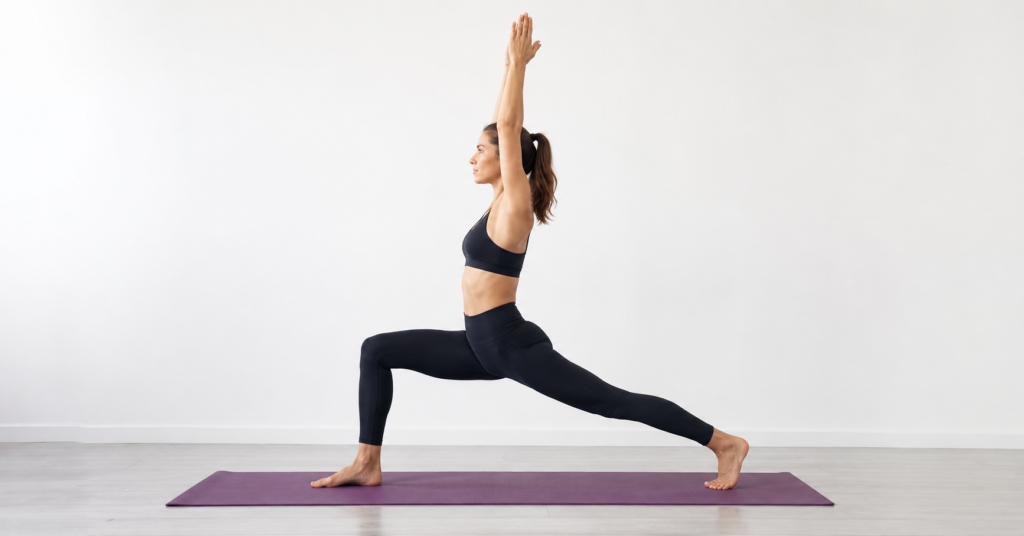
Warrior Pose 1, or Virabhadrasana I, is a foundational standing yoga pose that strengthens the legs, opens the chest and hips, and builds full-body stability. You perform it by stepping one foot back into a lunge, bending the front knee to 90°, and raising both arms overhead — holding for 5–10 breaths. It is ideal for beginners and experienced practitioners alike.
Want to build strength, open your hips, and feel grounded — all in one pose?
Warrior Pose 1 (Virabhadrasana 1) is one of the most iconic yoga postures in the world. Named after Virabhadra — a fierce warrior deity in Hindu mythology — this pose is as powerful as its origin story.
Whether you’re a complete beginner stepping onto the mat for the first time or a seasoned practitioner refining your alignment, Warrior Pose 1 delivers real results: stronger legs, better posture, deeper hip flexibility, and a sharper mind-body connection.
In this guide, you’ll learn exactly how to do Warrior Pose 1 step by step, what benefits to expect, and the key precautions to keep your practice safe and effective.
Want to practice Warrior Pose 1 with expert guidance? Explore our beginner yoga classes and start your journey today.
What is Warrior pose 1 (Virabhadrasana 1)?
Warrior Pose 1 — known in Sanskrit as Virabhadrasana I (Veer-ah-bah-DRAS-anna) — is a standing, strength-building yoga posture that belongs to the family of warrior poses (Virabhadrasana I, II, and III).
The pose is part of nearly every yoga style, including Hatha, Vinyasa, Ashtanga, and Power Yoga. It is often performed as part of the Sun Salutation B sequence.
| Feature | Details |
|---|---|
| Sanskrit Name | Virabhadrasana I |
| Type | Standing Pose |
| Level | Beginner–Intermediate |
| Hold Duration | 5–10 breaths (30–60 seconds) |
| Target Muscles | Quads, glutes, hip flexors, core, shoulders |
| Chakra Activated | Solar Plexus (Manipura), Root (Muladhara) |
The Mythology Behind Warrior Pose 1
The warrior poses are inspired by the story of Virabhadra, a powerful warrior created by Lord Shiva from a lock of his hair. Virabhadra was born to avenge an injustice — and he rose from the earth, arms raised high, ready for battle.
Warrior Pose 1 captures that exact moment: the warrior rising from the ground, strong, focused, and unstoppable.
Practicing this pose connects you not just to physical strength, but to inner courage and resilience.
How to Do Warrior Pose 1: Step-by-Step Guide
Before you begin, make sure you have a non-slip yoga mat and enough space to extend one leg behind you comfortably.
Step 1: Start in Mountain Pose (Tadasana)
Stand tall at the top of your mat. Feet together, arms by your sides, spine long. Take a few deep breaths and set your intention.
Step 2: Step Your Left Foot Back
Step your left foot back 3.5 to 4 feet. Your right foot stays facing forward. Your left foot turns out at approximately 45° (not fully sideways, not fully forward).
Step 3: Square Your Hips Forward
This is the most important alignment cue in Warrior Pose 1. Rotate your hips so both hip points face the front of the mat. Draw your left hip forward and your right hip slightly back. Use your core to maintain this squared position.
Step 4: Bend Your Right Knee
Bend your front (right) knee so it stacks directly over your right ankle — not past your toes. Aim for a 90° angle in the front leg. Your thigh should be as close to parallel to the floor as comfortable.
Step 5: Press Through Your Back Foot
Press the outer edge of your left foot firmly into the mat. Keep your back leg straight and strong — don’t let the back knee bend or the arch of your back foot collapse.
Step 6: Inhale and Raise Your Arms
On an inhale, sweep both arms up overhead. Palms face each other or touch, fingers pointing toward the ceiling. Keep your shoulders relaxed — pull them down and away from your ears.
Step 7: Lift Your Chest and Gaze Upward
Gently lift your chest and heart toward the ceiling. You can keep your gaze forward (neutral) or, if comfortable for your neck, tilt your head back slightly and gaze at your thumbs.
Step 8: Hold and Breathe
Hold the pose for 5–10 slow, deep breaths. Stay grounded through both feet. Engage your core. Soften your face.
Step 9: Release and Switch Sides
To exit: exhale, lower your arms, step your back foot forward to meet the front foot, and return to Mountain Pose. Repeat on the other side.
8 Powerful Benefits of Warrior Pose 1
1. Strengthens the Legs, Glutes, and Entire Lower Body
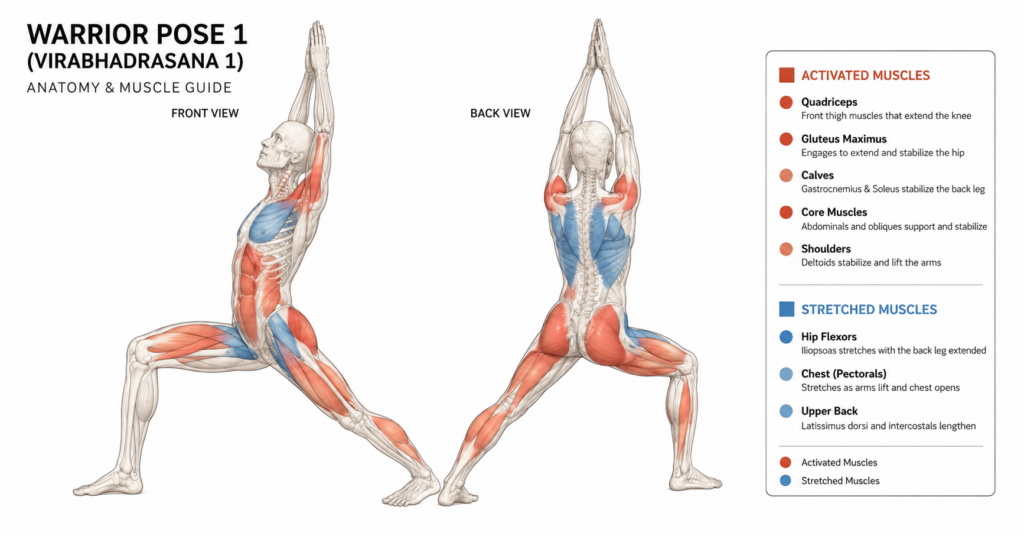
Warrior Pose 1 engages your quadriceps, hamstrings, glutes, calves, and ankles simultaneously — making it one of the most effective lower-body strengtheners in yoga. The front leg works hard to maintain the 90° bend, while the back leg presses firmly into the mat to hold the stance.
Beyond raw strength, this pose also tones the thighs, calves, and ankles and builds real endurance. Over time, the consistent muscular demand helps stabilize the joints of the entire leg and develops the kind of functional strength that supports everyday movement.
2. Improves the Respiratory System and Lung Capacity
When you raise both arms overhead and lift your chest in Warrior Pose 1, a deep stretch travels from the fingertips all the way down through the chest and diaphragm. This expansion activates the respiratory muscles in a unique way — the diaphragm is required to work more actively, causing it to contract and release more fully with each breath.
As a result, fresh air circulates more efficiently through the lungs, the windpipe stays clear, and oxygen flow to the blood improves. With regular practice, breathing becomes slower, deeper, and more conscious — a foundation of good health and stress reduction. This active respiratory engagement also makes Warrior Pose 1 particularly beneficial for those prone to allergies or mild breathing difficulties.
3. Improves the Circulatory System and Heart Health
The combination of deep breathing and full-body engagement in Warrior Pose 1 sends fresh oxygen into the bloodstream in higher quantities. As air flows in through the nasal passages and exerts pressure on the diaphragm, the heart responds by pumping more actively — increasing blood circulation throughout the body.
This enhanced circulatory activity supports better metabolism and hormone regulation. An active circulatory system ensures that oxygen and nutrients reach every cell efficiently, which contributes to overall vitality, faster recovery, and a more balanced internal environment. The pose is especially valuable for people who lead sedentary lifestyles and need gentle cardiovascular stimulation.
4. Calms the Mind and Reduces Mental Stress
In today’s world, mental stress has become one of the most common health challenges people face. Warrior Pose 1 is a powerful antidote. Named after Virabhadra — the celestial warrior — this posture embodies courage, grace, and resilience, and that energy translates directly into your mental state as you hold it.
The focused breathing required in the pose activates the parasympathetic nervous system, gently shifting the body out of “fight or flight” mode and into a state of calm alertness. Holding the warrior stance with intention builds mental stability and emotional grounding, making it as much a mindfulness practice as a physical one.
5. Opens the Hip Flexors and Improves Full-Body Flexibility
The deep lunge position creates a powerful stretch for the hip flexors of the back leg — muscles that are chronically tight in people who sit for long hours. This release is one of the most significant physical benefits of regular Warrior Pose 1 practice.
Over time, the pose delivers a progressive, full-body stretch that gradually improves overall flexibility. The chest, shoulders, neck, back, thighs, and calves all experience lengthening in a single hold. This developing flexibility doesn’t just feel good — it directly enables you to access deeper, more advanced yoga postures with greater ease and safety.
6. Acts as Therapeutic Support for Specific Conditions
Warrior Pose 1 is recognized in traditional yoga as having therapeutic value for conditions including asthma, sciatica, and insomnia.
For asthma, the diaphragmatic expansion that occurs in the pose helps the respiratory system function more effectively, making breathing more efficient over time. For sciatica, the hip flexion, spinal lengthening, and activation of the leg muscles work together to support the sciatic nerve pathway and relieve compression. For insomnia, the stamina, stability, and inner focus cultivated through the pose help settle an overactive nervous system — and the conscious breathwork builds the kind of physical tiredness that leads to restful sleep. New energy and vitality are transmitted through the body with each practice session.
7. Builds Confidence, Stability, and Mental Strength
It is no coincidence that this pose is named after a warrior. Practicing Virabhadrasana I consistently builds not just physical stamina but inner confidence and a sense of empowerment. The act of holding a strong, expansive stance — even when the muscles challenge you — cultivates mental resilience and willpower.
The pose also improves balance and body awareness (proprioception), challenging the stabilizing muscles around the ankles, knees, and hips. This enhanced stability carries into daily life: better posture, more confident movement, and a stronger sense of groundedness in challenging situations.
8. Supports Digestion and Internal Organ Health
With regular practice of Warrior Pose 1, the muscles of the lower abdomen and the organs of the digestive and reproductive systems begin to work more effectively. The engaged core, combined with the deep breath work and hip activation, gently stimulates the abdominal organs — improving peristalsis (the movement that pushes food through the digestive tract) and relieving common digestive complaints.
The pose activates the Solar Plexus Chakra (Manipura), which in yogic tradition governs energy, confidence, and metabolism. This internal stimulation supports better nutrient absorption, reduces bloating, and over time, contributes to a more balanced and well-functioning digestive system.
Common Mistakes to Avoid in Warrior Pose 1
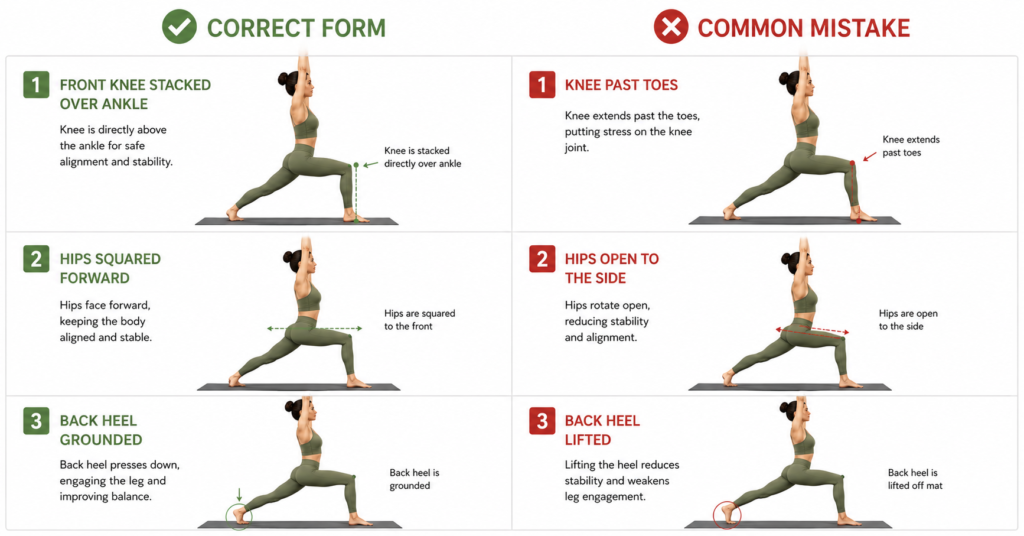
Even experienced practitioners fall into these patterns. Watch for them in your practice:
❌ Front Knee Collapsing Inward Keep your front knee tracking directly over your second toe. Press the outer edge of your foot down and engage the glute.
❌ Back Heel Lifting Off the Mat Your back heel should stay grounded. If it lifts, shorten your stance slightly. Use a wall for support if needed.
❌ Hips Not Squared This is the defining challenge of Warrior 1 vs. Warrior 2. Actively rotate your back hip forward and your front hip slightly back. A yoga block under your back heel can help.
❌ Shoulders Creeping Up to Ears Actively pull the shoulder blades down and apart. Think: “long neck, open chest.”
❌ Overarching the Lower Back Engage your core and slightly tuck your tailbone to prevent excessive lumbar compression.
Modifications for Beginners
Not quite there yet? These modifications make Warrior Pose 1 accessible for everyone:
- Shorter stance: Reduce the distance between your feet if your hips feel tight.
- Arms at shoulder height: Instead of reaching fully overhead, keep arms at a T-shape or place hands on your hips.
- Back heel at the wall: Press your back heel against a wall for extra support and stability.
- Chair-assisted: Perform the pose next to a chair, resting one hand on the backrest for balance.
- Yoga block under back heel: Slightly elevate the back heel to ease the calf and Achilles stretch.
Variations to Explore After Mastering Warrior 1
Once Warrior Pose 1 feels stable and comfortable, explore these natural progressions:
| Variation | What It Adds |
|---|---|
| Warrior Pose 2 (Virabhadrasana II) | Opens the hips laterally, deepens thigh engagement |
| Warrior Pose 3 (Virabhadrasana III) | Adds a strong balance challenge, full-body integration |
| Crescent Lunge (Anjaneyasana) | Similar shape with back heel lifted, deeper hip flexor stretch |
| Humble Warrior | Arms interlaced behind, torso folds inside front thigh |
| Reverse Warrior | Back arm drops to back leg, front arm rises — side body stretch |
Precautions and Contraindications
Warrior Pose 1 is generally safe for most people, but certain conditions require caution or modification.
Be Cautious If You Have:
High blood pressure: Avoid fully raising arms overhead. Keep them at shoulder height or place hands on hips. The raised arm position can temporarily increase blood pressure.
Neck problems: Keep your gaze forward (neutral) rather than tilting the head back. Never force the neck into discomfort.
Knee injuries: Ensure the front knee never goes past the toes. Consider shortening your stance. Avoid the pose during active knee inflammation.
Hip or sacroiliac joint issues: Squaring the hips can stress the SI joint. Work with a qualified yoga teacher to modify the hip alignment if you have SI joint instability.
Heart conditions: Practice under the supervision of a qualified yoga teacher and in consultation with your healthcare provider.
Pregnancy: Generally considered safe in early pregnancy with modifications. Widen the stance for stability. Consult your midwife or doctor and practice with an experienced prenatal yoga instructor.
When to Skip the Pose Entirely:
- Recent knee, hip, or shoulder surgery
- Acute lower back injury or disc herniation (unless cleared by a physiotherapist)
- Severe vertigo or balance disorders
Always listen to your body. Yoga is not about pushing through pain — it’s about finding strength within your limits.
How Long Should You Hold Warrior Pose 1?
For most practitioners, holding Warrior Pose 1 for 5 to 10 full breaths on each side is ideal. This equals approximately 30–60 seconds per side.
As your strength builds, you can extend the hold. In some advanced practices, the pose is held for up to 2–3 minutes per side to deeply develop endurance and focus.
Warrior Pose 1 in a Yoga Sequence
Warrior Pose 1 naturally fits in the middle of a standing yoga sequence. Here is a simple beginner flow:
- Mountain Pose (Tadasana) — 5 breaths
- Standing Forward Fold (Uttanasana) — 5 breaths
- Low Lunge (Anjaneyasana) — 5 breaths per side
- Warrior Pose 1 (Virabhadrasana 1) — 5–8 breaths per side
- Warrior Pose 2 (Virabhadrasana II) — 5 breaths per side
- Triangle Pose (Trikonasana) — 5 breaths per side
- Child’s Pose (Balasana) — rest and restore
What you need to know before doing this asana
Yoga is practiced early in the morning, but if you are not going to get up early, the next best time to practice yoga is in the evening.
It is necessary that your stomach and your bowels are empty before you perform Virabhadrasana. Ensure a four to six-hour gap between your meal and exercise so that the food is fully digested and you are energetic for the workout.
Before doing this asana you should know
Level: Beginners
Style: Vinyasa
Duration: 20 seconds on each leg
Repetition: 1
Firmness: ankle, thigh, shoulder, calf, arms, back
Stretch: ankle, navel, groin, throat, shoulder, lungs, calf, thorax, neck.
Preparatory Poses
- Supta Virasana (Reclined Hero pose,)
- Upavistha Konasana (Wide-angle seated forward bend)
- Adho Mukha Svanasana (Downward Dog Pose)
- Utthita Parsvakonasana (Extended side angle pose)
- Supta Padangusthasana (Reclining Hand to Big Toe Pose)
- Parivrtta Parsvakonasana (Revolved side angle pose)
- Virabhadrasana II (Warrior 2 pose,)
- Vrikshasana (Tree Pose)
- Gomukhasana (Cow Face Pose)
- Virasana (Hero Pose)
Conclusion
Warrior Pose 1 is more than a yoga posture — it’s a practice in courage, strength, and presence.
Every time you plant your back foot, square your hips, and reach your arms toward the sky, you embody the spirit of Virabhadra: grounded yet powerful, stable yet expansive.
The beauty of this pose is its accessibility. Whether you’re on your first yoga mat or your thousandth, there is always something new to discover in Warrior Pose 1 — a deeper hip opening, a steadier breath, a quieter mind.
Be patient with your body. Honor your limits. And return to this pose again and again, because the warrior inside you is always worth cultivating.
Ready to rise? Your mat is waiting.
Start Your Yoga Journey with TheShivYoga →
FAQ Section
Q1: Is Warrior Pose 1 suitable for complete beginners?
Ans: Yes. Warrior Pose 1 is considered a beginner-friendly pose. With the modifications listed — shorter stance, arms at shoulder height, or using a chair for support — nearly anyone can start practicing it safely. Focus on alignment over depth.
Q2: What is the difference between Warrior Pose 1 and Warrior Pose 2?
Ans: The key difference is hip orientation. In Warrior Pose 1, the hips face forward (squared to the front). In Warrior Pose 2, the hips open sideways toward the long edge of the mat. Both poses have the front knee bent, but the arm and gaze positions differ as well.
Q3: How often should I practice Warrior Pose 1?
Ans: Practicing Warrior Pose 1 three to five times per week is excellent for building strength and flexibility. It can be included in daily yoga flows or performed on its own as part of a targeted leg and hip workout.
Q4: Why do my hips not fully square in Warrior Pose 1?
Ans: Tight hip flexors, hip rotators, or a too-wide stance are the most common reasons. Try shortening your step, placing a block under your back heel, or doing preparatory hip-opener stretches before the pose. Consistency over weeks will create measurable improvement.
Q5: Can Warrior Pose 1 help with lower back pain?
Ans: Warrior Pose 1 can help some types of lower back pain by strengthening the core, glutes, and hip flexors that support the lumbar spine. However, if you have an acute back injury, consult a physiotherapist or yoga therapist before practicing. Always avoid any position that aggravates your pain.
Key Takeaways
- Warrior Pose 1 (Virabhadrasana 1) is a foundational standing yoga pose suitable for beginners and beyond.
- The pose strengthens legs, glutes, and core while opening the chest, hips, and shoulders simultaneously.
- The most important alignment cue is squaring the hips forward — this defines Warrior 1 and separates it from Warrior 2.
- Hold for 5–10 breaths per side, three to five times per week for best results.
- Avoid the pose during acute knee, back, or hip injuries. Use modifications freely — yoga meets you where you are.
- The pose carries mythological power: it represents the warrior rising from the earth — bold, focused, and undefeated.
Disclaimer: This article is for informational purposes only and does not constitute medical advice. Always consult a qualified healthcare provider before beginning any new exercise program, particularly if you have pre-existing health conditions or injuries.

