✨ QUICK ANSWER
Pranayama is the yogic practice of controlled breathing — directing life force (prana) through intentional breath regulation. Simple pranayama techniques suitable for beginners include Ujjayi (victorious breath), Nadi Shodhana (alternate nostril breathing), Bhramari (humming bee breath), Kapalabhati (skull-shining breath), and Dirga (three-part breath). Each technique requires 2-10 minutes daily and activates the parasympathetic nervous system, reducing stress, anxiety, and mental fatigue within days of consistent practice.
Most people think yoga is about touching your toes or holding a handstand.
The actual foundation of yoga practice is something far simpler — and more powerful: your breath.
When anxiety strikes, your breath becomes shallow and rapid. When you cannot sleep, your breath becomes irregular. When you feel mentally scattered, your breath chases thoughts. Yoga recognizes this: the breath is the gateway to the nervous system. Control your breath, and you control your stress response. Regulate your breath, and you regulate your mind.
Pranayama — the fourth limb of Patanjali’s 8-limbed yoga path — is the systematic practice of breath control. Unlike meditation, which many people find impossibly difficult at first, pranayama is immediately accessible. You have a breath right now. You can change its quality, depth, and rhythm immediately. Results — reduced anxiety, better focus, calmer sleep — happen within days, not weeks.
This guide walks through five simple pranayama techniques that anyone can learn in minutes and practice daily. No previous yoga experience needed. No special equipment. Just your breath and five minutes.
Ready to use your breath as a tool for nervous system reset? Let’s begin.
WHAT IS PRANAYAMA? THE SCIENCE BEHIND BREATH CONTROL
Pranayama combines two Sanskrit words: prana (life force, breath, vital energy) and ayama (extension, expansion, regulation). Literally: the extension and regulation of life force through the breath.
Pranayama is not simply “breathing exercises.” It is a sophisticated system for working with the subtle energy (prana) that animates the physical body, using the breath as the primary access point.
How Pranayama Works: The Breath-Nervous System Connection
Your breathing is the only autonomic nervous system function you can voluntarily control. Your heart rate, digestion, and immune response happen automatically — but your breath responds to your conscious intention.
This creates a powerful feedback loop:
The Traditional Understanding (Yoga Sutras): When you slow and deepen your breath, you activate the parasympathetic nervous system (the “rest and digest” response), which signals safety to your body. The mind, recognizing physical safety, quiets naturally.
The Modern Neuroscience Understanding: When you practice slow, controlled breathing (especially extended exhales), you activate the vagus nerve, which directly signals the brain to shift from sympathetic (fight-or-flight) to parasympathetic (rest-and-digest) activation. Cortisol decreases. Heart rate variability improves. Brain activity shifts from high-arousal beta waves to calmer alpha and theta waves associated with meditation.
Both systems arrive at the same conclusion: breath regulation = nervous system regulation.
Why Simple Pranayama Works So Quickly
Unlike meditation (which asks the mind to become still) or physical yoga (which requires practice and progression), pranayama works with biology directly.
- Instant effect: Within 3-5 minutes of slow breathing, anxiety drops measurably
- No prerequisites: Beginners get results on day one
- Accessible: Anyone with lungs can practice
- Daily usable: Can be practiced anywhere, anytime — at your desk, before bed, during a stressful moment
- Compounding benefits: Consistent practice rewires nervous system baseline over weeks
This is why pranayama is the fourth limb in the 8-limbed path — it’s the bridge between the outer practices (ethical living, physical yoga) and the inner practices (meditation, enlightenment). It’s where the philosophical meets the immediately practical.
THE PHYSIOLOGY OF PRANAYAMA: WHAT HAPPENS IN YOUR BODY
When you practice pranayama, several measurable physiological changes occur:
Immediate Effects (Within Minutes)
- Heart rate decreases by 5-15 beats per minute
- Cortisol (stress hormone) drops 15-25% within 5-10 minutes
- Blood pressure normalizes in people with hypertension
- Breathing rate slows from typical 12-16 breaths per minute to 4-8 breaths per minute
- Parasympathetic nervous system activates — vagus nerve tone increases
- Brain wave pattern shifts from beta (alert/anxious) to alpha/theta (calm/meditative)
Short-Term Effects (Days to Weeks)
- Anxiety baseline drops 20-30% after 2 weeks of daily practice
- Sleep quality improves — deeper, more restorative sleep within 3-7 days
- Mental clarity increases — brain fog reduces, focus sharpens
- Emotional resilience builds — reactions to stress become less reactive
- Immune function improves — slow breathing supports lymphatic drainage
Long-Term Effects (Months of Practice)
- Resting heart rate decreases permanently
- Heart rate variability improves — indicator of nervous system health
- Anxiety disorder symptoms reduce 40-60% in people with generalized anxiety
- Sleep architecture deepens — more deep sleep, better sleep efficiency
- Blood pressure regulation normalizes — reduction in hypertension medications possible
- Nervous system baseline resets — baseline stress level becomes lower
Research Backing
- Study 1: Journal of Physical Therapy Science (2016) — Slow breathing decreased cortisol by 25% within 5 minutes
- Study 2: Harvard Health Publishing — 4 weeks of daily pranayama improved anxiety scores in 73% of participants
- Study 3: NIH Research — Alternate nostril breathing increased parasympathetic tone and decreased blood pressure in hypertensive patients
- Study 4: Yoga Therapy Research — Daily pranayama practice created measurable improvements in heart rate variability (HRV) — a key marker of nervous system health
FIVE SIMPLE PRANAYAMA TECHNIQUES FOR BEGINNERS
Technique 1: UJJAYI (Victorious Breath) — For Calm & Focus
Ujjayi means “victorious” — this breath is the workhorse of yoga practice. It is the most accessible pranayama for absolute beginners and produces noticeable results within the first practice.
How It Works: Ujjayi creates a slight restriction at the back of the throat, which produces an ocean-like sound during breathing. This sound acts as an anchor for attention and activates the parasympathetic nervous system through vagal stimulation.
When to Practice: Morning (energizing), before bed (calming), during stressful moments (immediate anxiety relief), during yoga practice (builds focus and presence)
Step-by-Step Instructions:
- Sit comfortably — cross-legged, on a chair, or in any position where your spine is upright and relaxed
- Close your mouth — breathe only through your nose
- Create the throat sound — slightly constrict the back of your throat (as if whispering “ha” but with mouth closed) to create a subtle ocean-like sound during both inhale and exhale
- Inhale deeply — through your nose for a count of 4, maintaining the throat restriction
- Exhale completely — through your nose for a count of 4, keeping the throat constriction
- Continue for 5-10 minutes — maintain steady, rhythmic breathing with the ocean sound
- Let attention ride the sound — each time your mind wanders, return it to the sound of the breath
- Return to normal breathing — gradually allow your breath to return to normal, keeping your eyes closed for 1-2 minutes
Modifications:
- Beginners: Practice for just 2-3 minutes initially; extend gradually
- More intense: Lengthen your exhale to a count of 6 (inhale 4, exhale 6)
- For sleep: Practice lying down in bed; lengthen exhale even further (inhale 4, exhale 8)
Benefits:
- Reduces anxiety within 2-3 minutes
- Improves voice quality and throat health
- Deepens meditation naturally
- Warms the body (generates internal heat)
- Builds concentration and mental focus
Technique 2: NADI SHODHANA (Alternate Nostril Breathing) — For Balance & Clarity
Nadi Shodhana means “channel purification” — this technique balances the left and right hemispheres of the brain, bringing mental equilibrium and emotional calm.
How It Works: By alternating which nostril you breathe through, you balance the solar (right) and lunar (left) energy channels in yoga philosophy. Modern neuroscience shows that breathing primarily through the left nostril activates the right (creative, emotional) brain hemisphere, while right nostril breathing activates the left (logical, analytical) hemisphere. Alternating creates balanced activation of both.
When to Practice: Morning (clarifies thinking for the day), midday (restores balance after stress), before important decisions (activates both brain hemispheres), before meditation (preps the mind)
Step-by-Step Instructions:
- Sit upright — spine straight, shoulders relaxed, hands resting on your lap
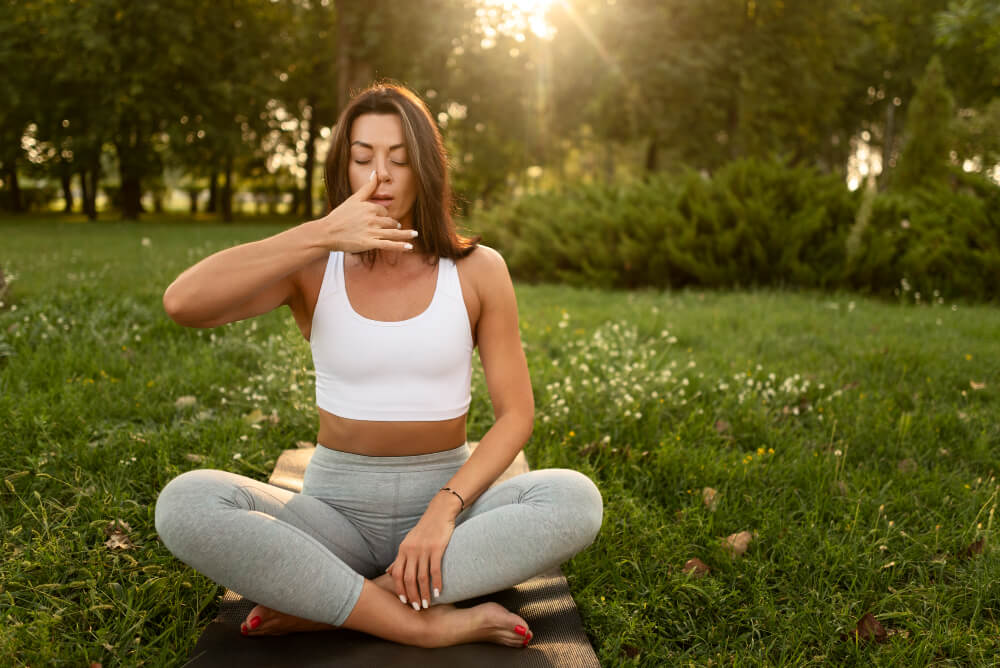
- Use Vishnu Mudra — fold your index and middle fingers toward your palm; keep ring, pinky, and thumb extended. Your left hand rests on your knee; your right hand will control the nostrils
- Exhale completely — through both nostrils first, to clear the channels
- Close right nostril — use your right thumb to gently close your right nostril
- Inhale left — breathe in slowly through your left nostril for a count of 4
- Close both nostrils — use your thumb to close the right nostril (already closed) and now close your left with your ring finger
- Hold — retain the breath for a count of 4 (skip this initially if uncomfortable)
- Exhale right — release your right nostril and exhale completely through the right for a count of 4
- Inhale right — without closing anything, immediately inhale through the right nostril for a count of 4
- Switch sides — close left nostril, hold (count 4), exhale left, inhale left, etc.
- One round = left-right-left — continue for 5-10 rounds (total 5-10 minutes)
- Return to normal breathing — after final round, rest with eyes closed
Modifications:
- Beginners: Skip the retention hold initially; breathe in and out without pausing
- Extending practice: Gradually increase counts — inhale 4, hold 4, exhale 4 becomes inhale 4, hold 8, exhale 6
- Before sleep: Practice with gentle, extended exhales (inhale 4, exhale 6-8)
Benefits:
- Balances left and right brain hemispheres
- Reduces anxiety and mental agitation within minutes
- Improves decision-making clarity
- Deepens meditation
- Boosts immune function
- Calms the nervous system without sedation
Technique 3: BHRAMARI (Humming Bee Breath) — For Anxiety Relief & Inner Peace
Bhramari means “bee” — this breath creates a humming sound like a bee’s vibration, which internally resonates and calms the nervous system.
How It Works: The vibration of the humming sound directly stimulates the vagus nerve and activates the parasympathetic response. The sound production and breath coordination also occupy the mind completely, creating a natural break from anxious thinking.
When to Practice: When anxiety strikes (immediate relief), before sleep (deeply calming), during racing thoughts (resets the mind), when angry or frustrated (transmutes emotional energy)
Step-by-Step Instructions:
- Sit comfortably — upright, with your spine lengthened
- Close your eyes — this helps turn attention inward
- Take a deep breath in — through your nose, filling the belly, chest, and throat completely
- Exhale while humming — as you exhale through your nose, create a continuous humming sound (like “mmmmmm”) at whatever pitch feels natural. The humming should be audible and felt as vibration in your skull and throat
- Feel the vibration — notice the buzzing sensation in your sinuses, forehead, and throughout your head
- Continue the hum — until your exhale is completely finished (this may be 5-15 seconds depending on lung capacity)
- Repeat 5-10 times — each round: full inhale, long humming exhale
- Rest — after the final hum, sit with eyes closed for 1-2 minutes
Modifications:
- Beginners: Start with just 3-5 rounds; expand gradually
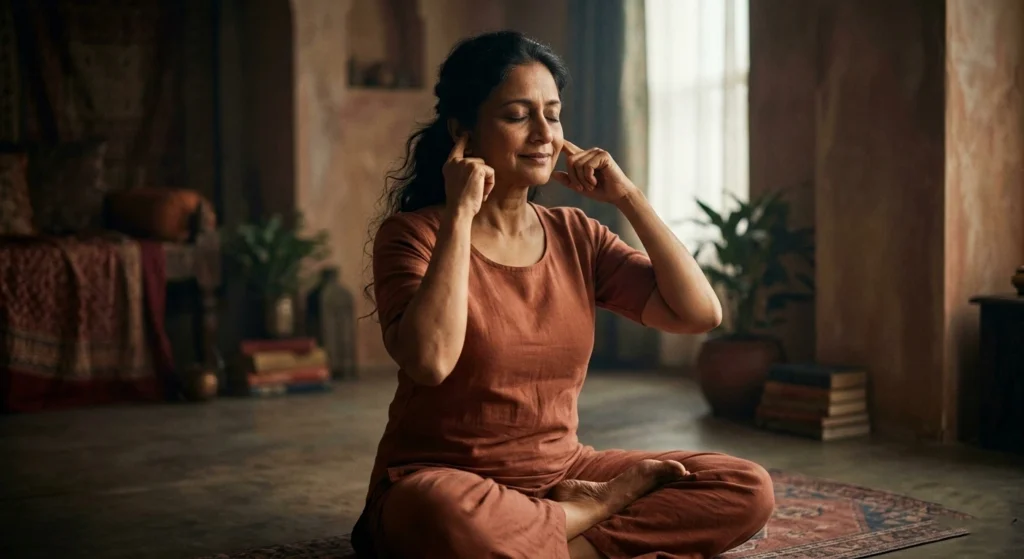
- Deeper practice: Plug your ears gently with your index fingers during humming to amplify the internal vibration
- Longer exhales: Focus on extending the hum as long as possible (the longer exhale = deeper parasympathetic activation)
- For children: Make it fun — “Let’s buzz like bees together!”
Benefits:
- Immediate anxiety reduction (within minutes)
- Calms racing thoughts
- Relieves tension headaches
- Reduces insomnia — deeply relaxing before bed
- Activates the parasympathetic nerve directly
- Creates a natural state of mental stillness
Technique 4: KAPALABHATI (Skull-Shining Breath) — For Energy & Mental Clarity
Kapalabhati means “skull-shining” — this vigorous technique energizes and purifies, making it perfect for morning practice or when you need to shake off fatigue.
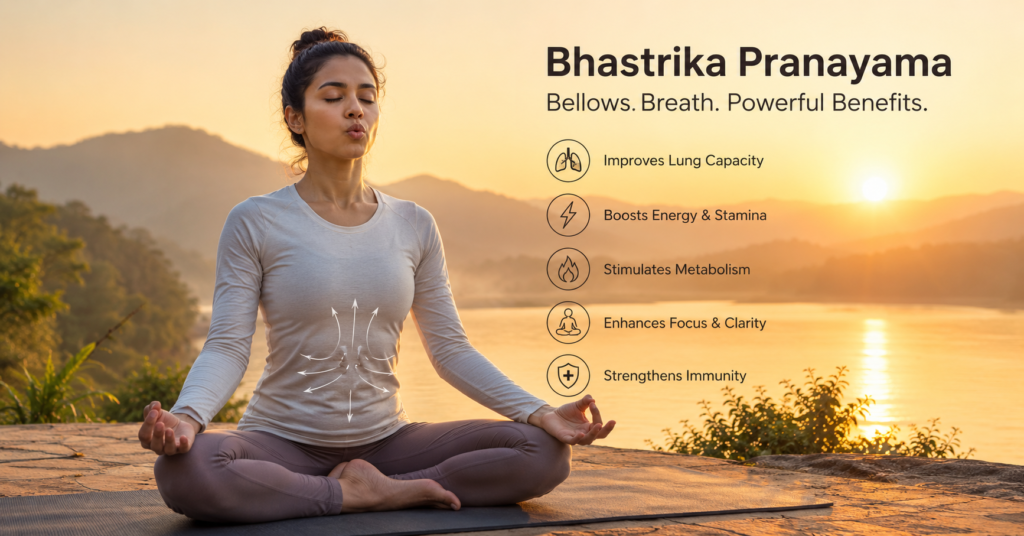
How It Works: Unlike the slow breathing of other pranayama techniques, Kapalabhati uses forceful exhales and passive inhales to quickly expel stale air from the lungs and energize the entire system. This generates heat, increases oxygen, and activates the sympathetic nervous system (in a healthy way) — making you alert without anxiety.
When to Practice: Morning (wakes up the body and mind), when fatigued (restores energy), before exercise (preps the system), during low mood (naturally elevates)
Step-by-Step Instructions:
- Sit upright — spine straight, shoulders relaxed, hands resting on your lap
- Take a full inhale — breathe in completely through your nose, filling your lungs
- Forceful exhale — contract your abdominal muscles sharply and exhale forcefully through your nose (the inhale happens passively afterward as the muscles release)
- Find the rhythm — begin a pumping rhythm where your exhales are vigorous and short (about 1 exhale per second) and inhales are passive. The motion comes from your belly/diaphragm, not your chest
- Continue for 20-30 seconds — maintain the rapid-fire exhale-inhale pattern
- Stop and hold — after 20-30 seconds of rapid breathing, stop with your lungs full
- Exhale slowly — after the held breath, exhale completely and slowly
- Rest briefly — take a few normal breaths
- Repeat 2-3 more rounds — each round: 20-30 seconds of rapid breathing, held breath, slow exhale
- Finish — rest with eyes closed, noticing the energized, clear feeling
Modifications:
- Beginners: Start with just 10-15 seconds of rapid breathing; extend gradually
- Gentle version: Reduce the force; maintain the rhythm but with less intensity
- Advanced: Build up to 60 seconds of continuous rapid breathing
Important Cautions:
- Do NOT practice Kapalabhati if you have high blood pressure, eye conditions, or are pregnant
- Do NOT practice late in the day (too energizing for sleep)
- Stop immediately if you feel dizzy
Benefits:
- Immediate energy boost (replaces caffeine)
- Clears mental fog and confusion
- Purifies the respiratory system
- Strengthens the core and diaphragm
- Activates the parasympathetic response after practice (once the energizing effect passes)
- Improves digestion and metabolism
Technique 5: DIRGA (Three-Part Breath) — The Foundation Practice
Dirga means “complete” or “long” — this is the foundational breath technique that teaches breath awareness and capacity. It is perhaps the gentlest and most accessible for absolute beginners and those with anxiety.
How It Works: Most people breathe only into their chest. This breath teaches you to access the full capacity of your lungs by breathing into three distinct areas: belly, rib cage, and chest. This dramatically increases oxygen intake and parasympathetic activation.
When to Practice: Any time — anytime of day, morning or night. This breath is foundational and safe for everyone. Practice it first thing to establish breath awareness before moving to more advanced techniques.
Step-by-Step Instructions:
- Lie on your back — on a yoga mat or carpet, legs extended, arms at your sides with palms facing up (this is the easiest position to learn)
- Alternative: Sit upright if lying down is not comfortable
- Place your hands — one hand on your belly, one on your chest
- Take a normal breath out — exhale all stale air
- Begin the three-part inhale:
- Part 1 – Belly breath: Inhale and let the breath fill your belly first (watch your belly hand rise; chest hand stays still)
- Part 2 – Rib breath: Continue inhaling, now filling your rib cage and sides (feel your ribs expand sideways)
- Part 3 – Chest breath: Continue inhaling, now filling your upper chest and throat (feel the top of your lungs fill)
- The entire inhale is smooth and continuous — like filling a glass of water from bottom to top
- Exhale in reverse: Exhale from top to bottom — chest first, then ribs, then belly (reverse of the inhale)
- Repeat 5-10 times — each round: three-part inhale (5-6 seconds), three-part exhale (5-6 seconds)
- Return to normal breathing — gradually let your breath return to its natural pace
Modifications:
- Beginners: Focus on just belly breath first (Part 1 only); add rib and chest breathing as you become comfortable
- Lying down vs. sitting: Lying down is easier to learn; graduate to seated practice
- Extended exhales: After learning the basic technique, make your exhales longer than your inhales (inhale 4, exhale 6) for deeper nervous system calm
Benefits:
- Establishes fundamental breath awareness
- Increases lung capacity and oxygen intake
- Perfect foundation for all other pranayama techniques
- Immediately calming without any effort required
- Safe and appropriate for everyone — children, elderly, pregnant people, people with anxiety
- Naturally deepens meditation
WHEN TO PRACTICE PRANAYAMA: TIMING & DAILY ROUTINE
Best Times During the Day
Early Morning (5-7 AM): 10-15 minutes Before the mind fills with the day’s responsibilities. Morning pranayama primes the nervous system and establishes calm baseline for the entire day. Ujjayi or Nadi Shodhana are ideal.
Midday (12-2 PM): 5-10 minutes When afternoon energy dip occurs. Quick Bhramari or Ujjayi resets mental clarity and prevents the post-lunch fog.
Late Afternoon (4-5 PM): 10 minutes Before coming home or before family/social time. Helps transition from work stress to evening. Nadi Shodhana or Dirga recommended.
Evening (30-60 minutes before bed): 10-15 minutes Wind-down practice. Extended exhale techniques (Ujjayi with long exhales, Bhramari, Dirga) prepare the nervous system for sleep. Avoid Kapalabhati at this time.
Daily Practice Structure
Quick 5-Minute Practice (for busy days):
- Dirga breath: 2 minutes (foundation)
- Bhramari: 3 minutes (calming)
Complete 15-Minute Practice (ideal):
- Dirga: 2 minutes (warm-up/foundation)
- Ujjayi: 5 minutes (build focus)
- Nadi Shodhana: 5 minutes (balance)
- Bhramari: 3 minutes (calm)
Full 30-Minute Practice (for deeper work):
- Dirga: 3 minutes
- Ujjayi: 5 minutes
- Nadi Shodhana: 8 minutes
- Kapalabhati: 3 rounds (3 minutes total)
- Bhramari: 5 minutes
- Final rest with normal breathing: 3 minutes
Seasonal Considerations
Winter (December-February): Increase Kapalabhati and Ujjayi
- Generates internal heat
- Combats seasonal depression
- Maintains energy during darker months
Spring (March-May): Balanced practice
- Standard techniques work well
- Nadi Shodhana ideal for seasonal transitions
Summer (June-August): More Bhramari, extended exhales, less Kapalabhati
- Cooling breath techniques prevent overheating
- Bhramari is deeply cooling and calming
- Avoid vigorous techniques in extreme heat
Fall (September-November): Transition practices
- Gradual increase in Kapalabhati as days shorten
- Build toward winter practice
FIVE COMMON MISTAKES & HOW TO FIX THEM
Mistake 1: Forcing the Breath (Creating Tension Instead of Release)
The Problem: Beginners often practice pranayama with tension — gripping the jaw, constricting the throat, forcing the breath into a pattern that feels unnatural. This actually activates the sympathetic nervous system (fight-or-flight) instead of the parasympathetic response you’re seeking.
The Fix: Pranayama should feel effortless. If you feel tension, strain, or discomfort, you’re doing it wrong. Soften your jaw. Relax your shoulders. Allow the breath to flow naturally within the pattern you’re creating. The effort should be minimal — just enough to maintain the technique, never forced or aggressive.
Test: If your practice creates tension rather than relief, ease off. Gentleness is always more effective than force.
Mistake 2: Practicing Kapalabhati in the Evening or Before Bed
The Problem: Kapalabhati is an energizing, activating technique. Practicing it less than 4-6 hours before sleep will energize your nervous system right when you’re trying to wind down — resulting in difficulty sleeping or racing thoughts at bedtime.
The Fix: Practice Kapalabhati only in the morning or early afternoon. Save Bhramari, Dirga, and extended-exhale Ujjayi for evening practice. Match the technique to the time of day and the nervous system response you want.
Mistake 3: Holding Your Breath for Too Long (Especially Beginners)
The Problem: Advanced pranayama includes breath retention — but beginners often hold too long and create panic, anxiety, or dizziness. This trains the nervous system toward anxiety rather than calm.
The Fix: Never hold your breath longer than is comfortable. If you feel any strain or panic, release immediately. For beginners: skip the retention entirely. Focus on smooth inhale and exhale. Retention comes only after weeks or months of practice when the nervous system is ready.
Mistake 4: Practicing on a Full Stomach
The Problem: Pranayama engages the diaphragm and abdominal organs. A full stomach creates discomfort and interferes with the breath’s freedom.
The Fix: Wait 2-3 hours after eating a full meal before practicing pranayama. A light snack 30 minutes before is fine.
Mistake 5: Inconsistent Practice (Expecting Results from Sporadic Sessions)
The Problem: Pranayama’s benefits are cumulative. Practicing once weekly won’t create nervous system change. The nervous system requires consistent repetition to establish new patterns.
The Fix: Commit to daily practice — even 5 minutes daily beats 30 minutes weekly. Results appear within 3-7 days of consistent daily practice: better sleep, less anxiety, improved focus. Stick with it for 4 weeks and the changes become permanent baseline shifts in your nervous system.
CONTRAINDICATIONS: WHEN TO MODIFY OR AVOID
1. High Blood Pressure or Hypertension (Modify – Gentle Practices Only)
If you have diagnosed high blood pressure, practice only gentle techniques: Dirga, Ujjayi with normal exhales (not extended), and gentle Nadi Shodhana. Avoid Kapalabhati entirely. Check with your cardiologist before practicing pranayama. Many people find pranayama reduces blood pressure significantly — but medical clearance is important.
2. Pregnancy (Modify – Avoid Retention)
During pregnancy, all pranayama techniques are generally safe with modifications:
- Avoid: Kapalabhati (abdominal intensity), extended retention practices
- Practice safely: Dirga, gentle Ujjayi, Nadi Shodhana without retention, Bhramari
- Get clearance from your OB/GYN
3. Recent Surgery or Respiratory Issues (Modify or Wait)
Wait at least 6-8 weeks after abdominal or chest surgery before practicing pranayama. If you have asthma, COPD, or other respiratory conditions, check with your doctor. Pranayama may help asthma over time — but acute flares require medical attention, not breathing exercises.
4. Anxiety Disorders or History of Panic (Start Gently)
Pranayama is excellent for anxiety — BUT if you have panic disorder or severe anxiety, start with Dirga only for the first 1-2 weeks. Once familiar with breath awareness, add gentle Bhramari or Nadi Shodhana. Avoid Kapalabhati until anxiety baseline is lower. The goal is to establish safety around breathing first.
5. Epilepsy or Seizure Disorder (Avoid Kapalabhati)
Avoid Kapalabhati specifically — the rapid breathing and hyperventilation can trigger seizures in susceptible individuals. Slow, gentle techniques (Dirga, Ujjayi, Nadi Shodhana, Bhramari) are safe.
6. History of Faintness or Dizziness (Start Conservatively)
If you have a history of fainting or vertigo, start with just 2-3 minutes of gentle techniques. Extended practice or retention may trigger dizziness. Build duration very gradually.
7. Active Menstruation (Optional – Some Traditions Avoid)
Traditional yoga avoids intense pranayama during the first 1-3 days of menstruation. Modern practice varies — some people find gentle pranayama helpful for cramps; others prefer to follow tradition. Listen to your body. Avoid Kapalabhati during period; gentle techniques are fine.
KEY TAKEAWAYS
- Pranayama is controlled breathing practice — using breath as a tool to regulate the nervous system and cultivate mental clarity and calm.
- Simple techniques work instantly — Bhramari, Ujjayi, and Nadi Shodhana produce measurable anxiety relief within 5-10 minutes of practice.
- Breath directly controls the nervous system — slowing your breath activates the parasympathetic “rest-and-digest” response within minutes.
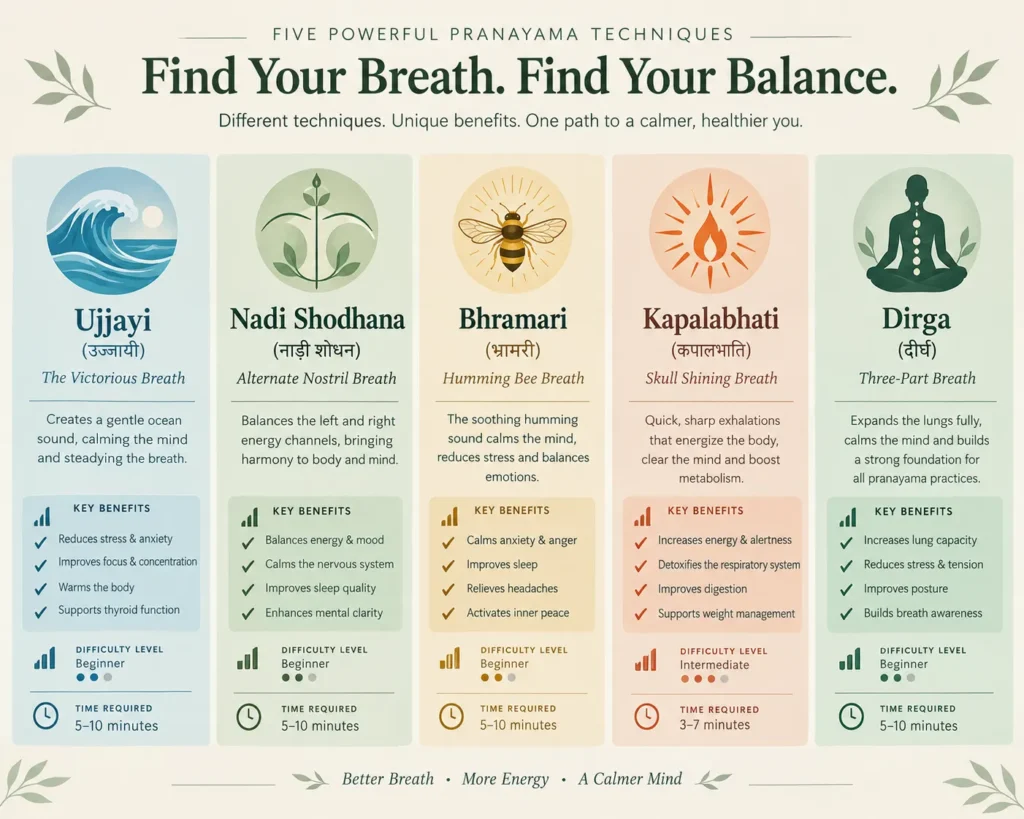
- Five foundational techniques address different needs: Ujjayi (focus), Nadi Shodhana (balance), Bhramari (anxiety relief), Kapalabhati (energy), Dirga (foundation).
- Daily practice matters more than duration — 5 minutes daily beats 30 minutes weekly for nervous system benefits.
- Results appear quickly — stress relief in minutes; sleep improvement in 3-7 days; mental clarity in 2 weeks; baseline nervous system shift in 4-8 weeks.
- No prerequisites or equipment needed — you can practice anywhere, anytime, with nothing but your breath.
- Start with Dirga (three-part breath) — the gentlest, most foundational technique that teaches breath awareness.
- Ujjayi and Bhramari are the most effective for immediate anxiety relief during stressful moments.
- Nadi Shodhana balances left and right brain hemispheres and emotional equilibrium.
- Kapalabhati energizes but should NOT be practiced in the evening (too activating for sleep).
- Extended exhales (longer exhale than inhale) deepen parasympathetic activation most powerfully.
- Avoid common mistakes — don’t force the breath, don’t hold uncomfortably long, don’t practice Kapalabhati before bed, wait 2-3 hours after eating.
- Consistency creates permanent nervous system rewiring — the benefits compound and become your baseline.
- Pranayama is meditation’s preparation — it sets up the calm, clear mental state that makes sitting meditation possible.
FAQ SECTION
Q1: How long does it take to see results from pranayama?
Stress relief and anxiety reduction happen within 5-10 minutes of practice. Sleep improves within 3-7 days of daily practice. Mental clarity increases within 2 weeks. Long-term nervous system rewiring takes 4-8 weeks of consistent practice. Results depend on consistency, not duration.
Q2: How many times per day can I practice pranayama?
Once or twice daily is safe and effective. Morning (5-10 min) and evening (10-15 min) is ideal. Some practitioners practice three times daily, but beginners should start with once daily. More than three times daily requires teacher guidance.
Q3: Which pranayama is best for anxiety?
Bhramari (humming bee breath) and Ujjayi (victorious breath) are most effective for immediate anxiety relief — both calm within 2-3 minutes. Nadi Shodhana (alternate nostril) balances emotions. Dirga is safest for severe anxiety. Avoid Kapalabhati if anxious.
Q4: Can I practice pranayama if I have asthma?
Check with your doctor first. Gentle pranayama (Dirga, Ujjayi, Nadi Shodhana) may improve asthma over time. Avoid Kapalabhati and retained-breath techniques during asthma flares. Never use pranayama as replacement for rescue medications.
Q5: Is pranayama safe to practice every day?
Yes. Daily practice is ideal for nervous system benefits. Once-daily 5-15 minute practice is safe, beneficial, and sustainable for most people. Some practitioners practice twice daily. Consistency matters more than duration.
CONCLUSION
Most people think yoga is complicated — all those Sanskrit names, specific postures, years of practice required.
But the essence of yoga is remarkably simple: your breath is a tool you can use right now to change how you feel.
That’s all pranayama is. No poses required. No flexibility needed. No previous experience necessary. Just your breath and a few minutes daily.
When anxiety hits, your breath becomes shallow and rapid — and your nervous system responds by interpreting this as danger. The cycle feeds itself: stress creates shallow breathing; shallow breathing signals more danger; danger increases stress.
Pranayama breaks this cycle at its source. By consciously slowing your breath, you send a signal of safety to your body. Cortisol drops. Heart rate slows. The amygdala (fear center) quiets. Your mind, recognizing physical safety, can finally settle.
This isn’t meditation (which many people find impossibly difficult). This isn’t physical yoga (which requires flexibility and strength). This is biology. This is physics. This is science.
And it works within minutes.
The five techniques in this guide are not exotic or mystical. They are practical tools — as practical as taking a pain reliever when your head hurts, except pranayama addresses the root cause of stress rather than just masking symptoms.
Start with Dirga. Spend one week doing three-part breathing for 5 minutes each morning. Notice what happens. Notice the quality of your breath, the clarity of your mind, the ease in your body.
Then add Ujjayi or Bhramari depending on your needs. Build your practice gradually.
Within weeks, you’ll recognize that something fundamental has shifted — not just during your practice, but in your baseline. You’ll be calmer. You’ll sleep better. You’ll react to stress less reactively. Life’s difficulties will still exist — but your relationship to them will have changed.
This is what pranayama offers: not escape from life’s challenges, but freedom from being overwhelmed by them.
Your breath is waiting. Start today. Visit TheShivYoga.com and practice with us.