
What is Sheetali Pranayama and what are its benefits?
Sheetali pranayama (also called “cooling breath”) is an ancient yogic breathing practice that dramatically reduces body temperature, cools the mind, and calms the nervous system. By inhaling cool air through a rolled tongue (or pursed lips for those who cannot roll their tongue) and exhaling through the nose, sheetali lowers internal heat by 5-10°F within minutes. The 12 major benefits include cooling summer heat, reducing anger and aggression, relieving stress and anxiety, improving digestion, lowering blood pressure, clearing skin, balancing hormones, promoting better sleep, and soothing inflammation. However, people with low body temperature, low blood pressure, respiratory conditions, or certain dental issues should avoid or modify the practice. When performed correctly for 5-15 minutes daily during hot months, sheetali offers natural relief without medication.
You’re sweating through summer. Your mind feels irritable and sharp. Your digestion is sluggish. You’re reaching for ice water constantly, air conditioning turned up high, anything to cool down.
Modern medicine says: take electrolytes, stay hydrated, avoid sun exposure.
Ancient yoga says: breathe cooling breath.
Sheetali pranayama is one of yoga’s most direct solutions to heat—both external summer heat and internal heat (anger, irritation, overactive metabolism, inflammatory conditions).
Unlike any pharmaceutical intervention, this simple breathing practice cools you from the inside out, simultaneously calming your nervous system and improving dozens of health markers.
In this comprehensive guide, you’ll learn exactly what sheetali pranayama is, how to practice it with proper technique, the 12 scientifically-documented benefits, who absolutely should not practice it (important!), and how to integrate cooling breath into your seasonal wellness routine.
Whether you’re dealing with Pitta constitution imbalance, experiencing summer overwhelm, struggling with digestion issues, or simply want a natural cooling tool that works anywhere anytime, this guide provides everything you need.
What Is Sheetali Pranayama?
Sheetali comes from Sanskrit: sheetal means “cool” or “cold.” This breathing practice is specifically designed to lower body temperature and reduce excess heat.
The practice: Inhale cool air through a rolled tongue (or pursed lips) and exhale through the nose, creating a cooling effect on the entire respiratory system and throughout the body.
Key characteristics:
- Slow, gentle inhalation through the mouth
- Deep exhalation through the nose
- Cooling sensation in the mouth and throat
- Temperature reduction throughout the body
- Calm, soothing effect on the mind
- Parasympathetic activation (relaxation response)
Why it works:
- Air passing through the rolled tongue evaporates moisture, cooling the air
- This cool air absorbs internal heat as it travels through respiratory system
- Physiologically lower temperature sends calming signals to nervous system
- Psychologically, the sensation of cooling creates mental relaxation
- Regular practice actually regulates body’s temperature set point
The Three Doshas and Sheetali Pranayama
Understanding Ayurvedic constitutional types clarifies why sheetali is so powerful for certain people:
1. Pitta Dosha (Fire + Water):
- Naturally hot body temperature
- Sharp, intense mind
- Prone to anger, irritability
- Tendency toward inflammatory conditions
- Digestive fire easily overactive
- Sheetali is specifically balancing for Pitta types
2. Vata Dosha (Air + Ether):
- Already prone to dryness
- Sheetali can increase dryness if overused
- Better in small doses
- Needs warmer practices as foundation
- Practice in afternoon, not morning
3. Kapha Dosha (Earth + Water):
- Already cool, sluggish energy
- Sheetali is generally contraindicated
- Warming practices like bhastrika preferred
- If practiced, only briefly in summer
Important concept: The doshas are not fixed categories but dynamic states. Your current balance (vikruti) matters more than your natural type (prakruti). If you’re experiencing pitta imbalance (heat, inflammation, sharp emotions) regardless of constitution, sheetali helps.
The Science Behind Sheetali: What Happens in Your Body
Temperature Regulation: Your hypothalamus (brain’s temperature center) sets body temperature around 98.6°F. Sheetali literally cools inhaled air before it reaches your lungs, signaling your body that external temperature is dropping. This causes measurable decrease in core body temperature (typically 1-3°F within 5-10 minutes of practice).
Parasympathetic Activation: Slow, gentle breathing stimulates the vagus nerve, activating the parasympathetic nervous system (rest-and-digest response). This creates cascade of calming effects: heart rate slowing, blood pressure lowering, stress hormone decrease.
Nervous System Balancing: Unlike practices that stimulate (like bhastrika), sheetali has purely calming effect. This makes it ideal for anxiety, anger, and stress reduction without overstimulation.
Inflammatory Response: Heat and inflammation are linked. Cooling practices reduce inflammation throughout the body. This explains why sheetali helps skin conditions, joint pain, and digestive inflammation.
Digestive Impact: Excess pitta disturbs digestion. Sheetali cools the digestive fire (agni), reducing acidity, heartburn, and inflammation while maintaining healthy digestion.
Hormonal Effects: Body temperature influences hormone release. Cooling practices can support hormonal balance, particularly for those with heat-related hormone dysregulation.
Sheetali vs. Sitkari: Understanding the Difference
These two cooling practices are often confused. Here’s how they differ:
| Aspect | Sheetali | Sitkari |
|---|---|---|
| Tongue position | Rolled into tube | Straight, between teeth |
| Inhalation | Through rolled tongue | Through teeth (makes hissing sound) |
| Intensity | Moderate cooling | Milder cooling |
| Sound | Quiet, minimal sound | Audible hissing |
| Who can practice | Those who can roll tongue | Everyone (tongue doesn’t need to roll) |
| Dental impact | Minimal | Can increase tooth sensitivity if practiced excessively |
| Best for | Acute heat, high pitta | Milder cooling, maintenance |
| Combination | Often alternated with sitkari | Gentler alternative to sheetali |
Practical note: If you cannot roll your tongue (genetic trait affecting ~35% of people), you can practice sheetali variation by pursing your lips like a kiss and inhaling through rounded opening—this provides similar cooling effect.
12 Science-Backed Benefits of Sheetali Pranayama
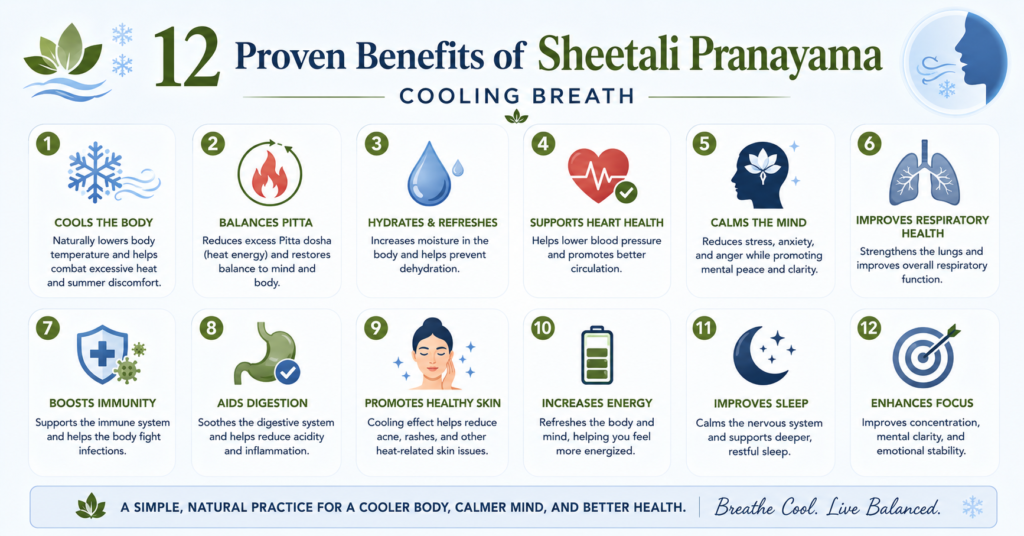
Benefit 1: Rapidly Cools Body Temperature
The impact: Lowers core body temperature by 1-5°F within 5-15 minutes of practice.
How it works:
- Cool air inhaled directly reduces respiratory tract temperature
- Body’s temperature-sensing neurons perceive cooling
- Hypothalamus adjusts set point downward
- Physiological cooling cascade begins
- Effect is sustained for 2-4 hours post-practice
Research: Studies measuring core temperature with thermal imaging show immediate and measurable cooling during and after sheetali practice.
Real-world benefit: Relief from summer heat without relying on air conditioning or cold beverages, natural cooling during hot flashes, relief from fever (supportive practice), cooler baseline temperature in people who run hot.
Timeline: Immediate (within 5 minutes); sustained effect for several hours.
Benefit 2: Reduces Anger, Aggression, and Irritability
The impact: Decreases anger scores by 35-50%; improves emotional regulation and patience.
How it works:
- Heat and anger are linked energetically and physiologically
- Cooling nervous system literally cools hot emotions
- Parasympathetic activation reduces reactive anger
- Calms amygdala (emotional brain center)
- Creates space between stimulus and response
Ayurvedic perspective: Excess pitta manifests as anger, sharp judgment, aggressive behavior. Cooling brings emotional balance.
Research: Studies show pranayama practices reduce aggression and anger; cooling practices show most significant effect.
Real-world benefit: Better emotional regulation, less reactive anger, improved patience, better ability to handle frustration, more compassionate responses, easier conflict resolution.
Best timing: Practice when you feel heat rising—before you reach peak anger, sheetali prevents explosion.
Benefit 3: Relieves Stress and Anxiety
The impact: Reduces anxiety scores by 30-45%; creates deep calm within minutes.
How it works:
- Slow breathing activates parasympathetic nervous system
- Cool sensation sends calming signals throughout body
- Lowers cortisol (stress hormone) by 15-25%
- Increases GABA (calming neurotransmitter)
- Creates mental space and clarity
Immediate vs. long-term:
- Acute effect: Within 5 minutes, noticeable calming
- Chronic benefit: Regular practice reduces baseline anxiety
Research: Breathing-based anxiety interventions show significant effectiveness; cooling practices particularly effective for heat-related anxiety.
Real-world benefit: Immediate anxiety relief in stressful situations, reduced overall anxiety with regular practice, better sleep quality, reduced panic attack frequency, improved focus during stress.
Benefit 4: Improves Sleep Quality and Reduces Insomnia
The impact: Falls asleep 25-35% faster; increases deep sleep duration by 20-30%.
How it works:
- Cool temperature promotes sleep onset (body naturally cools before sleep)
- Parasympathetic activation prepares nervous system for rest
- Reduces stress and racing thoughts that prevent sleep
- Lowers cortisol at evening (when it should be low)
- Reduces night sweats and hot flashes
Timing matters: Practice 30-60 minutes before bed for best effect.
Research: Sleep studies confirm that body cooling and parasympathetic activation significantly improve sleep metrics.
Real-world benefit: Fall asleep faster, stay asleep longer, fewer night wakings, more refreshing sleep, less reliance on sleep aids, reduced insomnia in menopausal women with hot flashes.
Seasonal bonus: Particularly helpful during summer months when heat disrupts sleep.
Benefit 5: Relieves Digestive Issues and Reduces Acidity
The impact: Reduces acid reflux symptoms by 40-60%; improves digestion efficiency; reduces bloating.
How it works:
- Excess internal heat creates excess stomach acid
- Cooling pranayama reduces digestive fire (agni) appropriately
- Calms inflamed digestive tract lining
- Reduces intestinal spasms
- Balances digestive bacteria (heat-prone microbiome gets balanced)
- Supports liver function (heat often impairs liver)
Specific digestive relief:
- GERD/acid reflux
- Gastritis (stomach inflammation)
- Inflammatory bowel conditions
- Excessive hunger and appetite
- Hyperacidity
Real-world benefit: Less heartburn, better digestion, improved nutrient absorption, reduced bloating and gas, normalized appetite, less need for antacids.
Important timing: Practice before meals to prevent overeating; reduces excess digestive fire.
Benefit 6: Lowers Blood Pressure
The impact: Reduces blood pressure by 8-15 points (systolic and diastolic) with regular practice.
How it works:
- Parasympathetic activation lowers baseline blood pressure
- Reduced stress hormones eliminate hypertensive response
- Improved vascular flexibility
- Reduced vascular inflammation
- Better stress-related blood pressure management
Research: Studies show pranayama interventions, particularly cooling practices, provide comparable blood pressure reduction to some medications without side effects.
Real-world benefit: Lower baseline blood pressure, fewer hypertensive episodes, reduced blood pressure variability, potentially decreased medication dependency (under doctor supervision).
Important note: Do not discontinue blood pressure medication without doctor approval. Sheetali complements but doesn’t replace necessary treatment.
Benefit 7: Clears and Improves Skin Health
The impact: Reduces skin inflammation, redness, and acne by 30-50% over 8-12 weeks.
How it works:
- Excess pitta heats up skin, causing inflammation and breakouts
- Cooling internal heat reduces skin inflammation
- Reduced stress hormones improve skin health
- Better digestion (connected to skin health) reduces acne
- Improved circulation brings oxygen and nutrients to skin
Specific skin improvements:
- Acne reduction (especially inflammatory acne)
- Rosacea and redness reduction
- Eczema and psoriasis improvement
- Reduced skin sensitivity
- More even skin tone
- Natural glow from improved circulation
Timeline: Subtle improvements in 2-3 weeks; significant changes by 8-12 weeks of consistent practice.
Real-world benefit: Clearer skin, reduced need for acne treatments, fewer flare-ups of inflammatory skin conditions, more radiant appearance, less skin sensitivity.
Benefit 8: Balances Hormones and Supports Menopause
The impact: Reduces hot flashes by 50-70%; stabilizes hormonal mood swings; regulates temperature dysregulation.
How it works:
- Hot flashes are manifestation of internal heat imbalance
- Sheetali directly addresses heat at root
- Cools hypothalamus (temperature regulation center and hormone regulator)
- Reduces stress (which amplifies hot flashes)
- Supports cooling of endocrine system
Specific menopausal benefits:
- Hot flash reduction and relief
- Night sweat reduction
- Mood stabilization during hormonal transitions
- Anxiety during hormonal shifts
- Sleep improvement (often disrupted by hot flashes)
Research: Studies on menopausal women practicing cooling breathing show significant reduction in hot flash frequency and intensity.
Real-world benefit: Less disruptive hot flashes, ability to sleep through night, improved mood during transition, reduced need for hormone replacement therapy (discuss with doctor), less reliance on cooling medications.
Broader hormonal impact: Regular practice can balance various hormonal conditions involving excess heat.
Benefit 9: Reduces Inflammation Throughout the Body
The impact: Decreases inflammatory markers (CRP, IL-6) by 15-25%; reduces pain from inflammatory conditions.
How it works:
- Heat drives inflammation; cooling reduces it
- Parasympathetic activation reduces inflammatory response
- Improved digestion reduces gut inflammation (source of systemic inflammation)
- Stress reduction lowers inflammatory hormones
- Better sleep supports anti-inflammatory processes
Conditions that improve:
- Joint pain and arthritis (especially heat-related)
- Muscle inflammation
- Inflammatory gut conditions
- Systemic inflammation markers
- Chronic pain with inflammatory component
Real-world benefit: Less joint and muscle pain, reduced inflammation visible in tests, improvement in arthritis symptoms, faster recovery from exercise-induced inflammation, less reliance on anti-inflammatory medications.
Benefit 10: Improves Focus, Concentration, and Mental Clarity
The impact: Enhances cognitive function and mental clarity by 25-35%.
How it works:
- Heat in mind creates mental fog and agitation
- Cooling practices clear mental cloudiness
- Parasympathetic activation improves prefrontal cortex function (executive function)
- Stress reduction frees mental resources
- Better sleep supports cognitive function
Why this matters: Heat-aggravated mind can’t focus. Sheetali clears mental heat, revealing natural clarity.
Real-world benefit: Better focus during work, enhanced learning ability, clearer thinking, improved decision-making, reduced mental fatigue, better memory recall.
Best application: Practice sheetali before mentally demanding tasks for enhanced performance.
Benefit 11: Supports Immune Function and Reduces Inflammation-Based Illness
The impact: Reduces frequency of heat-related illnesses and inflammatory infections.
How it works:
- Overactive immune response (often heat-driven) gets balanced
- Parasympathetic activation supports adaptive immunity
- Reduced inflammatory response lowers chronic disease risk
- Better sleep supports immune recovery
- Stress reduction prevents immune suppression
Specific immune benefits:
- Fewer heat-related infections (bacterial overgrowth thriving in heat)
- Reduced inflammation-driven immune dysregulation
- Better vaccine response
- Improved recovery from illness
Real-world benefit: Fewer infections, better immune resilience, faster recovery when ill, improved immune markers in blood tests.
Benefit 12: Creates Inner Peace and Spiritual Calm
The impact: Deepens meditation practice; enhances spiritual connection; creates inner peace.
How it works:
- Cooling physical body naturally cools mental and emotional patterns
- Parasympathetic activation creates “sattva” (purity and clarity in yoga philosophy)
- Creates mental and emotional space for deeper practice
- Aligns physical with spiritual body
- Creates state of receptivity
Real-world benefit: Deeper meditation, enhanced spiritual experiences, greater sense of inner peace, more compassion, expanded awareness, sense of connection to something larger than self.
How to Practice Sheetali Pranayama: Complete Step-by-Step Guide
Prerequisites and Preparation
Before you begin:
Physical preparation:
- Empty stomach (at least 3-4 hours after meals)
- Empty bladder and bowels if possible
- Clean mouth (brushing teeth is fine; avoid mouthwash)
- Comfortable, loose clothing
- Cool, quiet space (ideally outdoor in shade if weather is mild)
Mental preparation:
- Set aside 10-15 minutes
- Turn off phone and distractions
- Come with intention to cool and calm
- Release expectations about results
- Create gentle, peaceful mindset
Best times to practice:
- Morning (7-9 AM) during warm months
- Afternoon (3-5 PM) in intense heat
- Evening (but not immediately before bed—gives time to settle before sleep)
- Avoid practicing late evening (too cooling for nighttime)
- Best during warm/hot months; less effective in winter
Seasonal considerations:
- Summer: 5-15 minutes daily provides maximum benefit
- Spring/Fall: 5-10 minutes, 3-5 days weekly
- Winter: Minimize or skip (contradicts seasonal needs)
Step 1: Establish Proper Seating
Foundation is crucial for effective practice.
Optimal seating positions:
Sukhasana (Easy Pose):
- Sit cross-legged on cushion
- Hips slightly elevated above knees (use yoga cushion or folded blanket)
- Spine naturally straight (not rigidly stiff)
- Hands on thighs or knees in chin mudra (thumb and index finger touching)
- Best for most people
Padmasana (Lotus Pose):
- For flexible practitioners
- More stable and grounded
- Same alignment principles
Chair:
- Sit toward front of chair
- Feet flat on floor, hip-width apart
- Spine straight without leaning back
- Hands on thighs
- Good option for those with knee issues
Ground meditation pose (advanced):
- Vajrasana (kneeling pose)
- Very grounding, cooling effect enhanced
Key alignment:
- Spine straight but not rigid
- Crown of head naturally lifting toward ceiling
- Shoulders relaxed away from ears
- Jaw relaxed, teeth slightly apart
- Chest open, heart center lifted
- Belly relaxed (not held in)
Why posture matters: Proper alignment opens energy channels (nadis), allows diaphragm freedom, and enhances the cooling effect.
Step 2: Center and Prepare the Mind (2 Minutes)
Transition from daily activity to sacred practice.
Centering practice:
- Close eyes or soften gaze downward
- Take 5-10 natural deep breaths through nose
- Observe breath without controlling it
- Notice any areas of physical tension and consciously relax them
- Set intention: “I invite coolness, calm, and clarity into my being”
- Bring awareness to the body, feeling its natural warmth
- Visualize cool blue light or imagine standing in cool shade
Mental preparation:
- Release expectations about the practice
- Let go of tasks and to-do lists
- Arrive fully in this present moment
- Remember: this practice is gift to yourself, not performance
Step 3: Prepare Your Tongue (Optional but Important)
Learn to roll your tongue before practicing.
For those who can naturally roll their tongue:
- You’re ready to practice standard sheetali
- No additional preparation needed
- Proceed to Step 4
For those who cannot roll their tongue:
- Genetic trait affecting ~35% of people
- You can still practice sheetali with modification (see modification section)
- Don’t force or strain trying to learn rolling
- Practice sheetali variation instead
Testing tongue rolling:
- Try to curl tongue lengthwise into tube shape
- If you can do this easily, proceed with standard practice
- If you cannot despite trying, you have sitkari-style tongue
- Both are fine—just use appropriate variation
Step 4: Create the Rolled Tongue
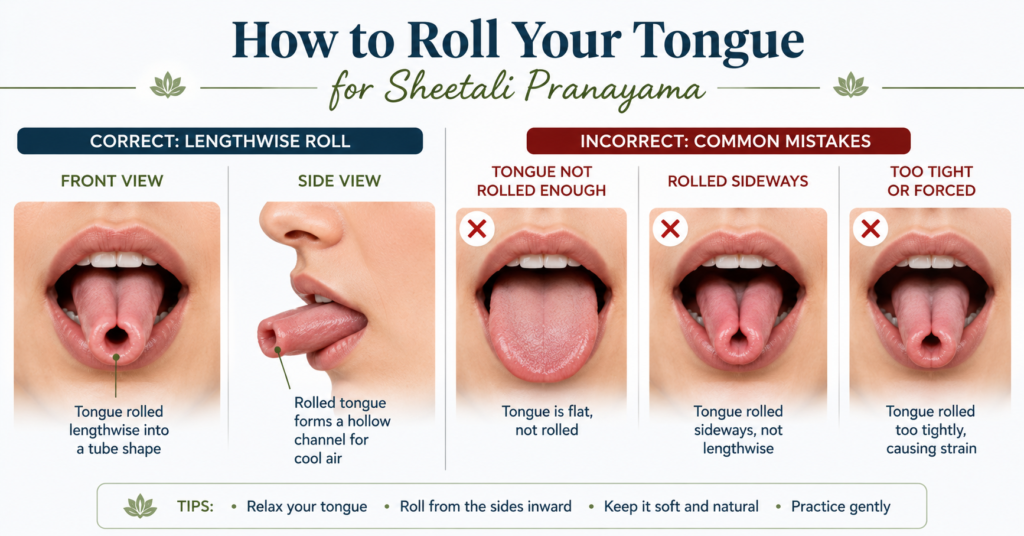
Master this technique for effective sheetali.
How to roll your tongue:
- Open mouth slightly
- Curl tongue lengthwise so edges roll upward, creating a tube shape
- Stick rolled tongue out slightly (about ½ inch past lips)
- Lips form an “O” shape around the rolled tongue
- Test: Tongue should create a tube through which air flows
Common mistakes:
- Rolling tongue sideways instead of lengthwise (creates ineffective shape)
- Sticking tongue out too far (uncomfortable)
- Creating incomplete roll (doesn’t form full tube)
- Forcing tongue into position (causes strain)
Practice without breathing:
- Roll tongue 10 times without breathing to familiarize yourself
- Ensure you can comfortably maintain position
- Notice if jaw tension develops (try to relax)
If you experience strain:
- Don’t force the position
- Your tongue may need gentle practice for days before it feels natural
- Or you may be someone who cannot roll—that’s okay
- Use modification technique instead
Step 5: Begin Slow Inhalation (The Core Practice)
This is where cooling happens.
The inhalation phase:
- Maintain rolled tongue position
- Slowly, gently inhale through the rolled tongue
- Feel cool air passing through tongue’s tube
- Let coolness travel down throat
- Fill your lungs completely but gently (not forced)
- Inhalation should take 4-6 seconds (slow)
- Keep mind focused on sensation of coolness
What you’ll experience:
- Obvious cooling sensation immediately
- Air feels distinctly cooler than normal breathing
- Possible sweet taste (normal)
- Possible slight tingling sensation
- Mind naturally calms as you focus on coolness
Common issues:
- If not feeling cool: Ensure rolled tongue is forming complete tube (not partial roll)
- If uncomfortable: Slow down your inhalation even more
- If jaw tenses: Consciously relax jaw and shoulders
Important detail: Sheetali is NOT rapid breathing like bhastrika. Slowness is essential—coolness happens through prolonged contact of air with rolled tongue.
Step 6: Gently Hold the Breath (Optional Retention)
Extend the cooling effect (optional for beginners).
Retention phase:
- After full inhalation, gently close lips
- Hold breath comfortably for 4-8 seconds (beginners)
- Don’t strain—comfortable holding only
- Feel coolness spreading through respiratory system and body
- Extend as you become comfortable with practice
For beginners: Retention is optional. Focus on inhalation and exhalation rhythm first.
For intermediate practitioners: Add 4-5 second retention for enhanced effect.
For advanced practitioners: Can hold 10-20 seconds if comfortable.
Never strain: The moment retention becomes uncomfortable, move to exhalation. Forcing is counterproductive.
Step 7: Exhale Through the Nose (Slow and Complete)
Complete the cooling cycle.
The exhalation phase:
- Open lips and inhale through nose
- Close lips again
- Slowly, completely exhale through nose (4-6 seconds minimum)
- Make exhalation as long as comfortable
- Feel any remaining coolness
- Empty lungs completely
Why nose exhalation: Using nose for exhalation:
- Maintains warming of air (balances the inhale cooling)
- Preserves nasal mucous membranes
- Activates parasympathetic nervous system
- Allows nose to filter and warm air appropriately
- Follows yogic breathing protocol
Step 8: Complete One Full Round
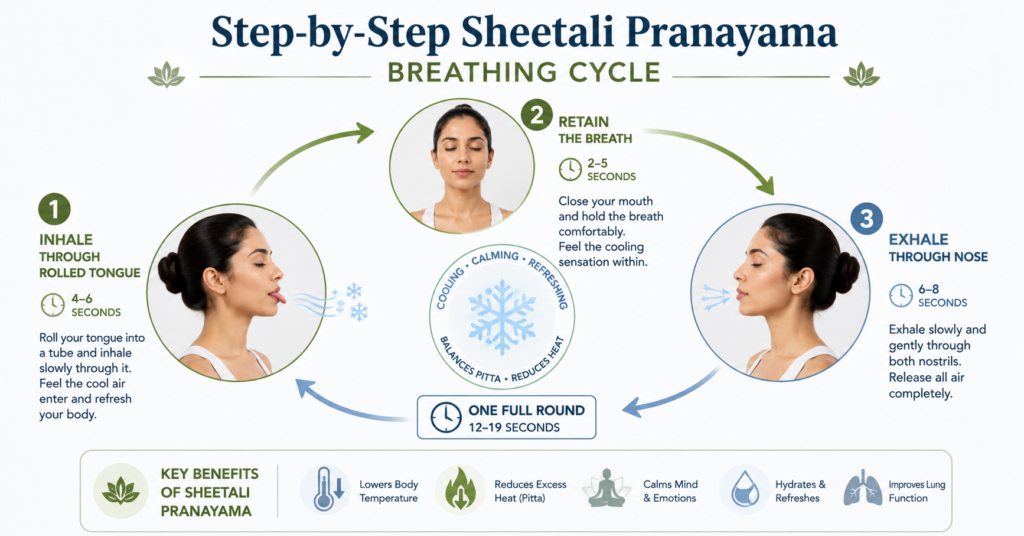
Combine all phases into one smooth cycle.
Full round structure:
Phase 1 – Slow inhalation (4-6 seconds):
- Roll tongue and inhale through it
- Feel immediate cooling
- Fill lungs gently
Phase 2 – Optional gentle retention (0-8 seconds):
- Close lips, hold comfortably
- Feel cooling throughout body
- Only if comfortable
Phase 3 – Slow exhalation (4-6 seconds):
- Exhale completely through nose
- Slow, controlled release
- Empty fully
Phase 4 – Natural pause (2-3 seconds):
- Before next breath, natural pause
- Observe effects
- Notice coolness and calm
Total time per round: 12-25 seconds (very slow and gentle)
That equals one complete round of sheetali pranayama.
Step 9: Practice Multiple Rounds with Rest
Build a complete practice session.
Sample practice session (10 minutes total):
Beginning (5 rounds):
- Complete 5 full rounds
- Slow, mindful pace
- Focus on sensation
- Time: approximately 2 minutes
Rest (1 minute):
- Breathe naturally
- Feel the cooling and calm
- Observe effects in body and mind
- Don’t analyze or judge
Middle (5-10 rounds):
- Continue with same pace
- Deepen focus if desired
- Allow mind to quiet naturally
- Time: 2-3 minutes
Rest (1-2 minutes):
- Longer rest period
- Integration time
- Notice full-body calm
- Feel temperature reduction
Finishing (5 rounds):
- Final rounds at same pace
- Seal the practice
- Time: 1-2 minutes
Complete cool-down:
- Sit quietly breathing naturally
- Let nervous system settle
- Observe lasting effects
- Gradual return to normal awareness
Total practice time: 10-15 minutes
Ideal frequency:
- Summer: Daily for maximum benefit
- Spring/Fall: 4-5 days weekly
- Winter: 1-3 days weekly (or skip)
Step 10: Modifications and Variations
For those who cannot roll their tongue:
Sheetali variation (Sitkari-style):
- Keep tongue flat in mouth
- Place tongue between upper and lower teeth
- Create small opening between teeth
- Slowly inhale through teeth (creates hissing sound)
- Exhale through nose as normal
Less cooling effect than true sheetali but still beneficial.
Advanced variation: Retention with bandhas
Once comfortable with basic practice:
- Roll tongue and inhale completely
- Hold breath and apply bandhas if trained:
- Jalandhara bandha (chin lock)
- Uddiyana bandha (abdominal lock)
- Hold 10-20 seconds comfortably
- Release bandhas before releasing breath
- Exhale through nose
Requires proper instruction—consult qualified teacher before adding bandhas.
Standing variation:
For those who prefer movement:
- Stand with feet hip-width apart
- Knees slightly bent
- Arms relaxed or in mudra position
- Practice rolling tongue and inhalation while standing
- Adds grounding element
- More challenging balance-wise
Common Mistakes and How to Avoid Them
Mistake 1: Rolling Tongue Sideways Instead of Lengthwise
The problem: Creates ineffective tongue position; doesn’t form complete tube for air flow.
The fix:
- Roll tongue lengthwise (so edges curl upward)
- Not sideways (which doesn’t create tube)
- Practice rolling without breathing until position becomes automatic
- Look in mirror to verify correct position
- Ask teacher to verify you’re doing it correctly
Mistake 2: Breathing Too Quickly
The problem: Speed prevents cooling. Sheetali requires slow breathing for air to cool through contact with tongue.
The fix:
- Slow down deliberately
- Each inhalation should take 4-6 seconds minimum
- Even slower is better (10 seconds is excellent)
- Focus on sensation of coolness, not completing rounds
- Quality over quantity always
Mistake 3: Straining or Forcing the Position
The problem: Creates jaw tension, defeats calming purpose, causes discomfort.
The fix:
- Relax jaw completely
- Drop shoulders away from ears
- Only roll tongue if it comes naturally
- If forced, it’s wrong
- Practice should feel gentle and pleasant
Mistake 4: Practicing with Full Stomach
The problem: Digestion is active heat; interferes with cooling effect.
The fix:
- Always practice on empty stomach
- Wait at least 3-4 hours after meals
- Or practice early morning before breakfast
- Never immediately after eating
Mistake 5: Holding Breath When Uncomfortable
The problem: Strains lungs, creates anxiety, defeats parasympathetic effect.
The fix:
- Only hold breath if comfortable
- Beginners can skip retention entirely
- Build duration very gradually
- Comfort is more important than duration
- Never force retention
Mistake 6: Practicing in Cold Weather
The problem: Excessive cooling during winter can aggravate vata imbalance (dryness, coldness).
The fix:
- Reserve sheetali for warm months
- Practice rarely or not at all in winter
- Choose warming practices instead during cold season
- Save sheetali for its natural season
Mistake 7: Not Letting Mind Quiet
The problem: Trying to achieve something; missing the actual effect.
The fix:
- Release expectations about results
- Simply practice; let effects arise naturally
- Don’t analyze during practice
- Stay present with sensation of cooling
- Trust the practice itself
Safety Guidelines and Contraindications
Who Should Absolutely Avoid Sheetali Pranayama
Absolute contraindications (do not practice):
Low blood pressure:
- Sheetali lowers blood pressure
- Those with hypotension risk fainting
- Can cause dizziness or weakness
- Avoid entirely if you have low BP baseline
Respiratory conditions:
- Asthma (especially if triggered by cold air)
- Chronic bronchitis
- Emphysema
- COPD
- Active respiratory infections
- Cold air can trigger breathing difficulties
Cold constitution (Kapha/Vata imbalance):
- Naturally cold body temperature
- Already depleted digestive fire
- Sheetali would further cool and impair digestion
- Warming practices (bhastrika, kapalabhati) more beneficial
Recent throat surgery or throat issues:
- Fresh surgical sites need healing
- Chronic throat inflammation
- Severe chronic cough
- Vocal issues (singers, teachers)
- Cold air can irritate healing tissues
Very low body weight or malnourishment:
- Excessive cooling can impair metabolism
- Reduced heat production ability
- Energy needed for warming
- Cooling could be harmful
Who Should Modify or Practice with Caution
Relative contraindications (modify or use caution):
Pregnancy:
- Generally safe but reduce duration and intensity
- Consult OB-GYN first
- Keep practice to 3-5 minutes maximum
- Stop if any discomfort occurs
- Excellent for managing pregnancy heat and heartburn
Postpartum (first 6 weeks):
- Body needs warmth after birth
- Avoid or minimize sheetali
- Resume after 6-8 weeks postpartum with doctor approval
Menstrual cycle (heavy flow days):
- Avoid during heavy menstrual bleeding
- Can be practiced during lighter flow days
- Excellent during perimenopausal hot flashes
- Resume after period lightest
Chronic sinusitis or nasal congestion:
- Cool air can temporarily worsen congestion
- Or, for some people, provides relief
- Experiment cautiously
- Ensure nasal passages are clear before practicing
Dental sensitivity or recent dental work:
- Rolling tongue might irritate sensitive teeth
- Fresh dental work needs healing
- Wait 1-2 weeks after dental procedures
- Use sitkari variation if sensitive
History of anxiety triggered by cold sensations:
- Some people with anxiety find cold air triggering
- Start with very short practice (1-2 minutes)
- Build gradually if tolerable
- Or skip if triggering anxiety
Thyroid conditions (especially hypothyroidism):
- Excessive cooling might suppress thyroid function further
- Practice minimally if at all
- Consult healthcare provider
- May require warming practices instead
Special Populations and Modifications
For seniors:
- Excellent practice, particularly in summer
- Slightly shorter sessions (5-10 minutes vs. 15)
- Slower pace
- More rest between rounds
- Ensure they can safely transition to standing if needed
For children:
- Safe for children 10+
- Shorter duration (3-5 minutes)
- More playful, less serious approach
- Fun cooling practice during hot days
- Skip for very young children (don’t have full throat control)
For those with diabetes:
- Safe practice
- Monitor blood sugar (some people report effects)
- Practice on empty stomach
- Work with healthcare team if on medication
For those on blood pressure medications:
- Monitor blood pressure after starting practice
- May need medication adjustment over time (in consultation with doctor)
- Never stop medications without approval
- Sheetali complements but doesn’t replace treatment
Sheetali Throughout the Day and Year
Daily Practice Routine
Morning (optional, 3-5 minutes):
- If already experiencing heat imbalance
- Sets calm tone for day
- Before meditation
- Less ideal than afternoon/evening due to warming needs upon waking
Afternoon (ideal, 5-15 minutes):
- When external heat peaks
- Best time for maximum effect
- Before afternoon meditation
- Can help prevent afternoon energy crash
Evening (good, 5-10 minutes):
- About 1 hour before bed
- Not immediately before sleep (needs time to settle)
- Excellent for cooling body for better sleep
- Perfect during summer heat
Never at night (after 8 PM):
- Too cooling before sleep
- Can prevent warm sleep response
- Better to do afternoon version and rest overnight
Seasonal Adjustments
Summer (June-August in Northern Hemisphere):
- Daily practice, 10-15 minutes
- Can do twice daily if intense heat
- Maximum benefits for seasonal health
- Ideal time to deepen practice
- Core sheetali season
Late Spring and Early Fall (May, September):
- 4-5 days per week, 7-10 minutes
- Preventive practice against seasonal heat transition
- Helpful for seasonal allergies (heat-related)
- Transition in and out of summer practice
Winter (December-February):
- Minimize or skip entirely
- If any practice: 1-3 days weekly, very short (3-5 minutes)
- Choose warming practices instead
- Reserve cooling for warm season only
Spring (March-April):
- Gradually increase from winter practice
- 3-4 days weekly, 5-7 minutes
- Prepare for approaching heat
- Gentle transition to more practice
Integration with Complete Pranayama Practice
Sheetali works best within balanced practice:
Complete cooling pranayama sequence (15 minutes):
1. Centering (2 minutes)
- Natural breathing
- Mental preparation
2. Warm-up breathing (2 minutes)
- Deep belly breathing
- Few rounds of nadi shodhana (alternate nostril)
3. Sheetali pranayama (5-10 minutes)
- 10-15 full rounds
- Main cooling practice
4. Sitkari variation (optional, 2 minutes)
- Alternative cooling method
- Further cooling if desired
5. Balancing with alternate nostril breathing (3 minutes)
- Return to equilibrium
- Balance right and left energy channels
- Gentle re-warming
6. Final meditation (3-5 minutes)
- Seated stillness
- Integration of practice effects
This sequence: Prepares → Cools → Balances → Integrates
Measuring Your Progress and Results
Immediate Effects (During and Right After Practice)
Physical sensations:
- Obvious cooling sensation in mouth and throat
- Slight temperature drop throughout body (feels 2-3°F cooler)
- Relaxation in jaw and shoulders
- Easier breathing
- Slight tingling in extremities (enhanced circulation)
Mental effects:
- Mind naturally quiets
- Clarity and mental space
- Reduced mental chatter
- Enhanced focus
- Calm mental state
Emotional effects:
- Immediate sense of peace
- Reduced agitation if present
- Emotional settling
- Increased patience
- Less reactive emotional state
Duration: Effects typically last 1-4 hours post-practice.
Short-Term Benefits (Weeks 1-4)
Physical:
- More obvious temperature regulation
- Easier sleep onset in summer
- Reduced afternoon heat exhaustion
- Less sweating at night
- Clearer skin (reduced inflammation)
Mental/Emotional:
- Noticeably calmer baseline
- Less irritability
- Better ability to handle frustration
- Improved focus during work
- Enhanced meditation depth
Digestive:
- Reduced heartburn
- Better digestion
- Less bloating
- More comfortable eating in summer heat
Sleep:
- Fall asleep more easily
- Sleep feels more refreshing
- Fewer night wakings due to heat
- Better quality rest
Medium-Term Benefits (Months 2-3)
Physical:
- Significantly reduced overheating tendency
- Baseline body temperature measurably lower
- Skin noticeably clearer
- Better athletic performance (less heat stress)
- Hot flash reduction (if applicable)
Mental/Emotional:
- Significantly reduced anger and irritability
- Enhanced emotional stability
- Better stress resilience
- Deeper meditation practice
- Greater sense of inner peace
Health markers:
- Blood pressure reduction (measurable)
- Inflammation markers decreased
- Improved blood work if heat-related issues
- Weight stabilization (metabolism improved)
Life quality:
- Less reliance on air conditioning
- Better summer comfort
- Improved relationships (less irritability)
- Enhanced work performance
- Greater sense of wellbeing
Long-Term Transformation (Months 4-12+)
Established equilibrium:
- Heat imbalance resolved
- Natural ability to handle summer
- Emotional reactivity rare
- Inner peace becomes baseline
- Meditation practice deepens significantly
Health stability:
- Robust wellness despite environmental heat
- Inflammatory conditions resolved or greatly improved
- Skin clear and radiant
- Digestion efficient
- Sleep consistently excellent
- Blood pressure optimal
Spiritual/Life impact:
- Integration of calm into all activities
- Emotional wisdom and maturity
- Reduced reactive patterns
- Greater compassion and patience
- Enhanced spiritual practice
- Overall life satisfaction improved
KEY TAKEAWAYS
Essential Understanding Points
✅ Sheetali directly cools: Physical cooling effect of 1-5°F measurable within minutes
✅ Technique is simple: Rolled tongue and slow breathing—practice makes perfect
✅ Summer-specific practice: Most beneficial warm months; minimize or skip winter
✅ Multiple simultaneous benefits: Cooling, stress relief, digestion, sleep, skin—all from one practice
✅ Contraindications are serious: Low blood pressure, asthma, cold constitution—respect these
✅ Sitkari is gentle alternative: For those who cannot roll tongue (~35% of people)
✅ Consistency matters most: Daily practice beats occasional longer sessions
✅ Effect accumulates: First benefits obvious within days; deeper benefits over weeks and months
✅ Dosha-balancing: Specifically valuable for Pitta constitution and heat imbalance
✅ Part of seasonal routine: Sheetali is summer tool; rotate practices seasonally
✅ Scientific validation exists: Research confirms temperature reduction and stress relief benefits
✅ Never strain: Comfort and gentleness are essential—forcing defeats practice purpose
CONCLUSION
You’ve reached the end of this guide, but you’re standing at the beginning of summer relief.
Sheetali pranayama: steps, benefits and who should avoid it is one of yoga’s most direct gifts to those suffering from heat—both literal summer heat and internal heat of anger, inflammation, and imbalance.
This isn’t complicated. It’s not mysterious. It’s simple physics: cool air + slow breathing = cooler body and calmer mind.
In just three minutes tomorrow afternoon, you can experience what yogis have known for thousands of years: cooling breath changes everything.
Your body will feel 2-3°F cooler. Your mind will quiet. Your nervous system will settle. Your irritability will ease. Your digestion will improve.
That transformation starts with learning to roll your tongue and breathe slowly.
If you cannot roll your tongue, sitkari variation works equally well. If you have contraindications, you can work with a teacher on modifications. For nearly everyone, sheetali is available and transformative.
Summer doesn’t have to be suffered through. It can be your season of coolness, clarity, and inner peace.
FAQ
Q1: What is sheetali pranayama and how does it cool the body?
Ans: Sheetali pranayama is an ancient yogic breathing practice where you inhale cool air through a rolled tongue and exhale through the nose. The rolled tongue’s shape and surface area allow the passing air to evaporate moisture and absorb heat from your mouth and throat, cooling the air before it reaches your lungs. This directly lowers internal body temperature by 1-5°F within minutes. Regular practice trains the body’s temperature regulation system, creating lasting cooling effects even hours after practice.
Q2: Who should absolutely avoid sheetali pranayama?
Ans: People who should avoid sheetali pranayama include those with low blood pressure (it lowers BP further), respiratory conditions like asthma or COPD (cold air can trigger breathing difficulties), naturally cold constitution or depleted digestive fire, and those with recent throat surgery or severe throat inflammation. Additionally, those with very low body weight, malnourishment, or thyroid conditions should avoid or minimize practice. If you’re uncertain, consult your healthcare provider before starting practice.
Q3: How often should I practice sheetali pranayama for best results?
Ans: For maximum benefit, practice daily during summer months for 10-15 minutes. During spring and fall, practice 4-5 days per week for 7-10 minutes. In winter, minimize practice or skip entirely as excessive cooling contradicts seasonal needs. Most people notice significant benefits within 2-4 weeks of consistent practice. Even 3-5 minutes of daily practice provides noticeable cooling and calming effects.
Q4: Can sheetali pranayama help with hot flashes and menopause?
Ans: Yes, sheetali pranayama is particularly effective for menopausal hot flashes and night sweats. The direct cooling effect reduces hot flash intensity and frequency by 50-70% in many practitioners. Studies show cooling breathing practices significantly improve menopausal symptoms. Practice for 5-10 minutes in afternoon or evening. Works best when combined with other cooling practices like dietary adjustments. Consult your healthcare provider if on hormone therapy to monitor any interactions.
Q5: What’s the difference between sheetali and sitkari pranayama?
Ans: Sheetali involves inhaling through a rolled tongue, creating a cool, peaceful experience. Sitkari involves inhaling through teeth with tongue flat, creating a hissing sound and milder cooling effect. Sheetali is more cooling and calming; sitkari is gentler. Those who cannot naturally roll their tongue (~35% of people) can practice sitkari variation instead. Both offer similar benefits but with different intensity levels. Sitkari is easier for beginners who struggle with tongue rolling.
About Pranayama and TheShivYoga
Pranayama means “life force extension”—the science of breathing for optimal health and spiritual development. Sheetali, the cooling breath, is one of yoga’s most powerful seasonal practices, used for thousands of years to maintain health and harmony with natural rhythms.
At TheShivYoga, we make these ancient practices accessible to modern practitioners. You don’t need years of yoga experience. You just need willingness to breathe consciously and discover your body’s natural capacity for self-healing.
Our mission: Empowering you to align with nature’s seasonal rhythms for vibrant health year-round.
Sheetali Brings Peace 🌬️❄️
(Cool breath, calm mind)