Quick Answer Box
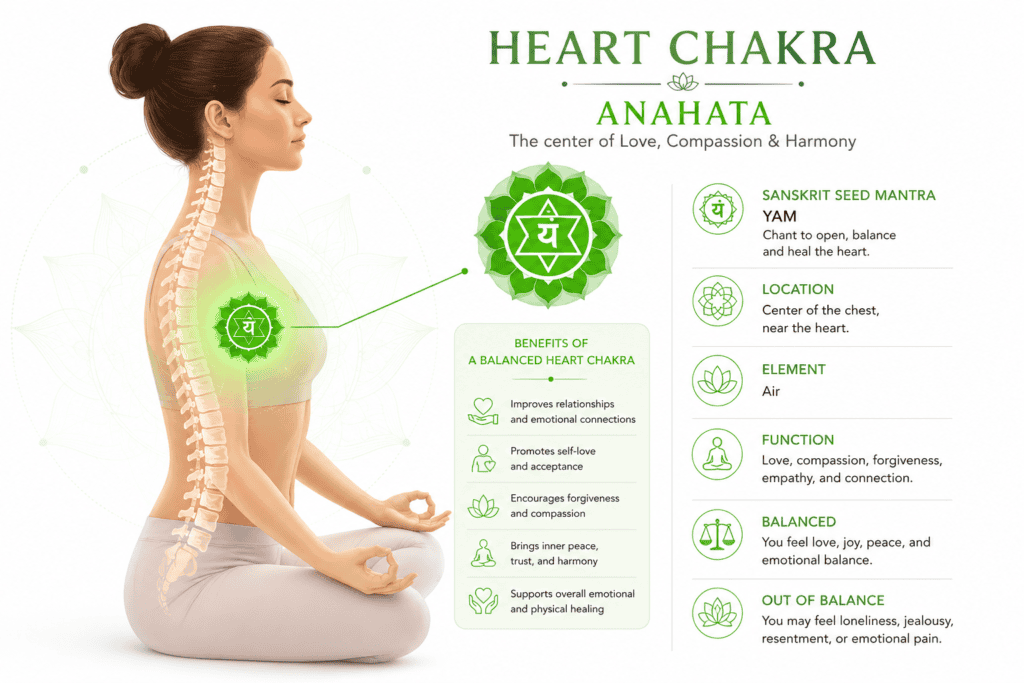
Heart chakra yoga — also called Anahata yoga — is a practice focused on opening, balancing, and healing the fourth energy center of the body, located at the center of the chest. It uses specific yoga poses (especially chest openers and backbends), breathwork, meditation, and affirmations to release emotional blockages, cultivate compassion, and restore the free flow of love — both for others and for yourself. Signs of a blocked heart chakra include emotional withdrawal, difficulty trusting, loneliness, and physical tightness in the chest and upper back.
Have you ever felt emotionally closed off — unable to fully give or receive love, stuck in grief, or carrying a heaviness in your chest that never quite goes away?
In yoga and Ayurvedic tradition, these feelings are understood as signs of a blocked or imbalanced heart chakra — the energy center at the core of your chest that governs love, compassion, connection, and emotional healing.
Heart chakra yoga is one of the most powerful practices available for releasing these emotional blockages. It combines purposeful yoga poses, conscious breathwork, healing meditation, and the transformative power of intention to gently reopen what has closed — and restore the sense of warmth, openness, and connection that is your natural state.
Whether you are healing from heartbreak, recovering from grief, struggling with self-worth, or simply feeling emotionally disconnected, this guide will walk you through everything you need to know about heart chakra yoga — from ancient wisdom to practical poses you can try today.
What Is the Heart Chakra (Anahata)?
The heart chakra is the fourth of the seven main chakras in the yogic energy system. In Sanskrit it is called Anahata (आनाहत) — a word that translates beautifully as “unstruck,” “unbeaten,” or “unhurt.” This name carries profound meaning: beneath every wound, beneath every heartbreak and loss, there is a part of you that has never been damaged and can never be destroyed.
Key Facts About the Anahata Chakra
| Attribute | Details |
|---|---|
| Sanskrit Name | Anahata (अनाहत) |
| Meaning | Unstruck / Unbeaten / Unhurt |
| Position | Center of the chest (cardiac plexus) |
| Element | Air (Vayu) |
| Color | Green (sometimes pink) |
| Seed Mantra | YAM (pronounced “yum”) |
| Sense | Touch |
| Governs | Love, compassion, empathy, forgiveness, joy, grief |
| Associated Organs | Heart, lungs, thymus gland, upper back, arms, hands |
| Petals | 12-petaled lotus |
| Related Gemstones | Rose quartz, green aventurine, emerald |
Where Is the Heart Chakra Located?
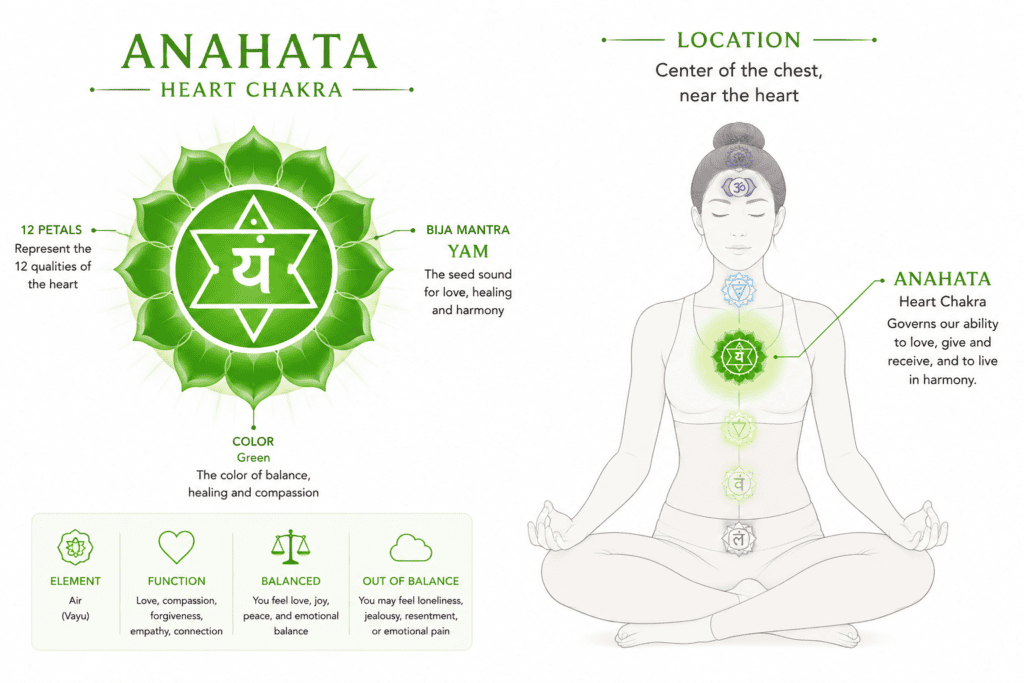
The heart chakra sits at the center of the chest — not exactly where your physical heart is (slightly to the left), but at the sternum, the cardiac plexus of nerves, and the thymus gland. Energetically, it is the bridge between the three lower chakras (earth, water, fire — survival, pleasure, power) and the three upper chakras (throat, third eye, crown — expression, wisdom, consciousness).
This bridge position is significant: the heart chakra is where the earthly and spiritual dimensions of human experience meet. When it is open and balanced, you can both love fully and live wisely.
The Significance of the Heart Chakra in Yoga Philosophy
In traditional yogic philosophy, Anahata is considered the seat of the Jivatman — the individual soul. The Upanishads describe a tiny flame burning within the heart that is the very essence of consciousness.
Anahata is also where prana (life force energy) is said to be most concentrated in the human body. When the heart chakra is open, prana flows freely through the entire system — nourishing every cell, organ, and emotional state.
The element associated with Anahata is air — light, expansive, and free-moving. This is reflected in heart chakra yoga, which emphasizes chest-opening, expanded breathing, and a quality of lightness and openness in the body and mind.
The 12 petals of the Anahata lotus each represent a quality of the heart: love, harmony, empathy, understanding, purity, clarity, compassion, unity, forgiveness, kindness, peace, and bliss. A fully open heart chakra expresses all twelve(1).
Signs Your Heart Chakra Is Blocked
Before exploring how to open the heart chakra through yoga, it helps to understand what a blocked or imbalanced Anahata looks like. Both underactive (too closed) and overactive (too open) states create problems.
Signs of an Underactive (Blocked) Heart Chakra
Emotional signs:
- Difficulty trusting people or forming close relationships
- Emotional withdrawal and isolation
- Inability to forgive — yourself or others
- Lingering grief, sadness, or depression
- Fear of intimacy and vulnerability
- Feeling unloved or unworthy of love
- Bitterness, resentment, or jealousy
Physical signs:
- Tightness or pain in the chest
- Shallow breathing or difficulty taking deep breaths
- Tension in the upper back and between the shoulder blades
- Poor posture — rounded, collapsed chest (the body physically closing around the heart)
- Frequent respiratory issues (colds, bronchitis, asthma)
- Low immune function (thymus gland — which governs immunity — is associated with Anahata)
Signs of an Overactive Heart Chakra
- Codependency and loss of self in relationships
- People-pleasing to the point of self-neglect
- Difficulty saying no or setting boundaries
- Excessive neediness or clinginess
- Giving love at the expense of your own wellbeing
When the Heart Chakra Is Balanced
A balanced Anahata expresses as:
- Unconditional love — for others and for yourself
- Healthy, boundaried relationships built on genuine connection
- The ability to grieve and heal, to forgive and move forward
- Deep empathy without losing your own sense of self
- A feeling of warmth, openness, and joy in daily life
- Easy, deep breathing and an open, upright posture
What Causes a Blocked Heart Chakra?
The heart chakra closes as a protective response to emotional pain. Common causes include:
- Heartbreak and romantic loss — breakups, divorce, unrequited love
- Grief — loss of a loved one, a pet, a relationship, or a significant life chapter
- Childhood wounds — feeling unloved, unseen, or emotionally neglected
- Betrayal and trust violations — being deceived, abandoned, or let down by those close to you
- Trauma — emotional, physical, or psychological
- Chronic stress — long-term stress causes shallow breathing and physical chest tension that mirrors energetic closure
- Self-criticism and unworthiness — ongoing negative self-talk that closes the heart inward
The protective closing of the heart chakra is not a failure — it is a deeply intelligent survival mechanism. Heart chakra yoga is not about forcing the heart open. It is about creating safety, breath, and space so the heart can open at its own pace.
Heart Chakra Yoga: How It Works
Heart chakra yoga works through four primary channels:
1. Physical Opening Yoga poses — especially chest openers, backbends, and shoulder openers — physically release the muscular tension, postural collapse, and fascial tightness that accumulate around a closed heart chakra. When the chest lifts and the shoulders draw back, the body sends a signal to the nervous system: it is safe to be open.
2. Breath Activation The connection between breath, the nervous system, and emotional healing is well supported by research. Studies show that pranayama and yoga practices directly activate the parasympathetic nervous system — reducing cortisol, calming the stress response, and creating the internal safety the heart needs to open. (Read the research)
3. Emotional Processing Many people experience unexpected emotional releases during heart-opening yoga — tears, laughter, or a deep sense of relief. This is normal and healthy. The poses create a container of safety in which stored emotions can finally move and release.
4. Intention and Awareness What separates heart chakra yoga from regular yoga is the quality of intention. Practicing with conscious awareness — focusing on the heart center, using affirmations, dedicating your practice to love or healing — amplifies the energetic effect significantly.
Best Heart Chakra Yoga Poses: Step-by-Step
The following poses are specifically chosen for their ability to open the chest, expand the front body, release shoulder tension, and activate the heart space. Practice them in the order given for a complete heart chakra sequence.
1. Cat-Cow (Marjaryasana-Bitilasana) — Warm-Up
Why: Opens the relationship between breath and spine. The Cow position specifically creates a gentle heart opener to begin warming the chest.
How to do it:
- Start on hands and knees — wrists under shoulders, knees under hips
- Inhale (Cow): Drop your belly, lift your chest and tailbone, gaze gently upward — feel the front of your chest open
- Exhale (Cat): Round your spine, tuck your chin, draw your belly in
- Flow slowly for 10 breath cycles
- On each Cow inhale, mentally direct your breath into the center of your chest
Heart chakra focus: On each inhale in Cow position, silently say: “I am open.”
2. Thread the Needle Pose — Shoulder Release
Why: Releases the deep muscular tension between the shoulder blades and in the upper back — the area most associated with a closed heart chakra. Carrying the weight of unexpressed emotion often shows up here first.
How to do it:
- Start in tabletop position
- Slide your right arm under your left arm, palm facing up
- Lower your right shoulder and right cheek to the mat
- Your left arm can remain where it is or extend forward for a deeper stretch
- Hold for 8–10 breaths, breathing into the space between your shoulder blades
- Come back to tabletop and switch sides
Heart chakra focus: With each exhale, visualize releasing tension, old pain, or grief from between your shoulder blades — let it dissolve into the mat beneath you.
3. Low Lunge with Chest Opener (Anjaneyasana)
Why: Opens the hip flexors while simultaneously creating space in the chest and front shoulders. The combination of grounding through the legs and opening through the heart is deeply balancing for Anahata.
How to do it:
- Step your right foot forward into a lunge, lower your left knee to the mat
- Place your hands on your right thigh
- Inhale and lift your chest, gently drawing your shoulder blades together
- Option 1: Hands stay on thigh — gentle chest lift
- Option 2: Clasp hands behind your back and open the chest more actively
- Option 3: Raise arms overhead and gently arch back (full crescent lunge)
- Hold for 8 breaths, then switch sides
Heart chakra focus: Breathe into the front of your chest with each inhale. On each exhale, soften your face and jaw — places where we unconsciously hold emotional tension.
4. Camel Pose (Ustrasana) — Deep Heart Opener
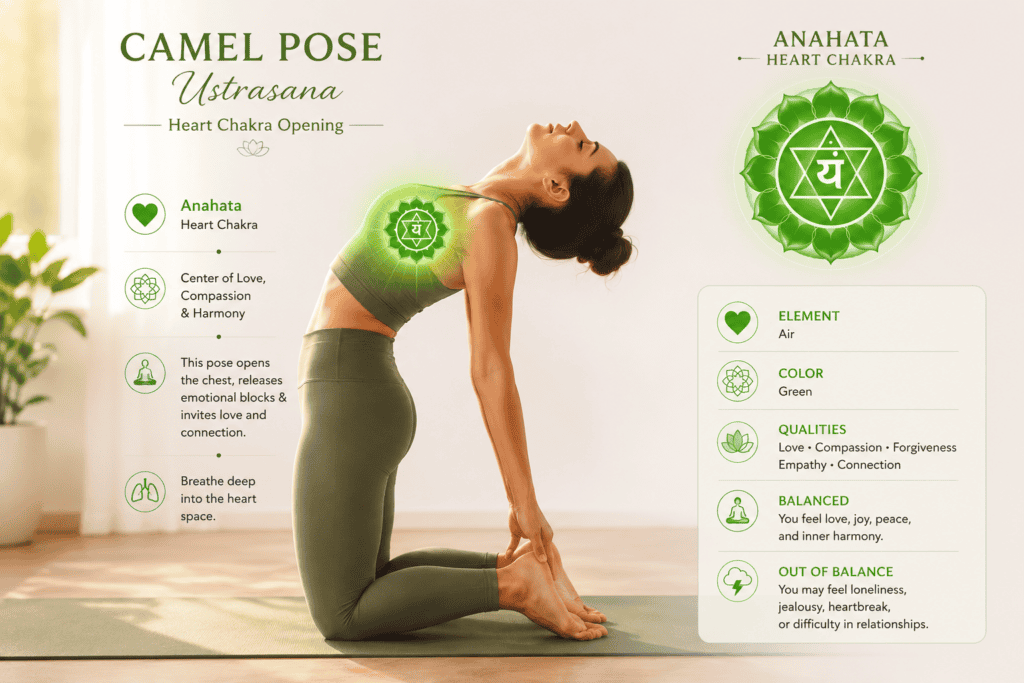
Why: Camel Pose is one of the most powerful heart chakra yoga poses available. It creates a full backbend that dramatically opens the entire front of the body — chest, throat, and hip flexors — while strengthening the spine.
How to do it:
- Kneel on your mat, knees hip-width apart
- Place your hands on your lower back, fingers pointing down, for support
- Inhale and lift your chest toward the ceiling
- Gently begin to arch backward — lead with the chest, not the lower back
- If comfortable, reach your hands back to your heels (or use blocks beside your feet)
- Let your head drop back gently only if your neck is comfortable
- Hold for 5–8 breaths
- To come out: hands return to lower back, inhale to rise — take your time
Key alignment cue: Never collapse into the lower back. The backbend should feel like an even arc through the entire spine, with the chest being the highest point.
Heart chakra focus: Visualize a warm green or pink light radiating from the center of your chest with each inhale — expanding outward with each breath.
Modification: Keep hands on your lower back and simply lift the chest without reaching for the heels. This is a complete and beneficial variation.
5. Sphinx Pose (Salamba Bhujangasana) — Gentle Backbend
Why: Sphinx is a gentle, supported backbend that opens the heart without the intensity of Camel. It is excellent for beginners or anyone with lower back sensitivity.
How to do it:
- Lie on your stomach
- Place your forearms on the mat, elbows directly under your shoulders
- Press your forearms down and lift your chest away from the mat
- Keep your lower body relaxed — legs hip-width apart, toes untucked
- Gaze forward or slightly upward
- Hold for 8–10 breaths
Heart chakra focus: Feel the front of your chest expand with each inhale. Notice any tightness and breathe into it without force.
6. Cobra Pose (Bhujangasana) — Heart Activator
Why: Cobra directly strengthens the spine while opening the chest. Unlike deeper backbends, Cobra is accessible to most beginners and can be held gently or practiced more actively.
How to do it:
- Lie on your stomach, hands under your shoulders, elbows close to your sides
- Press your pubic bone and tops of feet into the mat
- Inhale and lift your chest using the strength of your back muscles — not your hands
- Keep a slight bend in your elbows
- Roll your shoulders back and down — open the collarbones
- Gaze forward or slightly up
- Hold for 5–8 breaths, then lower slowly on an exhale
Heart chakra focus: Imagine your heart physically lifting toward the light with each inhale. This is not just a metaphor — let the image guide the movement.
7. Wheel Pose (Urdhva Dhanurasana) — Advanced Heart Opener
Why: Wheel Pose is the most expansive heart-opening posture in hatha yoga. It requires strength, flexibility, and courage — all qualities of an open Anahata. It is for intermediate to advanced practitioners.
How to do it:
- Lie on your back, knees bent, feet flat on the mat close to your hips
- Place your hands beside your ears, fingers pointing toward your shoulders
- Press into your feet and hands simultaneously
- Inhale and lift your hips, then the rest of your body, into a full backbend
- Straighten your arms as much as possible
- Let your head hang naturally — do not strain the neck
- Hold for 3–5 breaths, then tuck your chin and lower down slowly
Key alignment cue: Never force this pose. Build up to it over weeks or months. Bridge Pose is an excellent stepping stone.
Modification: Stay in Bridge Pose (Setu Bandha Sarvangasana) if Wheel is not yet accessible. Bridge offers many of the same heart-opening benefits.
8. Fish Pose (Matsyasana) — Heart and Throat Opener
Why: Fish Pose creates a gentle but powerful opening in the chest and throat — both the heart and throat chakras. It is often practiced as a counter-pose to shoulder stands and forward folds.
How to do it:
- Lie on your back, legs extended
- Place your hands palm-down under your hips
- Press your forearms and elbows into the mat
- Inhale and lift your chest, arching your back
- Tilt your head back and rest the crown (not the back) of your head on the mat
- Keep the weight in your elbows — not your head
- Hold for 5–8 breaths, then slowly lower your head and chest
Heart chakra focus: The throat and chest opening in Fish Pose releases not just physical tension but the energetic blocks around unexpressed emotion and unspoken words.
9. Seated Forward Fold (Paschimottanasana) — Integration
Why: After intense backbends, a gentle forward fold allows the nervous system to integrate and the spine to lengthen in the opposite direction. It also turns the awareness inward — essential in heart chakra work.
How to do it:
- Sit with legs extended straight
- Inhale and lengthen your spine
- Exhale and hinge forward from your hips — reach for your feet or use a strap
- Let your forehead soften toward your legs
- Hold for 10 slow, deep breaths
Heart chakra focus: In this inward-turning pose, bring your awareness to the center of your chest. Feel what is there — without judgment. Simply witness.
10. Supported Fish Pose / Heart Opener with Bolster — Restorative
Why: This restorative variation allows the heart to open passively and completely, with full muscular release. It is the most healing pose in a heart chakra sequence and can be held for several minutes.
How to do it:
- Place a yoga bolster or rolled blanket horizontally on your mat
- Sit in front of it and lean back so the bolster sits beneath your shoulder blades
- Let your head drop back — supported by the bolster or an additional blanket
- Extend your arms out to the sides, palms facing up — the classic “open heart” position
- Close your eyes and breathe
- Hold for 3–5 minutes
Heart chakra focus: This is a pose of complete surrender. You are not doing anything — you are allowing. Allow the chest to open. Allow emotions to surface. Allow yourself to be held.
11. Seated Meditation in Easy Pose (Sukhasana) — Closing
Why: After the physical practice, seated meditation allows the energetic work of heart chakra yoga to settle into the body and nervous system.
How to do it:
- Sit cross-legged on your mat (or on a folded blanket for comfort)
- Place your left hand on your heart, right hand on top
- Close your eyes
- Feel the warmth of your own hands against your chest
- Breathe slowly and deeply — in for 4 counts, out for 6
- Sit quietly for 5–10 minutes
Heart chakra meditation: With each inhale, silently receive: “I am loved.” With each exhale, silently offer: “I give love freely.”
12. Corpse Pose (Savasana) — Full Integration
Why: Savasana is always the final pose — and in a heart chakra practice, it carries particular power. It is the pose of complete surrender and acceptance, both qualities of an open heart.
How to do it:
- Lie flat on your back
- Let your feet fall open naturally
- Arms slightly away from the body, palms facing up
- Place one hand over your heart if it feels right
- Close your eyes and breathe naturally
- Stay for a minimum of 5 minutes — ideally 10
Complete Heart Chakra Yoga Sequence
| # | Pose | Hold | Purpose |
|---|---|---|---|
| 1 | Cat-Cow | 10 cycles | Warm up spine and breath |
| 2 | Thread the Needle | 8 breaths each side | Release shoulder blades |
| 3 | Low Lunge with Chest Opener | 8 breaths each side | Hip flexors + heart space |
| 4 | Camel Pose | 5–8 breaths | Deep heart opener |
| 5 | Sphinx Pose | 8–10 breaths | Gentle supported backbend |
| 6 | Cobra Pose | 5–8 breaths | Heart activator |
| 7 | Wheel Pose (or Bridge) | 3–5 breaths | Full expansion |
| 8 | Fish Pose | 5–8 breaths | Heart and throat opener |
| 9 | Seated Forward Fold | 10 breaths | Integration and inward turn |
| 10 | Supported Fish with Bolster | 3–5 minutes | Deep restorative healing |
| 11 | Seated Meditation | 5–10 minutes | Energetic integration |
| 12 | Savasana | 5–10 minutes | Complete surrender |
Estimated total practice time: 45–60 minutes
Pranayama (Breathwork) for the Heart Chakra
Breath is the element of Anahata. These three pranayama practices are especially powerful for heart chakra healing:
1. Nadi Shodhana (Alternate Nostril Breathing)
Balances the left and right energy channels (Ida and Pingala), bringing harmony to the entire chakra system. Practice for 5–10 minutes before heart chakra poses. It calms the nervous system and prepares the heart space for opening.
How: Close right nostril with thumb, inhale left. Close left with ring finger, exhale right. Inhale right. Close right, exhale left. This is one cycle. Repeat for 10 cycles.
2. Ujjayi Breath (Victorious Breath / Ocean Breath)
The primary breath used throughout heart chakra yoga practice. The gentle constriction at the back of the throat creates a soft, ocean-like sound that deepens focus and activates the parasympathetic nervous system.
How: Breathe in and out through the nose with a slight constriction at the back of the throat — as if you are fogging a mirror but with your mouth closed. Each breath should be slow, deep, and audible.
3. Loving-Kindness Breath Meditation (Metta)
Combine breath with intention. On each inhale, breathe in love, peace, or compassion. On each exhale, send it outward — first to yourself, then to someone you love, then to someone neutral, then to someone you find difficult, then to all beings.
Mantras and Affirmations for Heart Chakra Yoga
Sound vibration directly activates the chakras. The seed mantra for Anahata is YAM — chanted aloud or silently during meditation.
How to chant YAM: Sit quietly, close your eyes, and take a deep breath. As you exhale, chant “YAAAAMM” — feel the vibration in the center of your chest. Repeat 9 or 18 times.
Heart Chakra Affirmations
Use these affirmations during meditation, Savasana, or restorative poses:
- “I am open to giving and receiving love.”
- “I forgive myself and others with compassion.”
- “My heart is safe to be open.”
- “I am worthy of deep, genuine love.”
- “Love flows freely through me.”
- “I release what no longer serves my heart.”
- “I am connected to all living beings.”
- “Beneath every wound, my heart is whole.”
Heart Chakra Colors, Crystals, and Supporting Practices
Heart chakra healing extends beyond the yoga mat. These supporting elements amplify your practice:
Color: Green (and Pink)
Green is the primary color of Anahata — the color of nature, growth, renewal, and healing. Pink represents unconditional love and tenderness.
How to use color: Wear green or pink during your practice. Place green plants in your yoga space. Visualize green or pink light at the center of your chest during meditation.
Crystals for Heart Chakra Yoga
- Rose Quartz — the stone of unconditional love and emotional healing
- Green Aventurine — releases emotional wounds, attracts new opportunities for love
- Rhodonite — forgiveness and emotional balance
- Emerald — strengthens the heart and promotes compassion
Place crystals on your mat, hold them during meditation, or place one on your sternum during Supported Fish Pose.
Essential Oils
- Rose — the quintessential heart chakra oil; promotes love, self-worth, and emotional healing
- Bergamot — releases anxiety and uplifts emotional states
- Ylang-ylang — calms the nervous system and opens the heart
- Sandalwood — deepens meditation and spiritual connection
Diffuse during practice or apply diluted to the chest before beginning.
Journaling After Practice
Heart chakra yoga often surfaces emotions and insights. Keep a journal nearby and allow yourself to write freely after practice — without editing or judgment.
Journaling prompts for heart chakra healing:
- What am I holding in my heart that I have not yet allowed myself to feel?
- Who in my life needs my forgiveness? Can I begin that journey today?
- What does love — freely given and freely received — feel like in my body?
- What would I do differently if I truly believed I was worthy of love?
How Often Should You Practice Heart Chakra Yoga?
For active healing (grief, heartbreak, emotional blocks): Daily practice of 20–45 minutes for 2–4 weeks delivers the most significant results.
For ongoing maintenance: 2–3 times per week keeps the heart chakra open and energy flowing freely.
For beginners: Start with 3 sessions per week. Even a 20-minute practice that includes Camel Pose, Supported Fish, and 10 minutes of meditation is deeply effective.
What to Expect When You Open Your Heart Chakra
Opening the heart chakra is not always a smooth, linear experience. Here is what many practitioners encounter:
Emotional releases: Unexpected tears during or after practice are extremely common. This is healing — stored emotion finally finding a way out. Welcome it.
Physical sensations: Tingling, warmth, or pressure in the chest area during heart-opening poses is normal and often a sign that energy is moving.
Dreams and memories: Heart chakra work can bring up memories or dream content related to past relationships, losses, or emotional experiences. This is the subconscious processing and releasing what it is ready to let go.
Temporary discomfort before opening: Some practitioners feel more grief or sadness in the first week of practice before the opening begins. This is the energetic equivalent of stirring water before it clears.
A sense of lightness and warmth: Once the heart chakra begins to open, most people describe a feeling of warmth in the chest, emotional softness, increased empathy, and a greater capacity for joy and connection.
Precautions for Heart Chakra Yoga
Physical precautions:
- If you have lower back issues, practice all backbends gently and with extra core support. Avoid Wheel Pose with an acute back condition.
- Neck injuries: Keep your gaze forward in backbends — do not drop your head back fully.
- Recent chest or shoulder surgery: Consult your doctor before practicing chest openers.
- High blood pressure: Avoid deep inversions. Practice gentle backbends only.
Emotional precautions:
- If you are in acute grief or trauma, practice restorative heart chakra yoga only (Supported Fish, Savasana, seated meditation) rather than active backbends. Allow the body to be held rather than opened forcefully.
- Heart chakra work can surface stored trauma. If you notice overwhelming emotional distress, pause the practice, come to Child’s Pose, and breathe. Consider working with a trauma-informed yoga teacher.
- Always honor your own timing. The heart opens when it is ready — not when forced.
Conclusion
The heart chakra does not close because you are broken.
It closes because, at some point, it needed to protect you — from pain, from loss, from the overwhelming weight of love that was given or taken away. That closure was wise. It was your heart doing its job.
But protection was never meant to be permanent. And heart chakra yoga is the gentle, consistent practice of creating enough safety, space, and breath that the heart can remember what it has always known — that it is built for openness. That love is its natural state. That beneath every wound, every disappointment, every heartbreak, something in you remains unstruck.
That is what Anahata means. And that is what this practice is for.
Roll out your mat. Place your hands on your heart. Take one deep breath.
That is enough to begin.
Your heart knows the way — visit TheShivYoga.com and practice with us.
Key Takeaways
- The heart chakra (Anahata) is the fourth chakra, located at the center of the chest. Its element is air, its color is green, and its mantra is YAM.
- A blocked heart chakra shows up as emotional withdrawal, difficulty trusting, physical chest tightness, rounded posture, and an inability to forgive.
- Heart chakra yoga works through four channels: physical opening, breath activation, emotional processing, and conscious intention.
- The most powerful heart chakra poses are Camel Pose, Supported Fish, Cobra, Fish Pose, and Thread the Needle.
- Pranayama — especially Nadi Shodhana and Ujjayi breath — directly activates the Anahata chakra through the element of air.
- Emotional releases (tears, warmth, lightness) during practice are normal and healthy — they are signs of healing, not weakness.
- Practice 3–5 times per week for active healing; 2–3 times per week for ongoing maintenance.
- The heart chakra’s deepest teaching is carried in its Sanskrit name — Anahata: unstruck. Beneath every wound, your heart is whole.
Disclaimer: This article is for informational and educational purposes only. It does not constitute medical or psychological advice. If you are experiencing acute grief, trauma, or mental health challenges, please consult a qualified healthcare provider or therapist alongside your yoga practice.
FAQ
Q1: How long does it take to open the heart chakra with yoga?
Most practitioners notice a meaningful shift in emotional openness, chest expansion, and breath capacity within 2–4 weeks of consistent heart chakra yoga practice (3–5 sessions per week). Deeper emotional healing — particularly around grief, trauma, or long-held emotional patterns — is a gradual process that unfolds over months. Consistency and gentleness matter far more than intensity.
Q2: What are the best yoga poses for the heart chakra?
The most effective heart chakra yoga poses are chest openers and backbends including Camel Pose (Ustrasana), Cobra Pose (Bhujangasana), Fish Pose (Matsyasana), Supported Fish with a bolster, Bridge Pose, Wheel Pose, and Sphinx Pose. Thread the Needle is excellent for releasing the upper back tension associated with a closed Anahata.
Q3: Can heart chakra yoga help with grief and heartbreak?
Yes — heart chakra yoga is one of the most supportive practices for grief and heartbreak. The combination of chest-opening poses, deep breathing, and intention creates a safe physical and emotional container for grief to move and release. Restorative poses like Supported Fish and long Savasana are particularly healing in acute grief. Many practitioners report significant emotional relief after even one session.
Q4: What is the mantra for the heart chakra?
The seed mantra (bija mantra) for the heart chakra is YAM (pronounced “yum”). Chanting YAM — aloud or silently — is believed to directly activate and balance the Anahata chakra. Chant it 9 or 18 times during seated meditation, or repeat it silently during restorative poses. The vibration is felt in the center of the chest when chanted correctly.
Q5: Is heart chakra yoga suitable for complete beginners?
Yes — most heart chakra yoga poses have beginner-friendly modifications. Sphinx Pose, supported Fish, Cat-Cow, Low Lunge, and Cobra are all accessible to beginners. Wheel Pose is the only pose in this guide that requires prior experience. Beginners should focus on the restorative and gentle versions of chest openers and spend extra time in Savasana and seated meditation — where much of the heart chakra work actually happens.