| ⚡ Quick Answer: What is Chakra Balancing Yoga? Chakra balancing yoga is a yoga practice specifically designed to open, activate, and harmonise the seven main energy centres (chakras) of the body — from the Root Chakra (Muladhara) at the base of the spine to the Crown Chakra (Sahasrara) at the top of the head. Each chakra corresponds to specific physical, emotional, and spiritual qualities. Specific yoga poses, breathing techniques, and meditation practices target each chakra. A complete chakra balancing yoga sequence works through all seven chakras systematically, taking approximately 30-60 minutes for a full practice. |
Most people come to yoga looking for something physical — flexibility, strength, stress relief. And yoga delivers all of that. But somewhere along the way, many practitioners discover something deeper running beneath the physical practice. A system of energy, awareness, and inner balance that the ancient yogis mapped out thousands of years ago with extraordinary precision.
That system is the chakra system. And chakra balancing yoga is the practice of using specific yoga poses, breathing techniques, and focused awareness to work with these energy centres intentionally — not just moving the body, but actively engaging with the subtle energetic architecture that underlies it.
You don’t need to believe in chakras as a metaphysical reality to benefit from chakra balancing yoga. Even approached purely as a framework for self-awareness — a way of asking ‘where am I holding tension, where do I feel contracted, where do I feel open?’ — the chakra system offers something genuinely useful that pure physical yoga sometimes misses.
This guide covers everything: what the seven chakras are, how to recognise when each one is out of balance, the specific yoga poses that target each chakra, and a complete 30-minute chakra balancing yoga sequence you can practice today. Whether you’re exploring this for the first time or deepening an existing understanding, this is your complete guide.
What Are Chakras? A Clear, Simple Explanation
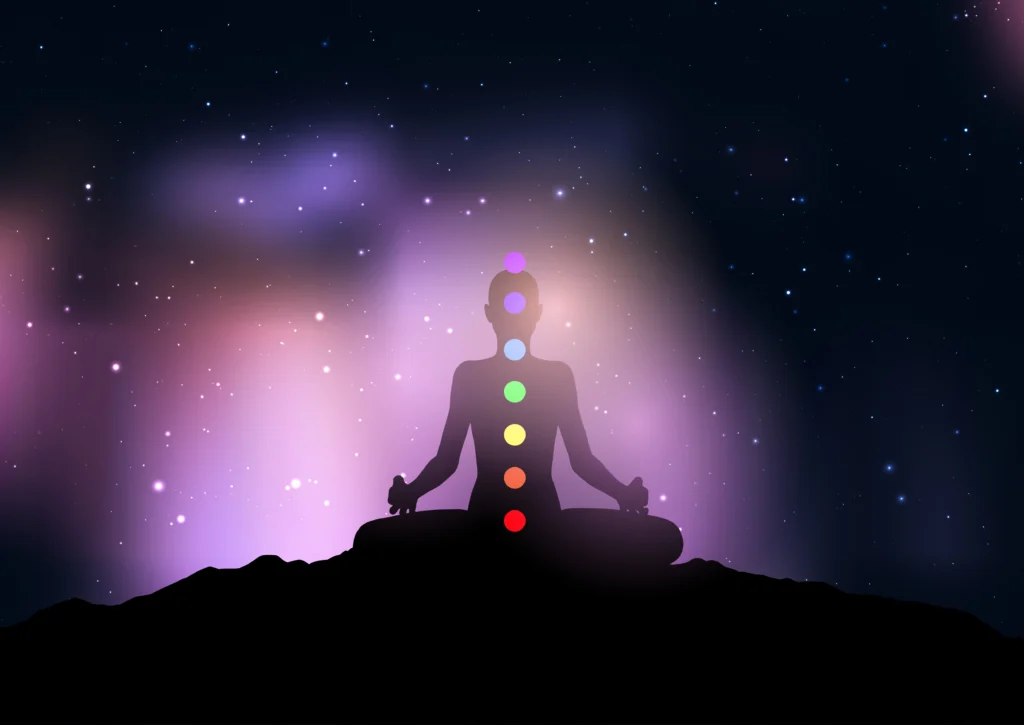
The word ‘chakra’ comes from Sanskrit and means wheel or circle. In yogic philosophy, chakras are spinning wheels or vortices of energy located along the central channel of the body (the sushumna nadi), running from the base of the spine to the crown of the head.
There are traditionally 114 chakras in the body — but seven are considered the main energy centres, each governing specific physical organs, emotional states, psychological patterns, and spiritual qualities. When these chakras are open and balanced, energy flows freely through the body and we experience health, vitality, emotional stability, and clarity. When they become blocked or overactive, we experience the specific physical and emotional symptoms associated with that chakra.
Modern neuroscience has noted interesting correlations between the locations of the seven main chakras and major nerve plexuses along the spine — suggesting that what ancient yogis described as energy centres may correspond to real physiological structures. Whether viewed through a spiritual or scientific lens, the chakra map offers a remarkably practical guide to self-understanding.
The 7 Chakras at a Glance
| Chakra | Location | Element | Yoga Poses | Signs of Imbalance |
| 1. Muladhara (Root) | Base of spine | Earth 🌍 | Mountain, Child’s Pose, Warrior I | Fear, insecurity, financial anxiety, feeling ungrounded |
| 2. Svadhisthana (Sacral) | Below navel | Water 💧 | Pigeon, Bound Angle, Low Lunge | Guilt, creative blocks, emotional instability, low libido |
| 3. Manipura (Solar Plexus) | Above navel | Fire 🔥 | Boat, Warrior III, Plank | Low confidence, powerlessness, digestive issues, anger |
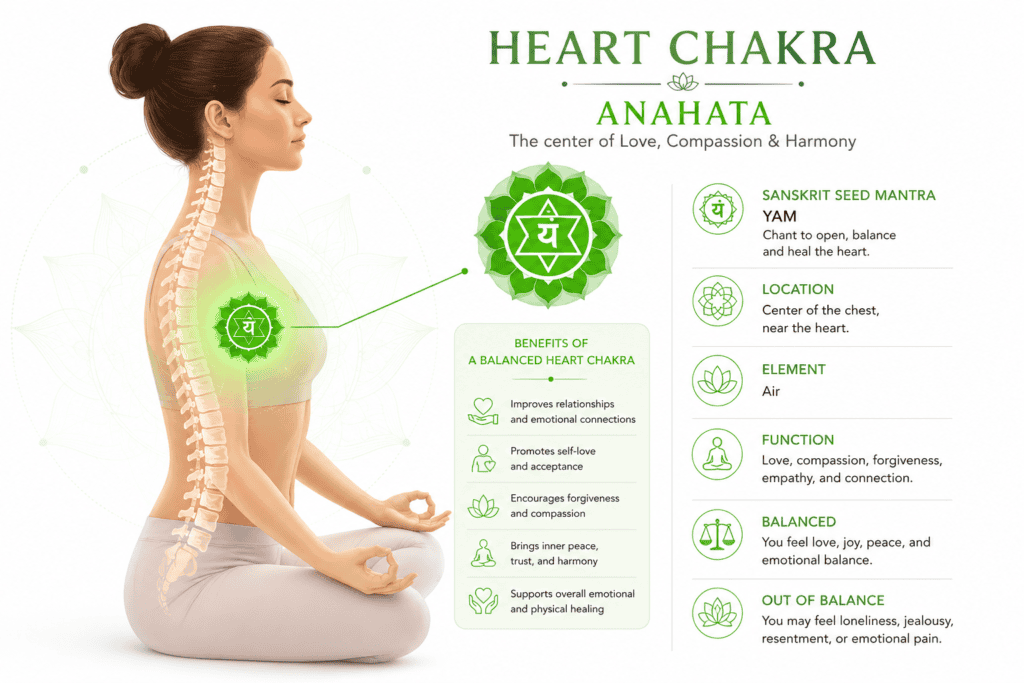
| 4. Anahata (Heart) | Centre of chest | Air 🌬️ | Camel, Cobra, Bridge, Fish | Grief, inability to love/receive, loneliness, resentment |
| 5. Vishuddha (Throat) | Throat | Space 🌌 | Shoulder Stand, Fish, Lion | Fear of speaking, poor communication, creativity blocks |
| 6. Ajna (Third Eye) | Between eyebrows | Light 💡 | Child’s Pose, Dolphin, Headstand | Lack of intuition, confusion, overthinking, poor focus |
| 7. Sahasrara (Crown) | Top of head | Thought ✨ | Headstand, Savasana, Lotus | Spiritual disconnection, cynicism, feeling meaningless |
The 7 Chakras and Their Yoga Poses — Complete Guide
1. Muladhara — Root Chakra 🔴
| 📍 Location: Base of spine, perineum | 🌊 Element: Earth 🧘 Best Poses: Mountain Pose, Child’s Pose, Warrior I, Malasana (Garland Pose) ✨ Affirmation: I am safe. I am grounded. I belong here. ⚠️ Signs of Imbalance: Anxiety, financial fear, feeling unsafe, disconnection from body, lower back pain |
The Root Chakra is your foundation — your sense of safety, stability, and belonging in the physical world. When it’s balanced, you feel grounded, secure, and at home in your body and in your life. When it’s blocked, even ordinary life feels threatening. Anxiety, financial worry, and a constant background sense of unease are classic Root Chakra imbalance symptoms.
Root Chakra yoga poses work by connecting you physically to the earth — grounding postures that emphasise the feet, legs, and base of the spine. The intention is to feel the floor beneath you, to let the earth hold your weight, to remember that you are supported.
Best Root Chakra Yoga Poses:
- Mountain Pose (Tadasana) — Stand with feet hip-width apart, press all four corners of both feet into the mat. Feel the floor rise to meet you. Hold for 10 breaths, eyes closed, breathing deeply into the belly.
- Child’s Pose (Balasana) — Kneel and fold forward, forehead to mat, arms extended or alongside the body. The contact of the forehead with the earth activates the grounding quality of this pose profoundly. Hold for 2-3 minutes.
- Malasana (Garland/Squat Pose) — A deep squat with feet flat or on a rolled mat if heels don’t reach. This pose connects you deeply to the earth and opens the hips and lower back simultaneously. Hold for 10-15 breaths.
2. Svadhisthana — Sacral Chakra 🟠
| 📍 Location: Below the navel, lower abdomen | 🌊 Element: Water 🧘 Best Poses: Pigeon Pose, Bound Angle Pose, Low Lunge, Hip Circles ✨ Affirmation: I feel. I create. I flow with life. ⚠️ Signs of Imbalance: Creative blocks, emotional numbness, guilt, relationship difficulties, lower abdominal tension |
The Sacral Chakra governs creativity, pleasure, emotional flow, and sensuality. It is associated with the element of water — which tells you something about what it needs: fluidity, movement, and the willingness to feel. When blocked, life feels flat and joyless. Creativity dries up. Emotions get stuck. When open and balanced, there is a natural aliveness and creative energy that flows effortlessly.
Sacral Chakra yoga focuses on the hip area — deep hip openers and fluid, circular movements that release the physical and emotional holding that accumulates in this region. The hips are famously where we store unexpressed emotions, and hip-opening poses often release surprising feelings.
Best Sacral Chakra Yoga Poses:
- Pigeon Pose (Eka Pada Rajakapotasana prep) — From Downward Dog, bring your right knee toward your right wrist. Lower your hips. Stay for 2-3 minutes each side. Breathe into any tension without forcing. This is the ultimate hip opener and Sacral Chakra pose.
- Bound Angle Pose (Baddha Konasana) — Sit with the soles of your feet together, knees open to the sides. Hold your feet and breathe deeply for 2-3 minutes. Allow the inner thighs to soften without forcing the knees down.
- Hip Circles — On all fours, make large, slow circles with your hips — clockwise, then counterclockwise. This fluid movement directly activates and frees the sacral energy. 10 circles each direction.
3. Manipura — Solar Plexus Chakra 🟡
| 📍 Location: Above the navel, upper abdomen | 🌊 Element: Fire 🧘 Best Poses: Boat Pose, Warrior III, Plank, Navasana, Twists ✨ Affirmation: I am powerful. I act with confidence. I am enough. ⚠️ Signs of Imbalance: Low self-confidence, powerlessness, poor digestion, anger, victim mentality, lack of direction |
The Solar Plexus Chakra is your personal power centre — the seat of confidence, willpower, and self-esteem. Its element is fire, and that’s exactly what a balanced Manipura feels like: a warm, steady flame of inner strength that doesn’t need external validation to keep burning. When blocked, there is either a collapse inward (low confidence, passivity) or an overcompensation outward (aggression, control, ego).
Solar Plexus yoga poses are active, core-engaging, and require real effort — because the Manipura needs to be activated, not just stretched. Poses that challenge the core and require sustained effort build the energetic quality of this chakra alongside the physical.
Best Solar Plexus Chakra Yoga Poses:
- Boat Pose (Navasana) — Sit with knees bent, lean back slightly, and lift your feet. Hold for 20-30 seconds, repeat 3 times. The intense core engagement directly activates Manipura energy. As you hold, affirm silently: ‘I am strong. I am capable.’
- Warrior III (Virabhadrasana III) — From standing, hinge forward at the hips and extend one leg behind you, creating a T-shape. Arms extended forward or at sides. Hold 5 breaths each side. The balance and core engagement required build solar plexus strength and confidence simultaneously.
- Spinal Twists — Seated or supine twists compress and release the digestive organs, stimulating the digestive fire (agni) that is directly linked to Manipura. Hold each side for 5-8 breaths.
4. Anahata — Heart Chakra 💚
| 📍 Location: Centre of chest, heart region | 🌊 Element: Air 🧘 Best Poses: Camel Pose, Cobra, Bridge, Fish Pose, Wild Thing ✨ Affirmation: I love freely. I give and receive with an open heart. ⚠️ Signs of Imbalance: Grief, loneliness, inability to forgive, fear of intimacy, resentment, chest tightness |
The Heart Chakra sits at the centre of the seven chakras — bridging the lower three (physical/earthly) and the upper three (spiritual/transcendent). It governs love, compassion, forgiveness, and connection. A balanced Anahata is warm, generous, and able to give and receive love freely. A blocked Heart Chakra manifests as grief held in the chest, inability to forgive, emotional walls, or a persistent loneliness even when surrounded by people.
Heart Chakra yoga focuses on backbends and chest-opening poses — physically opening the front of the body, the sternum, and the space around the heart. Many practitioners report unexpected emotional releases during deep backbending. This is the Anahata doing exactly what it is supposed to do.
Best Heart Chakra Yoga Poses:
- Camel Pose (Ustrasana) — Kneel with hips over knees, reach back for your heels, let the chest rise toward the ceiling. The complete front-body opening of Camel is one of the most powerful Heart Chakra poses. Hold for 5-8 breaths. Come out slowly.
- Bridge Pose (Setu Bandhasana) — Lie on your back, bend your knees, press through your feet to lift your hips. The chest gently presses toward the chin. Hold for 10 breaths, repeat 3 times. A gentler heart opener that is accessible to all levels.
- Fish Pose (Matsyasana) — Lie on your back, press through your elbows to lift your chest and drop the crown of your head gently toward the mat. The full front of the chest opens completely. Hold for 5-10 breaths, breathing deeply into the heart space.
5. Vishuddha — Throat Chakra 🔵
| 📍 Location: Throat, neck, jaw | 🌊 Element: Space/Ether 🧘 Best Poses: Shoulderstand, Fish Pose, Lion’s Breath, Neck Stretches, Plow Pose ✨ Affirmation: I speak my truth. My voice matters. I express myself freely. ⚠️ Signs of Imbalance: Fear of speaking, poor communication, chronic throat issues, inability to express feelings, feeling unheard |
The Throat Chakra governs communication, self-expression, and the ability to speak your truth. In a culture that frequently teaches people — especially women — to be quiet, to shrink, to not take up space, the Throat Chakra is one of the most commonly blocked energy centres. The physical manifestations can be striking: chronic throat clearing, frequent sore throats, tight jaw, and a persistent sense of ‘not being heard’ even when you do speak.
Throat Chakra yoga involves poses that bring attention and energy to the neck and throat region — inversions that increase blood flow to the area, gentle backbends that open the throat, and pranayama practices that work directly with the breath and voice.
Best Throat Chakra Yoga Poses:
- Supported Shoulderstand (Sarvangasana) — Lie on your back and lift your legs and torso, supporting your lower back with your hands. The chin draws toward the chest, creating a chin lock (jalandhara bandha) that directly stimulates the Throat Chakra. Hold for 1-3 minutes.
- Lion’s Breath (Simhasana Pranayama) — Sit comfortably, inhale deeply, then exhale forcefully through an open mouth with tongue extended and a ‘ha’ sound. This pranayama directly releases throat tension and blocked expression. Repeat 5-7 times.
- Gentle Neck Stretches — Seated, slowly drop your right ear toward your right shoulder, holding for 5 breaths. Switch sides. Then slowly drop your chin toward your chest and hold. Move slowly and consciously — the neck holds an enormous amount of stress and tension.
6. Ajna — Third Eye Chakra 👁️
| 📍 Location: Between the eyebrows, centre of forehead | 🌊 Element: Light 🧘 Best Poses: Child’s Pose, Dolphin Pose, Headstand, Forward Folds ✨ Affirmation: I trust my intuition. I see clearly. I am connected to my inner wisdom. ⚠️ Signs of Imbalance: Overthinking, poor intuition, confusion, lack of focus, difficulty making decisions, headaches |
The Third Eye Chakra is the centre of intuition, inner vision, and wisdom. It governs the ability to see clearly — not just with the physical eyes, but with the inner eye of perception and discernment. When balanced, you trust your gut, make decisions with clarity, and have a strong sense of your own inner knowing. When blocked, the mind becomes noisy, overthinking dominates, and there is a persistent sense of confusion or inability to see the path forward.
Third Eye Chakra yoga focuses on poses that bring physical awareness and pressure to the forehead region — forward folds and inversions where the forehead contacts the mat, as well as practices that quiet the mental chatter and develop inward focus.
Best Third Eye Chakra Yoga Poses:
- Child’s Pose with Forehead to Mat — The gentle pressure of the forehead on the mat directly stimulates the Ajna point. Stay for 3-5 minutes, breathing slowly. This is one of the most effective Third Eye practices available — and one of the simplest. Let the mind quiet.
- Dolphin Pose (Forearm Downward Dog) — With forearms on the mat and hips lifted, the head hangs between the arms. The mild inversion increases blood flow to the head and the brain. Hold for 10-15 breaths, focusing your internal gaze at the space between the eyebrows.
- Trataka (Steady Gazing) — This isn’t a yoga pose but a yoga practice: fix your gaze softly on a candle flame or a single point on the wall for 2-3 minutes without blinking. This simple practice directly develops the focused, one-pointed awareness of the Third Eye. Do it at the end of your asana practice.
7. Sahasrara — Crown Chakra 🟣
| 📍 Location: Top of the head | 🌊 Element: Thought/Consciousness 🧘 Best Poses: Headstand, Lotus Pose, Savasana, Silent Meditation ✨ Affirmation: I am connected. I am part of something greater. I am at peace. ⚠️ Signs of Imbalance: Spiritual disconnection, cynicism, existential emptiness, feeling meaningless, inability to surrender |
The Crown Chakra sits at the top of the head — the point of connection between individual consciousness and universal consciousness. It governs our sense of spiritual connection, meaning, and the understanding that we are part of something greater than the individual self. When balanced, there is a deep sense of peace, trust in life, and connection to a larger purpose. When blocked, life feels meaningless, spirituality feels empty, and there is a persistent sense of separation.
Crown Chakra yoga is the most subtle of all the chakra practices. The physical poses are secondary to the quality of awareness and surrender that you bring to them. Headstand, Lotus, and Savasana are the primary poses — with deep, silent meditation being perhaps the most powerful Crown Chakra practice of all.
Best Crown Chakra Yoga Poses:
- Headstand (Sirsasana) — The king of all poses and the ultimate Crown Chakra practice. The crown of the head contacts the earth while the feet reach toward the sky — literally connecting the body’s highest point to the ground. If headstand is not yet accessible, practice its preparation: Dolphin Pose with eyes closed and focus at the crown.
- Lotus Pose or Easy Seated Pose with Eyes Closed — Sit comfortably, spine tall, hands in Gyan Mudra (index finger and thumb touching), and simply be. No agenda. No goal. This quality of open, agenda-free sitting is the purest Crown Chakra practice.
- Savasana (Corpse Pose) — Lie completely flat, arms slightly away from the body, eyes closed. The practice of complete surrender in Savasana is a Crown Chakra practice. It asks you to let go of doing, planning, and controlling — and to simply be. Stay for 5-10 minutes minimum.
Complete 30-Minute Chakra Balancing Yoga Sequence
This sequence moves through all seven chakras in order — from Root to Crown. Practice it in the morning for an energising start, or in the evening for a deep release. All you need is a yoga mat and 30 quiet minutes.
| # | Pose | Chakra Target | Hold Time | Focus |
| 1 | Mountain Pose (Tadasana) | Root 🔴 | 10 breaths | Feel feet grounded, breathe into base of spine |
| 2 | Malasana (Squat Pose) | Root 🔴 | 10 breaths | Press heels down, feel earth connection |
| 3 | Low Lunge (Anjaneyasana) | Sacral 🟠 | 8 breaths/side | Open hips, breathe into lower belly |
| 4 | Pigeon Pose Prep | Sacral 🟠 | 2 min/side | Let hips fully release, no forcing |
| 5 | Boat Pose (Navasana) | Solar Plexus 🟡 | 3 x 20 sec | Core engaged, affirm inner strength |
| 6 | Warrior III | Solar Plexus 🟡 | 5 breaths/side | Balance and power, steady gaze |
| 7 | Camel Pose (Ustrasana) | Heart 💚 | 5 breaths | Open chest fully, breathe into heart |
| 8 | Bridge Pose (Setu Bandhasana) | Heart 💚 | 10 breaths | Lift heart toward chin, soften |
| 9 | Supported Shoulderstand | Throat 🔵 | 2 minutes | Chin toward chest, long smooth breath |
| 10 | Fish Pose (Matsyasana) | Throat 🔵 | 8 breaths | Open throat, breathe freely |
| 11 | Child’s Pose (forehead to mat) | Third Eye 👁️ | 3 minutes | Forehead presses gently, mind quiets |
| 12 | Savasana with Crown awareness | Crown 🟣 | 5-10 minutes | Complete surrender, total stillness |
| 💡 How to Practice This Sequence Move through each pose slowly and deliberately. This is not a workout — it is a journey inward. Between poses, pause for 2-3 natural breaths and notice what you feel. The transitions are as important as the poses. Keep a journal nearby — insights that arise during chakra balancing yoga practice are worth capturing. |
How to Know When Your Chakras Are Balancing
Many people ask — how do I know if this is working? Here are the signs that your chakra balancing yoga practice is having a genuine effect:
- You feel more grounded and less reactive to daily stressors (Root Chakra opening)
- Creative ideas flow more easily — you feel inspired rather than blocked (Sacral Chakra opening)
- You feel more confident in decisions and less dependent on others’ approval (Solar Plexus opening)
- Relationships feel easier — you give and receive affection more naturally (Heart Chakra opening)
- You speak up more easily and feel genuinely heard by others (Throat Chakra opening)
- Intuitive flashes become more frequent and reliable (Third Eye opening)
- A background sense of peace and meaning that doesn’t depend on external circumstances (Crown Chakra opening)
These shifts happen gradually — over weeks and months of consistent practice, not overnight. The physical yoga practice opens the energetic pathways. Regular meditation deepens the work. Patience and consistency are the only requirements.
Expert Tips for Deepening Your Chakra Balancing Yoga Practice
- Practice the full sequence at least twice a week — once a week is maintenance, twice a week is transformation
- Add colour visualisation — as you work each chakra, visualise its corresponding colour filling that region of your body with light
- Use seed mantras — each chakra has a Sanskrit seed sound (LAM, VAM, RAM, YAM, HAM, OM, silence) that can be chanted or silently repeated during the relevant poses
- Keep a chakra journal — note which chakras feel tight or blocked during practice. Patterns over weeks reveal where your deepest work is
- Combine with pranayama — Bhramari pranayama is excellent for the upper chakras; Kapalbhati for the lower three
- Don’t rush the Crown — Savasana is not optional. The Crown Chakra opens in surrender, not in effort
Conclusion
Chakra balancing yoga is one of the most complete practices available to a modern yogi — because it addresses not just the physical body, but the emotional, psychological, and spiritual dimensions of being human. It gives you a language for what you’re feeling, a map for where to look, and a set of practical tools for working with whatever you find.
The seven chakras are not abstract concepts. They are living, breathing aspects of your experience — showing up as the anxiety in your chest before a difficult conversation (Throat), the grief that sits heavy in the heart after a loss (Heart), the scattered, foggy mind that can’t make a decision (Third Eye). Chakra balancing yoga meets these experiences exactly where they are and offers a path through them.
Start with the 30-minute sequence in this guide. Practice it twice this week. Notice what feels tight, what feels open, what surprises you. Then come back to it. The chakras will keep teaching you — as long as you keep showing up to learn.
Frequently Asked Questions About Chakra Balancing Yoga
Q: What is chakra balancing yoga and does it actually work?
A: Chakra balancing yoga uses specific poses and breathing techniques to harmonise the seven main energy centres of the body. Research supports its physical benefits — reduced stress, improved flexibility, and emotional balance. Most practitioners notice genuine shifts within 4-8 weeks of consistent practice.
Q: How long does it take to balance all 7 chakras?
A: There is no fixed timeline — it is an ongoing practice, not a one-time fix. Most people notice shifts within 4-8 weeks of twice-weekly practice. Deeper transformation typically takes 3-6 months. Think of the chakras as a lifelong system to maintain, not a checklist to complete.
Q: Which chakra should I work on first?
A: Always start with the Root Chakra. Without a stable foundation — safety, grounding, physical wellbeing — the higher chakras cannot function properly. Even if your symptoms seem to be at the Heart or Throat level, Root Chakra work supports everything above it. Then work your way up in order.
Q: Can I do chakra balancing yoga every day?
A: Yes — daily practice is ideal. Alternate between the full 30-minute sequence 2-3 times per week and shorter 10-minute focused sessions on other days. Consistency matters more than duration — 10 minutes daily beats 60 minutes once a week every time.
Q: What are the signs of blocked chakras?
A: Root: anxiety, lower back pain. Sacral: creative blocks, emotional numbness. Solar Plexus: low confidence, digestive issues. Heart: grief, difficulty in relationships. Throat: fear of speaking, feeling unheard. Third Eye: overthinking, poor focus. Crown: spiritual disconnection, feeling empty. Most people have 1-2 chronically blocked chakras that become their main focus.
Q: Do I need to believe in chakras for this to work?
A: No. The poses are excellent yoga regardless of your beliefs. Pigeon Pose opens the hips whether you call it Sacral Chakra work or a hip stretch. The chakra framework adds intention and self-awareness — but the physical and psychological benefits exist independently of it.
Visit our YouTube channel to find out more information on yoga and meditation.