

⚡ Quick Answer Box
The best yoga poses for sleep are restorative, forward-folding, and legs-elevated postures that activate the parasympathetic nervous system — the body’s “rest and digest” mode. The top 12 include Child’s Pose, Legs Up the Wall, Reclined Butterfly, Seated Forward Fold, Supine Twist, and Corpse Pose. Practice them for 15–30 minutes within 1–2 hours before bed. Research confirms that regular bedtime yoga significantly improves sleep onset time, sleep quality, and total sleep duration — especially for people with insomnia and anxiety.
You’re exhausted. You get into bed. And then — nothing. Your mind races. Your body won’t settle. You stare at the ceiling until 2 AM wondering why sleep feels so impossibly far away.
If this sounds familiar, yoga poses for sleep may be the most practical and effective solution you haven’t tried yet.
Not the sweaty, vigorous kind. Not power yoga or vinyasa flow. Specifically: slow, gentle, breath-focused postures performed in the 30–60 minutes before bed — designed to shift your nervous system from the anxious, overstimulated “fight or flight” state into the calm, receptive “rest and digest” state where sleep becomes natural and inevitable.
This guide covers exactly which yoga poses help you sleep, why they work at a physiological level, how to do each one step by step, and how to build them into a complete 20-minute bedtime routine you can start tonight.
Why Yoga Poses Help You Sleep: The Science
Before we cover the poses, here is the mechanism — because understanding why something works makes you far more likely to do it consistently.
The Nervous System Connection
Your body has two operating modes governed by the autonomic nervous system:
Sympathetic nervous system (SNS) — “Fight or flight.” Activated by stress, screens, deadlines, arguments, caffeine, and mental stimulation. Raises cortisol. Elevates heart rate. Keeps the brain alert and scanning for threats. This is the mode most modern adults are stuck in when they try to fall asleep.
Parasympathetic nervous system (PNS) — “Rest and digest.” Activated by slow breathing, physical stillness, warmth, dim light, and gentle physical movement. Lowers cortisol. Slows heart rate. Signals to the brain: the day is over. It is safe to sleep.
Yoga poses for sleep work by directly activating the parasympathetic nervous system. Forward folds stimulate the vagus nerve — the primary nerve of the PNS. Legs-elevated poses redirect blood flow away from the muscles and toward the core organs, triggering deep relaxation. Slow, deep breathing (the foundation of all bedtime yoga) activates the diaphragm in a way that sends parasympathetic signals throughout the entire body.
What the Research Says
A systematic review published in the peer-reviewed journal Alternative Therapies in Health and Medicine found that yoga significantly improved subjective sleep quality in participants with chronic insomnia. Participants who practiced bedtime yoga for 8 weeks reported:
- Faster sleep onset (falling asleep more quickly)
- Fewer nighttime awakenings
- Longer total sleep duration
- Improved daytime functioning and reduced fatigue
Research published on the National Center for Biotechnology Information confirms that yoga and pranayama practices directly activate the parasympathetic nervous system — reducing cortisol, calming the stress response, and creating the internal conditions the body needs for sleep. (Read the research)
The mechanism is clear. The evidence is solid. Now — here are the poses.
The 3 Golden Rules of Yoga for Sleep
Before you begin any of the poses below, internalize these three rules. They determine whether your bedtime yoga actually shifts your nervous system — or accidentally stimulates it further.
Rule 1: Slow Everything Down
Bedtime yoga is not a workout. Move at half the speed you think you need to. Transition between poses slowly. The slower you move, the deeper the parasympathetic response.
Rule 2: Breathe Through Your Nose — Long Exhales
The exhale activates the parasympathetic nervous system. Extend your exhale to be longer than your inhale. A 4-count inhale / 6-count exhale pattern is ideal for sleep preparation. Never breathe through the mouth during bedtime yoga.
Rule 3: No Screens — No Exceptions
The blue light emitted by phones and screens suppresses melatonin production directly. Practicing yoga while looking at your phone defeats the purpose entirely. Keep your phone in another room or face-down. Follow this guide from memory after reading it once.
12 Best Yoga Poses For Sleep: Step-by-Step
These 12 poses are ordered into a complete bedtime sequence. Practice them in this order for maximum nervous system benefit.
1. Easy Seated Breathing (Sukhasana with Pranayama)
Start here. Seated breathing grounds your awareness and begins the shift from sympathetic to parasympathetic nervous system activity before you do a single physical pose.
Why it works for sleep: The act of sitting still with closed eyes and directing attention to the breath immediately begins to downregulate the stress response. It signals to the brain: we are no longer in problem-solving mode.
How to do it:
- Sit cross-legged on your bed or mat with a folded blanket under your hips if needed
- Close your eyes
- Place both hands on your knees, palms facing up
- Inhale slowly through your nose for 4 counts
- Exhale slowly through your nose for 6 counts
- Repeat for 10–15 breath cycles before moving to any physical pose
- Notice your body beginning to slow and soften with each exhale
Hold: 10–15 breath cycles (approximately 2–3 minutes)
Why the extended exhale matters: The exhale stimulates the vagus nerve — the primary nerve of the parasympathetic nervous system. Extending the exhale beyond the inhale has been shown to reduce heart rate variability and lower cortisol within minutes. This is not metaphor — it is measurable physiology.
Modification: If sitting cross-legged is uncomfortable, sit on the edge of a chair with feet flat on the floor. The breathing is the practice here — not the posture.
2. Neck Rolls and Shoulder Release
The neck and shoulders are the primary storage sites for daily stress tension. Releasing them before lying down dramatically improves your ability to relax into sleep.
Why it works for sleep: Chronic tension in the trapezius, levator scapulae, and sternocleidomastoid muscles (neck and shoulder muscles) keeps the sympathetic nervous system mildly activated throughout the night — contributing to restless sleep, tension headaches, and morning stiffness. Releasing this tension directly before bed removes a significant physical barrier to deep rest.
How to do it:
- From Easy Pose, inhale and lengthen your spine
- On an exhale, drop your right ear toward your right shoulder — do not force it
- Breathe here for 3–4 slow breaths. Feel the left side of your neck and upper shoulder lengthening
- Inhale to bring your head back to center
- Exhale and drop your left ear to your left shoulder — hold 3–4 breaths
- Bring your head to center — chin slightly tucked
- Slowly roll your chin toward your chest and make 3–4 very slow circles in each direction
- Finish with 3–5 slow shoulder rolls: inhale — shoulders up to ears. Exhale — roll them back and down
Hold: 3–4 breaths each side, 3–4 minutes total
Key awareness cue: Never roll the head fully backward (no full neck circles). Keep all movement slow and pain-free. If you feel any sharp sensation, make the movement smaller.
3. Cat-Cow (Marjaryasana-Bitilasana) — Slow Version
A slow, breath-synchronized Cat-Cow directly massages the vagus nerve through diaphragmatic activation — one of the fastest routes to parasympathetic activation available in yoga.
Why it works for sleep: The spine contains the sympathetic nerve chain (the paravertebral chain) running alongside the vertebrae. Gentle, rhythmic spinal movement — especially combined with deep diaphragmatic breathing — modulates the activity of this chain, reducing its output and shifting the system toward rest.
How to do it:
- Come to hands and knees — wrists under shoulders, knees under hips
- Make your Cat-Cow even slower than usual — take a full 4 counts for each inhale, 6 for each exhale
- Cow: Inhale (4 counts) — belly drops, chest lifts, tailbone rises, gaze soft
- Cat: Exhale (6 counts) — spine rounds fully to ceiling, chin tucks, belly draws in
- Move so slowly that the breath is clearly leading the movement — not following it
- Close your eyes if balance allows
Hold: 10 very slow breath cycles (approximately 3–4 minutes at this pace)
Sleep-specific modification: Make each Cat position slightly more pronounced — the full rounding of the spine in Cat is particularly activating for the vagus nerve. Linger in the exhale/Cat position slightly longer than the inhale/Cow.
4. Child’s Pose (Balasana) — Extended Hold
Child’s Pose is one of the single most effective yoga poses for sleep. The forward fold, the physical compression of the belly, and the grounding of the forehead all send powerful parasympathetic signals to the brain.
Why it works for sleep: Three mechanisms work simultaneously in Child’s Pose:
- Forward fold — stimulates the vagus nerve through abdominal compression
- Forehead on mat — pressure on the forehead activates the frontal lobe’s parasympathetic centers
- Fetal position — the body’s evolutionary association with safety and rest is activated by this posture
How to do it:
- From tabletop, bring your big toes together and widen your knees to the edges of your mat (or keep knees together if you prefer)
- Exhale and walk your hands forward, lowering your chest and forehead to the mat
- Let your arms extend forward OR rest them alongside your body, palms facing up
- Completely surrender your body weight to the floor — no holding, no bracing
- With each exhale, feel yourself sinking fractionally deeper into the mat
- Breathe into your lower back — feel it expand on each inhale
Hold: 15–20 breaths (3–5 minutes). This pose is worth holding longer than feels normal.
Sleep enhancement tip: Mentally scan your body from the crown of your head to your toes while in Child’s Pose. At each body part, consciously release. This progressive body scan in the pose amplifies the parasympathetic response significantly.
Modification: Place a folded blanket or pillow between your thighs and calves if your hips don’t reach your heels. Place a pillow under your forehead for full support.
5. Thread the Needle (Parsva Balasana)
Thread the Needle releases the deep muscles of the upper back and between the shoulder blades — the muscles most responsible for carrying unresolved daytime tension into the night.
Why it works for sleep: The rhomboids and middle trapezius (muscles between the shoulder blades) are chronically overactivated in people who experience stress-related sleep difficulties. These muscles also physically compress the thoracic spine when tense — restricting breathing depth. Releasing them before bed directly improves breathing quality during sleep.
How to do it:
- Start in tabletop position
- Slide your right arm under your left arm along the mat, palm facing up
- Allow your right shoulder and the right side of your head to rest on the mat
- Your left hand can stay where it is or walk forward for a deeper stretch
- Breathe slowly and deeply — feel your right shoulder and upper back releasing with each exhale
- Stay for 8–10 slow breaths
- Press back to tabletop and repeat on the left side
Hold: 8–10 breaths each side (approximately 3–4 minutes)
Semantic specificity note: This pose specifically targets the thoracic spine rotation and posterior shoulder capsule — two areas rarely addressed by forward folds alone. Including it in a bedtime sequence addresses a gap that most “yoga for sleep” posts miss entirely.
6. Seated Forward Fold (Paschimottanasana)
Seated Forward Fold is one of yoga’s most powerful parasympathetic-activating postures. The complete forward fold — chest over legs, head down — directly stimulates the vagus nerve and signals the brain that the body is safe to rest.
Why it works for sleep: The vagus nerve runs from the brainstem, through the chest, and into the abdomen. Forward folds compress the abdomen gently, stimulating vagal tone directly. Higher vagal tone is associated with faster sleep onset, deeper sleep stages, and greater emotional resilience — making this one of the most physiologically well-supported yoga poses for sleep.
How to do it:
- Sit on your mat or bed with legs extended straight in front of you
- Place a pillow or bolster across your thighs if available
- Inhale — sit tall and lengthen your spine
- Exhale — hinge from your hips (not your waist) and fold forward
- Rest your hands on your shins, ankles, feet, or on a strap around your feet
- If you have a pillow on your thighs, rest your forehead on it — this deepens the relaxation significantly
- Let your entire upper body surrender to gravity
- Breathe into your lower back — it should expand with each inhale
Hold: 15–20 very slow breaths (4–6 minutes). The longer this is held, the deeper the relaxation response.
Key alignment cue for sleep: At bedtime, the goal is NOT hamstring stretch depth — it is nervous system downregulation. Bend your knees generously. Use a pillow. Round your back if it helps you feel more collapsed and surrendered. The surrender is the practice.
Modification: Sit on a folded blanket to tilt the pelvis forward. Loop a strap around your feet if your hands don’t reach. Bend your knees as much as needed.
7. Butterfly Pose / Reclined Butterfly (Baddha Konasana)
Reclined Butterfly (lying on your back with the soles of the feet together and knees open) is the perfect transition from seated to supine poses — and one of the deepest hip openers available in a bedtime sequence.
Why it works for sleep: The inner thighs and groin area hold significant tension in people who experience chronic stress — particularly those who sit for long periods during the day. The passive opening of the hips in Reclined Butterfly releases this tension without any muscular effort, making it deeply restoring. The supine position also begins the transition toward the sleeping position.
Seated Butterfly — How to do it:
- Sit tall with the soles of your feet together, knees falling open like a book
- Hold your feet or ankles with both hands
- Inhale — lengthen your spine
- Exhale — hinge gently forward, resting your elbows on your thighs if comfortable
- Hold for 8 breaths
Reclined Butterfly — How to do it:
- From seated Butterfly, gently lower your back to the floor
- Soles of feet together, knees falling open
- Place one hand on your belly and one on your heart
- Close your eyes
- Breathe slowly — feel your belly rise and fall under your palm
- With each exhale, feel your knees dropping fractionally closer to the floor — without any forcing
Hold: 15–20 slow breaths in Reclined Butterfly (4–5 minutes)
Sleep enhancement: Place yoga blocks or folded blankets under each knee to fully support the weight of your legs. When the legs are supported, the inner thigh muscles release completely — this is when the deepest parasympathetic response occurs.
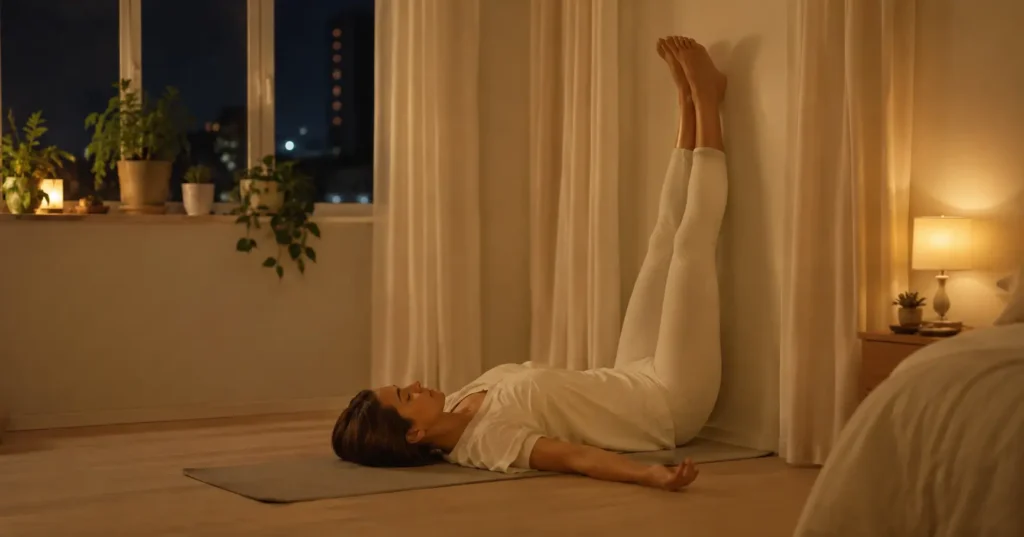
8. Legs Up the Wall (Viparita Karani)
Legs Up the Wall is the single most powerful yoga pose for sleep in this entire guide. It combines the benefits of a mild inversion, complete muscular rest, and the body’s natural response to elevated legs — all of which drive deep parasympathetic activation.
Why it works for sleep: When your legs are elevated above your heart:
- Blood and lymphatic fluid flow away from the legs (where tension accumulates during the day) and back toward the heart and core organs
- Venous return to the heart is assisted by gravity — reducing cardiac workload and lowering heart rate
- The nervous system reads the supine, legs-elevated position as a signal of complete physical safety — no running required, no threat present
This is one of the most well-researched restorative yoga poses for insomnia and anxiety-related sleep disruption.
How to do it:
- Sit sideways next to a wall (or your headboard)
- Swing your legs up the wall as you lower your back to the floor
- Shuffle your hips as close to the wall as comfortable — ideally 2–5 cm from the baseboard
- Extend both legs up the wall, feet relaxed (not flexed)
- Let your arms rest at your sides, palms facing the ceiling
- Close your eyes and breathe naturally
- Feel the weight of your legs being held completely by the wall — no muscular effort required
Hold: 5–10 minutes. This is the one pose worth holding the longest.
Sleep-specific variation: Perform this pose in your bedroom with the lights dimmed or off. Many people fall asleep either in this pose or immediately after lying flat from it.
Modification: Place a folded blanket or bolster under your hips to elevate them slightly — this deepens the inversion effect and relieves any lower back discomfort. If a wall is not available, elevate your legs on a stack of pillows instead.
Contraindication: Avoid during menstruation (traditional yoga teaching). Avoid with glaucoma, high blood pressure, or if you have had recent abdominal or eye surgery.
9. Supine Spinal Twist (Supta Matsyendrasana)
A gentle supine twist before sleep releases the spinal muscles, massages the abdominal organs, and completes the physical release of tension accumulated along the spine during the day.
Why it works for sleep: The spine contains the sympathetic nerve chain — a network of ganglia running alongside the thoracic and lumbar vertebrae that governs the “fight or flight” response. Gentle spinal twisting has been shown to reduce the output of this chain, directly complementing the parasympathetic activation achieved by the forward folds and inversions above.
How to do it:
- Lie on your back with knees bent, feet flat on the mat
- Draw your right knee to your chest and hug it briefly
- Guide your right knee across your body to the left — letting it rest on the mat or on a pillow
- Extend your right arm out to the right at shoulder height, palm facing up
- Turn your gaze gently to the right — toward your outstretched arm
- Left hand rests gently on your right knee (no pressure — just a light suggestion)
- With each exhale, feel your right shoulder softening toward the floor
- Breathe here for 10–12 slow breaths
- Inhale to bring the knee back to center — pause — then switch to the left side
Hold: 10–12 breaths each side (approximately 4–5 minutes total)
Key sleep cue: Let both shoulders rest equally heavy on the floor. The twist does not need to be deep to be effective. In bedtime yoga, the quality of relaxation always outweighs the degree of physical rotation.
10. Happy Baby Pose (Ananda Balasana)
Happy Baby Pose releases the lower back, sacrum, and inner groins simultaneously while placing the body in a posture physically associated with comfort, safety, and play — all of which counter the vigilance state that disrupts sleep.
Why it works for sleep: The sacroiliac joint and lower lumbar spine carry enormous tension in adults who sit for prolonged periods. This tension often manifests as a subtle, low-level discomfort that keeps the nervous system partially activated during the night. Happy Baby directly addresses this with no effort beyond holding the pose.
How to do it:
- Lie on your back and draw both knees toward your chest
- Open your knees wider than your torso
- Flex your feet — soles facing the ceiling
- Reach your hands to the outer edges of your feet (or hold your shins if that’s more comfortable)
- Gently draw your knees toward your armpits
- Rock gently side to side — like a happy baby
- Feel your lower back release and flatten against the mat with each gentle rock
Hold: 10–15 breaths (3–4 minutes)
Sleep note: The gentle rocking movement in Happy Baby activates the vestibular system — the same system that causes babies to fall asleep when rocked. This is not coincidental. The rhythmic, gentle movement is deeply sleep-inducing.
11. Corpse Pose with Body Scan (Savasana + Yoga Nidra)
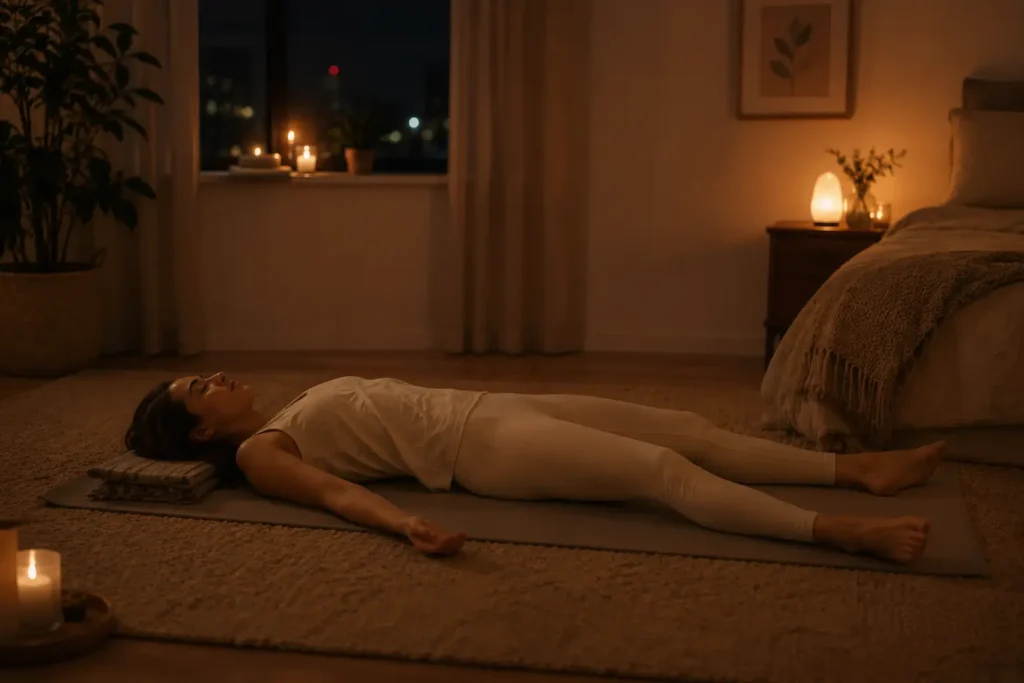
Savasana with a body scan (a simplified form of Yoga Nidra) is the most powerful sleep-inducing yoga practice available. It moves practitioners through the hypnagogic state — the threshold between waking and sleep — in a controlled, intentional way.
Why it works for sleep: Yoga Nidra (often called “yogic sleep”) induces a brain-wave state between alpha and theta — the state of deep relaxation just before sleep. Studies using EEG have shown that even 20 minutes of Yoga Nidra is equivalent in restorative effect to 4 hours of ordinary sleep. While a full Yoga Nidra practice is a guided protocol, the body scan described below creates a similar neurological state.
How to do it:
- Lie flat on your back — arms slightly away from your body, palms facing up
- Let your feet fall open naturally
- Close your eyes and take 3 deep, slow breaths
- Begin the body scan — directing your awareness to each body part in sequence, and consciously releasing any held tension there:
Body Scan Sequence (say each mentally on an exhale):
- “My right foot is heavy and warm.”
- “My right calf is heavy and warm.”
- “My right thigh is heavy and warm.”
- “My left foot is heavy and warm.”
- “My left calf is heavy and warm.”
- “My left thigh is heavy and warm.”
- “My lower back is heavy and released.”
- “My belly is soft.”
- “My chest is open and at rest.”
- “My right hand is heavy.”
- “My right arm is heavy.”
- “My left hand is heavy.”
- “My left arm is heavy.”
- “My shoulders are released.”
- “My jaw is soft.”
- “My eyes are heavy.”
- “My forehead is smooth.”
- “My entire body is heavy, warm, and at rest.”
- After completing the scan, simply breathe — do not try to sleep, do not try to stay awake. Simply observe.
Hold: 10–20 minutes. Many people will fall asleep during or immediately after the body scan.
Key instruction: If you notice your mind moving away from the body scan — toward thoughts, plans, or worries — gently return it to the next body part without self-criticism. The return is the practice.
12. Reclining Bound Angle with Bolster (Supta Baddha Konasana — Supported)
The supported, bolster-assisted Reclining Bound Angle is the ultimate restorative closing pose. It combines passive chest opening, hip release, and complete physical surrender — creating the ideal conditions for the transition from practice to sleep.
Why it works for sleep: Unlike Reclined Butterfly (pose 7), this version uses a bolster under the spine to create a gentle passive chest opener. This combination — open chest, open hips, supine position, complete support — has been called “the most restorative yoga pose” by several Yin yoga traditions. It directly counters the physical posture of stress (collapsed chest, tight hips, forward head) at a structural level.
How to do it:
- Place a yoga bolster or rolled blanket lengthwise on your mat (running head to tailbone)
- Sit in front of the bolster with soles of feet together, knees open
- Lean back onto the bolster — it should run along your entire spine
- Your head rests at the top end of the bolster (use an extra pillow if needed)
- Place yoga blocks or folded blankets under each knee for full support
- Let your arms rest open at your sides — palms up
- Close your eyes
- Breathe naturally and completely let go
Hold: 5–10 minutes. This is a pose you can fall asleep in.
The most important instruction: Do nothing. There is nothing to achieve here. No alignment to check. No deeper to go. Simply be held — by the bolster, by the floor, by gravity — and allow your nervous system to complete its journey from activated to at rest.
Your Complete 20-Minute Bedtime Yoga Sequence
Practice these 12 poses in order, 30–60 minutes before sleep:
| # | Pose | Hold | Nervous System Effect |
|---|---|---|---|
| 1 | Easy Seated Breathing | 3 min | Initiates PNS shift |
| 2 | Neck Rolls + Shoulder Release | 3 min | Releases stress storage sites |
| 3 | Cat-Cow (slow) | 3–4 min | Vagus nerve activation |
| 4 | Child’s Pose | 3–5 min | Deep parasympathetic signal |
| 5 | Thread the Needle | 3 min | Thoracic + shoulder release |
| 6 | Seated Forward Fold | 4–6 min | Vagal tone increase |
| 7 | Reclined Butterfly | 4–5 min | Hip tension release |
| 8 | Legs Up the Wall | 5–10 min | Full systemic restoration |
| 9 | Supine Spinal Twist | 4–5 min | Sympathetic chain release |
| 10 | Happy Baby | 3–4 min | Sacral + lower back release |
| 11 | Savasana + Body Scan | 10–20 min | Hypnagogic state induction |
| 12 | Supported Reclining Butterfly | 5–10 min | Complete surrender |
Total time: 20 minutes (minimum) — 45 minutes (full practice) Recommended frequency: Nightly for maximum benefit; 4–5 times per week minimum
What to Avoid in Bedtime Yoga (Critical)
These common mistakes will prevent your bedtime yoga from working — even if you practice every pose correctly:
❌ Practicing vigorous or heating yoga within 2 hours of bed Vinyasa, power yoga, or hot yoga within 2 hours of sleep raises core body temperature and cortisol — both of which delay sleep onset. Keep bedtime yoga exclusively slow and restorative.
❌ Looking at your phone between poses Every glance at a screen reactivates the sympathetic nervous system. Keep your phone away from the practice space entirely.
❌ Rushing through the holds The nervous system downregulation that makes yoga effective for sleep requires time. A pose held for 3 minutes produces a measurably different physiological response than the same pose held for 30 seconds. Longer holds are the mechanism — not optional extras.
❌ Practicing in a brightly lit room Bright light suppresses melatonin. Practice your bedtime yoga by lamplight or candlelight — never overhead fluorescent or LED lighting.
❌ Doing core-strengthening poses Boat Pose, Plank, or any core-activation work at bedtime activates the sympathetic nervous system. Save all strengthening work for morning or afternoon practice.
How Long Before Bed Should You Do Yoga?
Optimal timing: 30–90 minutes before your intended sleep time.
This window allows:
- The parasympathetic shift initiated by the practice to fully develop
- Core body temperature to decrease slightly (a natural prerequisite for sleep onset)
- The transition from practice to sleep without re-exposure to stimulating activities
Practicing immediately before lying down (within 5–10 minutes) is also effective for the restorative poses — particularly Legs Up the Wall, Body Scan, and Supported Reclining Butterfly, which can be performed on or very near your bed.
Bedtime Yoga for Specific Sleep Problems
Yoga Poses for Anxiety-Driven Insomnia
Best poses: Extended seated breathing (4:6 ratio), Legs Up the Wall, Supported Reclining Butterfly, Body Scan Savasana. The extended exhale in breathing exercises is the most direct tool for anxiety-related sleeplessness — it activates the vagus nerve faster than any physical pose.
Yoga Poses for Stress-Related Sleeplessness
Best poses: Cat-Cow (slow), Child’s Pose, Thread the Needle, Supine Twist. Physical tension accumulated during a stressful day lives in the spine, shoulders, and neck. These four poses target those areas specifically before any other practice.
Yoga Poses for Racing Mind at Bedtime
Best poses: Body Scan Savasana (Yoga Nidra approach), Seated Forward Fold with forehead support, Child’s Pose. Directing conscious attention to sequential body parts (body scan) gives the analytical mind something concrete to do — preventing it from cycling through thoughts and worries.
Yoga Poses for Physical Discomfort Disrupting Sleep
Best poses: Supine Twist (for lower back), Legs Up the Wall (for restless legs and leg swelling), Reclined Butterfly (for hip pain), Happy Baby (for sacral tension). Physical discomfort is one of the most underaddressed causes of poor sleep — and targeted yoga poses address it without medication.
How to Build a Consistent Bedtime Yoga Habit
Consistency matters more than duration. Here is a realistic 4-week approach:
Week 1: Practice 3 poses nightly (Child’s Pose, Legs Up the Wall, Body Scan) — 10 minutes. The goal is habit formation, not perfection.
Week 2: Add Thread the Needle, Seated Forward Fold, and Supine Twist — 15–20 minutes. Notice changes in how quickly you fall asleep and how you feel in the morning.
Week 3: Practice the full 12-pose sequence 4 nights per week — 30–45 minutes. Use the shorter version (poses 1, 4, 8, 11) on the other 3 nights.
Week 4: The practice should feel natural by now. Sleep quality metrics (time to fall asleep, nighttime wakenings, morning energy) will typically show measurable improvement at this point.
The single most important habit cue: Practice at the same time every night. The nervous system learns through repetition. A consistent bedtime yoga routine — practiced at the same time, in the same space, with the same sequence — becomes a powerful conditioned signal that sleep is coming.
Key Takeaways
- Yoga poses for sleep work by activating the parasympathetic nervous system — the body’s “rest and digest” mode — through forward folds, mild inversions, and slow diaphragmatic breathing.
- The extended exhale (breathing out longer than you breathe in) is the single most powerful tool in bedtime yoga. A 4-count inhale / 6-count exhale ratio stimulates the vagus nerve within minutes.
- Legs Up the Wall is the most effective single pose for insomnia — combining muscular rest, blood flow redistribution, and complete physical surrender in one effortless posture.
- Hold times matter enormously — a pose held for 3–5 minutes produces a qualitatively different nervous system response than one held for 30 seconds. Longer is better in bedtime yoga.
- The Body Scan Savasana (simplified Yoga Nidra) is the most powerful sleep-inducing yoga practice — many practitioners fall asleep during it.
- Practice 30–90 minutes before bed in a dimly lit room, without screens, at the same time each night for maximum habit formation and nervous system conditioning.
- Research confirms that 8 weeks of regular bedtime yoga significantly improves sleep onset, sleep quality, and daytime functioning in people with chronic insomnia.
- Never practice vigorous yoga (vinyasa, power yoga) within 2 hours of sleep — it raises cortisol and core temperature, delaying sleep onset.
FAQ Section
Q1: How long before bed should I do yoga poses for sleep?
Practice bedtime yoga 30–90 minutes before your intended sleep time for the best results. This allows the parasympathetic nervous system shift to fully develop before you lie down. Restorative poses like Legs Up the Wall and Supported Reclining Butterfly can be practiced immediately before sleep — even on or near your bed.
Q2: Which single yoga pose is most effective for insomnia?
Legs Up the Wall (Viparita Karani) is consistently rated the most effective single yoga pose for insomnia and sleep difficulties. It combines muscular rest, mild inversion, blood flow redistribution, and complete physical surrender — all powerful parasympathetic activators — in one passive, effortless pose that anyone can practice regardless of flexibility.
Q3: Is it OK to do yoga poses for sleep every night?
Yes — daily bedtime yoga is not only safe but actively beneficial. Unlike vigorous exercise, restorative and sleep-focused yoga poses do not require recovery time. In fact, daily practice is where the greatest sleep benefits are realized, because the nervous system learns through repetition and begins to associate the bedtime sequence with sleep onset.
Q4: Can yoga poses really help with chronic insomnia?
Research supports yoga as an effective complementary intervention for chronic insomnia. A systematic review found that 8 weeks of bedtime yoga practice significantly improved sleep onset time, sleep quality, nighttime awakenings, and daytime functioning in chronic insomnia sufferers. Yoga is most effective when combined with good sleep hygiene — consistent sleep schedule, dark room, no screens.
Q5: What is the difference between yoga for sleep and yoga nidra?
Yoga for sleep refers to physical poses practiced before bed to activate the parasympathetic nervous system. Yoga Nidra (“yogic sleep”) is a guided meditation technique — practiced lying still — that systematically induces a brain-wave state between waking and sleeping. Both improve sleep, and they complement each other. The Body Scan Savasana in this guide (Pose 11) is a simplified form of Yoga Nidra practice.
Conclusion
Sleep is not a performance. It is not something you achieve through effort or willpower. It is something that happens naturally — when your body finally receives the signal that the day is over and it is safe to let go.
That is all bedtime yoga is doing. It is giving your nervous system that signal — clearly, consistently, and in a language your body understands without translation: slow movement, deep breath, physical surrender, and time.
The 12 yoga poses for sleep in this guide are not complicated. You don’t need flexibility. You don’t need experience. You don’t need anything except a mat, a dim room, and 20 minutes you were probably going to spend scrolling on your phone anyway.
Start with three poses tonight. Child’s Pose. Legs Up the Wall. Body Scan.
That is enough.
And tomorrow night — come back and add three more.
Your nervous system knows how to rest. These poses simply remind it. Visit TheShivYoga.com and practice with us tonight.
Disclaimer: This article is for informational and educational purposes only. It does not constitute medical advice. If you experience chronic insomnia, sleep disorders, or related health conditions, please consult a qualified healthcare provider. Yoga is a complementary practice — not a replacement for medical treatment.

