

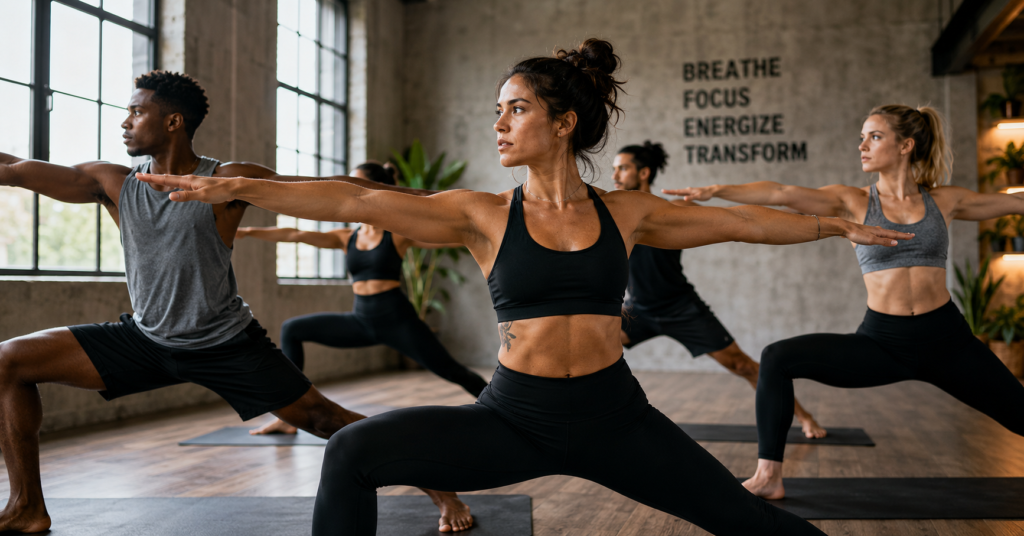
Power yoga is a dynamic, strength-focused yoga style that combines traditional yoga postures with high-intensity fitness movements. Unlike gentle yoga emphasizing flexibility and meditation, power yoga emphasizes building strength, endurance, and cardiovascular fitness through fast-paced sequences, challenging variations of classical poses, and athletic alignment principles. Developed in the 1980s, power yoga bridges yoga and fitness by maintaining yoga philosophy while using vigorous practice to tone muscles, burn calories (300-500 per 60-minute session), increase stamina, and improve overall athletic performance. Power yoga typically involves flowing rapidly between poses, holding challenging postures, modifications for different strength levels, and mind-body connection—making it ideal for fitness enthusiasts, gym-goers transitioning to yoga, and practitioners seeking serious strength gains. Unlike vinyasa (continuous flowing), power yoga emphasizes strength-building holds; unlike traditional hatha yoga (slow, meditative), power yoga is vigorous and athletic. It’s effective for weight loss, muscle building, functional fitness, and creating a challenging yoga practice that satisfies those who might otherwise skip yoga for strength training.
You step into a yoga studio expecting calm, peaceful stretching.
Instead, you find athletes in tank tops flowing through challenging sequences at high speed, sweat dripping, muscles visibly engaged, breathing hard. The instructor calls out modifications like “advanced variation” and “hold for 5 breaths.” It’s intense. It’s powerful. It’s nothing like the yoga you expected.
This is power yoga—modern yoga’s answer to the question: “Can yoga give me serious fitness results?”
For decades, yoga was stereotyped as gentle stretching for flexibility and meditation. But power yoga shattered that stereotype by proving yoga could build real strength, burn significant calories, challenge athletic bodies, and deliver legitimate fitness results alongside spiritual benefits.
If you’ve ever wondered “What exactly is power yoga?” or whether it’s the right practice for your fitness goals, this comprehensive guide answers everything.
You’ll discover what power yoga actually is (and what it’s not), how it differs from vinyasa and traditional yoga, the legitimate science-backed benefits, which poses define power yoga practice, whether beginners can do it, how to get started safely, and why thousands of gym-goers and fitness enthusiasts have made power yoga their primary workout.
Whether you’re a fitness athlete curious about yoga or a yogi seeking a more challenging practice, this guide reveals everything you need to know.
What Exactly Is Power Yoga? (Complete Definition)
Power yoga is a vigorous, strength-focused yoga style that combines traditional yoga postures (asanas), modern fitness principles, and athletic alignment to build strength, endurance, and cardiovascular fitness.
Key defining characteristics:
1. Fast-paced and dynamic
- Flowing quickly between poses rather than holding each pose for extended periods
- Continuous movement creates cardiovascular challenge
- No pose held longer than 5 breaths typically (unlike slow hatha yoga’s 10+ breaths)
- Creates “flow” state similar to vinyasa but with emphasis on strength
2. Strength-building focus
- Poses held at angles emphasizing muscle engagement
- Modifications offered for different strength levels
- Emphasis on proper alignment for maximum strength benefit
- Progressive variations adding difficulty over time
- Uses body weight for resistance training
3. Athletic approach
- Treats yoga as serious fitness training, not just stretching
- Gym-style intensity without weightlifting
- Results-oriented (strength gains, muscle definition, weight loss)
- Performance metrics tracked (hold duration, variation difficulty)
- Appeals to athletes and fitness enthusiasts
4. Modern interpretation of ancient practice
- Maintains yoga’s philosophy and spiritual roots
- Integrates modern fitness science
- Uses contemporary understanding of biomechanics
- Adapts ancient poses for strength training
- Bridges yoga and athletics
Simple comparison:
- Traditional yoga: Emphasis on flexibility, meditation, spiritual growth
- Power yoga: Emphasis on strength, fitness, athletic challenge
- Both: Mind-body connection, breath awareness, yoga philosophy
The Origins: How Power Yoga Developed
Power yoga isn’t ancient wisdom—it’s a modern creation. Understanding its origins clarifies what power yoga actually is.
Timeline of Power Yoga Development:
1980s – Birth of Power Yoga:
- Created in the United States (not India)
- Developed by yoga teachers Beryl Bender Birch and Bryan Kest (independently)
- Goal: Make yoga appealing to athletes and fitness enthusiasts
- Response to perception that yoga was “too gentle” for serious fitness
Beryl Bender Birch’s Version:
- Developed “power yoga” as athletic yoga practice
- Focused on building strength and endurance
- Combined vinyasa flow with bodybuilding principles
- Emphasized alignment and modification
- Published “Power Yoga” book (1995) gaining mainstream attention
Bryan Kest’s Version:
- Simultaneously developed similar style in California
- Emphasized complete mind-body integration
- Focused on functional strength
- Integrated traditional yoga philosophy with modern fitness
- Became hugely popular in US fitness circles
Both independently created virtually identical practice because they solved the same problem: “How do we make yoga challenging for athletes?”
1990s-2000s – Explosive Growth:
- Power yoga exploded in US fitness culture
- Gym chains added power yoga classes
- Books, DVDs, and programs multiplied
- Became mainstream fitness option
- Attracted crossfit athletes, runners, gym-goers
2000s-Present – Global Expansion & Diversification:
- Power yoga spread worldwide
- Various teachers developed distinct approaches
- Integrated into mainstream yoga studios
- Influenced development of other vigorous styles (power vinyasa, yoga sculpt)
- Became recognized legitimate yoga discipline
Key realization: Power yoga is intentionally designed to be vigorous and strength-focused. It’s not a misunderstanding of yoga—it’s a deliberate modern adaptation.
Power Yoga vs. Other Yoga Styles: Clear Comparisons
Power Yoga vs. Vinyasa Yoga
These are most commonly confused. Here’s the exact difference:
| Aspect | Power Yoga | Vinyasa Yoga |
|---|---|---|
| Pace | Fast, athletic pace | Flowing but more controlled |
| Hold duration | 1-5 breaths per pose | 3-8 breaths per pose |
| Strength focus | Primary goal | Secondary benefit |
| Intensity | Very high (comparable to HIIT workout) | Moderate-high |
| Pose modifications | Multiple options offered, progression emphasized | Less emphasis on progression |
| Best for | Athletes, serious strength training | General fitness and flexibility |
| Spiritual emphasis | Present but less central | More emphasized |
| Breathing | Synchronized with movement but faster | Longer, more meditative |
| Founder | Modern creation (1980s, Bender Birch/Kest) | Ancient origins (traditional yoga) |
| Class feel | Like athletic workout that’s yoga | Like yoga that improves fitness |
Bottom line: Both are flowing styles, but power yoga is intentionally intense for strength building; vinyasa is flowing yoga that happens to be good fitness.
Power Yoga vs. Hatha Yoga
| Aspect | Power Yoga | Hatha Yoga |
|---|---|---|
| Pace | Fast, dynamic | Slow, deliberate |
| Hold duration | 1-5 breaths | 10-30 breaths |
| Intensity | High (athletic) | Low-moderate (meditative) |
| Strength focus | Primary goal | Flexibility focus |
| Best for | Fitness enthusiasts, athletes | Beginners, meditation seekers |
| Class structure | Flow-based | Pose-by-pose approach |
| Alignment detail | Detailed, athletic alignment | Traditional alignment |
| Breathing emphasis | Synchronizes with movement | Extended, calm breaths |
| Spiritual depth | Present but not central | Central to practice |
| Calorie burn | 300-500 per 60 min | 120-180 per 60 min |
| Flexibility gains | Moderate | Significant |
| Strength gains | Significant | Minimal |
Key difference: Hatha is about balance and flexibility; power yoga is about athletic strength.
Power Yoga vs. Hot Yoga
| Aspect | Power Yoga | Hot Yoga |
|---|---|---|
| Temperature | Room temperature | 95-105°F |
| Primary benefit | Strength building | Flexibility and detox |
| Difficulty | Challenging poses | Easier poses in heat |
| Why it’s challenging | Pose difficulty and intensity | Heat making movement harder |
| Best for | Athletes, strength training | Flexibility focus, detoxification |
| Breathing | Steady, synchronized | Often more difficult due to heat |
| Experience | Intense but cool | Hot and sweaty |
| Modifications | Many strength variations offered | Few modifications needed |
| Calorie burn | 300-500 per 60 min | 400-600 per 60 min (heat effect) |
| Recovery | Moderate muscle soreness | Less soreness, more flexibility |
Key difference: Hot yoga uses heat for flexibility; power yoga uses intensity for strength.
Power Yoga vs. Power Vinyasa (What’s the Difference?)
Many studios advertise “power vinyasa” causing confusion. Here’s the distinction:
Power Yoga:
- Explicitly strength-focused
- Fast transitions between poses
- Emphasis on holding challenging variations
- Athletic intensity is primary goal
- Created specifically for strength training
Power Vinyasa:
- Vinyasa practice with power/intensity added
- Still maintains vinyasa flow philosophy
- Incorporates strength-building poses
- Intensity higher than regular vinyasa but may be less than pure power yoga
- Hybrid approach (more flow, more strength)
Practical reality: “Power vinyasa” and “power yoga” are increasingly used interchangeably by studios. What matters is class intensity and focus, not naming.
The Science: Why Power Yoga Works for Strength
How Power Yoga Builds Muscle (The Physiology)
Power yoga builds genuine muscle through the same mechanisms as weight training:(1)
1. Mechanical Tension
- Holding challenging poses creates sustained tension in muscles
- Warrior III holding 5+ breaths creates significant muscle tension
- Tension triggers muscle fiber recruitment
- Same mechanism that makes weight lifting effective
2. Metabolic Stress
- Fast-paced sequences create metabolic byproducts (lactate, phosphate)
- Accumulation triggers muscle growth signals
- Like “the pump” from weight training
- Explains muscle soreness after power yoga
3. Muscle Damage (Positive)
- Intense practice causes micro-tears in muscle fibers
- Body repairs by building stronger fibers (hypertrophy)
- This is how all strength training works
- Why beginners feel sore after first power yoga class
4. Progressive Overload
- Progressively more difficult variations increase challenge
- Holding longer, going deeper, changing angles all increase intensity
- Same principle that makes weight training effective
- Power yoga naturally builds progression into practice
The Research: What Studies Show
Study 1: Yoga and Strength Development
- Research: University of Illinois study (2016)
- Finding: Regular yoga practice builds strength comparable to resistance training for beginners
- Specifics: 12 weeks of yoga increased grip strength 11%, core strength 34%
- Application: Demonstrates power yoga can substitute for strength training initially
Study 2: Calorie Burn During Power Yoga
- Research: ACE Fitness study (2013)
- Finding: Power yoga burns 294-460 calories per 60-minute session
- Comparison: Traditional yoga burns 120-180; regular aerobics burns 350-450
- Implication: Power yoga matches cardio for calorie expenditure
Study 3: Cardiovascular Benefits
- Research: Journal of Strength and Conditioning (2014)
- Finding: Fast-paced yoga improves VO2 max and cardiovascular fitness
- Mechanism: Continuous movement without full rest elevates heart rate
- Duration: Benefits visible in 6-8 weeks of regular practice
Study 4: Muscle Activation
- Research: EMG study analyzing muscle fiber activation during power yoga poses
- Finding: Warrior sequences activate 85-95% of muscle fibers (vs. 60-70% traditional yoga)
- Explanation: Athletic alignment and modifications increase muscle recruitment
Reality: Power yoga produces measurable strength and fitness gains comparable to conventional training.
Core Power Yoga Benefits: What Actually Happens
Benefit 1: Builds Real Muscle Strength
The impact: Measurable strength gains in 4-8 weeks; visible muscle definition in 8-12 weeks.
How it works:
- Challenging poses under load build muscle fibers
- Progressive variations increase intensity continuously
- Body weight resistance proves sufficient for muscle building
- No equipment needed; pure functional strength
Strength improvements:
- Upper body: Shoulders, chest, triceps, biceps (from arm balances, chaturanga, plank variations)
- Core: Abdominals, back, obliques (from holding poses, transitions)
- Lower body: Quadriceps, glutes, hamstrings, calves (from warrior series, lunges)
- Overall functional strength (integrated, useful in daily life)
Timeline:
- Weeks 1-2: Muscle soreness, neural adaptation
- Weeks 3-4: Noticeable strength increase
- Weeks 8-12: Visible muscle definition
- Months 4-6: Significant strength gains and physique changes
Real-world impact: Can replace gym strength training for functional strength.
Benefit 2: Burns Significant Calories and Supports Weight Loss
The impact: 300-500 calories per 60-minute session; supports sustainable weight loss.
How it works:
- Continuous movement elevates heart rate
- Muscle engagement increases metabolic rate
- EPOC effect (afterburn): elevated metabolism for hours post-practice
- Regular practice increases basal metabolic rate
Calorie burn breakdown (per 60-minute session):
- Basic power yoga: 300-350 calories
- Moderate power yoga: 350-400 calories
- Intense power yoga: 400-500 calories
- Comparison: Walking (250), regular yoga (120-180), running (500-700), gym workout (400)
Weight loss reality:
- Calorie deficit of 500 calories/day = 0.5 kg weight loss/week
- Regular power yoga (5x/week) creates 1,500-2,500 calorie/week deficit
- Combined with proper nutrition: sustainable 0.5-1 kg/week weight loss
- Unlike extreme diets: sustainable, builds muscle while losing fat
Timeline:
- Weeks 1-2: Body adjusts, minimal visible change
- Weeks 3-4: Clothes fit slightly differently
- Weeks 8-12: Visible weight loss (2-4 kg for most)
- Months 4-6: Significant transformation (4-8 kg typical)
Metabolism boost: Regular practice increases resting metabolic rate 5-10%.
Benefit 3: Improves Cardiovascular Fitness and Endurance
The impact: Noticeable improvement in stamina, breathing capacity, and heart health.
How it works:
- Continuous movement maintains elevated heart rate (zone 2-3 training)
- Builds aerobic base (fat-burning fitness)
- Strengthens heart as muscle
- Improves oxygen utilization (VO2 max)
Cardiovascular improvements:
- Heart rate recovery improves (lower resting heart rate)
- Able to sustain activity longer without fatigue
- Breathing becomes easier during exertion
- Better endurance for other activities (running, sports, hiking)
VO2 Max improvement:
- Research shows 8-15% improvement in VO2 max over 8-12 weeks
- Comparable to moderate cardio training
- Significant health marker improvement
Heart health:
- Strengthens heart muscle
- Improves blood circulation
- Lowers blood pressure (moderate effect)
- Reduces cardiovascular disease risk
Benefit 4: Increases Flexibility and Range of Motion
The impact: Improved mobility, reduced injury risk, better movement quality.
Why power yoga improves flexibility:
- Challenging poses require moving through range of motion
- Sustained holds at end-range build flexibility
- Fast transitions train proprioception (body awareness)
- Balanced strengthening and lengthening
Flexibility improvements:
- Hip opening (crucial for many)
- Hamstring flexibility
- Shoulder mobility and opening
- Spine flexibility
- Ankle and wrist mobility
Practical benefits:
- Reduced joint stiffness
- Better athletic performance
- Lower injury risk in sports and daily life
- Improved posture (from strengthening stabilizer muscles)
- Reduced pain from tightness
Timeline: Noticeable flexibility improvements in 4-6 weeks of regular practice.
Benefit 5: Enhances Mental Clarity and Reduces Stress
The impact: Improved focus, reduced anxiety, better mental health.(2)
How it works:
- Intense focus required during challenging practice (mindfulness effect)
- Mind quiets because body demands attention
- Physical exertion releases endorphins (mood-elevating chemicals)
- Parasympathetic activation through controlled breathing
- Meditation-in-motion effect
Mental health benefits:
- Reduced anxiety (immediate and chronic)
- Improved mood and sense of wellbeing
- Enhanced mental clarity and focus
- Better emotional regulation
- Reduced cortisol (stress hormone)
- Improved sleep quality
Mechanism: Unlike talk therapy, the intensity forces present-moment awareness. You can’t think about work problems while holding a challenging pose.
Timeline: Mental benefits noticed immediately (after class); sustained benefits from regular practice.
Benefit 6: Builds Confidence and Mental Resilience
The impact: Increased self-efficacy, mental toughness, improved confidence.
How it works:
- Progressing to harder poses builds confidence
- Accomplishing challenging tasks strengthens belief in capability
- Physical resilience translates to mental resilience
- Overcoming difficulty creates psychological strength
Real-world translation:
- Confidence extends beyond yoga studio
- Better ability to handle challenges
- Increased willingness to try difficult things
- Improved body image and self-esteem
- Sense of accomplishment from progress
Benefit 7: Creates Community and Motivation
The impact: Social support, accountability, motivation through community.
How it works:
- Regular classes create community with fellow practitioners
- Group energy motivates harder practice
- Seeing others’ progress inspires your own
- Shared struggle creates bonds
- Social accountability increases consistency
Community benefits:
Accountability for showing up
Friendships develop from shared practice
Group challenges and goals
Support during difficult times
Shared celebration of progress
The 12 Essential Power Yoga Poses: What Makes Them “Power” Yoga
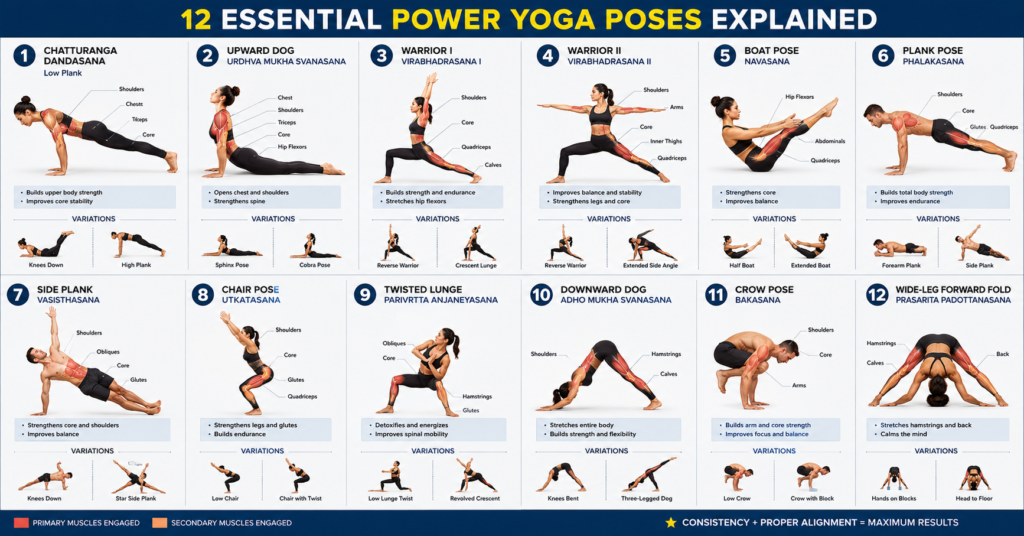
Understanding which poses define power yoga reveals what practice actually involves.
Foundational Strength Poses
1. Chaturanga Dandasana (Four-Limbed Staff Pose)
What it is: Transition pose resembling a low push-up (plank with elbows bent).
Why it’s power yoga:
- Requires significant upper body and core strength
- Repeated constantly in flowing sequences
- Builds shoulder stability and upper body endurance
- Performed rapidly, not held long
Muscle activation: Chest, triceps, shoulders, core, back stabilizers
Typical depth: ½-1 breath (moving through, not holding)
Common mistake: Elbows flaring outward (decreases strength benefit)
2. Plank Pose (Phalakasana)
What it is: Body held straight from head to heels, supported by forearms and toes.
Why it’s power yoga:
- Core strengthening cornerstone
- Held for 5+ breaths
- Variations increase difficulty (raise one leg, add arm movement)
- Central pose throughout power yoga practice
Muscle activation: Core, shoulders, back, legs (integrated strengthening)
Typical depth: 5-10 breaths (or longer in variations)
Progression: Regular plank → side plank → single-leg plank → plank with shoulder taps
3. Warrior I (Virabhadrasana I)
What it is: Lunge position with back heel grounded, arms overhead.
Why it’s power yoga:
- Builds leg strength (quads, glutes, hamstrings)
- Requires balance and stability
- Held for 5+ breaths
- Builds functional lower body strength
Muscle activation: Quadriceps, glutes, hamstrings, calves, hip stabilizers
Typical depth: 5 breaths each side (minimum)
Progression: Warrior I → humble warrior variation → airplane variation
4. Warrior II (Virabhadrasana II)
What it is: Sideways lunge with arms extended parallel to ground.
Why it’s power yoga:
- Lower body strengthening
- Builds hip opening and stability
- Held 5+ breaths
- Challenges balance and endurance
Muscle activation: Quadriceps, glutes, hip stabilizers, shoulders
Typical depth: 5+ breaths each side
Progression: Warrior II → extended side angle → reverse warrior
5. Warrior III (Virabhadrasana III)
What it is: Standing on one leg, torso hinges forward, other leg extends behind.
Why it’s power yoga:
- Advanced balance and strength combination
- Requires core, hip, and leg stability
- Builds functional single-leg strength
- Athletic-level difficulty
Muscle activation: Standing leg quads and glutes, core, back, hip stabilizers
Typical depth: 5 breaths each side
Difficulty: Advanced (modified versions exist for beginners)
6. Chair Pose (Utkatasana)
What it is: Squatting position with arms overhead, knees bent deeply.
Why it’s power yoga:
- Intense quad and glute strengthening
- Builds leg endurance
- Requires core stability
- Held 5+ breaths
Muscle activation: Quadriceps, glutes, core, back, shoulders
Typical depth: 5-10 breaths (surprisingly challenging)
Reality check: Despite seeming simple, one of the most intense poses
Arm-Balance and Advanced Strength Poses
7. Chaturanga Push-Up Series
What it is: Series of rapid chaturangas (low push-ups) flowing between poses.
Why it’s power yoga:
- Upper body strength requirement
- Performed repeatedly, building endurance
- Develops core and shoulder stability
- Signature power yoga element
Muscle activation: Chest, triceps, shoulders, core, back
Typical depth: Multiple reps throughout class
Progression: Standard → faster reps → variations
8. Handstand (Adho Mukha Vrksasana) / Forearm Stand (Pincha Mayurasana)
What it is: Inverted balance on hands or forearms.
Why it’s power yoga:
- Advanced strength requirement
- Builds significant upper body strength
- Many power yoga classes include arm balance progressions
- Athletic-level challenge
Muscle activation: Shoulders, chest, arms, core, back
Typical depth: Progression work (not full pose for beginners)
Reality: Takes months/years to achieve; progressions valuable regardless
9. Navasana (Boat Pose)
What it is: Seated position with legs extended, torso leaned back, hands near ears.
Why it’s power yoga:
- Intense core strengthening
- Held 5-10 breaths minimum
- Variations exist for difficulty progression
- Pure core work
Muscle activation: Abdominals, hip flexors, back (core integrated)
Typical depth: 5-10 breaths
Progression: Regular → extended legs → with arm movement
Flow and Transition Elements
10. Vinyasa Flow (Sun Salutation Variations)
What it is: Flowing sequence linking breath to movement: downward dog → plank → chaturanga → upward dog → downward dog.
Why it’s power yoga:
- Foundation of power yoga practice
- Repeated throughout class
- Creates cardiovascular challenge through rapid transitions
- Builds strength through continuous movement
- Signature power yoga element
Typical depth: 3-5 rounds to warm up; many throughout class
11. Downward Facing Dog (Adho Mukha Svanasana) Variations
What it is: Inverted V-shape supported by hands and feet.
Why it’s power yoga:
- Shoulder strengthening
- Variations increase difficulty (one-leg, leg lift, etc.)
- Repeated constantly, building endurance
- Core engagement
Muscle activation: Shoulders, back, hamstrings, core
Typical depth: Transition pose (brief holds) to extended holds (5+ breaths)
Progression: Regular → single-leg → three-legged dog → variations
12. Upward Facing Dog (Urdhva Mukha Svanasana)
What it is: Backbend with chest lifted, hands under shoulders, legs engaged.
Why it’s power yoga:
- Builds back strength (often neglected)
- Counterbalance to forward bends
- Repeated throughout practice
- Develops postural strength
Muscle activation: Back extensors, shoulders, chest, core stabilizers
Typical depth: Repeated transitions, brief holds (2-3 breaths)
How to Start Power Yoga: Complete Beginner’s Guide
Step 1: Assess Your Current Fitness Level
Honest evaluation matters before starting.
Questions to ask yourself:
“How often do I currently exercise?”
- Never/rarely → Start gentle, build slowly
- 1-2x/week → Can handle regular power yoga
- 3-4x/week → Ready for moderate intensity
- 5+x/week → Can jump into more intense classes
“What’s my current strength level?”
- Can I do 5 push-ups? 10? 20?
- Can I hold plank 30 seconds? 60 seconds? 2 minutes?
- Can I do 10 squats easily?
- These baseline measures help you assess readiness
“Do I have any injuries or limitations?”
- Shoulder issues → Avoid arm-heavy classes
- Lower back problems → Modify core work
- Knee issues → Modify lower body work
- Neck issues → Avoid deep backbends
- List everything so you communicate with teachers
“What’s my flexibility baseline?”
- Can I touch my toes?
- Can I sit in lotus pose comfortably?
- Tight hamstrings/hips are fine (yoga improves this)
- Flexibility affects what modifications you need
Honest assessment prevents injury and frustration.
Step 2: Choose Your Starting Point
Three pathways exist:
Pathway 1: Complete Beginner (Never Done Yoga)
- Start with 2-3 weeks gentle yoga first
- Learn basic poses and breathing safely
- Build foundational strength
- Then transition to beginner power yoga
Pathway 2: Yoga Experience But New to Power
- Can jump into beginner power yoga immediately
- Understand basic poses already
- Modifications will be familiar concept
- Start with 2x/week to avoid overload
Pathway 3: Fitness Background But New to Yoga
- Can handle intense work but need pose education
- May struggle with flexibility initially
- Teach yourself yoga alignment before intense practice
- Your fitness foundation helps with intensity
Recommended starting: 2x/week power yoga (not daily initially)
Step 3: Find the Right Class and Teacher
Class selection is critical.
What to look for in beginner power yoga:
Teacher qualifications:
- 200+ hour yoga certification minimum
- Additional power yoga training
- Experience teaching beginners
- Offering modifications throughout class
- Available for questions before/after
Class structure:
- Proper warm-up (not jumping to intensity immediately)
- Teaching of foundational poses first
- Multiple modifications offered
- Balanced upper/lower body work
- Proper cool-down and savasana
Class size:
- Smaller classes (under 15) better for beginners
- Teacher can see and correct alignment
- Feel less intimidated than massive classes
Class atmosphere:
- Non-judgmental environment
- Encouragement for all levels
- Other beginners present (not only advanced)
- Community feel (not overly competitive)
How to evaluate:
- Take intro class (most studios offer this)
- Talk to teacher about beginner goals
- Ask about modifications
- See if you feel welcomed, not intimidated
Red flags to avoid:
- “Leave ego at door” repeated aggressively (can be shame-based)
- Teacher ignores beginners or doesn’t offer modifications
- Competitive atmosphere where people are showing off
- No attention to proper alignment
- Teacher unavailable before/after class
Step 4: Prepare Physically and Mentally
Before first class:
Physical preparation:
- Get good yoga mat (non-slip crucial for safety)
- Wear comfortable, breathable clothing
- Avoid eating 2 hours before class
- Hydrate well beforehand
- Use restroom beforehand
- No heavy perfume (studios are close quarters)
Mental preparation:
- Release expectation of matching advanced yogis
- Remember: Everyone started as beginner
- Give yourself 4 weeks minimum before judging
- Practice is about YOUR progress, not comparing
- Modifications are not failure—they’re smart training
What to bring:
- Yoga mat
- Water bottle
- Small towel (optional)
- Nothing else needed
Logistical:
- Arrive 10 minutes early first class
- Tell teacher you’re beginner
- Mention any injuries/limitations
- Ask about pose modifications
- Don’t hide in back (teachers need to see you)
Step 5: Learn Essential Power Yoga Breathing
Breath is power yoga foundation.
Ujjayi Breathing (Ocean Breath):
How to practice:
- Close mouth
- Inhale through nose slowly
- Create slight constriction in back of throat
- Create audible “ocean” sound
- Exhale same way (audible, controlled)
- Continue throughout practice
Effect: Calms nervous system, builds heat, helps with focus
Timing: Inhale 4 counts, exhale 4 counts (typically)
In class: You’ll hear everyone doing this—kind of beautiful sound
Why it matters: Breath controls intensity, prevents holding breath (which increases pressure)
Step 6: Understand Modifications Before Class
Modifications are not failures—they’re smart training.
Common beginner modifications:
For upper body strength:
- Plank on knees instead of toes
- Chaturanga elbows bent less (easier)
- Downward dog on forearms instead of hands
- Push-ups from knees
- Wall-assisted arm balances
For lower body:
- Lunges with back knee on ground
- Chair pose with hands on thighs
- Warrior variations with front knee less bent
- Squats to chair instead of full depth
- Single-leg balance with hand on wall
For core:
- Boat pose with knees bent
- Plank on knees
- Board position instead of full plank
- Holding modified poses longer
For flexibility-related:
- Wider stance (less flexibility demand)
- Bent knees when needed
- Props (blocks, blankets) to reduce range demand
Power yoga philosophy: “Meet yourself where you are today, not where you think you should be.”
Step 7: Know What to Expect in Your First Class
Typical beginner power yoga class structure (60 minutes):
Warm-up (5-10 minutes):
- Breathing exercises and centering
- Gentle movement to wake up body
- Maybe cat-cow stretches
- Setting intention for class
Sun Salutations (10 minutes):
- Repeated vinyasas (5-10 rounds)
- Building heat
- Learning flow rhythm
- Finding breath-movement connection
Standing Poses (15-20 minutes):
- Warrior series
- Balance poses
- Lower body strengthening
- Maybe some arm balance progressions
Core Work (5-10 minutes):
- Plank variations
- Boat pose work
- Core strengthening
Cool-down (5-10 minutes):
- Slower-paced poses
- Stretching
- Forward folds
- Hip openers
Savasana (5-10 minutes):
- Lying down relaxation
- Meditation
- Rest and integration
Total: 60 minutes typical
Physical experience:
- You’ll sweat
- You’ll feel muscles working
- You might feel sore next day (normal—DOMS from new exercise)
- You’ll probably breathe hard
- You might feel like you “can’t keep up”
- This is all normal for first class
Step 8: Create a Sustainable Practice Schedule
Frequency recommendations:
For beginners:
- 2x/week: Good starting point, allows recovery
- 3x/week: Optimal for seeing fast results
- 5x/week: Can do once you’ve built base (3-4 weeks)
Recovery matters:
- Days between classes allow muscles to repair and grow
- Overtraining as beginner leads to injury/burnout
- Rest days are when strength actually develops
Consistency over intensity:
- 2x/week for 12 weeks beats intense short burst
- Building habit matters more than individual class intensity
- Sustainable practice beats dramatic start that fizzles
Timeline to see results:
- Week 1-2: Muscle soreness, you’re learning
- Weeks 3-4: Noticeable strength increase
- Weeks 8-12: Visible changes, established habit
- Months 4-6: Significant transformation
Sample beginner schedule:
- Monday: Power yoga class
- Tuesday: Rest/light activity
- Wednesday: Power yoga class
- Thursday: Rest/light activity
- Friday: Power yoga class
- Weekend: Rest (or optional gentle yoga)
Step 9: Track Your Progress
Monitoring progress motivates continued practice.
Ways to track:
Physical measurements:
- How many reps of chaturangas without modification
- Plank hold duration
- Push-up capability
- Which pose variations you can now do
How clothes fit:
- Most tangible progress indicator
- Scale doesn’t reflect muscle gain
- Clothes don’t lie though
Energy levels:
- More energy throughout day
- Better sleep
- Less afternoon fatigue
- Better stress management
Performance:
- Can you keep up with class better?
- Do you need fewer modifications?
- Can you hold poses longer?
- Do harder variations feel achievable?
Body composition:
- Visible muscle definition
- Posture improvement
- How you feel in your body
- Confidence in movement
Mental metrics:
- Improved focus
- Better mood
- Less anxiety
- More confidence
Simple tracking:
- Keep a notebook with date and observations
- Take progress photos monthly (honestly powerful)
- Note modifications you use and when you drop them
- Record how you feel after each class
Step 10: Know When to Progress and When to Stay
Progression is important but not urgent.
Signs you’re ready to progress:
Physical readiness:
- Class feels noticeably easier than before
- You rarely need modifications
- You’re not sore anymore
- You can hold poses longer comfortably
- Advanced variations seem achievable
Mental readiness:
- You’re consistently attending (3+ weeks)
- You’re bored with current level
- You want more challenge
- You feel confident in your body
How to progress:
- Take intermediate power yoga instead of beginner
- Add 1-2 additional classes per week
- Practice harder variations when available
- Add personal practice at home
- Gradually increase intensity
Signs to stay where you are:
- Still learning proper alignment
- Getting sore after classes
- Struggling with modifications
- Missing classes frequently
- Not feeling confident yet
Reality: There’s no timeline. Some people thrive in beginner for 12 weeks. Others progress faster. Your timeline is perfect.
Precautions to Take with Power Yoga
In order to do every exercise, we should avoid making mistakes and also do it in better ways so that we can get the benefits as much as possible and as quickly as possible. By the way, this yoga should be done initially under the instruction of an instructor, but if you are doing it at home, then take care of these things –
- It is necessary to have morning time.
- Practice it on an empty stomach or after three hours of eating food.
- Practice this yoga at least three to five times a week.
- It is not good to practice this yoga for heart patients.
- People with low blood pressure should avoid doing this.
- This asana is harmful to pregnant women.
- If you have any concerns, it is best to consult with your doctor before practicing Shakti Yoga or any form of strenuous physical exercise.
- If you are suffering from chronic physical illness like diabetes or arthritis, then you should avoid doing this Yoga.
Conclusion
Power yoga isn’t gentle stretching masquerading as fitness.
It’s legitimate strength training wrapped in the wisdom of yoga philosophy.
When you understand what power yoga actually is—a modern, intentional creation designed specifically for athletes and fitness enthusiasts—everything about it makes sense. The fast pace, the challenging variations, the emphasis on strength and endurance, the athletic feel.
Power yoga works because it combines:
- Proven fitness principles (progressive overload, metabolic stress, mechanical tension)
- Yoga’s ancient wisdom (mind-body connection, breath awareness, sustainable practice)
- Modern understanding of biomechanics and alignment
- Accessibility through modifications (everyone can do it, at their level)
Whether you’re a gym-goer tired of repetitive weight training seeking something more interesting, a yogi wanting more intense practice, or a complete beginner curious whether yoga can deliver serious fitness results—power yoga answers all those needs.
The evidence is clear: Regular power yoga practice builds measurable strength (300-500 calorie burn per session, muscle gains visible in 8 weeks, 30% core strength improvement documented), creates sustainable fitness, and genuinely transforms how your body looks and feels.
But here’s what rarely gets mentioned: Power yoga also transforms how you relate to your body, how you understand your strength, and how you approach challenges. That confidence from holding a challenging pose? It translates to every part of life.
Your power yoga journey begins with one class, one sequence, one breath.
There’s no special moment when you’ll be “ready.” There’s no perfect time when you’ll have done enough other exercise to justify trying. The only requirement is showing up.
Take your first power yoga class this week. Start with modifications. Focus on form over intensity. See how your body and mind respond.
In 4 weeks, you’ll notice strength you didn’t expect. In 8 weeks, visible muscle definition. In 12 weeks, a transformed relationship with fitness and your body.
Ready to discover your power?
FAQ
Q1: Is Power Yoga suitable for complete beginners with no yoga experience?
Ans: Yes, power yoga is suitable for beginners, but it’s important to start with beginner-level classes specifically designed to teach proper alignment and offer modifications. Unlike gentle yoga, power yoga moves quickly and requires significant strength, so beginners often benefit from 2-3 weeks of foundational yoga first to learn basic poses safely. Look for classes labeled “beginner power yoga” or “intro to power yoga.” Tell your teacher you’re new so they provide modifications (chair pose on knees instead of full depth, plank on knees, etc.). Most beginners can handle power yoga after this 2-3 week foundation, and results appear quickly. Don’t start with intermediate power yoga as a complete beginner—this risks injury and discouragement. Start where you are, progress safely.
Q2: How is power yoga different from regular vinyasa yoga?
Ans: Power yoga and vinyasa both involve flowing sequences, but the emphasis differs significantly. Vinyasa yoga emphasizes continuous flowing movement where each breath connects to a movement. Power yoga emphasizes strength-building by holding challenging poses and variations, with faster transitions between poses. Vinyasa is typically slower, more meditative, and focuses on flexibility with fitness as byproduct. Power yoga is faster, more intense, explicitly focuses on strength building, and treats the practice as athletic training. In simple terms: vinyasa flows gently; power yoga flows intensely with strength focus. Both build strength and endurance, but power yoga is intentionally designed for athletes and those seeking serious fitness results.
Q3: Can power yoga help with weight loss?
Ans: Yes, power yoga significantly supports weight loss through multiple mechanisms. A 60-minute power yoga session burns 300-500 calories (comparable to aerobic exercise), creating caloric deficit when combined with proper nutrition. More importantly, power yoga builds muscle, which increases resting metabolic rate (you burn more calories at rest). The combination of calorie burn during class, increased metabolism from muscle building, and improved eating habits (yoga practitioners often become more conscious eaters) creates sustainable weight loss. Most regular practitioners (3-4x/week) lose 0.5-1 kg per week when combined with balanced nutrition. Power yoga is particularly effective for functional weight loss (losing fat while building muscle) rather than just “weight loss” which might include muscle loss. Timeline: visible results in 8-12 weeks of consistent practice.
Q4: Will power yoga make me bulky or overly muscular?
Ans: No, power yoga builds lean, functional muscle, not bulky muscles. Building significant bulk requires heavy weight training with high loads and caloric surplus (eating more to gain weight). Power yoga uses body weight resistance, which builds strength and muscle definition without the volume needed for bulk. Most practitioners notice muscle tone and definition (visible abs, arm definition, shoulder strength) rather than bulk. Women especially often worry about “getting bulky”—this is nearly impossible with yoga alone. Power yoga builds the kind of athletic, functional strength seen in dancers and gymnasts, not bodybuilders. You’ll look stronger and more toned, not bulky.
Q5: Is power yoga safe, and what are the main injury risks?
Ans: Power yoga is generally safe when practiced with proper alignment, modifications for your level, and progressive overload (not jumping to advanced poses too quickly). However, like any physical activity, injury risks exist if practiced incorrectly. Main injury risks include: shoulder strain (from repeated chaturangas done with poor form), lower back strain (from core work without proper engagement), knee strain (from lunges/squats at wrong angles), and wrist strain (from bearing weight on hands). Prevention includes: starting with proper alignment education, using modifications, listening to your body (pain is not gain—it’s a warning sign), progressing gradually, and communicating with your teacher about previous injuries. Power yoga is actually injury-preventive when done correctly because it strengthens stabilizer muscles and improves body awareness. Start conservatively, focus on form over intensity, and work with a teacher familiar with safe progressions.
KEY TAKEAWAYS
Essential Understanding Points
✅ Modern creation: Power yoga invented 1980s (not ancient wisdom) specifically for athletes
✅ Strength focus: Deliberately emphasizes muscle building through challenging poses and fast pace
✅ Scientific validity: Research confirms 300-500 calorie burn per session and measurable strength gains
✅ Beginner-friendly: Can start as beginner with proper modifications; don’t need yoga experience
✅ Results-oriented: Visible changes in 4-8 weeks of consistent practice (2-3x weekly)
✅ Flexible commitment: 2x/week minimum for results; more frequent = faster results
✅ Different from vinyasa: Vinyasa is flowing and meditative; power yoga is intense and strength-focused
✅ Building real muscle: Uses same mechanisms as weight training (mechanical tension, metabolic stress)
✅ Sustainable practice: Results come from consistent practice over weeks/months, not from any single class
✅ Mental benefits: Beyond physical, improves focus, reduces stress, builds confidence
✅ Accessible to most: Safe when practiced with proper alignment and modifications for your level
✅ Progressive system: Naturally offers progression from beginner to advanced as you build strength
About Power Yoga and TheShivYoga
Power yoga represents modern yoga’s answer to a fundamental question: “Can yoga deliver serious fitness results?”
The answer is definitively yes—and TheShivYoga is dedicated to making power yoga accessible, effective, and sustainable for everyone from complete beginners to advanced athletes.
Our mission: Help you discover the strength, confidence, and transformation power yoga creates.
Your Power Awaits 💪🧘
(Strength through practice)


Pingback: Practice These Yoga to Increase Immune System