


⚡ Quick Answer Box
The best yoga styles for weight loss are Vinyasa flow (burns 180–300 calories/hour), Ashtanga (same calorie burn, higher intensity), Power yoga (200–350 calories/hour), and Hot yoga (200–400 calories/hour depending on room temperature). However, weight loss from yoga depends equally on three factors: consistency (4–5 sessions weekly), calorie-deficit nutrition (yoga alone won’t create weight loss), and progressive challenge (advanced poses require more energy than beginner poses). Most practitioners see noticeable results in 8–12 weeks when combining yoga with mindful eating.
You’ve probably heard someone say, “I started yoga and lost 20 pounds.”
But then you might have also heard, “I did yoga for 6 months and gained weight.”
Both stories are true. Yoga can absolutely support weight loss — but only if you understand which styles actually burn significant calories, how often you need to practice, and how nutrition fits into the equation. The problem is that most yoga information online either overhypes yoga as a complete weight loss solution, or dismisses it as “not intense enough” compared to running or the gym.
The reality is more nuanced.
Certain yoga styles do burn as many calories as moderate-intensity cardio. Yoga builds lean muscle, which increases resting metabolic rate. And the mindfulness cultivated through yoga can transform your relationship with food in ways that support sustainable weight loss.
But yoga alone — without nutrition changes and consistency — won’t create the calorie deficit needed to lose weight, no matter how powerful the practice.
This guide answers the question thousands of people search for every month: Which yoga is best for weight loss? We’ll compare specific yoga styles by calorie burn, explain the science of how yoga supports weight loss, identify which poses burn the most energy, clarify what realistic timelines look like, and show you exactly how to structure your practice and nutrition for results.
The 4 Yoga Styles That Actually Support Weight Loss
Not all yoga styles are created equal when it comes to calorie burn and weight loss potential. While slower, more restorative styles have tremendous value for stress reduction and mindfulness, they won’t generate the metabolic demand needed for significant calorie expenditure.
The four styles that consistently deliver weight loss results are:
Vinyasa Flow Yoga: The Calorie-Burning Baseline
Vinyasa (meaning “to place in a special way”) links breath with continuous movement, creating a flowing sequence where you move from one pose to another on each breath cycle.**
Calorie Burn: 180–300 calories/hour (depending on pace, your body weight, and intensity level)
Why it works for weight loss:
- Continuous movement elevates heart rate into moderate cardio zone (60–75% max heart rate)
- Emphasis on moving through strength poses (plank, chaturanga, upward dog) builds lean muscle
- Each sun salutation cycle engages core, arms, legs, and chest simultaneously
- Accessible for beginners while offering enough complexity for advanced practitioners to progressively challenge themselves
- Mental focus required prevents mindless eating patterns that often derail weight loss
Best for: Anyone seeking an accessible entry point to fitness yoga; people who like variety in their sequences; those who need the meditation-meets-movement combination; people working full-time with limited workout time (30 minutes of Vinyasa delivers real results)
Realistic expectations: With 4–5 sessions weekly + nutrition adjustments, most practitioners see 5–10 pounds of weight loss in 8–12 weeks. Results accelerate if you progress to more challenging pose variations.
Ashtanga Yoga: The Structured Power Practice
Ashtanga yoga consists of fixed sequences performed in a specific order — Primary Series, Intermediate Series, Advanced Series. Each sequence builds progressively.
Calorie Burn: 180–300 calories/hour (similar to Vinyasa, but higher intensity for most practitioners due to longer holds and deeper poses)
Why it works for weight loss:
- Fixed sequences mean you can precisely measure progression — moving from beginner to intermediate variations of each pose
- Longer holds in weight-bearing poses (warrior sequences, arm balances) build serious muscle
- The “mysore” style (self-paced in group setting) allows you to move at your intensity level while still in community
- Higher commitment barrier (practitioners typically commit to 5–6 days/week) leads to better results than sporadic practice
- Specific progression teaches the nervous system to handle increased challenge, which drives metabolic adaptation
Best for: People who respond well to structure and commitment; those with previous yoga experience; practitioners seeking community and accountability; people who want clear progression markers; individuals who benefit from ritual and established routine
Realistic expectations: With 5–6 sessions weekly + proper nutrition, Ashtanga practitioners typically lose 8–15 pounds in 12 weeks. The high commitment barrier means practitioners who stick with it see dramatic body composition changes (muscle gain, fat loss) rather than just scale weight loss.
Power Yoga: The Gym-Alternative Approach
Power Yoga applies yoga principles to a more athletic approach — stronger poses, faster-paced sequences, and visible fitness results. It’s yoga designed explicitly for calorie burn and strength building.
Calorie Burn: 200–350 calories/hour
Why it works for weight loss:
- Deliberately incorporates high-intensity intervals (quick transitions between poses, longer holds in demanding postures)
- Heavy emphasis on arm balances, inversions, and core-focused poses creates significant muscle demand
- Attracts people with fitness backgrounds, so classes often feature competition and challenge (which drives effort)
- No spiritual or philosophical framing — purely results-focused (this matters for people intimidated by traditional yoga’s spiritual elements)
- Can include props and modifications that allow both beginners and advanced athletes in the same class
Best for: Athletes transitioning to yoga; people intimidated by traditional yoga’s spiritual aspects; those who thrive on intensity and measurable progress; fitness enthusiasts wanting to build flexibility alongside strength; people who enjoy the atmosphere of gym-like challenge
Realistic expectations: Power Yoga practitioners with high consistency typically see 6–12 pounds of weight loss in 8–12 weeks, often with significant muscle gain (which means scale weight may not drop as much as body composition improves).
Hot Yoga / Bikram Yoga: The Heat-Enhanced Metabolism Boost
Hot Yoga is any yoga practice performed in a room heated to 90–105°F (32–40°C). The most standardized form is Bikram Yoga — a specific sequence of 26 poses repeated in a 105°F room.
Calorie Burn: 200–400 calories/hour (varies significantly based on room temperature, humidity, and personal sweat response)
Why it works for weight loss:
- Heat elevates heart rate and increases cardiovascular demand even during the same poses done at room temperature
- Increases metabolic rate for several hours post-practice (EPOC — excess post-exercise oxygen consumption effect)
- Promotes sweating, which creates perceptible evidence of exertion (psychologically rewarding)
- Dehydration risk forces practitioners to think about hydration and nutrition (inadvertently supporting healthier patterns)
- Easier to access “flow state” in heat, which can reduce emotional eating triggers
Important clarification: The heat does NOT increase calorie burn during practice more than warm-up intensity would suggest. A 90-minute Bikram class and a 90-minute room-temperature Power Yoga class burn nearly identical calories. The perceived greater effort in hot yoga is partly physiological (dehydration, cardiovascular stress) and partly psychological (sweat = work). However, heat does increase pre-class and post-class metabolic rate slightly.
Best for: People who enjoy warmth; those seeking intense sensations; practitioners who live in cold climates and struggle with motivation; people who respond well to a specific, repeatable structure (Bikram’s standardized sequence); those who want an “intense experience” feeling
Realistic expectations: With 4–5 sessions weekly + proper hydration + nutrition adjustments, practitioners typically lose 5–10 pounds in 8–12 weeks. Results may plateau if nutrition isn’t addressed — the heat environment alone won’t create weight loss without calorie deficit.
Comparison Table: Which Yoga Style Matches Your Goals?
| Criteria | Vinyasa | Ashtanga | Power Yoga | Hot Yoga |
|---|---|---|---|---|
| Calorie Burn (per hour) | 180–300 | 180–300 | 200–350 | 200–400 |
| Difficulty Learning Curve | Moderate (poses vary, some challenge) | Steep (fixed sequences, complex progressions) | Moderate-High (intense poses, athletic) | Beginner-friendly (adapted poses in heat) |
| Commitment Level Needed | 4–5x/week for results | 5–6x/week (high structure) | 4–5x/week | 4–5x/week |
| Muscle Building | Moderate (varied poses) | High (progressive intensity) | Very High (athletic focus) | Moderate (heat doesn’t add muscle directly) |
| Flexibility Improvement | High (stretching emphasis) | Very High (deep progressions) | Moderate (less stretch focus) | Very High (heat improves range) |
| Stress Reduction | High (breath-movement sync) | Very High (meditation + discipline) | Moderate (intense, less meditative) | Very High (heat + breath support parasympathetic) |
| Beginner-Friendly? | Yes (modifications easy) | No (fixed sequences challenging) | Yes (intensty adjustable) | Yes (heat supports access) |
| Best for Weight Loss Speed | Moderate-Fast | Fast | Fastest | Moderate |
| Long-Term Sustainability | Very High (variety prevents boredom) | Very High (progression structure) | Moderate (intensity burnout risk) | Moderate-High (heat dependency risk) |
| Cost | $ (classes $12–18) | $$ (often membership-based) | $$ (upscale studios) | $$$ (specialized studios) |
How Yoga Actually Creates Weight Loss: The 3-Factor Model
Many people mistakenly believe that if they “do yoga,” weight loss will automatically happen. This misconception leads to frustration when the scale doesn’t move despite consistent practice. The truth is that yoga supports weight loss through three interconnected factors — and all three must be present for significant results (1).
Factor 1: Calorie Expenditure (Movement)
Yoga does burn calories, but the amount varies dramatically by style and intensity.
A 150-pound person doing:
- Restorative yoga: 50–75 calories/hour
- Beginner Vinyasa: 120–180 calories/hour
- Intermediate Vinyasa: 180–240 calories/hour
- Advanced Vinyasa/Ashtanga: 240–300 calories/hour
- Power Yoga: 250–350 calories/hour
- Bikram/Hot Yoga: 200–400 calories/hour (highly variable)
- Running (6 mph): 450–550 calories/hour
- Cycling (moderate intensity): 400–600 calories/hour
The reality: Yoga doesn’t burn more calories than running or cycling. A 60-minute Vinyasa class (200 calories) burns less than a 30-minute run (300 calories). This matters when comparing modalities — but it doesn’t mean yoga doesn’t work. It means yoga must be paired with consistency (doing it 4–5 times weekly) to accumulate significant calorie expenditure.
The advantage: Many people who hate running or find gym exercise boring will actually do yoga consistently. A practice you enjoy for 5 years beats a practice that burns 50 more calories per session but that you quit after 3 months.
Factor 2: Metabolic Adaptation & Muscle Building
Weight loss isn’t solely about calories in vs. calories out. Muscle tissue is metabolically active — it burns calories at rest. Building muscle increases your Basal Metabolic Rate (BMR) — the number of calories your body burns simply existing.
Yoga builds lean muscle, particularly in:
- Upper body (arms, shoulders, chest — through planks, chaturangas, arm balances)
- Core (deep abdominal and stabilizer muscles — through holds and transitions)
- Legs (quadriceps, glutes, hamstrings — through warrior sequences and lunges)
- Back muscles (erector spinae, latissimus — through backbends and inversions)
A person who gains 5 pounds of muscle while losing 10 pounds of fat ends up 5 pounds lighter on the scale — but the body composition transformation is visible even though the scale “only” shows 5 pounds lost.
Importantly, muscle adaptation takes time. After 4–6 weeks of consistent practice, your body adapts to current demands and stops building muscle at the same rate — unless you progressively challenge yourself with harder variations. This is why advancing to more difficult pose progressions matters for continued weight loss.
Factor 3: Behavioral & Nutritional Changes
This is the factor most overlooked in yoga-for-weight-loss conversations — but it’s often the most powerful.
Yoga, particularly styles emphasizing breath awareness and present-moment focus, naturally:
Reduces stress eating: Chronic stress elevates cortisol, which increases abdominal fat storage and food cravings. Yoga’s parasympathetic activation (through focused breathing and mindfulness) reduces cortisol, which reduces unconscious eating driven by stress.
Increases body awareness: Regular yoga practice makes you acutely aware of hunger vs. emotional eating signals. When your body is a primary focus of practice, you notice its signals more clearly — and you naturally make choices that honor it.
Improves food choices: Practitioners who spend 60 minutes daily connecting with their body’s intelligence often find themselves spontaneously making healthier food choices. This isn’t willpower — it’s alignment. Your body wants to feel good, and healthy food supports that; processed food doesn’t.
Supports sleep quality: Yoga improves sleep (through parasympathetic activation), and better sleep improves weight loss (poor sleep disrupts hunger hormones, particularly leptin and ghrelin).
Builds community accountability: Attending classes regularly creates social accountability — you’re more likely to stay consistent when your yoga teacher and fellow practitioners are expecting you.
Shifts the identity: Many people who practice yoga for 3–6 months find their self-concept shifts from “I’m trying to lose weight” to “I’m a yoga practitioner.” This identity shift is powerful — it leads to consistent behavior without constant willpower.
The 12-Week Yoga + Nutrition Blueprint for Weight Loss
Understanding that yoga alone is insufficient, here’s a complete framework for combining yoga practice with nutrition changes for maximum results:
Weeks 1–4: Foundation & Consistency Building
Yoga focus: Establish consistent practice, master basic pose alignment, build initial strength endurance
- Practice frequency: 4 sessions weekly (mix of Vinyasa and restorative; 45–60 min each)
- Intensity: Moderate (modified poses to build foundation before intensity)
- Key practice: Focus on breath awareness and mind-body connection
- Realistic goal: Build the habit; expect 1–3 pounds weight loss from baseline calorie expenditure + water retention normalization
Nutrition focus: Audit, don’t restrict. Understand current patterns.
- Track current eating: Use MyFitnessPal or similar for one week to establish baseline
- Identify patterns: When/where do you eat most? What triggers overeating? When do you eat on autopilot?
- Add before subtracting: Add protein to each meal; add vegetables to each meal; add 30 min water intake before reducing calories
- Sleep focus: Target 7–8 hours (poor sleep sabotages weight loss more than most people realize)
Expected results: 2–5 pounds (often includes water weight normalization)
Weeks 5–8: Progressive Intensity & Protein Foundation
Yoga focus: Progress to more challenging pose variations, increase heart rate intensity
- Practice frequency: 5 sessions weekly (4 Vinyasa/Ashtanga, 1 restorative)
- Intensity: Moderate-High (move into full pose variations, longer holds, faster transitions)
- Key practice: Introduce power-building sequences; focus on holding demanding poses (warrior flows, arm balance progressions)
- Progression metric: Can you hold Plank without modification? Hold Warrior III? Full Chaturanga? (Measure strength progress, not just scale weight)
Nutrition focus: Establish sustainable calorie deficit
- Protein target: 1.0–1.2g per pound of body weight (supports muscle retention during fat loss)
- Calorie deficit: 300–500 calories below maintenance (sustainable, prevents muscle loss)
- Meal structure: Eat protein + fat + fiber at each meal to prevent blood sugar crashes and energy crashes
- Hydration: 3–4 liters daily + extra on practice days
- Pre/post-practice nutrition: Small protein snack 30 min before practice; protein + carbs within 30 min after (supports muscle recovery)
Expected results: 5–10 pounds (should see body composition changes beyond scale weight)
Weeks 9–12: Optimization & Habit Integration
Yoga focus: Challenge and variety to prevent adaptation plateau
- Practice frequency: 5 sessions weekly + 1 optional (can be beginner-friendly or restorative)
- Intensity: High (full pose variations, longer holds, faster flows, introduction to advanced poses)
- Key practice: Teach your nervous system to handle challenge; practice advanced pose progressions you couldn’t do at Week 1
- Cross-train: Consider 1 weekly session of Power Yoga or Hot Yoga to break adaptation patterns
Nutrition focus: Fine-tune based on results; build long-term sustainability
- Assess progress: If weight loss plateaued, reduce calories 100–150 more or increase yoga intensity
- Refine macros: Adjust protein/carbs/fat based on energy levels and results (some people need higher carbs; others thrive on lower carbs)
- Build habits: By week 12, yoga and clean eating shouldn’t feel like discipline — they should feel like identity
- Plan beyond 12 weeks: What will your sustainable practice look like? Can you commit to 3–4x weekly yoga permanently?
Expected results: 10–20 pounds total (highly variable based on starting point and adherence)
Top 10 Yoga asanas for weight loss
1. Adho Mukha Svanasana (Downward Facing Dog)
Downward-Facing Dog is an essential pose for weight loss, as it opens up your upper back and shoulders and tones your arms, thighs, buttocks, calves and heels. It also gets you moving again after sitting at a desk all day!
Some variations to try include easing into Downward Facing Dog from Plank pose. Start in plank pose on your hands and knees (or on your hands or elbows), exhale, bend in half while keeping your legs straight.
Walk or crawl forward with knees straight until you feel a stretch in hamstrings. Straighten both legs without locking knees, inhale and look forward or down. Hold here 5-10 breaths before coming out of Downward Facing Dog; repeat several times during work day if possible!
Also Read: Downward facing dog steps
2. Viparita Karani (Legs up the Wall)

Legs up the Wall is one of my favorites to do in a class. It’s so simple, but it feels wonderful. All you need is a wall and some trust. Lie on your back, with your legs up and against a wall.
Stretch out your arms by your sides and allow them to relax. You can close your eyes or let them rest softly open—whatever feels best to you at that moment.
Your mind may wander or feel calmer than usual, which is why I often think of yoga as mindfulness training in addition to flexibility and strength work-outs. Relax into your practice and try not to judge yourself while doing so!
3. Parsvottanasana (Intense Side Stretch)

The intense stretch provided by Parsvottanasana not only releases tension in your lower back and hamstrings, but it also helps improve circulation, corrects posture and reduces bloating.
This deep stretch can be added to a run at almost any point of your route. When you enter into your pose, try to resist bending forward at all; keep all movement limited to side-to-side motion.
Breathe evenly as you focus on what’s happening in your glutes and quads. Hold for five breaths or up to 60 seconds, depending on how long you need to recover before moving on with your run. You’ll be amazed by how good it feels when you return to running after a few repetitions of Parsvottanasana!
4. Virabhadrasana 1 (Warrior One)

This challenging pose is known to work multiple muscle groups at once, including your glutes, hamstrings, and quads.
There are a few variations of Warrior One to increase or decrease intensity. Virabhadrasana 1 is an excellent posture for weight loss because it provides many benefits in a relatively short amount of time.
Not only does it build strength in your thighs and calves, but also stretches your shoulders and spine while keeping your arms and wrists strong as well.
Also Read: How do you do warrior pose 1 step by step?
5. Marjaryasana 2 (Cat Cow)

You’ve heard people talk about stoking your metabolism, and that’s exactly what Marjaryasana 2 (Cat Cow) does. This simple yet effective yoga pose is a cat-cow sequence that provides several important physical benefits. First, it stretches your spine and shoulders, improving your posture.
Then it works to stretch out your abdomen, helping you flatten your belly while toning up those abs. If this is your main target area, integrating a full routine of yoga for reducing belly fat alongside this pose can accelerate your results.This pose also massages and stimulates digestion by opening up circulation through your torso and lower body, which allows more blood flow throughout all of these areas, including to vital organs like your liver and kidneys. Even better?
6. Bhujangasana (Cobra Pose)

A form of backbend, Bhujangasana is part of Suryanamaskar, or Sun Salutation. It stretches your upper body, back and arms while toning your abdominals. When done correctly, it helps with weight loss by improving digestion.
Make sure to keep your shoulders away from your ears while doing Bhujangasana to avoid any pinching or pain in these areas. If you find yourself slouching in order to touch your toes during Sun Salutations, stop and rest in Bhujangasana until you’re able to sit up straight again.
7. Ardha Chandrasana (Half Moon Pose)

Ardha Chandrasana has some great benefits when it comes to weight loss. By opening up your chest and shoulders, you can stretch out your chest and release tight pectoral muscles—all of which reduce stress levels that are often caused by too much time spent sitting at a desk.
It also strengthens your abs and lengthens your spine, helping keep you in an upright position. So, if you’re looking to cut down on belly fat and improve posture, Ardha Chandrasana is just what you need!
8. Kumbhakasana (The plank)

Regular practice of Kumbhakasana helps to increase core strength and prevents back pain. It activates important abdominal muscles required to do other asanas in your daily routine.
A strong core is an essential part of healthy living and doing yoga on a regular basis helps to strengthen it. You can perform kumbhakasana anywhere and anytime you want, especially when you are feeling stressed out or anxious about something.
9. Prasarita Padottanasana 1 (Wide-Legged Forward Bend)

With its lengthening effect on muscles, ligaments and tendons of hips, thighs and lower back, Prasarita Padottanasana 1 is great for losing weight. It makes you feel relaxed and flexible which is a sure way to lose those extra pounds. Standing upright with feet together, inhale deeply as you lift your arms straight up above your head.
Exhale as you bend forward from hips keeping hands interlocked behind waist. Lower chest toward knees then reach down as far as possible without bending knees or rounding back.
Keep your feet firm apart throughout exercise with soles of both feet firmly planted on ground. Let your head relax forward in alignment with spine in a pose called jolting staff pose.
10. Ardha Matsyendrasana 3 (Half Lord of the Fishes Pose Twist)

This is a deep twist that stretches out your lower back and spine. It also gently massages your internal organs, including your liver, which helps boost metabolism. Make sure to come out of the pose slowly and keep your knees bent to avoid feeling lightheaded from blood rushing to your head.
If you are new to yoga or have an injury, work with a knowledgeable instructor before trying it on your own. However, if you’re in good health, then Ardha Matsyendrasana 3 can be great for boosting metabolic activity and losing weight.
Poses to Minimize for Weight Loss Goals
Conversely, if your primary goal is weight loss (not flexibility or stress relief), minimize time in these poses:
- Savasana (Final Relaxation): Minimal calorie burn; valuable for parasympathetic activation but not for weight loss acutely
- Gentle stretching poses: Lower calorie demand than dynamic movement
- Yin yoga: Designed for deep tissue release, not calorie burn
Optimization strategy: A weight-loss-focused yoga class should be 60–70% dynamic movement (flowing sequences with high-demand poses like Chaturangas, Planks, Arm Balances, Warriors) and 30–40% holds/stretches/recovery.
Common Mistakes That Sabotage Yoga Weight Loss
Thousands of people practice yoga consistently and wonder why the scale isn’t moving. Usually, one of these five mistakes is the culprit:
Mistake 1: Practicing Too Gently (Too Much Restorative Yoga)
The problem: Restorative yoga, while wonderful for stress and flexibility, burns only 50–100 calories per hour — insufficient for meaningful weight loss. Many beginners are guided toward gentle classes for injury prevention, but if weight loss is the goal, gentle practice alone won’t create the calorie expenditure needed.
The fix: Mix yoga intensities. Do 1–2 restorative classes weekly for recovery and nervous system balance, but 3–4 dynamic/power classes for calorie burn and muscle building.
Mistake 2: Not Progressing (Practicing the Same Way for Months)
The problem: Your body adapts to demands within 4–6 weeks. If you’re still practicing Beginner Vinyasa after 8 weeks, your body is burning significantly fewer calories than it did at Week 1 because it’s adapted to the intensity. This creates a weight loss plateau.
The fix: Intentionally progress every 3–4 weeks. Move from modified to full poses. Hold longer. Flow faster. Add arm balances. Challenge your nervous system so it keeps adapting.
Mistake 3: Ignoring Nutrition (Assuming Yoga = Automatic Weight Loss)
The problem: Many yoga practitioners believe that practicing gives them license to eat whatever they want — “I did yoga, so I can have this dessert.” Yoga might burn 200 calories, but one coffee shop muffin contains 350 calories. The math doesn’t work.
The fix: Implement the 3-Factor Model described above. Yoga + consistent practice + calorie deficit nutrition = weight loss. Any one factor alone is insufficient.
Mistake 4: Practicing Inconsistently (Sporadic Sessions)
The problem: One class per week burns only 150–300 calories weekly — easily offset by a single additional snack or meal. Weight loss requires consistency: 4–5 sessions weekly to accumulate meaningful calorie expenditure.
The fix: Commit to a minimum frequency (4–5 sessions weekly) for 8–12 weeks. This builds the habit AND accumulates the calorie expenditure needed for results.
Mistake 5: Undereating or Over-Restricting (The Starvation Trap)
The problem: Some yoga practitioners, especially those influenced by wellness culture, drastically cut calories (eating 1,200 calories daily) while practicing yoga frequently. This backfires: muscle loss accelerates, metabolism slows, energy crashes, and after 2–3 weeks of willpower, food cravings become overwhelming and the diet fails.
The fix: Use a moderate calorie deficit (300–500 calories below maintenance, not 1,000+). Eat sufficient protein to retain muscle during fat loss. If you’re constantly hungry or exhausted on your current nutrition plan, it’s too restrictive — adjust upward.
Realistic Timeline: When Will You See Results?
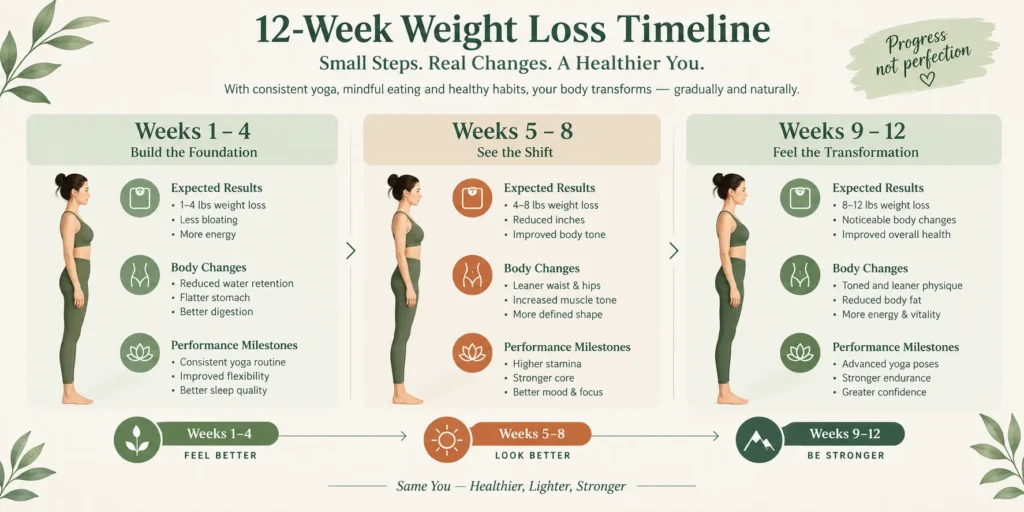
One of the most common questions yoga students ask: “How long until I see weight loss?” Here’s the realistic breakdown:
Weeks 1–2: Minimal Scale Movement, Significant Body Awareness Shift
- Scale weight: 0–2 pounds (often fluctuation from hydration changes)
- Visible changes: None yet
- Feels like: “Wow, I’m sore,” “I’m more aware of my breathing,” “I feel less anxious after class”
- The reality: You’re building neural pathways (muscle-mind connection), not yet significant fat loss
Weeks 3–4: First Real Calorie Deficit Effects
- Scale weight: 2–5 pounds (some water weight + early fat loss + possible initial muscle gain)
- Visible changes: Subtle — clothes fit slightly different, face might look less puffy
- Feels like: “I can hold Plank longer,” “I’m sleeping better,” “I’m thinking about food less”
- The reality: Calorie deficit is working; muscle adaptation is beginning
Weeks 5–8: Noticeable Transformation
- Scale weight: 5–10 pounds
- Visible changes: Obvious — defined arm muscles, slimmer legs, smaller waist, more defined face
- Feels like: “This is actually working,” “I can do poses I couldn’t do 4 weeks ago,” “My energy is better”
- The reality: You’ve built enough muscle that your BMR is increasing; you’re seeing real body composition changes
Weeks 9–12: Establishment & Habit
- Scale weight: 10–20 pounds (highly variable based on starting point)
- Visible changes: Dramatic — friends comment, you need new clothes, your performance in poses is visibly stronger
- Feels like: “This is my life now,” “Yoga isn’t a chore — it’s what I do,” “I notice when I don’t practice”
- The reality: The habit is established; if you continue this way, weight loss will continue but at slower rate (after 12 weeks, weight loss typically slows to 1–2 pounds weekly)
Important caveat: These timelines assume:
- 4–5 yoga sessions weekly
- Progressive increases in intensity every 3–4 weeks
- Calorie deficit nutrition (300–500 calories below maintenance)
- 7–8 hours sleep nightly
- No other major stressors (high stress slows weight loss)
If any of these factors aren’t in place, extend timelines by 2–4 weeks.
Yoga Weight Loss FAQ
Q1. Can you lose weight doing yoga alone, without changing diet?
Technically yes, but very slowly. A person doing 60-minute Vinyasa 5x weekly burns approximately 1,000 calories from yoga weekly. To lose 1 pound of fat weekly (3,500 calorie deficit), you’d need to create an additional 2,500-calorie deficit from other sources — essentially impossible without dietary changes. For practical purposes, assume you need both yoga AND nutrition changes for meaningful weight loss results.
Q2. Is hot yoga better than regular yoga for weight loss?
Not significantly. While Hot Yoga increases perceived exertion and sweating, the actual calorie expenditure is only slightly higher than room-temperature yoga of equivalent intensity — perhaps 25–50 extra calories per session. However, if the heat environment motivates you to practice more consistently, then the added consistency (more sessions weekly) creates better results than the heat itself.
Q3. How often should I practice yoga to lose weight?
4–5 sessions weekly is the minimum for meaningful calorie accumulation. 6+ sessions can accelerate results but increases injury risk if form degrades from fatigue. For long-term sustainability, 4–5 sessions weekly is ideal — aggressive enough for results, conservative enough to prevent burnout or overuse injuries.
Q4. What’s the difference between weight loss and fat loss in yoga?
Weight includes muscle, water, bone, organs, and fat. Fat loss is specifically losing body fat while retaining (or building) muscle. A person doing yoga consistently for 8 weeks might lose 10 pounds on the scale but only 12 pounds of fat (because they’ve also built 2 pounds of muscle). For aesthetics, fat loss matters more than weight loss — 10 pounds of fat lost looks better than 10 pounds of weight lost, even though the scale shows the same number.
5. Can beginners lose weight with yoga, or do I need to be flexible first?
Beginners absolutely can lose weight with yoga. You don’t need flexibility to start — you need consistency. Flexibility is a byproduct of practice, not a prerequisite. All yoga styles offer modified versions of poses that beginners can use while building strength and flexibility simultaneously. Start with beginner-friendly classes (Beginner Vinyasa, Beginner Power Yoga, or Bikram) and progress from there.
Step-by-Step: Starting Your Yoga Weight Loss Practice
Step 1: Assess Current Fitness & Health
Before starting any new fitness program, ensure you’re healthy enough. If you have injuries, joint issues, or chronic health conditions, consult a doctor or physical therapist before beginning yoga.
Step 2: Choose Your Yoga Style Based on Your Fitness Level
- Complete beginner: Beginner Vinyasa, Beginner Power Yoga, or Hot Yoga (heat supports access for stiff bodies)
- Some fitness background: Intermediate Vinyasa or Ashtanga Primary Series
- Experienced athlete: Power Yoga or Advanced Vinyasa
Step 3: Find a Class & Teacher
Choose between in-person classes (better form feedback, accountability) or online classes (convenience, cost-effective). If possible, attend 1–2 in-person classes with a teacher to establish proper alignment before relying on online.
Step 4: Commit to 4 Sessions Weekly for 8 Weeks
Mark your calendar. Schedule practice like any other appointment. Consistency matters more than intensity in these early weeks.
Step 5: Establish a Nutrition Baseline
Use MyFitnessPal or similar app for one week to understand current calorie intake. Then create a 300–500 calorie deficit by either eating slightly less or moving slightly more (or both).
Step 6: Add Protein to Every Meal
Protein supports muscle retention during weight loss and prevents hunger. Aim for 0.8–1.0g per pound of body weight daily.
Step 7: Track Progress Beyond the Scale
- Week 4: Can you hold Plank 1 minute without modification?
- Week 8: Can you do full Chaturangas? Arm balances?
- Week 12: What poses feel easier? What poses have you progressed toward?
Step 8: Assess & Adjust After 8 Weeks
If weight loss has plateaued, increase intensity (progress to advanced pose variations) or decrease calories further (by 100 calories). If energy is low, increase calories by 100–150.
Modifications for Different Bodies & Fitness Levels
Yoga’s power is its accessibility — almost any human body can practice in some form. Here are key modifications:
For Bodies with Extra Weight (Higher BMI)
Challenges: Weight-bearing poses feel harder; flexibility is limited initially; joints (knees, hips) may have discomfort.
Modifications:
- Use props (blocks, straps, bolsters) liberally — they’re not “cheating,” they’re proper alignment tools
- Practice Half Plank (knees down) before full Plank
- Use wall support for arm balances until strength builds
- Widen stance in standing poses for stability
- Practice Warrior poses over narrow warrior stances (stability first, then challenge)
- Consider water yoga or chair yoga in early weeks if joint pain is significant
Timeline adjustment: Expect 2–3 additional weeks to see significant results. Your body requires more time to adapt to new movement patterns. This is normal, not a failure.
For Bodies with Limited Flexibility (Tight Muscles)
Challenges: Forward folds feel impossible; hip openers feel frustrated; can’t “look like” Instagram yoga.
Modifications:
- Use blocks under hands in forward folds (reduces stretch intensity)
- Place blocks under sitting bones in hip openers (reduces intensity)
- Use wall for stretches (gives feedback; removes depth pressure)
- Practice active stretching (engage muscles while stretching) before passive stretching
- Expect flexibility to improve gradually — often 6–8 weeks before noticeable gains
Reality check: Tight muscles often indicate tight neural patterns — your nervous system is protecting those muscles. As you practice consistently and develop body awareness, tightness naturally releases. Forcing deeper stretches typically backfires.
For Bodies with Previous Injuries (Knees, Lower Back, Shoulders)
Modifications vary by injury type:
- Knee issues: Avoid deep lunges, high-impact flows; practice modified lunges with wider stance
- Lower back issues: Avoid deep backbends; protect lumbar spine in forward folds (hinge at hips, not lower back)
- Shoulder issues: Avoid deep arm balances; practice shoulder-opening sequences; modify Chaturanga (lower onto forearms instead of arms)
Best practice: Inform your yoga teacher of any injuries. They can provide pose-specific modifications. If you have chronic injuries, one private consultation with a yoga therapist ($50–100) can establish your personal modification list, then apply those modifications in group classes.
For Athletic Bodies (From Running, Cycling, Gym)
Strengths: You probably have baseline strength; your cardiovascular system is prepared; you understand progressive overload.
Opportunities: Use Power Yoga or advanced Vinyasa to complement your fitness. Your existing fitness means you can progress to challenging poses faster than beginners. Leverage this to build muscle in new patterns (arm balances, inversions) that your normal training hasn’t addressed.
Risk: Don’t use ego to override proper alignment. The fact that you can hold Plank for 5 minutes from your gym training doesn’t mean you’re ready for arm balances — arm balance progression requires specific neural pathway development that’s independent of general strength. Respect the yoga progression.
When to Modify or Avoid Weight-Loss Yoga
While yoga is accessible for most people, certain conditions warrant modification or caution:
Modify (don’t avoid):
- Pregnancy: Practice modified Vinyasa (avoid deep twists, full backbends, heavy inversions after first trimester)
- High blood pressure: Avoid inversions and intense backbends; focus on breathing practices
- Osteoporosis: Avoid high-impact flows and forward bends; focus on strength-building instead
- Arthritis: Practice modified poses with gentler ranges of motion
Avoid until cleared by a healthcare provider:
- Recent injuries (within 4 weeks of injury)
- Severe back pain or active disc herniation
- Uncontrolled high blood pressure (>160/100)
- Recent abdominal or spinal surgery
Consult a physical therapist:
- Chronic pain
- Complex medical histories
- Previous injuries affecting multiple joints
Conversions Tracking: Measuring Progress Beyond the Scale
The scale is a crude measurement tool. Here’s what actually matters for weight loss sustainability:
Physical Measurements to Track
| Measurement | Frequency | Why It Matters |
|---|---|---|
| Waist circumference (at navel) | Weekly | Visceral fat (dangerous fat around organs) decreases first in women |
| Hip circumference | Weekly | Lower body fat loss shows here |
| Chest circumference | Weekly | Muscle gain in chest/shoulders shows here |
| Photos (front/side/back) | Every 2 weeks | Most revealing measure of body composition change |
| Clothing fit | Ongoing | Objectively tells you when fat loss is visible |
Performance Measurements to Track
| Metric | Frequency | Why It Matters |
|---|---|---|
| Plank hold duration | Weekly | Shows core strength progress |
| Number of full Chaturangas without break | Weekly | Shows upper body strength progress |
| Arm balance progression (can you hold Crow?) | Every 2 weeks | Shows nervous system adaptation |
| Heart rate after 10-min flow | Weekly | Lowering heart rate = improving cardiovascular fitness |
| Energy levels throughout day | Daily | Shows metabolism is improving |
Mental/Behavioral Tracking
| Metric | Frequency | Why It Matters |
|---|---|---|
| Cravings intensity (scale 1–10) | Weekly | Shows nutritional patterns are stabilizing |
| Sleep quality (scale 1–10) | Daily | Sleep improvement > weight loss speedup |
| Food choice quality (% of meals aligned with nutrition plan) | Daily | Behavior change drives sustainable results |
| Yoga consistency (sessions completed vs. planned) | Weekly | Shows habit strength; consistency predicts results |
Key insight: If the scale isn’t moving but your waist circumference is decreasing, your photos show visible change, and you’re holding Plank 30 seconds longer than 4 weeks ago — you’re winning. You’re losing fat and building muscle. The scale is just slow to show it.
Misinformation Alert: Common Myths About Yoga & Weight Loss
Myth 1: “Yoga alone will make you lose weight without diet changes.”
Reality: Yoga contributes to weight loss through calorie burn, but the magnitude requires diet changes to create meaningful deficit. Think of it as a supporting factor, not the primary driver.
Myth 2: “Hot yoga melts fat faster.”
Reality: Heat doesn’t accelerate fat loss. A 105°F room burns maybe 25–50 more calories than 75°F for the same intensity. However, if the heat environment increases your consistency (you practice more often in heat), then consistency drives results, not heat itself.
Myth 3: “You need to do yoga every single day to lose weight.”
Reality: 4–5 sessions weekly is ideal. 6+ sessions increases injury risk without proportional benefit. One rest day weekly allows recovery, which is when muscle builds and metabolism improves.
Myth 4: “Yoga is only for flexibility — it doesn’t build muscle like weights do.”
Reality: Yoga absolutely builds muscle through resistance training (your body weight as resistance). It builds lean muscle differently than gym weights, but the metabolic benefit is similar. An experienced yoga practitioner’s shoulders and core are visibly muscular.
Myth 5: “You can’t lose weight with yoga if you’ve never been flexible.”
Reality: You don’t need flexibility to start yoga. Flexibility improves as a byproduct of practice. Many strong, muscular yoga practitioners were completely inflexible when they started.
Key Takeaways
✅ Which yoga styles burn the most calories? Vinyasa, Ashtanga, Power Yoga, and Hot Yoga (180–400 calories/hour) all support weight loss when practiced consistently.
✅ 4–5 sessions weekly is the minimum for meaningful calorie accumulation; sporadic practice won’t create the deficit needed for weight loss.
✅ Nutrition changes are non-negotiable — yoga + 300–500 calorie deficit + adequate protein = weight loss. Yoga alone is insufficient.
✅ Progression is essential — your body adapts within 4–6 weeks; intentionally advance to harder pose variations every 3–4 weeks to continue calorie burn and muscle building.
✅ Realistic timeline is 8–12 weeks before significant visible changes; expect 10–20 pounds total (variable based on starting point).
✅ Track beyond the scale — waist circumference, photos, clothing fit, and performance metrics (can you hold Plank longer?) matter more than scale weight.
✅ Consistency matters more than intensity — a person who practices moderate-intensity yoga 5x weekly loses more weight than someone doing intense yoga 1x weekly.
✅ Behavioral changes amplify results — the mindfulness, stress reduction, and body awareness from yoga naturally support healthier food choices and sleep patterns.
✅ Modifications ensure accessibility — yoga serves all bodies; use props, modified poses, and beginner classes without shame.
✅ Long-term sustainability requires enjoyment — if you hate Power Yoga but love Vinyasa, choose Vinyasa. Consistency beats intensity when it comes to weight loss.
Conclusion
The question “Which yoga is best for weight loss?” has a nuanced answer. It’s not that one yoga style is inherently superior for weight loss — it’s that certain styles (Vinyasa, Ashtanga, Power Yoga, Hot Yoga) do burn sufficient calories to support weight loss when they’re practiced consistently (4–5x weekly) and combined with nutritional changes that create a calorie deficit.
The most common mistake people make is treating yoga as if it’s a complete weight loss solution. It’s not. Yoga is a powerful support — it burns calories, builds muscle, reduces stress, and cultivates the mindfulness that naturally supports healthier choices. But it works only when these three factors align: consistent practice, progressive challenge, and nutrition discipline.
If you’re considering yoga for weight loss, start by honestly assessing which of these three factors will be your biggest challenge. For some people, it’s consistency (scheduling practice in a busy life). For others, it’s progression (staying motivated to challenge yourself beyond beginner poses). For most people, it’s nutrition (changing eating patterns built over decades).
Address your specific challenge first. If consistency is hard, choose a studio with community (accountability helps). If progression is hard, hire a private teacher for 2–4 sessions to teach you how to progress safely. If nutrition is hard, start with the addition model (add protein, add vegetables, add water) before restricting anything.
Then commit to 8–12 weeks. Track your progress beyond the scale (photos, measurements, clothing fit, performance improvements). Expect 10–20 pounds of weight loss, meaningful visible changes, and a completely transformed relationship with your body.
Most importantly, understand that yoga for weight loss isn’t about punishing your body into submission. It’s about building a practice so sustainable, so enjoyable, and so effective that weight loss becomes a side effect of consistently showing up for yourself.
That’s when the real transformation happens.

