| ⚡ Quick Answer: What is Bhramari Pranayama? Bhramari Pranayama (also spelled Brahmari Pranayama) is a yogic breathing technique named after the Indian black bee — ‘Bhramari’ in Sanskrit. It involves making a soft humming sound on the exhale while closing the ears with the thumbs and covering the eyes with the fingers. This simple yet powerful practice immediately activates the parasympathetic nervous system, reducing stress hormones, lowering blood pressure, and calming anxiety within minutes. It is one of the safest and most accessible pranayama techniques for complete beginners. |
You’ve probably never thought of humming as a wellness practice. Most of us hum absentmindedly — in the car, in the shower, while making tea. We don’t think of it as something deliberate, something healing.
But Bhramari Pranayama — the yogic humming bee breath — turns something as simple as a hum into one of the most immediately effective stress-relief tools in the entire yoga system. Practitioners often describe the effect as almost shocking in its speed. You sit down feeling scattered, anxious, or wired. You do five rounds of Bhramari. And something in your nervous system just… settles.
This isn’t mystical — there’s real physiology behind it. The humming sound creates vibrations that stimulate the vagus nerve, the body’s primary pathway to the parasympathetic ‘rest and digest’ state. Research published in journals including the International Journal of Yoga has found measurable reductions in heart rate, blood pressure, and anxiety markers following Bhramari practice.(1).
In this complete guide, we cover exactly what Bhramari Pranayama is, the seven most significant benefits backed by both traditional yoga wisdom and modern research, a step-by-step technique guide for beginners, common mistakes that reduce its effectiveness, and who should approach this practice with caution.
Whether you’re dealing with chronic stress, struggling with sleep, or simply want to add a powerful calming tool to your yoga practice — Bhramari Pranayama is genuinely worth understanding.
What Is Bhramari Pranayama?
Bhramari Pranayama is one of the eight classical pranayama (breathing) techniques described in the Hatha Yoga Pradipika — one of yoga’s foundational texts. The word ‘Bhramari’ comes from the Sanskrit word for a specific type of large black Indian bee known for its distinctive low humming sound. The practice mimics this sound on the exhale.
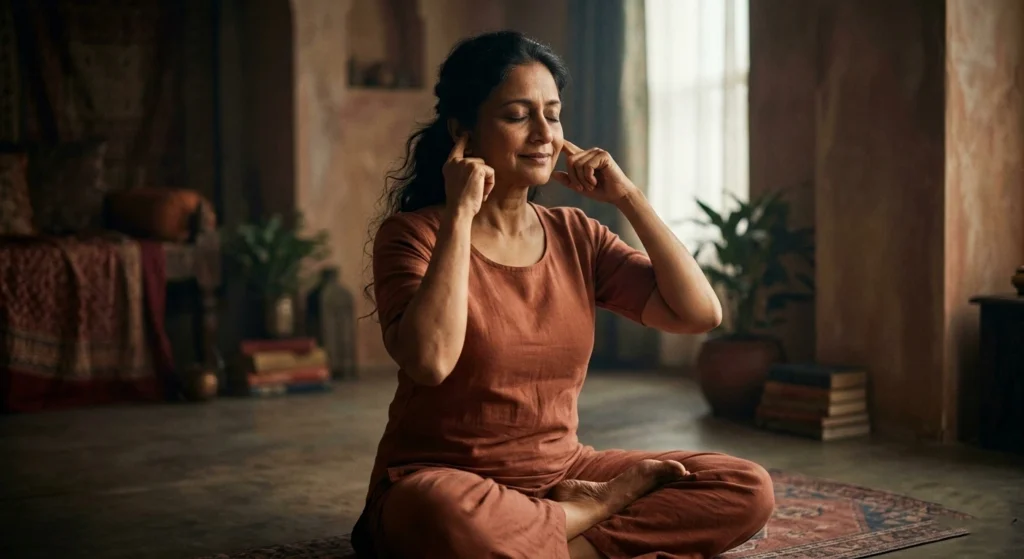
The technique involves a specific hand position (Shanmukhi Mudra or Yoni Mudra) where the fingers and thumbs are placed over the sensory openings of the face — closing the ears, resting over the eyes, and sometimes gently covering the nostrils and lips. With the external world shut out, you inhale deeply and then exhale with a continuous, resonant humming sound.
What makes Bhramari unique among pranayama practices is how immediately accessible it is. Unlike Kapalbhati (which requires building breath capacity) or advanced pranayama like Kumbhaka (breath retention), Bhramari can be practiced effectively from day one by virtually anyone who can breathe and hum. The learning curve is almost flat — and the benefits begin with the very first round.
Bhramari Pranayama is known by several names:
- Bhramari Breathing Technique
- Humming Bee Breath (most common English translation)
- Bee Breath Pranayama
- Brahmari Pranayama (alternate spelling)
| 🔬 What the Research Says Studies on Bhramari Pranayama have found significant reductions in heart rate and blood pressure after just 5 minutes of practice. Research from the International Journal of Yoga found that regular Bhramari practice led to measurable improvements in cardiovascular parameters and subjective stress levels. Neuroscientific research suggests the humming vibration stimulates the vagus nerve — the body’s longest cranial nerve and the primary controller of the parasympathetic nervous system. This vagal stimulation is likely responsible for the immediate calming effect most practitioners notice. Additional research suggests the nasal humming may increase nitric oxide production in the sinuses, which has vasodilatory and immune-supporting effects. |
7 Proven Benefits of Bhramari Pranayama
| Benefit | How It Helps You | Best For |
| Immediate Stress Relief | Activates parasympathetic nervous system within minutes; lowers cortisol and adrenaline levels | Anxiety, overthinking, panic |
| Lowers Blood Pressure | Slows heart rate and promotes vasodilation; research shows measurable BP reduction after 5 min | Hypertension, cardiovascular health |
| Reduces Anxiety & Depression | Vagal nerve stimulation shifts brain from reactive to calm state; similar mechanism to meditation | Anxiety disorders, low mood |
| Improves Sleep Quality | Calms the nervous system pre-sleep; reduces racing thoughts and physical tension | Insomnia, poor sleep, night anxiety |
| Enhances Concentration & Focus | The single-pointed focus on the humming sound trains attention; used before study or meditation | Mental fog, distraction, ADHD support |
| Relieves Headaches & Migraines | Vibrations may reduce sinus pressure and muscle tension in the head and neck | Tension headaches, sinus pressure |
| Supports Thyroid Health | Throat vibrations stimulate the thyroid region; traditional yoga texts associate this with throat chakra activation | Thyroid imbalance, voice health |
It’s important to be clear: while the stress, anxiety, and blood pressure benefits of Bhramari Pranayama have reasonable scientific support, some benefits — particularly around thyroid health and energetic/chakra effects — are based primarily on traditional yoga philosophy and anecdotal practitioner experience. Bhramari is a valuable complementary practice, not a replacement for medical treatment.
| ⚠️ Who Should Avoid Bhramari Pranayama Bhramari Pranayama is generally very safe — but avoid it if you have: active ear infection or severe ear pain, perforated eardrum, severe respiratory conditions that make controlled breathing difficult, or epilepsy (the stimulation of the vagus nerve may not be appropriate). Pregnant women can generally practice Bhramari safely but should avoid breath retention variations. If you feel dizzy, lightheaded, or experience any discomfort during practice, stop immediately and breathe normally. Always consult your doctor before starting any pranayama practice if you have existing medical conditions. |
How to Do Bhramari Pranayama: Complete Step-by-Step Guide
What You Need
- A quiet space — Bhramari works best without background noise
- A comfortable seated position — cross-legged on the floor, on a meditation cushion, or on a chair
- Loose, comfortable clothing that doesn’t restrict your breathing
- 5-15 minutes — though even 3 minutes is worthwhile
The Hand Position (Shanmukhi Mudra)
The traditional hand gesture for Bhramari is called Shanmukhi Mudra (six-gates seal) or sometimes Yoni Mudra. Here’s how to position your hands:
- Raise both hands to your face, elbows at shoulder height
- Place both thumbs gently over the tragus — the small cartilage flap at the entrance to your ear canal. Press lightly to close the ears. Do not push hard into the ear canal itself.
- Rest your index fingers lightly over your closed eyelids — no pressure on the eyeballs
- Middle fingers rest on either side of the nose bridge
- Ring fingers rest just above the upper lip
- Little fingers rest just below the lower lip
If this full hand position feels uncomfortable or awkward when starting out, a simplified version works perfectly well: simply use your thumbs to close your ears and keep your other fingers resting gently on your face or on your knees. The ear-closing is the most important element.
The Complete Bhramari Pranayama Technique — Step by Step
- Sit comfortably with your spine tall and your shoulders relaxed. Take a moment to settle — close your eyes and breathe naturally for a few breaths.
- Take a slow, deep inhale through your nose. Fill your lungs completely — expand your belly first, then your chest. The inhale should be smooth and unhurried.
- Raise your hands into Shanmukhi Mudra, gently closing your ears with your thumbs.
- As you begin to exhale, make a soft, continuous humming sound — like a bee buzzing, or like humming a note with your mouth closed. The sound should be smooth, steady, and relatively low-pitched. Your mouth stays closed throughout.
- Feel the vibration of the humming resonating in your skull, throat, and chest. This vibration is where much of the benefit lives — really let yourself feel it.
- Continue the humming until your exhale is complete. Don’t force it — just let the breath run out naturally while the hum continues.
- Lower your hands, open your ears, and take one natural breath without humming.
- This completes one round. Repeat for 5-10 rounds to start.
Bhramari Pranayama for Absolute Beginners — Simplified Version
If the full technique feels like too much at once, start even simpler:
- Sit comfortably. Close your eyes.
- Inhale slowly and deeply through your nose.
- As you exhale, simply hum — like you’re humming a tune, but with your mouth closed.
- Feel the vibration in your head and throat.
- Repeat 5 times.
That’s it. No special hand position required to start. The humming itself is the core of the practice. Add the hand position once the breathing pattern feels natural.
Bhramari Pranayama Variations
1. Bhramari with Extended Exhale
Once you’re comfortable with the basic technique, try extending your exhale humming time. Inhale for a count of 4, and try to hum for a count of 8 or even longer. A longer exhale deepens the parasympathetic response and increases the calming effect significantly.
2. Bhramari with Breath Retention (Advanced)
Advanced practitioners sometimes add a brief kumbhaka (breath retention) after the inhale before beginning the humming exhale. Retain for 2-4 seconds, then hum on the exhale. Do not attempt breath retention if you’re new to pranayama, pregnant, or have cardiovascular conditions.
3. Lying Down Bhramari
For sleep support or deep relaxation, Bhramari can be practiced lying on your back in Savasana. Without the hand position (which becomes awkward lying down), simply hum on each exhale with your eyes closed. This is particularly effective for anxiety before sleep.
4. Bhramari in Sequence with Anulom Vilom
One of the most effective pranayama combinations is to practice 5-10 rounds of Anulom Vilom (alternate nostril breathing) first to balance the nervous system, then follow with 5-10 rounds of Bhramari to deepen the calming effect. This sequence is excellent for pre-meditation practice.
How to Build a Daily Bhramari Pranayama Practice
Bhramari Pranayama works best as a consistent daily practice rather than an occasional one. Here’s a simple progression to build from beginner to established practitioner:
Week 1-2: Getting Started
- 5 rounds daily, simplified version (no hand position)
- Best time: morning before breakfast or evening before dinner
- Duration: 3-5 minutes total
Week 3-4: Adding the Full Technique
- 7 rounds with full Shanmukhi Mudra
- Begin extending the exhale slightly
- Duration: 5-8 minutes total
Month 2 and Beyond: Established Practice
- 10-15 rounds daily
- Combine with Anulom Vilom (5 rounds before Bhramari)
- Add to your meditation practice as a preparation
- Duration: 10-15 minutes total
The best time to practice Bhramari Pranayama is early morning on an empty stomach — Brahma Muhurta (the hour before sunrise) if you’re following traditional recommendations. However, practically speaking, any consistent time that fits your schedule is better than the ‘perfect’ time that you never actually keep.
Common Mistakes in Bhramari Pranayama — And How to Fix Them
- Making the Hum Too Loud: Bhramari is a gentle, inward practice — not a performance. The humming sound should be soft and resonant, not loud or forced. A quieter, more sustained hum creates more internal vibration than a loud, short one.
- Pressing Too Hard on the Ears: The thumbs close the ears gently — you’re just reducing sound input, not sealing the ears completely or pushing into the canal. Pressing too hard can be uncomfortable and distracts from the practice.
- Shallow Inhale: Many beginners take a short, shallow inhale before humming. Take your time. A full, deep belly-first inhale gives you more exhale to work with and deepens the practice significantly.
- Opening the Mouth: Your mouth stays completely closed throughout Bhramari. The humming sound comes through the closed lips. Opening the mouth changes the vibration pattern entirely and reduces effectiveness.
- Rushing Through Rounds: Bhramari is not a breathing exercise you rush. Between rounds, take at least one natural breath and notice the effect before beginning the next round. Slowing down dramatically increases the benefit.
- Practicing When Unwell: Avoid Bhramari when you have a cold, ear infection, or any condition affecting your sinuses or ears. The increased sinus pressure from the humming can be uncomfortable or counterproductive when you’re congested.
Expert Tips to Deepen Your Bhramari Practice
- Focus your internal gaze (eyes closed) at the Ajna chakra point — the space between the eyebrows. This deepens concentration and enhances the meditative quality.
- Experiment with pitch — a lower, deeper hum creates stronger chest vibrations; a higher hum creates more head and sinus vibration. Both are beneficial.
- Practice in a silent room initially — as you develop sensitivity to the internal vibration, external noise becomes less distracting.
- Try 3 rounds of Bhramari the moment you feel a stress response starting — before a difficult conversation, during a tense workday, or when anxiety spikes. The effect is fast.
- Track your resting heart rate before and after a session using any fitness tracker. The measurable drop will motivate consistent practice.
- Combine with a simple mantra intention — some practitioners silently set an intention before beginning their humming rounds.
Bhramari Pranayama Precautions
- Before doing this pranayama, you can do Anulom_Vilom pranayama.
- Before performing our Bhramari Pranayama or any other pranayama, keep the stomach empty.
- You can practice Bhramari Pranayama at any time, whether it is morning or evening, provided it should be done on an empty stomach.
- If you want to practice Bhramari Pranayama in the evening time, do not eat anything 3 to 4 hours before.
- If you are struggling with any kind of infection, then this pranayama should not be done.
- If there is any problem while doing this pranayama, then do not do this pranayama.
- Before doing this pranayama, take the advice of a yoga teacher.
Contraindications
There are no contradictions in performing Bhramari Pranayama. Anyone from a child to an old person can learn this pranayama by any yoga instructor. This pranayama ought to be done on an unfilled stomach.
Although yoga is very beneficial for the body and mind. It will be very beneficial to practice yoga asanas under the supervision of a trainer. If there is any physical or mental defect, it will be beneficial to do medical advice and under the supervision of the instructor.
Frequently Asked Questions About Bhramari Pranayama
What is Bhramari Pranayama and why is it called humming bee breath?
Bhramari Pranayama is a yogic breathing technique where you make a continuous humming sound on the exhale, similar to the sound of a bee. The name comes from ‘Bhramari’ — the Sanskrit word for a large black Indian bee known for its distinctive buzzing hum. The practice is called humming bee breath in English because the exhalation sound closely mimics that gentle, resonant bee hum.
How many times should I practice Bhramari Pranayama daily?
Beginners should start with 5 rounds daily and gradually build to 10-15 rounds over 2-4 weeks. Traditional yoga texts recommend practicing up to 21 rounds for therapeutic purposes, but 10 rounds is a complete and effective daily practice for most people. More important than the number of rounds is the consistency — 5 rounds every day beats 20 rounds once a week.
Can Bhramari Pranayama reduce blood pressure?
Research suggests yes — studies have found measurable reductions in both systolic and diastolic blood pressure following regular Bhramari practice. The mechanism is primarily vagal nerve stimulation, which slows heart rate and promotes vasodilation. However, Bhramari should be used as a complementary practice alongside — not instead of — prescribed medication for hypertension. Always work with your doctor.
Is Bhramari Pranayama safe during pregnancy?
Basic Bhramari Pranayama (without breath retention) is generally considered safe during pregnancy and may be particularly helpful for managing anxiety, sleep difficulties, and stress. However, the variation with breath retention (Kumbhaka) should be avoided during pregnancy. Always consult your healthcare provider before starting any breathing practice during pregnancy.
What is the best time to do Bhramari Pranayama?
The traditional recommendation is early morning on an empty stomach — ideally during Brahma Muhurta, approximately 1.5 hours before sunrise. However, Bhramari is also highly effective in the evening as a wind-down practice, and can be practiced at any time you need immediate stress relief. Avoid practicing within 2 hours of a large meal. Consistency of timing is more important than the perfect time of day.
Can Bhramari Pranayama help with anxiety and panic attacks?
Bhramari is one of the most effective breathing techniques for acute anxiety. The humming exhalation immediately activates the parasympathetic nervous system — the body’s calming response — which counteracts the physiological stress response. Many anxiety sufferers report significant relief within 3-5 rounds. For panic attacks specifically, the slow, focused exhale also interrupts the hyperventilation pattern that worsens panic symptoms. Regular daily practice builds baseline anxiety resilience over time.
What is the difference between Bhramari Pranayama and Anulom Vilom?
Both are important pranayama techniques but they work differently. Anulom Vilom (alternate nostril breathing) balances the two hemispheres of the brain and the ida and pingala nadis — it’s excellent for mental clarity and energetic balance. Bhramari Pranayama focuses specifically on calming the nervous system through sound vibration and is more immediately effective for acute stress, anxiety, and sleep preparation. Many practitioners use both in sequence: Anulom Vilom to balance, then Bhramari to calm and settle.