

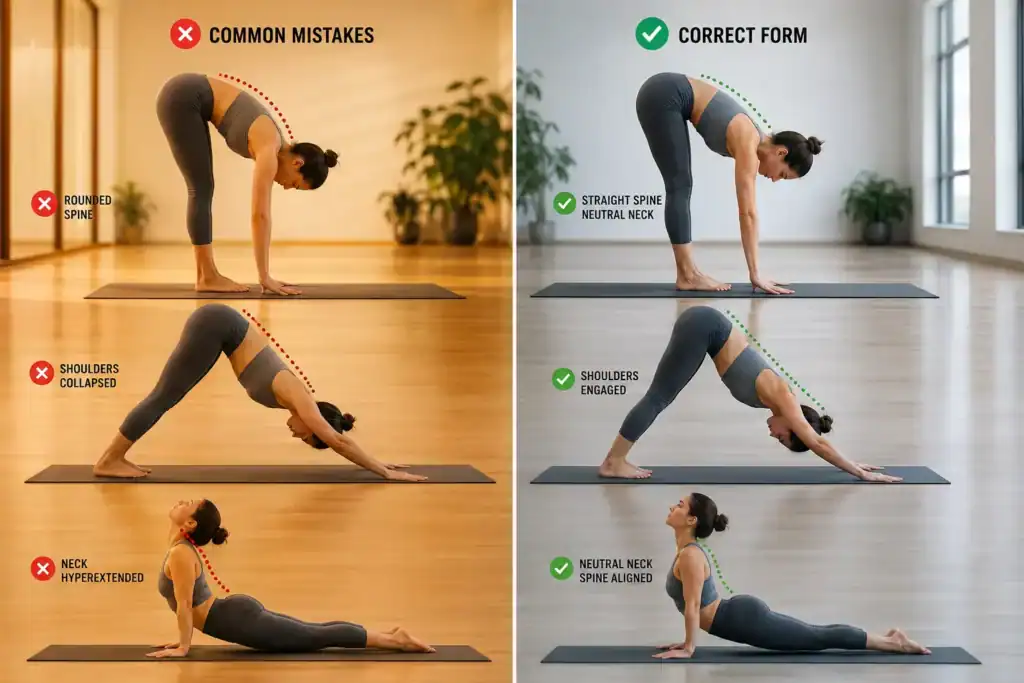
The 15 most common beginner yoga mistakes are: forcing deeper poses before building foundation, holding breath, comparing to advanced yogis, practicing on full stomach, ignoring pain, poor spine alignment, skipping strength work, not engaging core, refusing modifications, insufficient warm-up, inconsistent practice, ignoring body signals, wrong foot alignment, avoiding props, and practicing before bed. Each sabotages progress or risks injury. This guide explains each mistake and exactly how to fix it.
You step onto your mat with enthusiasm and determination.
You watch videos online, join a class, or follow along at home. You push yourself harder, deeper, faster. You want results—flexibility, strength, peace of mind.
But weeks pass and you’re not seeing improvement. Or you develop pain. Or the practice stops feeling good. Or you quit because it “just isn’t working.”
The problem isn’t yoga. The problem is beginner mistakes.
Most new practitioners make the same 15 preventable errors that sabotage progress, create frustration, cause injury, and lead to burnout. These mistakes are so common that thousands of yoga teachers watch new students repeating them every single day.
The good news? Every single one is fixable. And fixing them transforms your entire yoga experience.
This comprehensive guide reveals the 15 most common beginner yoga mistakes—the ones that actually matter, the ones that hold back progress. More importantly, you’ll learn exactly how to fix each one, proven techniques to prevent them, and how to build a sustainable, injury-free, rewarding yoga practice.
Whether you’ve been practicing for 2 weeks or 6 months, whether you’re in classes or practicing at home, whether you’re flexible or tight, this guide helps you identify mistakes you’re probably making right now—without even knowing it.
MISTAKE 1: Forcing Deep Poses Before Building Foundation
What it looks like:
Beginner tries full splits, deep backbends, or arm balances in first class despite lacking flexibility and strength.
Why it’s a mistake:
- Risks serious injury (hamstring strain, back injury, shoulder problems)
- Bypasses foundational strength development
- Creates frustration when progress plateaus
- Teaches nervous system that yoga is risky
- Prevents developing proper alignment in basic poses
How to fix it:
- Spend first 4-8 weeks mastering foundational poses only (child’s pose, downward dog, warrior I, forward fold)
- Use modifications without shame—modifications are intelligent training
- Progress only when pose feels stable and aligned, not just achievable
- Ask teacher: “What should I master before attempting this pose?”
- Follow sequential progressions, not Instagram goals
Test for readiness: Can you hold the pose for 5 breaths with perfect alignment and zero strain? If not, you’re not ready yet.
Timeline: 12-16 weeks to safely progress beyond basics for most beginners.
MISTAKE 2: Holding Your Breath Instead of Breathing Continuously
What it looks like:
Beginner inhales, then stops breathing—holding breath through entire pose or transition.
Why it’s a mistake:
- Increases blood pressure and muscle tension
- Prevents relaxation response
- Limits oxygen available to muscles
- Creates stress instead of stress relief
- Masks proper engagement (can “hold” poses through tension alone)
- Prevents accessing deeper stretch
How to fix it:
- Before class, practice continuous breathing for 2 minutes (in nose 4 counts, out nose 4 counts)
- Make breath audible (ocean breath/ujjayi) so you hear if you’re holding
- In poses, count breaths to stay aware
- If you can’t breathe, pose is too deep—back off immediately
- Teacher cue: “Breath is your body’s feedback system”
Simple test: Can you speak or hum while in the pose? If yes, you’re breathing. If no, you’re holding.
Why it works: Continuous breath = continuous relaxation. Your nervous system can’t stay tense while breathing smoothly.
MISTAKE 3: Comparing Yourself to Advanced Yogis
What it looks like:
Beginner looks at person in class who’s deeply flexible, matches their pose depth, and feels inadequate when they can’t match it.
Why it’s a mistake:
- You’re comparing your beginning to someone’s middle/advanced
- Risk of injury from forcing inappropriate depth
- Destroys confidence and motivation
- Misses the point of personal practice
- Creates toxic, competitive mindset instead of meditative one
How to fix it:
- Consciously not look at others—focus inward
- Remind yourself: “They’ve practiced for X years, I’ve practiced for X weeks”
- Use teacher’s alignment cues (based on YOUR body), not others’ depth
- Define success as “better than last week,” not “matching them”
- If practicing in group, position yourself where you can’t see others’ practice
Mental reframe: “My practice is perfect for my body right now. Someone else’s depth is irrelevant to my progress.”
Why it works: Yoga’s foundation is internal awareness, not external competition. Comparing sabotages the practice’s core benefit.
MISTAKE 4: Eating Large Meals Before Practice
What it looks like:
Beginner eats lunch 30 minutes before yoga class, then struggles with digestion, bloating, or nausea during practice.
Why it’s a mistake:
- Digestion requires blood flow; practice requires it too
- Causes bloating, nausea, or pain
- Prevents full breathing (full stomach restricts diaphragm)
- Limits depth of practice
- Uncomfortable physical sensation ruins mental clarity
How to fix it:
- Wait 2-3 hours after full meals before practicing
- Light snack (fruit, yogurt) okay 30-60 minutes before
- Hydrate well 1-2 hours before (not immediately before)
- Empty bladder and bowels before class
- If morning practice, practice fasted (eat after)
Rule of thumb: “Light to moderate = 1 hour; heavy meal = 3 hours”
Why it works: Your body can digest OR practice intensely, but not both simultaneously. Separate them.
MISTAKE 5: Practicing Through Pain (Ignoring Pain Signals)
What it looks like:
Beginner feels sharp, shooting, or burning pain but pushes through because “yoga is supposed to challenge me.”
Why it’s a mistake:
- Sharp pain = injury warning (not flexibility limitation)
- Pushing through causes actual tissue damage
- Creates chronic pain and long-term injury
- Teaches body to ignore its signals
- Prevents healing from minor strains
Critical distinction:
- Good sensation: Gentle stretch, muscle engagement, mild discomfort in target muscle group (pressure, not pain)
- Bad sensation: Sharp pain, shooting, burning, pain radiating down limb, joint pain, any pain that’s severe or sudden
How to fix it:
- Stop immediately if you feel sharp, shooting, or burning pain
- Back out of pose slowly and gently
- Immediately tell teacher if in class
- Check: Did I strain a muscle? Do I need modification?
- If pain continues after 5 minutes out of pose, ice and rest
Rule: “Pain is not gain in yoga. Discomfort might be. Pain is never okay.”
Why it works: Your body knows what’s dangerous. Listening prevents injury.
MISTAKE 6: Poor Spinal Alignment in Foundational Poses
What it looks like:
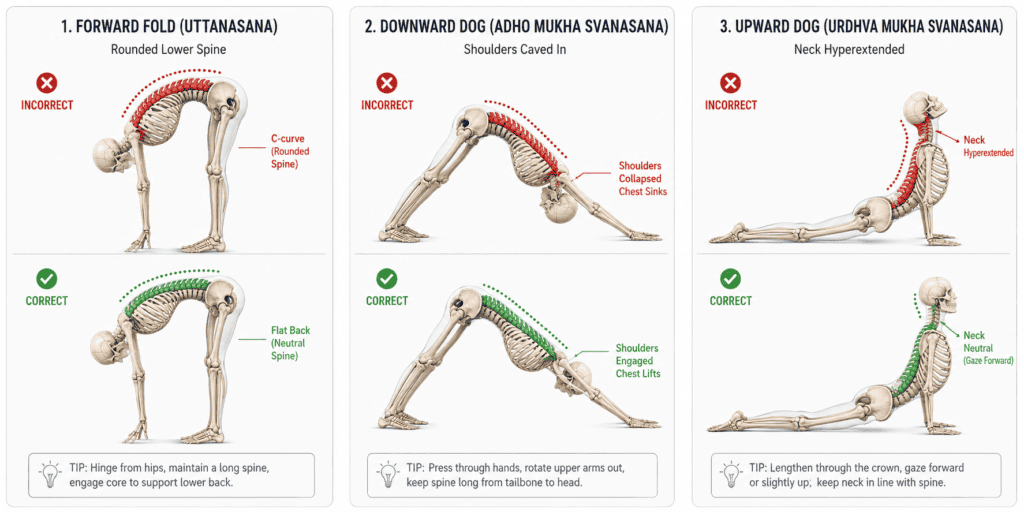
Beginner rounds lower back in forward fold, collapses chest in downward dog, or hyperextends neck in upward dog.
Why it’s a mistake:
- Causes lower back strain and potential herniation
- Prevents engaging core properly
- Misses the actual strengthening benefit
- Creates chronic neck and back pain
- Builds poor alignment patterns (hard to unlearn)
Common alignment errors:
Forward Fold:
- ❌ Rounding lower back (curving spine like C)
- ✅ Hinging from hips, keeping spine relatively straight
Downward Dog:
- ❌ Shoulders caving in, head looking down
- ✅ Shoulders back and down, head neutral (looking slightly forward)
Upward Dog:
- ❌ Neck hyperextended (head thrown back)
- ✅ Neck neutral (back of head in line with spine)
Warrior I:
- ❌ Back arching excessively
- ✅ Neutral spine, core engaged, chest squared
How to fix it:
- Work with teacher in person (video often can’t catch alignment)
- Use mirror if practicing at home (though don’t obsess)
- Engage core first, then move into pose
- Ask teacher to check your alignment
- Film yourself and compare to tutorial (check side angle, not front)
Why it works: Proper alignment prevents injury, creates strength, and makes poses accessible.
MISTAKE 7: Only Stretching, Never Building Strength
What it looks like:
Beginner focuses entirely on flexibility poses, avoiding anything that feels “hard,” skipping strength-building sequences.
Why it’s a mistake:
- Creates muscle imbalances
- Flexibility without strength = unstable joints = injury risk
- Weak muscles can’t support proper alignment
- Creates weak core that can’t protect spine
- Progress plateaus because foundation is missing
The balance needed:
- 40% flexibility/stretching
- 60% strength/stability
How to fix it:
- Include strength poses every practice: plank, warrior series, chaturanga
- Hold strength poses 5+ breaths (not just flow through)
- Don’t skip the “hard” poses
- Build upper body strength (essential for shoulder health)
- Develop core strength (essential for spine protection)
Why it works: Balanced strength and flexibility creates sustainable practice and prevents injury.
MISTAKE 8: Not Engaging Core Muscles
What it looks like:
Beginner does plank or downward dog with sagging hips, no abdominal engagement, or collapsed core.
Why it’s a mistake:
- Spine isn’t protected during poses
- Doesn’t build core strength (missing 40% of benefit)
- Creates back pain from unsupported spine
- Prevents progression to more advanced poses
- Misses the functional strength yoga builds
How to identify if your core is engaged:
- Can you draw navel toward spine while breathing?
- Are your hips level with shoulders in plank?
- Does your lower back sag in downward dog?
- Can someone see your abdominals engaged?
How to fix it:
- Before any pose, consciously engage core
- Draw navel in 20-30% (not full suction, just engagement)
- Maintain engagement while breathing
- Check alignment: are hips level?
- Teacher cue: “Draw navel in and up”
Simple practice:
- Stand tall
- Place hand on belly
- Draw navel toward spine
- Feel abdominals tighten
- This is the engagement you maintain throughout practice
Why it works: Core engagement protects spine, enables progression, and builds genuine strength.
MISTAKE 9: Using Ego Instead of Using Modifications
What it looks like:
Beginner refuses modifications (“I don’t need a prop”) and forces full pose, compromising alignment to “prove” capability.
Why it’s a mistake:
- Modifications aren’t failures—they’re intelligent progression
- Forcing full pose creates bad alignment patterns
- Risks injury from inappropriate depth
- Prevents building necessary foundation
- Shows misunderstanding of yoga’s purpose
Reality check: Every experienced yogi uses modifications regularly.
- Advanced yogis modify poses based on day’s energy
- Teachers use modifications to protect joints
- Props aren’t “giving up”—they’re using tools intelligently
How to fix it:
- Accept modifications without shame
- Remember: “This modification is stronger/smarter than full pose done wrong”
- Modifications often provide MORE muscle engagement
- Use them confidently—they’re part of intelligent practice
- Recognize when you’re ready to progress (with teacher guidance)
Mindset shift: “Modifications mean I’m smart enough to practice safely.”
Why it works: Proper foundation with modifications builds real strength faster than forcing deeper poses with poor alignment.
MISTAKE 10: Insufficient Warm-Up Before Intense Practice
What it looks like:
Beginner jumps immediately into vinyasa flow or power yoga without proper warm-up, then struggles with cold muscles and stiff joints.
Why it’s a mistake:
- Muscles are stiff when cold, prone to strain
- Joints aren’t lubricated yet
- Nervous system isn’t activated
- Can’t access full range of motion
- Increases injury risk
How to fix it:
- Always start with 5-10 minute warm-up
- Gentle movement: cat-cow, arm circles, gentle twists
- Slowly raise body temperature
- Begin practice only when muscles feel warm
- Longer warm-up = safer, deeper practice
Sample 5-minute warm-up:
- 2 min: Gentle stretching, breathing
- 1 min: Arm circles and shoulder rolls
- 2 min: Cat-cow, gentle twists, joint activation
Why it works: Warm muscles are flexible muscles. Time invested in warm-up prevents injury and improves practice.
MISTAKE 11: Inconsistent or Sporadic Practice
What it looks like:
Beginner practices intensely for 2 weeks, then skips 3 weeks, then comes back. Or practices randomly with no schedule.
Why it’s a mistake:
- Progress requires consistency (muscle memory, nervous system adaptation)
- Sporadic practice means constant restarting
- Plateau from lack of stimulus
- Takes 4-6 weeks consistency to see real benefits
- Harder to build habit without regular schedule
Research: Consistency matters more than intensity.
- 2x/week for 12 weeks = transformation
- 1x/month for 12 weeks = minimal progress
- 5x/week for 2 weeks = frustration (too fast to build)
How to fix it:
- Commit to realistic schedule (2-3x/week minimum)
- Treat classes like appointments (schedule them)
- Set calendar reminders
- Find accountability (friend, class, online community)
- Start with commitment period (4-6 weeks minimum)
Why it works: Consistency teaches your nervous system and muscles. Regular stimulus creates adaptation and progress.
MISTAKE 12: Not Listening to Your Body’s Unique Needs
What it looks like:
Beginner follows class exactly without modifications, ignoring signals their body is sending (tightness, weakness, previous injuries).
Why it’s a mistake:
- Everyone’s body is different (height, proportions, flexibility, injuries)
- Generic instruction doesn’t fit everyone perfectly
- Ignoring body signals risks injury
- Misses opportunity to customize practice
- Creates frustration from practice not “working”
How to fix it:
- Tell teacher about injuries/limitations (crucially important)
- Listen to sensations (tightness ≠ pain)
- Use modifications when needed
- Communicate: “This doesn’t feel right—what should I try?”
- Trust that YOUR practice is the right practice
For different body types:
- Tight hamstrings? Add extra forward fold prep
- Tight hips? Extra hip opening sequences
- Weak wrists? Avoid hand-heavy poses
- Rounded shoulders? Extra chest-opening work
Why it works: Yoga that honors YOUR body creates safety, progress, and sustainability.
MISTAKE 13: Wrong Foot Alignment in Standing Poses
What it looks like:
Beginner’s feet are splayed outward, heels splayed inward, or feet track incorrectly in lunges and warrior poses.
Why it’s a mistake:
- Misalignment stresses knees and ankles
- Prevents proper hip engagement
- Creates instability
- Can cause chronic knee or hip pain
- Misses glute activation benefit
Correct foot alignment:
Standing poses (Warrior, Triangle, etc.):
- ✅ Feet grounded
- ✅ Weight distributed evenly across foot
- ✅ Front foot points forward
- ✅ Back foot external rotation (only if needed for balance)
- ✅ Knees track over toes
Lunges:
- ✅ Front foot points forward
- ✅ Back foot can be at angle for balance
- ✅ Front knee tracks over ankle (not past toes)
- ✅ Back heel lifts slightly (that’s normal)
How to fix it:
- Have teacher check your feet (hard to see yourself)
- Practice in front of mirror (check side view especially)
- Film yourself and compare to proper tutorial
- Feel ground contact—weight should be distributed
- Adjust angle gradually (proper alignment takes time)
Why it works: Correct foot alignment protects joints and enables full-body engagement.
MISTAKE 14: Refusing to Use Props and Modifications
What it looks like:
Beginner declines blocks, straps, blankets, or bolsters despite teacher offering them.
Why it’s a mistake:
- Props make poses accessible to YOUR body
- Props often create MORE engagement than unmodified pose
- Refusing props limits practice depth
- Shows misunderstanding of props’ purpose
- Props are tools, not crutches
Reality:
- Advanced yogis use props regularly
- Props help with alignment
- Props make poses safer
- Props allow deeper stretches with proper positioning
Common props and their purpose:
| Prop | Purpose | When to Use |
|---|---|---|
| Block | Bring floor closer, support | Forward folds, lunges, chest openers |
| Strap | Extend reach, support | Tight hamstrings, shoulder work |
| Blanket | Cushion, support | Knees, sitting poses, restorative |
| Bolster | Support, relaxation | Restorative poses, chest opening |
| Wall | Support, alignment | Balance, backbends, shoulder work |
How to fix it:
- Accept props gladly
- Recognize props = intelligent practice
- Ask teacher: “Which prop helps my body?”
- Use props to achieve proper alignment
- See props as tools for deepening practice
Why it works: Props enable proper alignment, prevent injury, and actually deepen the practice.
MISTAKE 15: Practicing Immediately Before Bed or After Intense Activity
What it looks like:
Beginner does stimulating yoga (power yoga, vinyasa flow) right before bed, or practices immediately after running or gym workout.
Why it’s a mistake (before bed):
- Stimulating practice activates nervous system
- Elevated heart rate interferes with sleep
- Endorphins make falling asleep difficult
- Sleep quality suffers even if you fall asleep
Why it’s a mistake (after intense activity):
- Body needs recovery time between intense activities
- Doubled stress on nervous system
- Incomplete recovery from both activities
- Increased injury risk
- Overtraining effect
How to fix it:
Before bed:
- Save stimulating practices (power yoga, vinyasa) for morning/afternoon
- Evening yoga should be: gentle, restorative, yin
- No vigorous practice within 2 hours of bed
- Yoga + meditation + breathing before bed is perfect
After intense activity:
- Rest 2-3 hours before practicing yoga
- If you must practice same day: gentle yoga only
- Prioritize complete recovery for fitness training
- Separate intense activities by significant time
- Better: gentle yoga on strength-training days, vigorous yoga on rest days
Why it works: Nervous system needs recovery time. Spacing activities allows full adaptation and prevents burnout.
HOW TO AVOID MISTAKES – 7 STEP FIX STRATEGY
Step 1: Start With Realistic Expectations
Set the right mindset:
- Yoga takes time (4-6 weeks minimum to see changes)
- Flexibility doesn’t mean progress
- Comparison is the enemy
- “Perfect” form takes months to develop
- Every advanced yogi started exactly where you are
Redefine success:
- Success = consistent practice
- Success = listening to your body
- Success = improving YOUR alignment
- Success = building sustainable habit
- Success = feeling better than last week
Step 2: Find a Qualified Teacher (In-Person Preferred)
Why it matters:
- Teacher catches alignment mistakes
- Personalized feedback accelerates learning
- Modifications appropriate for YOUR body
- Safety guidance prevents injury
- Accountability maintains consistency
What to look for:
- 200+ hour yoga certification
- Experience teaching beginners
- Offers modifications (not ignores beginners)
- Communicates pre/post class
- Creates welcoming, non-competitive environment
If only online available:
- Record yourself and compare to tutorial
- Zoom classes with feedback option
- Post form questions in yoga communities
- Start with fundamentals, not advanced flows
Step 3: Communicate About Previous Injuries and Limitations
Critical pre-class conversation:
- “I have tight hamstrings—what should I modify?”
- “I have a knee injury—which poses should I avoid?”
- “My shoulder is sensitive—what’s safe?”
- “I’m very stiff—should I start differently?”
Why it matters:
- Teacher can offer specific modifications
- Prevents re-injury from yoga practice
- Allows customized progressions
- Shows teacher you’re serious about safety
Step 4: Focus on Foundations First (Not Advanced Poses)
Beginner foundational poses (master these first):
- Child’s pose
- Downward dog
- Forward fold
- Warrior I
- Mountain pose
- Plank
- Corpse pose (savasana)
How long on foundations: 4-8 weeks minimum
Progression only when:
- Pose feels stable and aligned
- You can hold 5+ breaths comfortably
- No strain or pain
- Teacher confirms readiness
Step 5: Develop Breath Awareness
Practice continuous breathing:
- Sit comfortably
- Inhale through nose (4 counts)
- Exhale through nose (4 counts)
- Continue for 2 minutes
- Make breath your anchor
In yoga class:
- Breath guides movement
- If you can’t breathe, back off
- Breath is your safety system
- Continuous breath = continuous practice
Step 6: Build Consistency Habit
Realistic commitment:
- 2-3x/week (minimum for results)
- Same days/times (builds habit)
- 4-6 week commitment (minimum to judge)
- Prioritize like any important appointment
Make it sustainable:
- Choose convenient time
- Choose class format you enjoy
- Find accountability partner
- Track practice (builds motivation)
Step 7: Track Progress Beyond Scale
Measure real progress:
- Can you hold poses longer?
- Is alignment cleaner?
- Do you need fewer modifications?
- Is flexibility improving?
- Do you feel stronger?
- Is mental clarity increasing?
- Are you sleeping better?
- Is stress reduced?
Timeline for results:
- Weeks 1-2: Muscle soreness, learning
- Weeks 3-4: Noticeable improvements
- Weeks 8-12: Significant changes
- Months 4-6: Transformed practice
Conclusion
You’ve discovered the truth: Your yoga struggles aren’t because yoga doesn’t work for you. They’re because you’re making fixable mistakes.
Every beginner makes these same 15 mistakes. Every single one. Advanced yogis made them too when they were starting. The difference? They fixed them.
That’s literally the only difference between beginners who quit and beginners who transform.
When you fix these mistakes—when you start practicing with proper alignment, breathing continuously, using modifications, listening to your body, and showing up consistently—everything changes.
The progress appears. The injuries stop happening. The practice becomes sustainable. The results become real.
This isn’t mystical. It’s not about being “naturally flexible” or “good at yoga.” It’s about practicing correctly.
You can practice yoga incorrectly for a year and see minimal results. Or you can practice correctly for 8 weeks and transform your strength, flexibility, and mental clarity.
The choice is that clear.
Start with one mistake. Identify the one you’re definitely making (Mistake #3 about comparison? Mistake #11 about inconsistency? Mistake #5 about ignoring pain signals?). Focus on fixing just that one for 2 weeks.
See how much better the practice becomes. See how much faster progress happens.
Then tackle the next mistake.
Within 8-12 weeks of focused, correct practice, you’ll be someone else entirely.
You’ll be strong where you were weak. Flexible where you were tight. Confident where you were doubtful. Consistent where you were sporadic.
And you’ll wonder why it took you so long to fix these simple things.
FAQ
Q 1: How long before I see improvements in yoga if I practice correctly?
Most see improvements within 4-6 weeks of consistent, properly-aligned practice (2-3x/week minimum). Initial benefits: increased flexibility in 2-3 weeks, noticeable strength by week 4-6, mental clarity immediately. Significant transformation (muscle definition, major strength gains) by 8-12 weeks. Consistency matters most—2x/week is minimum; 3-4x/week accelerates results. Avoiding the 15 mistakes listed above speeds progress dramatically.
Q 2: Is it normal to feel sore after beginner yoga?
Yes, muscle soreness (DOMS) is normal in first 1-2 weeks—it means muscles are adapting. Mild soreness should improve within 24-48 hours and shouldn’t prevent normal activity. However, sharp, shooting pain is different (warning sign requiring modification). If soreness lasts over 72 hours, dial back intensity. After 2-3 weeks of consistent practice, soreness decreases significantly.
Q 3: Can I fix alignment mistakes I’ve developed by practicing with poor form?
Yes, alignment mistakes can be corrected through consistent practice with proper form. Correction typically takes 2-4 weeks of conscious effort. The key: work with a teacher for feedback (hard to self-correct). Film yourself against tutorials, ask teacher to observe your specific issue, and consciously override the pattern each practice. Dedication required, but absolutely achievable.
Q 4: Should I use yoga videos at home or take classes to avoid these mistakes?
Mix both: start with in-person classes for teacher feedback and alignment correction, then supplement with home videos for flexibility. Best approach: 2-3 in-person classes weekly plus 1-2 home sessions from quality, slow-paced videos. If only videos available: record yourself, compare to tutorials, join online communities for form checks, and start with fundamentals-only videos at slower speeds.
Q 5: What’s the difference between good stretching sensation and pain I should avoid?
Good stretching = mild pressure/gentle tension in target muscle. You can breathe normally and relax. Bad pain = sharp, shooting, burning, radiating, or joint pain. Sharp pain signals tissue damage. When in doubt, back off. Stretch sensation should feel gentle and pleasant. “No pain, no gain” is wrong in yoga—pain always means stop or modify.
KEY TAKEAWAYS
Essential Understanding Points
✅ 15 common mistakes are completely fixable through conscious practice and proper feedback
✅ Poor alignment is the root cause of most beginner problems (injuries, lack of progress, frustration)
✅ Breathing continuously is non-negotiable (holding breath increases tension, limits benefits)
✅ Modifications are intelligent (not failures—they’re how you build proper foundation)
✅ Ego is the biggest obstacle (comparing to others, forcing depth, refusing props all sabotage practice)
✅ Consistency matters more than intensity (2-3x/week consistent beats sporadic intense practice)
✅ Pain ≠ stretching (sharp pain is always a warning; gentle stretch pressure is correct)
✅ Foundation takes 4-8 weeks (don’t rush to advanced poses before basics are solid)
✅ Teacher feedback is essential (you can’t see your own alignment mistakes)
✅ Results appear in 4-6 weeks when mistakes are fixed and practice is consistent
✅ Your body is unique (listen to your body, honor your limitations, customize practice)
✅ Breath is your guide (if you can’t breathe continuously, you’re doing it wrong)

