✨ Quick Answer
Yoga poses for kids that improve focus include tree pose, eagle pose, mountain pose, cat-cow, child’s pose, and bridge pose. These poses build balance and body awareness, while slow breathing calms the nervous system. Practicing for 5 to 10 minutes daily, two or three times per week, helps children settle before homework, class, or bedtime. Keep sessions playful.
A seven-year-old who cannot sit still through a spelling lesson is not necessarily lazy or defiant. Often, the child’s body is restless and the nervous system is stuck in high alert. Parents and teachers search for ways to help, and many find that short, playful yoga sessions make a measurable difference in how well children settle and pay attention.
Yoga poses for kids to improve focus work by combining three things: balance, which asks the brain to coordinate the body; slow breathing, which signals calm; and simple storytelling, which keeps young minds engaged. Unlike a long lecture on attention, a 5-minute practice gives the child something to do with their body.
This guide explains which poses work best, how to teach them step by step, how to adapt them for different children, and what the research does and does not show. If you want a complete beginner routine for your child, you can also explore our Balasana (Child’s Pose) guide and begin with the sequences below.
Why Focus Is Hard for Kids and How Yoga Helps
Children struggle to focus mainly because their attention, body control, and stress regulation are still developing. Yoga helps by training all three at once, through movement that requires concentration.
Balance poses such as tree pose require the child to keep one foot planted while the other body parts stay steady. This demands sustained attention, because the moment the mind wanders, the body wobbles. Over several weeks, many children learn to notice the wobble and correct it, which is the same skill they need to notice a wandering mind in class.
Slow breathing has its own role. When a child exhales longer than they inhale, the body shifts toward the parasympathetic “rest and settle” state. A calmer body generally makes it easier to hold attention on a task, which is why teachers often use breathing breaks before tests.
Yoga also gives children a predictable routine. Familiar poses, repeated cues, and a clear beginning and end reduce uncertainty, and reduced uncertainty frees mental energy for learning.
Key Benefits for Children’s Attention
- Balance and body awareness: Standing poses ask the child to notice their own position in space.
- Self-regulation: Breath and stillness give children a tool for managing frustration or restlessness.
- Routine and predictability: Repeated sequences build confidence and reduce overwhelm.
- Movement breaks: Short bursts of activity support children who need to move to think clearly.
The Best Yoga Poses for Kids to Improve Focus
The best yoga poses for kids to improve focus are tree pose, eagle pose, mountain pose, cat-cow, warrior II, and child’s pose, because each one combines balance, breath, or calm with a simple, memorable shape. Start with two or three poses and add more as the child gains confidence.
Tree Pose (Vrksasana)
Tree pose is the single most useful focus pose for children because it asks for stillness on one leg. Children can hold a hand on a wall or chair if needed. Tell the child to pick a spot on the floor or wall and keep their eyes there. This “spotting” technique trains visual attention, which directly supports reading and copying from the board.
Eagle Pose (Garudasana)
Eagle pose wraps one arm and leg around the opposite limbs, which requires the child to focus on a precise, detailed position. It is excellent for children who fidget, because the twisted shape demands full attention. Keep the twist gentle, and let the child practice on one side at a time.
Mountain Pose (Tadasana)
Mountain pose may look simple, but it teaches children to stand tall, feel their feet, and breathe evenly. Ask the child to imagine roots growing from their feet into the floor. This image gives them a concrete way to feel grounded, which is useful before a test or a difficult conversation.
Cat-Cow Pose (Marjaryasana-Bitilasana)
Cat-cow links movement with breath. The child inhales as the back arches (cow) and exhales as the back rounds (cat). Because the rhythm is easy to follow, cat-cow works well as a warm-up and a transition activity. It also helps children who sit at desks for long periods to release tension in the spine.
Warrior II (Virabhadrasana II)
Warrior II builds strength, stability, and focus through a wide, grounded stance. Children enjoy pretending to be a brave warrior, and the arms-out shape keeps the body balanced and open. Hold for 3 to 5 breaths, then switch sides.
Child’s Pose (Balasana)
Child’s pose is a calming finish to any focus routine. The child kneels, sits back on the heels, and folds forward with arms extended. It encourages slow breathing and gives tired or overstimulated children a safe place to rest. For a full breakdown of the shape, see our Balasana guide.
Step-by-Step Guide: A 10-Minute Focus Routine for Kids
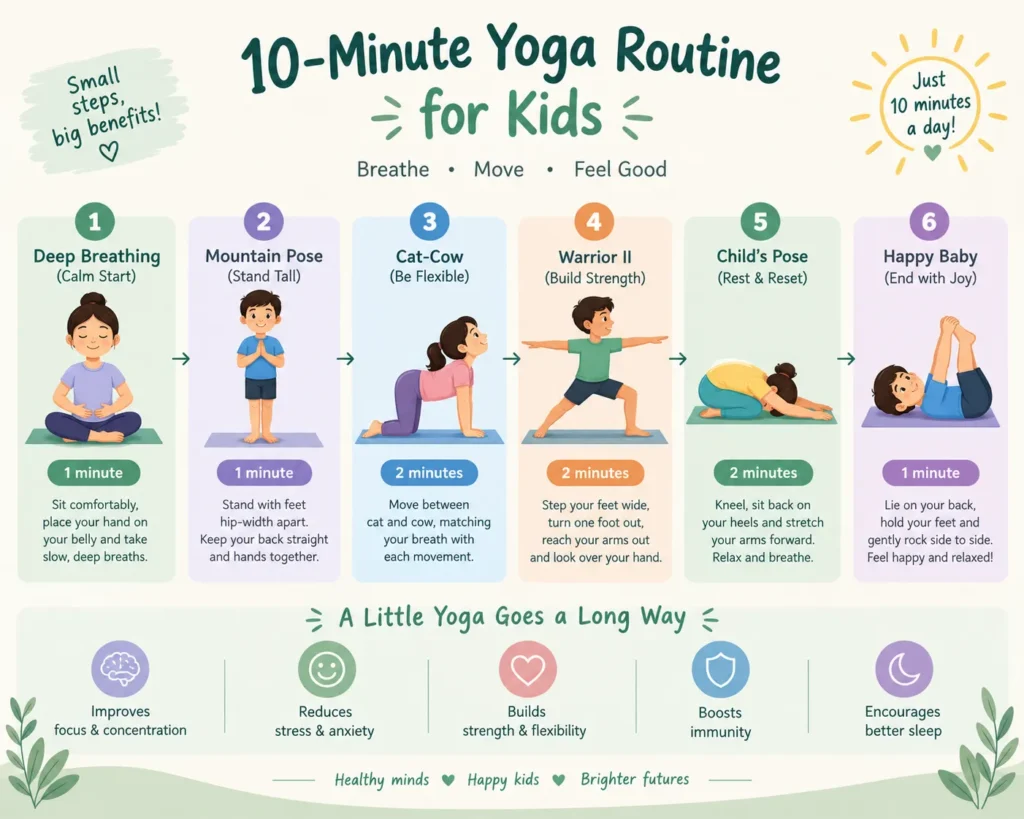
A 10-minute routine for children follows a simple order: warm up with movement, build focus with balance, and finish with calm breathing. Use this sequence with children aged 5 to 12, and adjust the hold times to match their attention span.
- Start with a breathing check-in (1 minute). Ask the child to sit tall, place one hand on the belly, and take three slow breaths. Say, “Notice how your belly rises and falls.” This sets the tone and gives the adult a quick reading of the child’s energy level.
- Warm up with cat-cow (1 minute). Have the child get on hands and knees. Guide them through 5 to 6 rounds, inhaling as the belly drops and the chest lifts, then exhaling as the spine rounds and the head tucks.
- Stand in mountain pose (1 minute). Feet hip-width apart, arms at the sides, shoulders relaxed. Ask the child to press all four corners of both feet into the floor and take five slow breaths.
- Practice tree pose on each side (2 minutes). Place the sole of one foot on the inner calf or inner thigh, never on the knee. Hold for 3 to 5 breaths, lower, and switch sides. Encourage the child to spot a fixed point at eye level.
- Move into warrior II on each side (2 minutes). Step the feet wide, turn one foot out, and extend the arms parallel to the floor. Hold 3 to 5 breaths per side, reminding the child to keep the front knee over the ankle.
- Try eagle pose if the child is ready (1 minute). Begin with arms only: cross one arm over the other and bring the palms together. Add the legs only when the child can hold the arms steady.
- Do child’s pose to settle (2 minutes). Kneel, sit back on the heels, and fold forward with arms extended. Ask the child to count five breaths slowly.
- Close with a quiet moment (1 minute). Have the child lie on their back or sit cross-legged. Ask one question: “What did your body notice today?” Keep the answer short and celebrate effort, not perfection.
Breathing Exercises That Sharpen Attention
Breathing exercises for kids focus work best when they are short, playful, and paired with a visual or sound cue. Three simple techniques suit most children.
Bumblebee Breath (Bhramari)
Ask the child to close their ears gently with their thumbs, place index fingers on the temples, and hum softly on the exhale. The humming creates a steady vibration that many children find soothing. Repeat three to five times. Teachers often use this technique at the start of a lesson because it quiets a noisy room quickly.
Balloon Breath
Have the child place both hands on the belly and imagine blowing up a balloon. Inhale through the nose to fill the balloon, then exhale slowly through the mouth as if letting the air out. Five rounds usually take less than one minute. This technique suits younger children, ages 5 to 7, who respond well to imagery.
Counting Breath
Ask the child to inhale for a count of four and exhale for a count of six. The longer exhale is the calming element. Children who struggle to sit still often find that counting gives their mind a job, which is the same principle behind many attention-building games.
Modifications for Different Kids
Every child can practice a version of these poses, and modifications make the routine safe and enjoyable for children with different bodies, abilities, and energy levels.
- Children who wobble in tree pose: Practice with the back against a wall, or hold the hip of the standing leg with one hand. Remove the foot placement entirely and keep both feet on the floor while raising the arms overhead.
- Children with tight hips or knees: Sit on a folded blanket during child’s pose, or place a pillow between the calves and thighs. Skip eagle legs and keep arms-only eagle.
- Children who feel dizzy or overwhelmed: Keep eyes open and fixed on a point, and use slower transitions. Stop the routine and return to seated breathing if the child feels unwell.
- Children with limited mobility or a physical disability: Practice seated versions. For example, seated cat-cow on a chair, seated tree with feet flat, and seated warrior with arms extended. Work with the child’s physiotherapist or occupational therapist if one is involved.
- Children with large energy bursts: Add a movement game first, such as animal walks, then move into the sequence. Use a timer so the child knows when the next pose begins.
- Children who refuse to participate: Offer a role, such as “tree leader” or “breath counter,” and let them observe and join when ready. Never force a pose.
Common Mistakes When Teaching Yoga to Kids
The most common mistakes adults make with children are pushing for perfect form, holding poses too long, and using adult language that children cannot follow. Correcting these errors makes the practice far more effective.
- Expecting adult-level form. A child’s posture will look different from an adult’s. Focus on participation and safety, not alignment perfection.
- Holding poses too long. Three to five breaths is enough for most children. Longer holds often cause fidgeting and frustration, which undermines the focus goal.
- Using vague cues. Say “bring your hand to your inner calf” instead of “find your balance.” Specific, concrete instructions work better with young children.
- Turning yoga into a competition. Comparing children to each other damages motivation and can make anxious children withdraw. Praise effort and breath.
- Skipping the calm-down ending. Finishing with an energetic game leaves children overstimulated. Always close with child’s pose or a seated breathing practice.
When to Practice Focus Yoga
The best time for a child to practice focus yoga is before a demanding task, such as homework, a test, or a difficult class, or after a long period of sitting. Short daily sessions work better than occasional long ones.
- Before school or homework: A 5-minute routine with cat-cow, mountain, and three breaths helps the child arrive ready to learn.
- Brain breaks during class: Teachers can lead tree pose, bumblebee breath, or chair cat-cow for one to two minutes between lessons.
- Transition moments: Use child’s pose after playtime or before bedtime to help the child shift from active to calm.
- Weekend family sessions: A 10-minute routine done together builds consistency and gives parents a chance to model the practice.
Aim for five to ten minutes daily when possible, or at least three sessions per week. Consistency matters more than length. For strategies to make a habit stick, read our guide on sustainable yoga habit strategies.
Contraindications: When to Modify or Skip
Most children can practice focus yoga safely, but some situations require modifications, medical advice, or a pause from the routine. Consult a pediatrician before starting if the child has a heart condition, seizures, recent surgery, a spinal injury, or any ongoing medical concern.
- Stop immediately if the child reports sharp, shooting, or burning pain, or dizziness, chest discomfort, or breathing difficulty.
- Avoid breath retention and any forceful breathing technique unless guided by a qualified instructor.
- Skip inversions such as headstand or shoulder stand unless a trained teacher supervises the child.
- Adjust for pregnancy in older teen caregivers or family members who join the session, and avoid deep forward folds or abdominal pressure.
- Work with a clinician for children with a diagnosed attention disorder, anxiety disorder, or developmental condition. Yoga supports care but does not replace treatment.
Myths About Yoga and Children’s Focus
Yoga is a useful support for focus and calm, but it is not a cure for ADHD, learning disorders, or anxiety disorders. Several small studies report improvements in attention, self-regulation, and mood in children who practice regularly, but the research is still developing, and results vary between children.
- Myth: Yoga cures ADHD. It does not. Yoga may help some children manage restlessness and attention, but a diagnosed condition needs professional care.
- Myth: Kids must be flexible to benefit. Flexibility is not the goal. Balance, breath, and body awareness matter more, and children of all body types can practice.
- Myth: Only long sessions work. Five focused minutes done consistently can be more useful than one long session done rarely.
- Myth: Yoga is only physical. The breath and attention components are central to how children benefit, which is why the breathing practices in this guide matter.
For authoritative information on yoga’s evidence base, visit the National Center for Complementary and Integrative Health.
Related Questions Parents and Teachers Ask
Q1. Can yoga help kids who cannot sit still?
Yes, many children who struggle with sitting still do better with movement-based focus practice. Short standing poses and breathing games give restless children an outlet while teaching them to settle. Start with two minutes and build gradually.
Q2. What yoga can a teacher do in a classroom?
Teachers can lead tree pose, chair cat-cow, bumblebee breath, and seated mountain pose. These take one to three minutes each and need no mats or equipment. They work well as brain breaks between lessons.
Q3. How old should a child be to start yoga?
Children as young as three can begin simple poses and breathing games, and most children can join structured routines from age five. Keep language playful, sessions short, and expectations realistic for the child’s age.
Q4. Does yoga help with homework focus?
A short routine before homework can help children arrive calmer and more ready to concentrate. Pair the session with a consistent start time so the body learns the cue for focus.
Q5. Is online yoga for kids effective?
Online classes can work well if an adult guides the child and the video uses clear cues. Choose videos with short sessions and calm pacing, and join the first few sessions to ensure safety and engagement.
Key Takeaways
- Yoga poses for kids to improve focus combine balance, slow breathing, and playful storytelling.
- Tree pose is the strongest starting pose because it demands sustained visual attention.
- Eagle arms, warrior II, and mountain pose build stability and body awareness.
- Cat-cow links movement with breath and works well as a warm-up.
- Child’s pose gives children a safe way to settle after an active session.
- Bumblebee breath, balloon breath, and counting breath are simple tools for calm attention.
- A 10-minute routine with eight steps covers movement, balance, breath, and rest.
- Modifications such as wall support, seated poses, and smaller holds make the practice inclusive.
- Avoid perfection pressure, long holds, and vague cues when teaching children.
- Yoga supports focus but does not cure ADHD, learning disorders, or anxiety disorders.
- Consistency of five to ten minutes daily matters more than occasional long sessions.
Conclusion
Yoga poses for kids to improve focus are one of the simplest tools parents and teachers can use to support attention, calm, and self-regulation. The key is to choose poses that combine balance with breath, such as tree pose, eagle arms, mountain pose, cat-cow, warrior II, and child’s pose. Each pose asks the child to notice their body, slow their breathing, and return to a steady shape. Over time, these small moments of practice can make transitions smoother and help children settle before homework or class.
Start small. A five-minute routine done three to five times a week builds more lasting benefit than a long session done once in a while. Use the eight-step sequence in this guide, keep the cues specific, and celebrate effort rather than perfect form. Adapt the poses for children with different bodies and energy levels, and stop if the child feels pain or dizziness.
Remember that yoga supports focus but does not replace professional care. If a child has a diagnosed attention disorder, anxiety, or a developmental condition, work with a pediatrician or specialist and treat yoga as one helpful part of the plan. Used thoughtfully, yoga can give children a calm, joyful way to connect with their bodies and their attention.
If you want a printable pose card and a ready-to-use routine for your classroom or home, download the free Kids Focus Card Pack from TheShivYoga.com today. Your first five minutes could be the calmest part of your child’s day.