Quick Answer
The main types of meditation are: (1) Mindfulness — focus on present moment without judgment, (2) Loving-kindness (Metta) — cultivate compassion for self and others, (3) Transcendental — silent repetition of a mantra, (4) Zen (Zazen) — observe thoughts without engagement, (5) Visualization — imagine peaceful scenes or outcomes, (6) Breathwork — focus exclusively on breath patterns, (7) Mantra — repeat words or sounds for focus, (8) Body Scan — progressively relax each body part, and (9) Walking Meditation — meditate while moving slowly. Each type produces different brain states and suits different goals. Beginners typically start with mindfulness or breathwork; choose based on your primary goal (calm, focus, compassion, or sleep) rather than trying all at once.
Most people think meditation is one thing — sitting still, clearing your mind, reaching some blissful blank state.
In reality, meditation is a diverse family of practices. Some use focus. Others use acceptance. Some incorporate sound. Others use movement. Some are secular. Others are rooted in ancient spiritual traditions.
The reason this matters: not all meditation types work equally for all people. What helps one person fall asleep might make another anxious. What develops compassion in one practitioner might feel forced in another. And what builds deep concentration in a 30-minute session for one person might require 60 minutes for someone else.
The types of meditation taught across yoga traditions, Buddhist schools, secular mindfulness programs, and neuroscience-backed interventions are not variations of the same thing — they are fundamentally different mental exercises that produce different results in the brain.
This guide walks through all nine major meditation types currently taught worldwide: how each works, what brain state it produces, which goals each serves best, how to practice it, and — most importantly — how to recognize which type matches your current needs.
By the end, you’ll know exactly which meditation type to choose for your specific goal — whether that’s calm, focus, better sleep, anxiety relief, or cultivating compassion.
Why Meditation Types Matter: Different Practices, Different Results
Before choosing a meditation type, it helps to understand what makes them different at a neurological level.
All meditation practices calm the nervous system and reduce stress. That’s the universal benefit. But the specific brain regions activated, the specific stress hormones reduced, and the specific mental skills developed differ significantly depending on which technique you practice.
Mindfulness meditation activates the anterior cingulate cortex and anterior insula — the brain regions responsible for present-moment awareness and self-regulation. This is why mindfulness is proven effective for anxiety and attention problems.
Loving-kindness meditation activates the ventromedial prefrontal cortex and insula — the brain areas associated with emotional warmth, reward, and social connection. This is why this type specifically reduces self-criticism and increases measurable compassion.
Transcendental meditation produces a unique brain pattern called “restful alertness” — the brain becomes deeply relaxed (similar to sleep) while remaining conscious and aware. This is distinct from all other meditation types.
Visualization meditation activates the visual cortex and sensory imagination networks — the same brain regions that activate when you actually see something. This is why this type is powerful for goal-setting and athletic performance.
This difference is not trivial. Choosing the wrong meditation type for your goal is like choosing a cardio workout when you need strength training — both exercise the body, but they produce different results. The practice will still be beneficial overall, but it won’t be optimized for what you actually need.
Type 1: Mindfulness Meditation — Present-Moment Awareness Without Judgment
Mindfulness meditation is what most people try first because it’s the most accessible and widely taught in secular settings.
The practice is simple: sit comfortably, focus attention on the breath (or body sensations, or sounds), and when the mind wanders — which it will, dozens of times — gently notice where it went and return attention to the breath, without judgment. You repeat this returning of attention over and over for 10–30 minutes.
The key insight that makes this a distinct meditation type is non-judging present-moment awareness. You are not trying to achieve a blank mind. You are not trying to reach any special state. You are simply practicing the skill of noticing where your attention is and returning it, repeatedly, with kindness toward yourself.
How Mindfulness Works: – Reduces activity in the default mode network — the brain system responsible for self-referential thinking, worry, and mental time-travel – Increases gray matter density in the prefrontal cortex (decision-making, emotional regulation) within 8 weeks of regular practice – Reduces cortisol (stress hormone) by 10–15% after just 10 minutes of practice – Trains the anterior cingulate cortex — the brain’s “attention switching” center
Primary Benefits: – Anxiety and panic disorder reduction (30–40% symptom decrease in clinical studies) – Improved focus and attention span – Better emotional regulation – Reduced reactivity to stress (you notice stressful thoughts without automatically believing or acting on them) – Improved sleep quality (particularly for racing mind at bedtime)
Best For: – Anxiety disorders, panic attacks – Racing thoughts and difficulty focusing – Reactive emotional patterns – People new to meditation (most accessible entry point) – Workplace stress management – Anyone wanting science-backed, secular meditation
Not Best For: – Severe depression (can sometimes increase rumination — better combined with compassion practices) – People seeking rapid relaxation (works over weeks, not immediately) – Those who find sitting still physically difficult
How to Practice Mindfulness Meditation:
Step 1: Choose your location Find a quiet space where you won’t be interrupted for at least 10 minutes. A bedroom, meditation cushion on the floor, quiet corner of a park, or even your car all work. Temperature should be comfortable — not cold, which causes distraction from shivering.
Step 2: Sit in a comfortable upright position Sit on a cushion, chair, or meditation bench. Your spine should be upright (not slouching) but not rigid. Shoulders relaxed, hands resting on your thighs or in your lap. If sitting is uncomfortable, you can practice mindfulness meditation lying down, though sitting creates better alertness.
Step 3: Set a timer for 10 minutes Use a meditation app with a gentle bell at the end, not a loud alarm. Starting with 10 minutes is realistic for beginners. Trying to sit 30 minutes your first session often leads to quitting in frustration.
Step 4: Close your eyes and begin observing the breath Notice the natural rhythm of your breath without trying to control it. Feel the temperature of the inhale. Notice the slight pause between inhale and exhale. You are not trying to breathe deeply — just noticing the breath that is already happening.
Step 5: When the mind wanders, gently return it Your mind will wander. This is not failure. This is the practice. The moment you notice you are thinking about your grocery list (or anything other than the breath), simply acknowledge “thinking” internally and return your attention to the breath. Do this with kindness — not frustration.
Step 6: Repeat the returning for the entire session The whole practice is just Step 5 repeated. You may return your attention 5 times or 100 times in 10 minutes. Both are completely normal. The practice is in the returning, not in never leaving.
Step 7: End gently When the timer signals, open your eyes slowly. Sit for another 30 seconds noticing how your body and mind feel. This transition time is important — you are not jumping immediately back into the busy day.
Realistic Timeline: – Weeks 1–2: Mind feels busier than ever (normal — you’re noticing thoughts you previously ignored). Some sessions feel easier than others. – Weeks 3–4: You notice gaps of quiet between thoughts. Easier to remember why you’re sitting when distracted. – Weeks 5–8: Noticeably calmer throughout the day. Able to sit for 15 minutes comfortably. – Months 3–6: Observable changes in how you respond to stress (less reactive, more spacious).
Common Mistakes in Mindfulness: – Believing a “successful” meditation has no thoughts (there is no such thing — all minds wander) – Forcing relaxation (relaxation comes as a side effect, not as a goal to achieve) – Practicing only when you’re already calm (practice when your mind is agitated — that’s when you need it) – Judging yourself for having a “bad” meditation (every meditation is showing you how your mind works — all are equally valuable data)
Type 2: Loving-Kindness Meditation (Metta) — Cultivate Compassion for Self and Others
Loving-kindness meditation (called Metta in Pali, the original language of Buddhist texts) is fundamentally different from mindfulness in one crucial way: instead of focusing on breath, you focus on generating the feeling of goodwill — first toward yourself, then gradually toward others.
The practice sounds simple but produces profound emotional shifts. Research shows it increases measurable compassion, reduces self-criticism, and actually increases activity in the brain’s empathy and reward centers.
Most people who are hard on themselves — perfectionists, high-achievers, people recovering from trauma — find this meditation type transformative precisely because it rewires the self-critical inner voice.
How Loving-Kindness Works: – Activates the ventromedial prefrontal cortex — the brain region for emotional warmth and reward – Increases oxytocin (the “bonding” neurochemical) by up to 16% after a single session – Reduces activity in the amygdala (fear center) and increases emotional resilience – Rewires neural pathways of self-judgment toward self-acceptance – Increases gray matter in brain regions associated with emotional processing and empathy
Primary Benefits: – Reduces self-criticism and increases self-compassion (measurable within 2–3 weeks) – Decreases anxiety rooted in perfectionism or shame – Increases genuine compassion for difficult people – Reduces anger and resentment – Improves relationships through increased patience and emotional openness – Supports recovery from trauma and grief
Best For: – People with strong inner critic / perfectionism – Anyone feeling isolated or disconnected – Those struggling with self-judgment after mistakes – Depression involving hopelessness or self-blame – People wanting to deepen compassion – Those in grief or recovering from betrayal
Not Best For: – People with unprocessed trauma (can feel too vulnerable without professional support) – Immediate relaxation (focus is emotional warmth, not physical calm) – Cynical people (initial resistance is common but usually dissolves within weeks)
How to Practice Loving-Kindness Meditation:
Step 1: Sit comfortably with hand on heart Sit upright as in mindfulness practice. Placing your hand on your heart creates a somatic reminder that this practice is about yourself, not just distant others.
Step 2: Begin with yourself (this is crucial) Most Westerners want to skip to loving others because self-focused kindness feels selfish or awkward. Skip this step at your own peril — the entire practice collapses without genuine self-directed warmth. Silently repeat: “May I be safe. May I be healthy. May I be happy. May I live with ease.”
Step 3: Feel the phrases, don’t just think them Don’t recite mechanically. After each phrase, pause and try to genuinely evoke the feeling. What does safety feel like in your body? What does ease feel like? The emotional resonance matters far more than perfect wording.
Step 4: Move to a loved one (someone you easily love) Pick someone who makes you smile immediately — a child, beloved pet, best friend, mentor. Silently repeat: “May you be safe. May you be healthy. May you be happy. May you live with ease.” Visualize them and feel the warmth when you think of them.
Step 5: Expand to a neutral person Move to someone you have no strong feelings about — a cashier you see weekly, a neighbor whose name you don’t know. Use the same phrases. This is where the practice deepens — generating kindness toward someone you don’t already love is powerful training.
Step 6: Include a difficult person (optional at first) Eventually (not immediately — usually week 3+), you can include someone you have conflict with. Start tiny: someone only slightly difficult, not your deepest nemesis. The point is not to condone their behavior but to unfreeze your own heart.
Step 7: Extend to all beings Conclude by extending these wishes to all beings everywhere: “May all beings be safe. May all beings be healthy. May all beings be happy. May all beings live with ease.”
Realistic Timeline: – Session 1: Awkward, mechanical, maybe even irritating. Many people’s inner critic argues: “This is fake, I don’t mean this.” This is normal. – Weeks 1–2: Easier with people you love. Difficult person phase feels forced. – Weeks 3–4: Noticeably softer approach to your own mistakes. Less self-blame. – Weeks 5–8: Genuine warmth emerging even during difficult sections. Measurable increase in patience with others.
Common Mistakes in Loving-Kindness: – Skipping the self-directed phase (this is where the real transformation happens) – Forcing the feeling (the feeling follows the practice, not the other way around) – Judging the practice as “not working” because it feels awkward at first (awkwardness is normal — it means you’re rewiring resistance) – Using identical phrases (experiment with wording that resonates for you — some people say “May I know safety” instead of “May I be safe”) – Practicing only with people you like (the neutral and difficult persons are where the growth happens)
Type 3: Transcendental Meditation (TM) — Mantra-Based Effortless Awareness
Transcendental Meditation (TM) is a specific branded technique introduced by Maharishi Mahesh Yogi in the 1960s. Unlike mindfulness (where you monitor thoughts) or loving-kindness (where you generate emotions), TM is almost passively easy — you sit and silently repeat a mantra, and the mantra carries your attention inward without effort.
The reason TM is distinctive is that it produces a unique brain state called “restful alertness” — the body is as relaxed as in deep sleep while the mind remains aware. No other meditation type produces this exact state.
This is why TM has robust scientific validation for heart health, blood pressure reduction, and deep physiological relaxation that appears after remarkably few sessions compared to other types.
How TM Works: – Produces a unique brain pattern of synchronized alpha and theta waves (restful yet alert) – Activates the parasympathetic nervous system — the body’s relaxation response — more deeply than other meditation types – Reduces cortisol (stress hormone) by 20–30% after just 4 weeks – Lowers blood pressure by 5–10 mmHg (equivalent to some blood pressure medications) – Reduces systolic and diastolic blood pressure in people with hypertension
Primary Benefits: – Deep physiological relaxation (fastest-acting of all meditation types) – Blood pressure reduction and cardiovascular health – Reduced anxiety and improved mood – Better sleep quality – Increased transcendence (feelings of peace beyond thought) – Sustainable long-term practice (feels effortless compared to focused concentration)
Best For: – People with hypertension or heart disease (scientifically supported) – Those seeking rapid physiological relaxation – Busy people wanting meditation that requires no maintenance of attention – Anyone resistant to monitoring thoughts (TM avoids this entirely) – Anxiety with physical tension (TM relaxes the body deeply)
Not Best For: – Deep insight seekers (TM is not designed for self-understanding) – People seeking compassion development (a different mechanism than TM) – Those without access to certified TM instructors (learning from books is not as effective) – Budget-conscious practitioners (TM requires paid instruction, typically $1,000+)
Key Distinction: TM requires personalized instruction from a certified TM teacher. The instruction process includes receiving an individually selected mantra chosen for your specific needs. Trying TM from a book or app is not genuine TM — the personalized mantra is a significant part of what makes TM effective. This is why most serious TM practitioners recommend investing in proper instruction.
Realistic Timeline with TM: – First session: Noticeably relaxed immediately after – Weeks 1–2: Deepening calm, easier to fall asleep, less racing thoughts – Weeks 3–4: Blood pressure begins to measurably decrease – Months 2–3: Sustained calm that carries into daily life – 6+ months: Deep meditative experiences, sense of inner stability
Type 4: Zen Meditation (Zazen) — Observing Without Attachment
Zen meditation, called Zazen, comes from Zen Buddhism. It’s the meditation type of Zen monks who sit in silence for hours without any object of focus — not monitoring breath, not repeating mantras, not visualizing, simply observing whatever arises without attachment.
This might sound like the same as mindfulness, but there’s a crucial difference: mindfulness actively returns attention to the breath when it wanders. Zazen simply allows all thoughts, sensations, and perceptions to arise and pass without engaging with them.
Zazen is often described as “just sitting” — letting the mind be as it is without trying to change or fix it.
How Zazen Works: – Trains the ability to observe thoughts and emotions from a distance (deidentification) – Reduces the stickiness of thought patterns (you realize thoughts are just thoughts, not truth) – Produces a state of “alert awareness” — the mind alert but not tracking any specific object – The brain settles into a state of flow similar to advanced practitioners of other types – Reduces the sense of separate “self” (this is the actual goal of Zen practice)
Primary Benefits: – Deep insight into the nature of mind and self – Liberation from identifying with thoughts and emotions – Equanimity in the face of difficult circumstances – Long-term reduction in anxiety and depression through perspective shift – Spiritual insight and connection to deeper reality
Best For: – Spiritual seekers wanting deeper insight – Those wanting liberation from mental patterns – People with strong intellectual capacity (requires subtle discernment) – Advanced practitioners deepening existing meditation – Anyone wanting to experience non-dual states – Zen practice communities and formal training
Not Best For: – Complete beginners (too subtle initially) – People seeking rapid relaxation (Zazen can be activating, not calming) – Those needing structure and clear instructions (Zazen instruction is often deliberately vague) – People with severe ADHD (requires ability to maintain alertness without anchor)
How to Practice Zazen:
Step 1: Sit in proper upright posture Zazen emphasizes posture as essential. Sit on a cushion (zafu) with your knees lower than your hips. Spine naturally upright. Hands in “cosmic mudra” (right hand on left palm, thumbs touching loosely in your lap). Eyes open (this is different from most meditation), looking slightly downward at about a 45-degree angle at the floor or wall.
Step 2: Breathe naturally through the nose No special breathing technique. Just natural, uncontrolled breath.
Step 3: Notice everything arising in awareness Thoughts, sensations, sounds, physical discomfort, everything. Don’t exclude anything. Don’t try to focus on anything. You are aware of the totality of your experience without selecting or centering on one thing.
Step 4: Don’t engage with or resist anything When a thought arises, don’t follow it (as if narrating your meditation to yourself). Don’t resist it (creating tension trying to suppress it). Simply let it appear and pass like clouds moving through the sky.
Step 5: Return to the present moment gently If you realize you’ve been following a train of thought, gently notice that and return to whole-body present awareness — the sensation of sitting, the sound of the room, the felt sense of breathing.
Step 6: Continue for the session 30 minutes is standard Zazen timing. The subtlety is in the non-doing — the less you try to achieve something, the more authentic the practice becomes.
Realistic Timeline: – First sessions: Extremely difficult, mind feels chaotic, frustrating – Weeks 1–4: Slightly easier to not follow thoughts, but still challenging – Weeks 5–12: Glimpses of “just sitting” without effort, deepening calm – Months 3+: Clearer perception of thoughts arising and passing naturally
Type 5: Visualization Meditation — Create Mental Imagery for Healing or Performance
Visualization meditation uses guided mental imagery rather than breath or sound. You might visualize a peaceful place, a healing light, or yourself succeeding at a goal. The practice trains your visual and sensory imagination networks.
This meditation type is distinctly different from the others because it’s actively creating something (an image) rather than observing (thoughts, breath) or cultivating (kindness). This makes it especially powerful for athletes, creative professionals, and people with strong visual imagination.
How Visualization Works: – Activates the visual cortex and sensory imagination networks – Uses the brain’s natural ability to mentally simulate reality (the same networks activate whether you’re physically doing something or vividly imagining it) – Creates neural pathways similar to actual experience (your nervous system doesn’t fully distinguish between vivid imagination and real experience) – Primes your nervous system for success before actual performance – Reduces stress by creating a “safe space” in your mind
Primary Benefits: – Accelerates skill acquisition and performance (athletes gain measurable improvement faster) – Anxiety reduction through repeated mental exposure to stressful situations – Better sleep (peaceful visualization before bed) – Accessing intuition and creativity – Emotional healing (visualizing forgiveness, for example) – Goal manifestation through mental rehearsal
Best For: – Athletes and performers wanting performance improvement – Anxiety sufferers needing a “safe place” to mentally escape to – Creative professionals seeking inspiration – People visualizing recovery from illness – Anxiety with panic (visualizing a safe place to return to) – Sleep problems (guided peaceful visualization)
Not Best For: – People with trauma histories (visualization can be triggering without professional support) – Those with weak visual imagination (though this can be developed) – Deep insight seekers (visualization is not designed for self-understanding) – Complete beginners to meditation (easier combined with other types)
How to Practice Visualization Meditation:
Step 1: Choose your visualization Decide before beginning: Will you visualize a real peaceful place (a beach you’ve been to, a forest), an imaginary place (a magical sanctuary), or an outcome (yourself succeeding at something)? Having a clear intention prevents your mind from wandering.
Step 2: Sit comfortably and close your eyes Use the same posture as mindfulness meditation. Closing your eyes helps you focus inward on the visual imagery.
Step 3: Engage all senses, not just sight This is the key difference between daydreaming and meditation visualization. As you visualize your peaceful place, actively engage the other senses: – What do you hear? (ocean waves, bird song, rustling leaves) – What do you smell? (salt air, pine trees, flowers) – What do you feel on your skin? (warmth of sun, cool breeze, soft sand) – What do you taste? (salt on your lips, fresh air)
Step 4: Add emotional resonance Feel the emotions associated with this place or outcome. Feel the peace, the safety, the joy, the sense of accomplishment. Let these feelings saturate your body.
Step 5: Spend 10–15 minutes in the visualization You can use a guided meditation recording that walks you through the visualization, or create it yourself. Either way, stay fully present in the imagined scene.
Step 6: Gradually return to the physical body Slowly bring your awareness back to your physical sensations. Feel your weight on the cushion. Notice the temperature of the air. Open your eyes gently.
Example Visualization Script (5 minutes): “Close your eyes. Imagine yourself on a beach at sunset. Feel the warmth of the sun on your face. Hear the sound of waves gently rolling toward shore and pulling back. Smell the salt in the air. Feel the soft sand between your toes, warm from the sun. You feel completely safe here. Time slows down. There is nowhere else you need to be. Stay here for as long as you like, breathing slowly, letting all tension melt into the sand. You are at peace.”
Realistic Timeline: – First sessions: Difficult to visualize vividly, mind wanders to random images – Weeks 2–3: Images becoming clearer, easier to stay in the scene – Weeks 4+: Visualization feels almost real, emotional benefit obvious – Months 2–3: Neural changes appear — measurable performance improvement if practicing sport/skill-based visualization
Type 6: Breathwork-Based Meditation — Focus Exclusively on Breath Patterns
Breathwork-based meditation differs from mindfulness (where breath is the focus but thoughts are also observed) by placing exclusive attention on the breath itself — its rhythm, texture, temperature, and patterns.
This meditation type is used in many yoga traditions (Pranayama) and is particularly effective for anxiety, as conscious breathing directly activates the parasympathetic nervous system (the body’s calm response).
How Breathwork-Based Meditation Works: – Activates the parasympathetic nervous system directly through vagal stimulation – Slows the mind by synchronizing it with the slower rhythm of intentional breathing – Reduces heart rate variability in anxiety sufferers – Increases CO2 tolerance, which paradoxically reduces panic and breathlessness – Activates the prefrontal cortex (rational brain) while reducing amygdala (fear) activation (1).
Primary Benefits: – Rapid anxiety reduction (effective within 3–5 minutes) – Better control of panic responses – Improved cardiovascular variability (a marker of health) – Reduced racing heart and shallow breathing patterns – Better access to calm state even during stressful situations – Improved oxygen utilization in the body
Best For: – Acute anxiety and panic attacks – Shallow breathing patterns – Sleep problems with racing heart – Anxiety disorders – Stress-related hypertension – Anyone wanting immediate stress relief
Not Best For: – Very advanced meditators seeking subtle insight (too simple) – People with breathing difficulties (asthma, COPD — modify accordingly) – Those seeking long-term emotional transformation (works best for acute symptoms)
How to Practice Breathwork-Based Meditation:
Step 1: Choose a breathing pattern There are several proven patterns. Most beginner-friendly is 4-7-8 breathing: Inhale for 4 counts, hold for 7, exhale for 8. This ratio (longer exhale than inhale) is the key to parasympathetic activation. Start with 5 cycles, gradually building to 10 cycles.
Step 2: Sit upright with spine straight Upright posture facilitates fuller breathing compared to slouching.
Step 3: Place hands on your belly Feel your belly expand on the inhale and soften on the exhale. This hands-on awareness keeps your mind engaged with the breath rather than wandering.
Step 4: Breathe exclusively through the nose Nose breathing is more calming than mouth breathing. If you can’t breathe through your nose, mouth is fine, but nasal breathing is preferred.
Step 5: Count internally with each cycle Silently count: “In: 1, 2, 3, 4. Hold: 1, 2, 3, 4, 5, 6, 7. Out: 1, 2, 3, 4, 5, 6, 7, 8.” The counting anchors your attention and prevents mind wandering.
Step 6: Notice the sensations each breath creates Feel the cool air entering on the inhale. Notice the slight stretch in your lungs. Feel the warm air exiting on the exhale. This sensory richness makes the practice more engaging.
Realistic Timeline: – First session: Noticeable calming within 2–3 minutes (fastest-acting meditation type) – Daily practice: Accumulated calm throughout the day, easier to access calm during stressful moments – Weeks 2–4: Breathing patterns naturally slower throughout the day, less reactivity to stress triggers
Type 7: Mantra Meditation — Repeat Words or Sounds for Mental Focus
Mantra meditation uses the repetition of a word, sound, or phrase as the anchor for attention, similar to Transcendental Meditation but adapted for personal practice and used across many spiritual traditions.
Unlike TM (which requires a personalized mantra from a certified teacher), mantra meditation can use traditional Sanskrit mantras (Om, So Hum, Sat Nam) or even English affirmations (“I am calm,” “I am safe”).
The key is that the mantra gives the mind something to “hold onto” rather than wandering into thought patterns.
How Mantra Works: – Provides a clear, simple anchor for attention (preventing mind-wandering) – The vibration and sound of the mantra activates specific neural pathways – Sanskrit mantras, if used, are believed to have particular vibrational effects (though this is less scientifically proven than Western neuroscience acknowledges) – Creates a rhythm that synchronizes breathing and heartbeat – Some research suggests the specific frequency of the sound matters (though this is still debated in neuroscience)
Primary Benefits: – Easier to maintain focus than breath-based meditation (the mantra is more interesting to the mind) – Anxiety reduction through repeated affirmation – Deepening sense of identity with the mantra’s meaning – Better integration of the meditation’s intention into daily life – Can be practiced anywhere (no need to close eyes) – Accessible to those who struggle with other types
Best For: – Busy minds that find breath monitoring boring – Those wanting to integrate positive affirmations into meditation – Spiritual seekers wanting to use traditional Sanskrit mantras – People preferring sound-based practices – Walking meditation or informal meditation during daily activities
Not Best For: – Those with repetitive thinking patterns or OCD (can strengthen unwanted thought loops) – People sensitive to sound or with tinnitus (sound-based practice can be aggravating) – Those seeking emotional transformation (less effective for this than loving-kindness)
How to Practice Mantra Meditation:
Step 1: Choose your mantra Options include: – Traditional Sanskrit: “Om” (the universal sound), “So Hum” (I am that), “Sat Nam” (truth is my name), “Lokah Samastah Sukhino Bhavantu” (may all beings know peace) – English affirmations: “I am calm,” “I am enough,” “Peace,” “Love” – Combination: “Om Shanti Shanti Shanti” (Om peace peace peace)
Start with a mantra that resonates emotionally. If “I am calm” feels forced, choose something that feels true.
Step 2: Sit comfortably and close your eyes Same posture as other meditation types. Eyes can be open (as in Zazen) if that feels more comfortable.
Step 3: Repeat the mantra silently or aloud You can chant the mantra aloud (which increases the benefit of sound frequency), or repeat it silently in your mind. Both work. Aloud is more powerful but less practical if you have family or neighbors. Start silently if privacy is an issue.
Step 4: Synchronize the mantra with your breath Inhale on one part of the mantra, exhale on another. Example: Inhale “So,” Exhale “Hum.” This rhythm coordination deepens the practice.
Step 5: Maintain a steady, rhythmic pace Like a drum beat. Not rushing, not dragging. The rhythm becomes meditative in itself.
Step 6: Allow the meaning to naturally emerge Don’t force understanding, but allow the mantra’s meaning to unfold as you repeat it. “So Hum” (I am that) might reveal what “that” means as you practice.
Step 7: Continue for 15–20 minutes The mantra can be repeated throughout the entire session without the distraction-management required in mindfulness.
Realistic Timeline: – First sessions: Mind still wanders despite the mantra, easy to lose the rhythm – Weeks 2–3: Easier to maintain the rhythm, mind calmer – Weeks 4–8: The mantra becomes almost automatic, deep peace, meaning reveals itself – Months 3+: The mantra becomes part of your mental background, accessible throughout the day
Type 8: Body Scan Meditation — Progressive Relaxation of Each Body Part
Body scan meditation involves systematically moving awareness through each part of your body, relaxing tension as you go. Unlike other types that anchor attention to one point (breath, mantra, visualization), body scan moves your attention progressively from feet to head (or vice versa).
This type is particularly effective for insomnia and for building body awareness — which is why it’s popular in somatic therapy alongside meditation practice.
How Body Scan Works: – Activates the parasympathetic nervous system through progressive muscle relaxation – Increases interoception (internal body awareness) — the ability to sense what’s happening in your body – Reduces tension held in the muscles, which in turn signals the nervous system that it’s safe to relax – Distributes awareness evenly throughout the body rather than concentrating in one area – Breaks the cycle of tension → stress → more tension
Primary Benefits: – Most effective for insomnia (falls asleep during practice ~75% of the time) – Chronic pain reduction through increased body awareness – Reduced muscle tension and jaw clenching – Better interoception (sensing what your body needs) – Increased relaxation without requiring active focus – Accessible to people with very busy minds (you’re not trying to be still, just aware)
Best For: – Insomnia and sleep problems – Chronic muscle tension and pain – Fidgety people who find sitting still difficult – Building body awareness – Anxiety manifesting as physical tension – End-of-day wind-down practice
Not Best For: – Deep meditation seeking (body scan is surface-level awareness) – People with trauma or extreme body disconnection (can be triggering; better with professional guidance) – Acute panic attacks (too slow — breathwork-based is faster)
How to Practice Body Scan Meditation:
Step 1: Lie on your back on a yoga mat or comfortable surface Unlike other types that use sitting posture, body scan is practiced lying down. This position allows every muscle to relax fully. Your arms can be at your sides with palms up, or along your body as feels comfortable.
Step 2: Close your eyes and take a few deep breaths Prepare your nervous system by taking 3–5 deep, conscious breaths. Then return to natural breathing.
Step 3: Begin at the feet or top of the head There are two directions: head-to-toe or toe-to-head. Head-to-toe is more energizing (better for daytime). Toe-to-head is more relaxing (better for sleep). Start with toe-to-head if sleep is your goal.
Step 4: Bring attention to the left foot Notice: Is there tension? Warmth? Coldness? Tingling? No judgment — just observation. Imagine warm, healing light entering the foot. Feel the muscles relaxing and softening.
Step 5: Mentally tell the foot it can relax “Left foot, you have done enough. You can relax completely. All tension is melting away.” This permission-giving language is powerful.
Step 6: Move to the left ankle, then left calf, then left knee, then left thigh Spend 30–60 seconds with each area. Move methodically. The slowness is the point — you are giving each area full attention.
Step 7: Move to the right foot and repeat Follow the same slow process with the right leg.
Step 8: Continue to the pelvis, lower back, abdomen, chest, upper back, shoulders These areas hold significant tension for most people. Spend extra time here if needed.
Step 9: Move to each arm individually Left hand → left forearm → left upper arm → left shoulder. Then right arm.
Step 10: Finish with the neck, jaw, face, and top of the head The jaw and face hold enormous unconscious tension. Imagine it all melting.
Step 11: Rest in full-body awareness After completing the scan, rest with awareness of your whole body simultaneously. Feel the weight of your body on the mat. The heaviness. The ease.
Full body scan typically takes 20–40 minutes. At the end, if you’re doing this at night, you may naturally fall asleep. If in the daytime, take a few deeper breaths before opening your eyes.
Realistic Timeline: – First sessions: Mind wanders from the body awareness, difficult to feel relaxation – Weeks 1–2: Easier to maintain body awareness, noticeable relaxation during practice – Weeks 3–4: Falls asleep during practice (if sleep is the goal, this is success) – Weeks 5+: Sleep improves even without practicing the scan (the body’s relaxation conditioning generalizes)
Common Mistakes in Body Scan: – Trying to actively tense and relax muscles (pure body scan is observation, not active tensing) – Rushing through body parts (the slowness creates the relaxation) – Expecting to feel relaxed immediately (relaxation deepens with repeated practice) – Lying on a surface that’s too hard (use a yoga mat, carpet, or soft surface)
Type 9: Walking Meditation — Meditate While Moving Slowly
Walking meditation is the practice of bringing the same quality of attention to the physical act of walking that you bring to breath in mindfulness meditation. It’s less well-known than sitting practices but equally powerful, especially for people with physical limitations or high energy.
The practice is simply walking slowly (typically at ¼ to ½ normal speed) while maintaining present-moment awareness of each step, each movement, each sensation.
How Walking Meditation Works: – Trains mindfulness in motion (the most relevant context for actual daily life) – Engages the motor cortex and sensorimotor processing (different brain regions than sitting practices) – Provides gentle movement while maintaining meditative awareness – Easier for some people than sitting still – Creates a bridge between formal meditation and daily activities
Primary Benefits: – Accessible meditation for people who can’t sit comfortably – Naturally integrates meditation into daily life – Full-body coordination improvement – Grounding effect (feeling connected to the earth) – Gentle exercise combined with meditation – Reduced restlessness and agitation
Best For: – People with physical pain or limitations on sitting – Those with ADHD or restlessness (movement helps) – Integration of meditation into daily routines – Walking to work or during outdoor time – Grounding practices – People who resist sitting meditation
Not Best For: – Environments with obstacles or crowds (unsafe) – Deep trance states (walking requires coordination) – Trauma survivors needing safety of controlled environment (more exposed)
How to Practice Walking Meditation:
Step 1: Choose a safe location A quiet room, garden path, or park trail. Somewhere you can walk 10–20 feet without obstacles or distractions.
Step 2: Stand at one end and establish your posture Spine upright, hands clasped in front or resting on your belly. Establish what normal standing feels like.
Step 3: Slow your walking to about ¼ normal speed This slowness is what allows meditation. You are no longer walking to get somewhere; you are walking to be present.
Step 4: Bring full attention to the feet and legs Feel the weight shifting from left foot to right foot. Notice the heel lifting, the foot traveling through the air, the heel landing, the rest of the foot arriving. The sensation of each part of the gait.
Step 5: Coordinate with breath if desired Inhale for a few steps, exhale for a few steps. This rhythm coordination deepens practice but is not required.
Step 6: When reaching the end of your path, stop briefly, turn slowly, and begin again The turning is also a meditation — a conscious, slow movement.
Step 7: Continue for 15–30 minutes Unlike sitting meditation where you’re stationary, walking meditation allows you to continue for longer periods comfortably.
Realistic Timeline: – First sessions: Awkward, difficult to walk slowly, mind wanders – Weeks 1–2: Easier to maintain attention, slowness begins to feel meditative – Weeks 3+: Entering a flow state during the walk, genuine meditation happening while moving
Modifications for Different Bodies: How to Adapt These Meditation Types
The meditation types described above are foundational, but human bodies vary wildly. Here are evidence-based adaptations for common physical and neurological differences.
For Chronic Pain (Any Meditation Type)
- Sitting meditation: Use a cushion high enough that your hips are elevated above your knees, reducing strain on the lower back
- Lying down: Practice body scan or any meditation lying down instead of sitting
- Chair meditation: Sit in a firm chair with feet flat on the ground
- Standing meditation: Stand with feet hip-width apart, hands hanging at sides, weight evenly distributed
- Duration: Start with 5 minutes instead of 10; pain reduces over weeks as nervous system calms
For ADHD or Restlessness
- Walking meditation: More sustainable than sitting (the movement channels excess energy)
- Shorter sessions: 5 minutes is perfectly valid; build gradually
- More interactive types: Loving-kindness or mantra (gives mind something to do vs. passive observation)
- Movement meditation: Combine with gentle yoga or tai chi
- Tactile focus: Use beads (mala beads) in your fingers as anchor instead of breath
For Back Problems
- Avoid slouching: Use lumbar support or recline slightly in a chair
- Wall support: Sit with your back against a wall
- Kneeling posture: Use a meditation bench (looks like a slanted stool) that takes weight off your knees
- Reclined posture: Body scan or visualization while lying down
- Shorter sessions: 5–10 minutes; duration creates micro-injuries if your spinal alignment isn’t ideal
For Hearing Loss or Tinnitus
- Avoid: Mantra meditation (sound-based)
- Best options: Mindfulness (breath focus), body scan, visualization, loving-kindness
- Vibration focus: Use the vibration of sound/mantra felt through your body rather than heard
For Visual Impairment
- Avoid: Visualization meditation
- Best options: All others — breath-based, mantra, loving-kindness, body scan, walking, Zen
- Sensory substitution: Use touch, sound, smell to anchor practice instead of visual imagery
For Anxiety Disorders
- Most effective: Breathing-based (fastest relief), loving-kindness (rewires self-criticism)
- Less effective at first: Mindfulness might feel like watching panic; combine with breathing
- Duration: Start with 3–5 minutes; longer sessions can be overwhelming
- Safety: Some types (TM, walking, body scan) feel safer than others; honor this
For Depression with Rumination
- Avoid: Mindfulness alone (can intensify rumination)
- Best combination: Loving-kindness + mantra (shifts from self-criticism toward self-compassion)
- Caution: Solo sitting meditation can intensify depressive thoughts; consider group classes or guided recordings
For Insomnia
- Best: Body scan (most direct), breathing-based, visualization (peaceful place)
- Timing: Practice 20–30 minutes before bed, lying down
- Goal: Fall asleep during practice (this is success, not failure)
- Avoid: Sitting upright and wakeful practices (mindfulness, Zen, mantra)
Common Mistakes in Choosing a Meditation Type
Mistake 1: Choosing by Popularity Rather Than Personal Goal
You choose mindfulness because it’s trendy, but your actual need is compassion development (loving-kindness is better) or rapid relaxation (TM is better). Match the type to your goal, not to what others practice.
Mistake 2: Assuming One Type is “Better”
There is no best meditation type. There are best-fits. Mindfulness is excellent for anxiety and focus, terrible for processing grief. Loving-kindness is excellent for self-criticism, less useful for sleep. Choose based on what you need right now.
Mistake 3: Trying Too Many Types at Once
Practicing 3 different meditation types simultaneously prevents any of them from deepening. Choose one for 4–6 weeks, then rotate if desired. Consistency matters more than variety.
Mistake 4: Abandoning After “Bad” Sessions
Every meditation type produces variations. Some sessions are quieter, some more active. Some bring profound peace, others bring visible emotions. All are valuable. Don’t judge the type by one session.
Mistake 5: Expecting Relaxation Immediately from Every Type
Mindfulness and Zazen can feel activating initially (you notice how busy your mind is). Loving-kindness can feel awkward. Visualization requires focus. Relaxation comes after weeks, not minutes. Give the practice time.
Mistake 6: Not Matching Duration to Type
Loving-kindness needs 20+ minutes to reach emotional depth. Breathing-based works in 5 minutes. Body scan works best for 30+ minutes. Match duration to type and adjust if sessions feel too short or too long.
Mistake 7: Practicing When Exhausted
Meditation requires sufficient nervous system resources. If you’re completely depleted, rest or gentle yoga might serve better than meditation. Meditation adds benefit when you have minimum reserves.
Comparison Table: Which Meditation Type Suits Each Goal
| Goal | Best Type | Second Best | Duration | Timeline |
|---|---|---|---|---|
| Anxiety/Panic | Breathing-based | Loving-kindness | 5–10 min | 1–2 weeks |
| Racing Mind/Focus | Mindfulness | Mantra | 10–15 min | 3–4 weeks |
| Self-Criticism | Loving-kindness | Mantra | 20 min | 2–3 weeks |
| Sleep/Insomnia | Body Scan | Visualization | 20–40 min | 1–2 weeks |
| Spiritual Insight | Zazen | TM | 30 min | 3+ months |
| Deep Relaxation | TM | Breathwork | 20 min | Immediate |
| Performance/Sports | Visualization | Mantra | 10–15 min | 2–4 weeks |
| Muscle Tension | Body Scan | Loving-kindness | 30 min | 2–3 weeks |
| Busy Lifestyle | Walking Meditation | Mantra | 15 min | 2 weeks |
| Compassion Development | Loving-kindness | Mantra | 20 min | 4–6 weeks |
How to Choose Your Meditation Type: A 4-Question Decision Framework
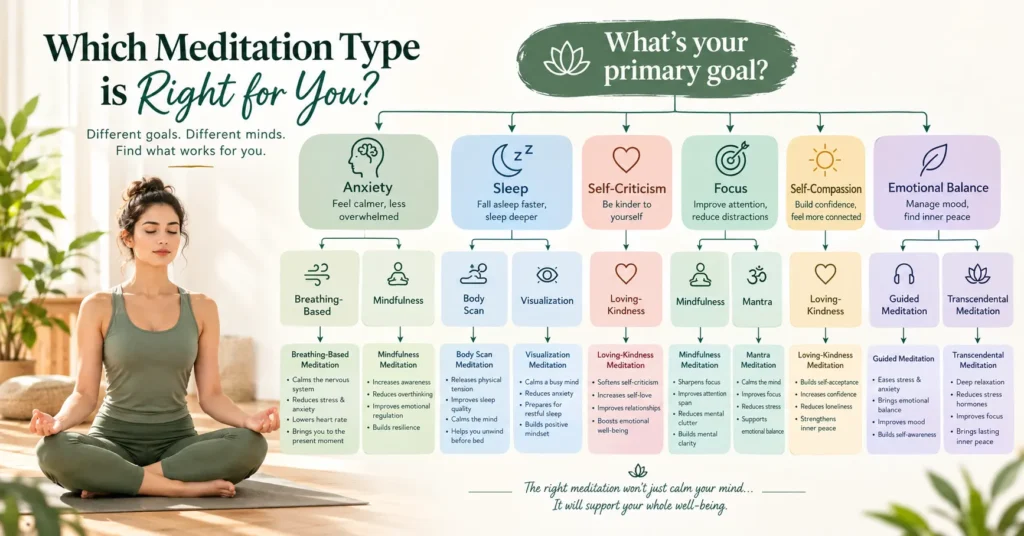
Choosing the right meditation type is simpler than it appears. Answer these four questions:
Question 1: What is your primary goal right now? – Calm/relaxation → TM, breathing-based, or body scan – Anxiety → Breathing-based or mindfulness – Self-compassion → Loving-kindness – Better sleep → Body scan or visualization – Spiritual insight → Zazen or TM – Improved focus → Mindfulness or mantra – Physical relaxation → Body scan or TM – Emotional processing → Loving-kindness
Question 2: How much time do you realistically have daily? – 5 minutes → Breathing-based or short mantra – 10–15 minutes → Mindfulness, loving-kindness, visualization – 20–30 minutes → Any type – 30+ minutes → Walking meditation, body scan, Zazen
Question 3: Do you prefer focused attention or open awareness? – Focused (mind anchored to one thing) → Mantra, breathwork, TM, visualization – Open (observing everything without focus) → Mindfulness, Zazen, body scan, walking – Emotional cultivation → Loving-kindness
Question 4: Any physical limitations? – Can’t sit comfortably → Walking meditation, body scan lying down, chair-based – Chronic pain → Body scan, visualization, gentle types with short duration – Hearing loss/tinnitus → Avoid mantra; use breath, body, or visualization – Vision loss → Avoid visualization; use breath, body, or mantra
Common Mistakes in Meditation Practice (Applicable to All Types)
Mistake 1: Expecting No Thoughts
Every meditation type produces thoughts. The practice is not achieving a blank mind — it’s observing thoughts (mindfulness), returning to an anchor (mantra, breath), or maintaining awareness (Zazen). Thoughts are not failure.
Fix: Recognize that thinking is normal. The practice is in how you relate to thoughts, not in eliminating them.
Mistake 2: Judging Sessions as Good or Bad
You had a “good” meditation if you felt calm, and a “bad” one if your mind was busy. This is backward thinking. The busy-mind sessions are showing you exactly where your attention control is weak — they are the most valuable.
Fix: Every meditation is revealing something useful. No “bad” sessions exist.
Mistake 3: Stopping When You Feel Uncomfortable
Meditation sometimes surfaces uncomfortable emotions, sensations, or memories. This isn’t a sign to stop — it’s a sign that the practice is working. Discomfort doesn’t mean you’re doing it wrong.
Fix: Plan for 5–10 minutes beyond the discomfort. Emotions usually shift if given time.
Mistake 4: Practicing Inconsistently (on and off)
Three sessions one week, none the next, two sessions the following week, creates no neurological change. Consistency matters more than duration.
Fix: Choose a realistic daily duration (even 5 minutes) rather than inconsistent longer sessions.
Mistake 5: Comparing Your Practice to Others
Your meditations will never match someone else’s. Your mind works uniquely. Their calmness doesn’t mean they’re doing it better — they may just have a naturally quieter mind, be at a later stage, or be practicing a different type that works better for their brain.
Fix: Measure progress by your own baseline. Are you slightly calmer than 4 weeks ago? Better at returning attention? Less reactive to stress? These are wins.
When to Practice: Integrating Meditation into Your Daily Routine
Morning Practice (Best for Most People): – Timing: Within 1–2 hours of waking (cortisol is naturally elevated, making the mind alert) – Best types: Mindfulness, loving-kindness, mantra – Duration: 10–20 minutes – Result: Calmer, more clear-headed for the day – Ideal: Before coffee, before checking phone
Midday Practice (Reset): – Timing: After lunch, before 2 PM slump – Best types: Breathwork-based (quick reset), walking meditation – Duration: 5–10 minutes – Result: Renewed focus, reduced afternoon stress – Ideal: At work, outdoors, or during lunch break
Evening Practice (Wind-Down): – Timing: 20–30 minutes before bed, or 1–2 hours before sleep – Best types: Body scan, visualization, loving-kindness – Duration: 20–40 minutes (longer works better) – Result: Deeper sleep, fewer nighttime awakenings – Ideal: On your bedroom floor or bed
Informal Practice (Throughout the Day): – Walking meditation while commuting – Breathing-based meditation at red lights or waiting rooms – Mantra repetition during exercise – Body scan awareness during stretching
FAQ Section
Q1: Which meditation type is best for beginners?
The best starting type for most beginners is mindfulness meditation. It requires no special equipment, preparation, or belief system. You sit, observe your breath, and return your attention when it wanders. This fundamental skill — noticing where your mind is and redirecting it — is the foundation for all other types. After 4–6 weeks of mindfulness, you can explore other types that might suit your specific goals. If mindfulness feels too open or directionless, breathing-based meditation is an excellent alternative (more structured, faster calming effect).
Q2: Can I practice two meditation types on the same day?
Technically yes, but it’s not recommended while learning. Mixing types prevents any single type from establishing neural patterns deeply. The exception: you can do a short breathing-based meditation (5 min) for acute stress, then practice your main type later. Once you’re experienced (3+ months), combining types becomes less problematic. General advice: One primary type per day, keep other types for different days or weeks.
Q3: How long before meditation shows results?
It depends on the type and your goal. Breathing-based meditation reduces acute anxiety within 3–5 minutes. Body scan improves sleep within 1–2 weeks. Mindfulness and loving-kindness require 3–4 weeks of consistent practice (5+ sessions weekly) before observable results. Brain structure changes visible on MRI appear after 8 weeks of regular practice. Don’t judge your practice by results in week one.
Q4: Is meditation safe for people with mental health conditions?
Meditation is generally safe and beneficial for anxiety, depression, ADHD, and trauma recovery. Some cautions: (1) Mindfulness can intensify rumination in depression — pair with loving-kindness or professional support. (2) Trauma survivors should practice with professional guidance — body scan or visualization can be triggering without proper preparation. (3) Severe psychotic disorders require medical supervision. For your specific condition, consult a therapist or psychiatrist before starting. Meditation is not a replacement for treatment; it’s a complement.
Q5: Do I need to sit in a specific posture, or can I meditate lying down?
You can meditate in any stable, comfortable position — sitting, lying down, kneeling, or even standing. Different postures suit different types: sitting is standard for mindfulness and concentration-based types (keeps you alert enough to notice wandering), lying down is best for body scan and sleep-preparation practices, walking meditation obviously requires standing and walking. If sitting causes pain, lie down or sit in a chair. Posture should support your practice, not create strain.
Key Takeaways
- 9 main meditation types exist, each producing different brain states and suited to different goals: mindfulness, loving-kindness, transcendental, Zen, visualization, breathwork, mantra, body scan, and walking meditation.
- All meditation types reduce stress and calm the nervous system, but the specific brain regions activated differ — mindfulness activates attention networks, loving-kindness activates emotional warmth regions, TM produces a unique “restful alertness.”
- Choosing by goal is critical. Mindfulness for anxiety is proven, but transcendental is faster-acting. Loving-kindness for self-criticism, body scan for insomnia, visualization for performance. Match the type to your specific need, not to what’s trendy.
- Beginners typically start with mindfulness or breathing-based meditation because both are accessible, require no special preparation, and are widely taught. After 4–6 weeks, explore other types.
- One type per practice session is better than mixing, especially while learning. Consistency of one type for weeks produces measurable neural changes faster than rotating through multiple types.
- Duration varies by type and goal. Breathing-based works in 5 minutes (acute anxiety relief). Body scan works best for 20–40 minutes (sleep improvement). Mindfulness and loving-kindness require 10–20 minutes daily. Match duration to type.
- Physical posture matters for sustainability. Sitting keeps you alert for concentration types. Lying down suits body scan and sleep preparation. Walking works for restless or time-limited practitioners. Choose posture that supports, not strains.
- Results timelines differ. Breathing-based: 3–5 minutes. Body scan: 1–2 weeks. Mindfulness and loving-kindness: 3–4 weeks. Brain structure changes: 8 weeks. Don’t judge your practice by week one results.
- Every meditation session is valuable, even ones that feel “bad.” Busy-mind sessions show you where your attention control is weak. Emotional sessions show you what needs processing. There are no failed meditations.
- Meditation is safe for most people with mental health conditions, but trauma survivors and those with severe psychotic disorders should work with professional guidance. Mindfulness can intensify rumination in depression — pair with loving-kindness or therapy.
- The “best” meditation type doesn’t exist. There are only best-fits for your current goals, timeline, and preferences. Consistency with one type you’ll actually practice beats sporadic practice with the “optimal” type.
- Daily practice produces measurable changes faster than occasional sessions. Even 10 minutes daily for 4 weeks creates observable shifts in stress response, focus, and emotional regulation — far more than 60 minutes once per month.
Conclusion
Most people think meditation is one practice — sitting still, clearing your mind, reaching a blissful blank state.
In reality, meditation is a diverse family of practices, each producing different results.
If you practice mindfulness and struggle with self-criticism, you’re using the wrong tool for your actual problem. Loving-kindness would transform your relationship with yourself in ways mindfulness never can. If you practice loving-kindness seeking rapid anxiety relief, you’re using a tool designed for long-term compassion development when transcendental or breathing-based meditation would serve you immediately.
The reason most people quit meditation after two weeks is not that they lack discipline. It’s that they chose the wrong type for their brain, their goal, and their life.
The types of meditation you’ve read about in this guide represent the full spectrum of what modern practice offers: focused concentration (mantra, breathwork), open awareness (mindfulness, Zazen), emotional cultivation (loving-kindness), sensory imagination (visualization), physical relaxation (body scan), movement-based practice (walking), and physiologically distinct states (Transcendental Meditation).
One of these nine types will resonate with you.
Not because it’s trendy or because a friend recommended it, but because it addresses the actual transformation you need right now — whether that’s calm, focus, self-compassion, better sleep, or spiritual insight.
Start with one. Practice it daily for four weeks. Not intermittently, not when you “feel like it” — daily. This is how your nervous system rewires. This is how the practice becomes real.
Choose your type using the decision framework in this guide. Honor your timeline. Adapt your posture to your body. Show up even when the mind is busy — especially then.
The practice is not about achieving a blank mind. It’s about understanding the mind you have — and through that understanding, freeing yourself from its limitations.
Your meditation practice begins now. Visit TheShivYoga.com and choose your type. We’ll guide you from your first breath forward.