

Quick Answer: How to Do Downward Facing Dog Pose Correctly Downward Facing Dog (Adho Mukha Svanasana) is a foundational yoga pose where the body forms an inverted V-shape with hands and feet on the mat, hips pressed toward the ceiling. To do it correctly: start on all fours, spread your fingers wide, tuck your toes, press through your palms and lift your hips up and back, straighten your legs as much as flexibility allows, and create a long straight spine — heels do not need to touch the floor. It is one of the most practised yoga poses in the world and appears in almost every yoga style from Hatha to Vinyasa to Ashtanga.
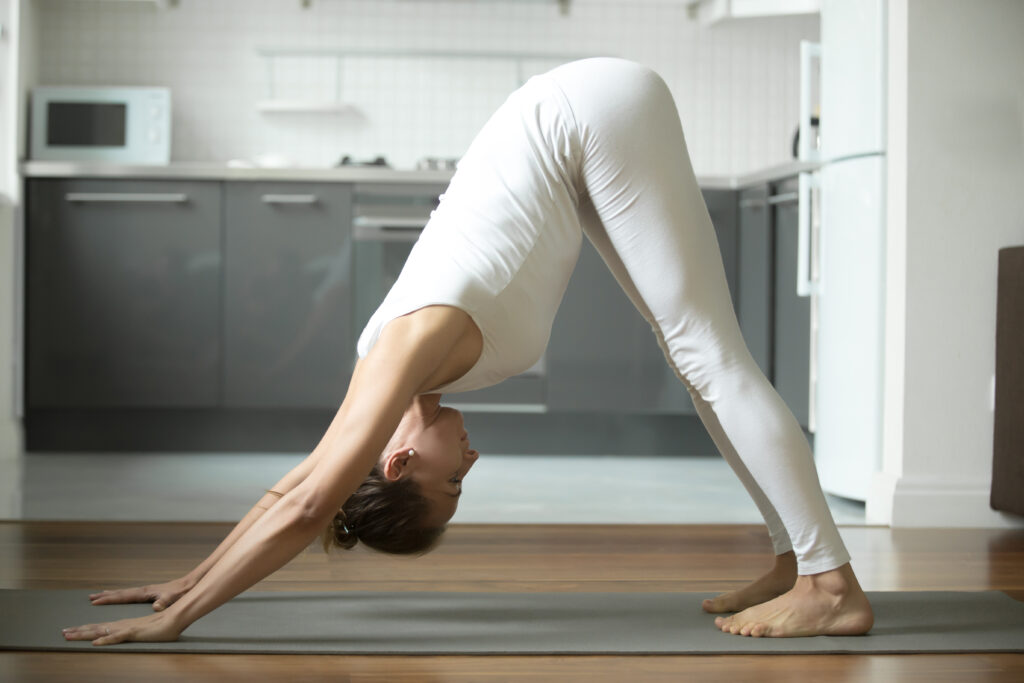
Sporty attractive woman practicing yoga, standing in Downward facing dog exercise, adho mukha svanasana pose, working out, wearing white sportswear, indoor full length, home interior background
Downward-Facing Dog (Adho Mukha Svanasana) One of the most ubiquitous of yoga poses, Downward-Facing Dog (Adho Mukha Svanasana), is one of the most widely recognized yoga poses. It is also a pose and a resting position in a number of yoga sequences, including the Vinyasa and Ashtanga styles. But though the pose is so common, even many beginning to intermediate yogis have issues with getting into it in a way that is beneficial to their bodies. This ultimate guide will break down exactly how to do Downward-Facing Dog pose correctly, ensuring you receive all the benefits while avoiding common injuries.
What is Downward Facing Dog Pose?
Downward Facing Dog — called Adho Mukha Svanasana in Sanskrit — is a standing inversion and one of the most fundamental poses in Hatha and Vinyasa yoga. The Sanskrit name breaks down beautifully: ‘Adho’ means downward, ‘Mukha’ means face, ‘Svana’ means dog, and ‘Asana’ means pose. Put together — the pose that mimics a dog stretching forward with its head down and hips up.
In yoga tradition, Downward Facing Dog sits at an interesting intersection. It’s both a resting pose — used between more challenging sequences as a moment of recovery — and an active strengthening pose in its own right. In Ashtanga yoga, it’s held for five breaths in every Sun Salutation. In Vinyasa, it’s the home base to which practitioners return constantly. In Yin yoga, it’s held for three to five minutes as a deep connective tissue stretch.
What makes this pose so universally valuable is what it does simultaneously: it stretches the entire posterior chain of the body (back of the legs, spine, and back muscles), strengthens the arms and shoulders, mildly inverts the body to improve circulation, and requires genuine core engagement to hold the position well. Few poses offer this breadth of benefit in a single shape.
8 Proven Benefits of Downward Facing Dog Pose
| Benefit | How It Helps | Who Benefits Most |
| Full Posterior Chain Stretch | Stretches hamstrings, calves, spine, and back muscles simultaneously in one complete movement | Desk workers, runners, cyclists |
| Shoulder & Arm Strengthening | Weight-bearing through the arms builds shoulder stability and arm strength progressively | Those with weak upper body |
| Spinal Decompression | The mild inversion and active lengthening creates traction that relieves spinal compression | Back pain sufferers, desk workers |
| Improved Circulation | Mild inversion with hips above heart delivers fresh blood flow to brain and upper body | Fatigue, mental fog, low energy |
| Core Strength Development | Maintaining the inverted V requires constant engagement of deep abdominal muscles | Core weakness, lower back pain |
| Calming the Nervous System | The combination of mild inversion and controlled breathing activates parasympathetic response | Stress, anxiety, overwhelm |
| Wrist & Hand Strengthening | Regular practice builds wrist strength needed for more advanced arm balances | Anyone progressing in yoga |
| Improved Digestion | Abdominal compression and release in the pose massages digestive organs gently | Bloating, sluggish digestion |
⚠️ When to Avoid or Modify Downward Facing Dog Avoid or modify Downward Facing Dog if you have: carpal tunnel syndrome or acute wrist injury (use fists or forearms instead), uncontrolled high blood pressure (avoid prolonged holds), active shoulder injury or rotator cuff tear, late-stage pregnancy (the full inversion may be uncomfortable — use a chair modification), or severe hamstring injury. If you experience sharp wrist, shoulder, or lower back pain during the pose, come out immediately and check your alignment before retrying. Mild discomfort from tight hamstrings or calves is normal and will ease with consistent practice.
How to Do Downward Facing Dog Pose Correctly — Step-by-Step
Read through all the steps before you try it. Understanding the intention behind each instruction makes a significant difference to how quickly you get it right.
Step 1: Set Up Your Foundation — Hands and Feet
- Begin on your hands and knees — what yoga teachers call a tabletop position. Your wrists are directly under your shoulders. Your knees are directly under your hips. Your spine is flat and parallel to the floor.
- Spread your fingers wide — really wide. Your middle finger points straight forward. Press firmly through all four corners of each palm: the base of the index finger, the base of the little finger, the thumb mound, and the outer edge of the wrist. This full-palm contact protects your wrists and gives you a stable base.
- Tuck your toes under so the balls of your feet are on the mat and your heels are lifted.
💡 Hand Placement Tip A common mistake is placing hands too close to the knees. Your hands should be slightly forward of your shoulders — about one hand-length forward. This gives you the space you need to create length in the pose. If your hands are too close, the pose feels cramped and the spine rounds.
Step 2: Lift Your Hips — Finding the Inverted V
- On an exhale, press firmly through your palms and begin to lift your hips up and back toward the ceiling. Think of your hips as being pulled up by a string attached to the ceiling — not just lifted, but reaching upward and backward simultaneously.
- As your hips lift, let your knees straighten — but do not lock them. A very slight softness in the knees is fine, especially for beginners with tight hamstrings.
- Your body now forms an inverted V or a triangle shape. Your arms and spine create one long line from your wrists to your hips. Your legs create another line from your hips to your heels.
- Your heels may or may not touch the floor — and this does not matter. Heels reaching the floor is a nice sensation when it happens naturally, but forcing your heels down by rounding your spine or bending your knees is counterproductive. Let the heels be wherever they naturally land.
Step 3: Align Your Spine — The Most Important Element
- From your inverted V position, focus entirely on your spine. The spine should be long, straight, and extending from your tailbone all the way through the crown of your head. This long spine is the heart of the pose.
- To find spine length: on an inhale, bend your knees generously and tilt your tailbone up toward the ceiling. Feel your lower back lengthen and your spine extend. Now, maintaining that length in the spine, begin to slowly straighten your legs — only as far as you can without losing the spinal length. This is your correct Downward Facing Dog.
- Your lower back should have a natural, gentle curve — not rounded like a cat, not excessively arched. Neutral spine with active length is the goal.
💡 The Golden Rule of Downward Dog Bent knees with a long, straight spine is always better than straight legs with a rounded back. Every single time. The hamstrings open over weeks and months of practice — the spine alignment must be correct from day one. A rounded spine in Downward Dog places stress on the lumbar discs and reduces the benefit of the pose dramatically.
Step 4: Align Your Shoulders and Arms
- Your arms are straight — but not hyperextended. A very small, soft bend in the elbows is fine for those who hyperextend.
- Rotate your upper arms outward — think of turning your inner elbows to face each other or toward the front of the mat. This external rotation opens the shoulder joint and takes strain off the rotator cuff.
- Draw your shoulder blades down your back — away from your ears. Many beginners hunch their shoulders up toward their ears in Downward Dog, which creates tension in the neck and reduces shoulder stability. Actively press your shoulder blades down and slightly toward each other.
- Your head hangs naturally between your upper arms. Your neck is relaxed — it should not be cranked up to look forward or dangling with excessive tension. Let gravity take care of it.
Step 5: Engage and Breathe — Hold the Pose
- With your foundation set, gently draw your lower belly in and up — a light core engagement that stabilises the pose without creating tension or restricted breath.
- Press firmly through all four corners of each palm — you should feel the floor pushing back into your hands. This active pressing lifts weight out of the wrists and engages the arms more fully.
- Breathe slowly and steadily. In Downward Facing Dog, breath is what transforms it from a static shape into an active, living pose. Inhale to lengthen the spine. Exhale to press the hips further back and up.
- Hold for 5-10 breaths initially, building to longer holds as strength and flexibility develop.
Step 6: Coming Out of the Pose
- To come out of Downward Facing Dog, exhale and slowly bend your knees, lowering them to the mat one at a time.
- Return to tabletop, then lower into Child’s Pose for a few breaths of rest.
- Never rush out of Downward Dog — the transition should be as controlled as the pose itself.
5 Most Common Downward Facing Dog Mistakes — And How to Fix Them
| Common Mistake | Why It Happens | The Fix |
| Rounded lower back | Tight hamstrings force the pelvis to tuck and spine to round | Bend your knees generously — prioritise spine length over straight legs always |
| Shoulders hunched to ears | Upper body weakness and unfamiliarity with the pose | Actively press shoulder blades DOWN your back. Think: ‘shoulders away from ears’ |
| Weight dumped into wrists | Insufficient arm engagement and poor hand placement | Spread fingers wide, press all four corners of the palm firmly into the mat |
| Heels forcing to the floor | Misunderstanding that heels must touch — they don’t | Let heels be where they naturally land. Forced heels = compressed spine |
| Holding breath | The challenge of the pose triggers breath holding | If you can’t breathe, you’re working too hard. Bend knees, soften the pose, breathe first |
Downward Facing Dog Modifications for Beginners
Modification 1: Bent Knees Downward Dog
This is the most important modification and should be the default for anyone with tight hamstrings — which is most beginners. Simply keep a generous bend in both knees throughout the pose. Your heels will lift further from the floor, but your spine will be able to lengthen fully. The hamstrings will open gradually over weeks of consistent practice. There is no timeline — just consistent work.
Modification 2: Downward Dog at the Wall
Place your palms flat against a wall at hip height, step your feet back until your body forms an L-shape — arms horizontal, body parallel to the floor. This is a wonderful modification for those with wrist sensitivity, extreme hamstring tightness, or shoulder weakness. It provides all the spinal lengthening benefits of Downward Dog without the weight-bearing demands. Hold for 10-15 breaths.
Modification 3: Forearm Downward Dog (Dolphin Pose)
For those with carpal tunnel syndrome, wrist injuries, or anyone finding wrist pain in Downward Facing Dog — Dolphin Pose is the perfect alternative. Place your forearms on the mat, elbows under shoulders, and lift the hips exactly as you would in full Downward Dog. This removes all wrist pressure while maintaining the full benefit of the inversion and posterior chain stretch. Many practitioners find this version more challenging than the full pose — it is an excellent strengthening exercise in its own right.
Modification 4: Blocks Under the Hands
Placing yoga blocks under your hands effectively raises the floor — which is particularly helpful for those with very tight wrists, limited wrist extension, or shoulder tightness. The slightly elevated hand position reduces the angle at the wrist joint, making the pose immediately more comfortable and accessible. Use blocks at their lowest height first and lower gradually as wrist flexibility improves.
Downward Facing Dog Variations for Intermediate Practitioners
1. Three-Legged Downward Dog (Eka Pada Adho Mukha Svanasana)
From full Downward Facing Dog, inhale and lift your right leg straight up behind you — toes pointed, hip level, leg parallel to the floor or higher depending on flexibility. Keep both hip bones even — the lifted hip naturally wants to open toward the ceiling, which reduces the stretch. Hold for 5 breaths, then switch sides. Three-Legged Dog builds single-leg strength, opens the hip flexor of the lifted leg, and prepares the body for lunges and standing balance poses.
2. Twisted Downward Dog
From Downward Facing Dog, take your right hand to your left ankle or calf. The body rotates open slightly — right shoulder lifting, left shoulder pressing toward the floor. This adds a spinal rotation component and a beautiful outer hip stretch. Hold for 3-5 breaths then switch sides. This variation helps prepare the body for revolved standing poses.
3. Downward Dog Pedalling
Rather than holding a static Downward Facing Dog, gently bend one knee while pressing the opposite heel toward the floor. Alternate slowly — right knee bends while left heel drops, then left knee bends while right heel drops. This gentle pedalling motion creates a progressive calf and hamstring stretch that is often more effective for tight beginners than a static hold. Practice for 10-20 slow alternating cycles.
30-Day Plan to Perfect Your Downward Facing Dog
| Week | Focus | Daily Practice | Goal |
| Week 1 | Foundation & Alignment | Hold 5 breaths x 5 rounds. Focus: hand placement and spine length. Use bent knees freely. | Consistent spinal length every time |
| Week 2 | Shoulder & Arm Engagement | Hold 8 breaths x 5 rounds. Focus: shoulders away from ears, arms rotating outward. | No shoulder tension in the pose |
| Week 3 | Hamstring Opening | Hold 10 breaths x 5 rounds. Add pedalling variation. Begin to slowly straighten legs. | Heels noticeably closer to floor |
| Week 4 | Full Expression | Hold 15-20 breaths x 3 rounds. Add Three-Legged Dog. Practice in Sun Salutation flow. | Comfortable 20-breath hold with alignment |
💡 Best Time to Practice Morning is ideal — your body is less fatigued and the hamstrings will be tighter, which actually helps you focus on spinal alignment rather than depth. After a hot shower is a close second as muscles are warm. Never skip the warm-up — at least 5 minutes of gentle movement before holding Downward Dog for extended periods.
Expert Tips to Improve Your Downward Facing Dog
- Think ‘lengthen’ not ‘stretch’ — approaching the pose with the intention of lengthening the spine produces better alignment than trying to stretch the hamstrings
- Press the floor away from you — actively pressing the mat creates engagement throughout the arms and core that passive hanging never achieves
- Film yourself from the side every 2 weeks — what you feel in the pose and what you actually look like are often completely different. Side view shows immediately whether your spine is long or rounded.
- Build holds gradually — if 5 breaths feels hard, that is correct. Do 5 breaths 6 times rather than 30 breaths once. Frequency builds strength faster than duration when starting out.
- Use Downward Dog as a diagnostic tool — how the pose feels on a given day tells you a lot about your body’s state. Tight hamstrings? Tired arms? Restless mind? The pose reflects it all.
- Link it with Child’s Pose — moving between Downward Dog and Child’s Pose in a slow rhythm is one of the most satisfying and effective warm-up flows in yoga. 5 cycles of this before class transforms your practice.
- Don’t neglect the feet — spread your toes actively in the pose. Engaging the feet increases stability and proprioception throughout the whole pose.
Conclusion
Mastering Downward-Facing Dog requires patience, consistent practice, and attention to alignment details. This foundational pose offers tremendous benefits for your entire body and mind when performed correctly. Remember that yoga is a personal journey—honor your body’s unique needs and limitations as you work with this pose, and enjoy the process of improvement over time.
By following the detailed instructions in this guide on how to do Downward-Facing Dog pose correctly, you’ll develop a strong, stable, and therapeutic Downward-Facing Dog that serves as an excellent foundation for your entire yoga practice.
Disclaimer: While yoga is generally safe for most individuals, consult with a healthcare provider before beginning any new exercise program, especially if you have pre-existing medical conditions.
FAQs
How long should I hold Downward-Facing Dog?
Beginners should aim for 5-8 breaths (approximately 30 seconds). Advanced practitioners can hold for 1-2 minutes or longer during specific practices.
My heels don’t touch the ground. Am I doing it wrong?
No. Heels lifting off the ground is completely normal, especially for beginners or those with tight hamstrings or calves. Focus on creating the inverted V-shape with your body rather than forcing your heels down.
Why do my wrists hurt in Downward Dog?
Wrist pain often occurs from improper weight distribution or wrist weakness. Ensure you’re pressing firmly through your knuckles and fingertips, not collapsing into your wrists. Building wrist strength gradually will help, as will using modifications like wedges or blocks.
Should my feet be together or apart?
For most practitioners, positioning feet hip-width apart provides the best stability and alignment. Feet together is an advanced variation that requires greater core and hip stability.
How do I know if I’m doing it correctly?
You should feel a balance of stretch and strength throughout your body. Your weight should be evenly distributed between arms and legs, your spine should feel long, and your breathing should remain steady. Working with a qualified yoga instructor for feedback is also beneficial.
Can Downward Dog help with back pain?
Yes, when practiced correctly, Downward Dog can help alleviate back pain by decompressing the spine, stretching the back muscles, and strengthening the supportive musculature of the core and upper body.
How frequently should I practice Downward Dog?
Downward Dog can be practiced daily as part of a yoga routine. However, listen to your body and take rest days if you experience unusual pain or fatigue.
References: